Research@NVIDIA. Into CG/rendering, ML, ergonomic programming, high-perf SW design. Formerly Intel, demos, space warping. :)
Opinions are my own.
(Archived)
Tomorrow (Tuesday) at SIGGRAPH and 11:15 am we will be demonstrating N-Dimensional Gaussian Fitting interactively and will be giving some insight into the applications and method. Join us at Exhibit Hall F for our demo!
We are finally releasing the code for NDG so you can train 6D Radiance Fields, 10D+ Global Illumination or use it in your own applications. We are aiming to improve the codebase over time so reach out in Denver or online!
https://t.co/gHy8js2Mrb
I just released nanobind v2.0.0 featuring significantly improved typing infrastructure. It can now automatically build reference-quality stubs for your extensions (enabling completion in VS Code, static type checking via MyPy/PyLance, etc.) https://t.co/v8YTTH5n5e
It was a joy to work with @StavrosDiol on this one, dissecting a wide spectrum of hybrid to classic representations to capture the essence of balanced adaptivity in higher-dimensional representations. The end result is surprisingly explicit and compact!
Time to share our #SIGGRAPH2024 paper "N-Dimensional Gaussians for Fitting of High Dimensional Functions"!
We show that N-Dimensional Gaussian mixtures can be optimized to handle high dimensional inputs like MLPs with a fraction of the training times.
https://t.co/4edn0ZFwPr
Ever wanted to load a large asset in your GPU path tracer, only to find it doesn't fit in memory? Then check out our #SIGGRAPH2024 paper “N-BVH: Neural ray queries with bounding volume hierarchies” (with Alexander Rath, @exppad, @iliyang, Philipp Slusallek and @boubek)
In our latest @I3DCONF paper, we transform any rasterizer into a differentiable one with minimal engineering and zero external dependencies.
Optimize game assets and volumes, train 3D Gaussian Splats, etc. directly within your existing engine. Compute shaders is all you need!
Intel Open Image Denoise 2.2.0 is out! It improves image quality and CPU performance, adds support for Intel Meteor Lake GPUs, Apple GPUs (via Metal) and all ARM64 CPUs, removes dependency on CUDA Runtime (switches to Driver API), and more! https://t.co/XDwtJdE8tD #IamIntel
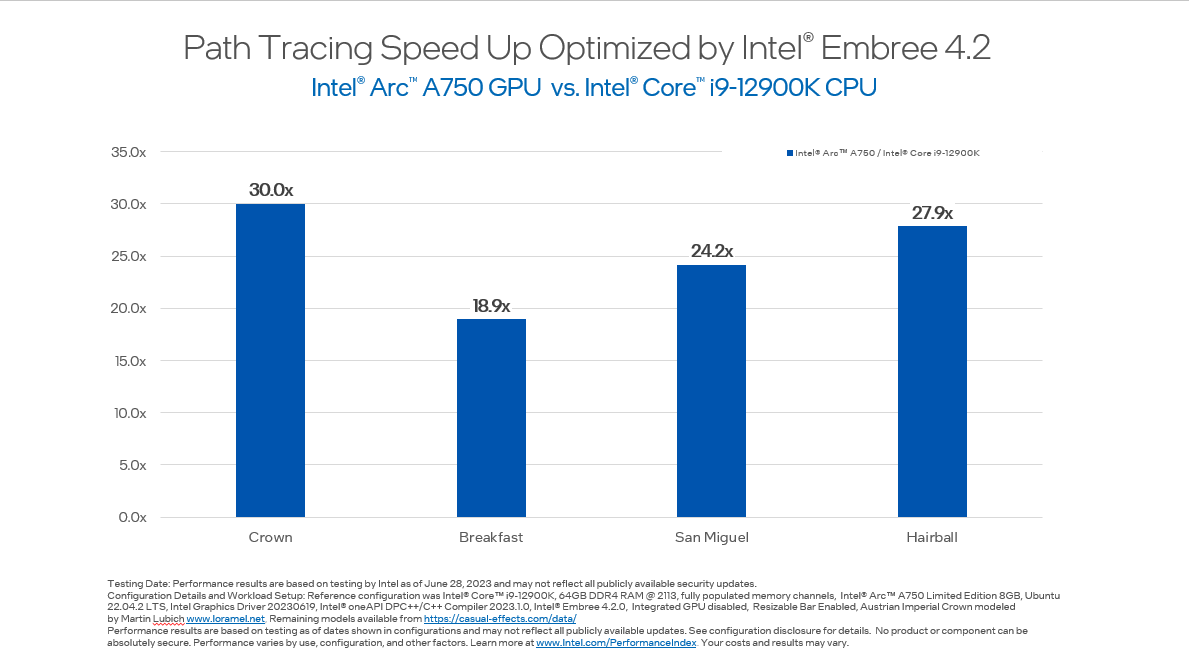
Intel Embree 4.2 is out with stable SYCL support, enabling high ray tracing performance on Intel discrete GPUs: https://t.co/4QIukFknKv #oneAPI#IamIntel
@HPG_Conf Our @HPG_Conf presentation on real-time ray tracing of micro-poly geometry is on YouTube now:
https://t.co/46qkQw4aB5
I also added PPTX and PDF slides to the paper page:
https://t.co/yUMFIUYZLo
@HPG_Conf Thanks to Carsten, the #Embree branch with all of his research code for real-time ray tracing of micro-poly geometry is open source now.
https://t.co/vGw0Iv0vVR
The paper page has some pointers to important functions.
https://t.co/yUMFIUYZLo
Intel Graphics Research is excited to share our contribution across SIGGRAPH, EGSR, HPG, and EG this summer. Low-energy path tracing, generative AI, neural graphics and more!
https://t.co/RMFbOrzXhK
Amazing work of our researchers and collaborators.
@HPG_Conf If you never understood how Nanite manages to avoid cracks, you should take a look at the appendix of the paper. It describes the method rigorously, including details that were not clear to me at first, and provides a formal proof that it works.
https://t.co/yUMFIUYZLo
Nanite rasterizes virtualized geometry by selecting ~20 million triangles with appropriate LOD each frame.
Carsten Benthin and I wrote a @HPG_Conf paper on how to build a BVH for these 🔺s instead. Since they are already clustered, the build is 10x faster!
https://t.co/yUMFIUYZLo
Did you know you could importance sample the GGX BRDF using spherical caps?
Our latest paper shows how and leads to an even simpler and faster algorithm than that of @eric_heitz.
Check it out online: https://t.co/iMqYXSyVbT
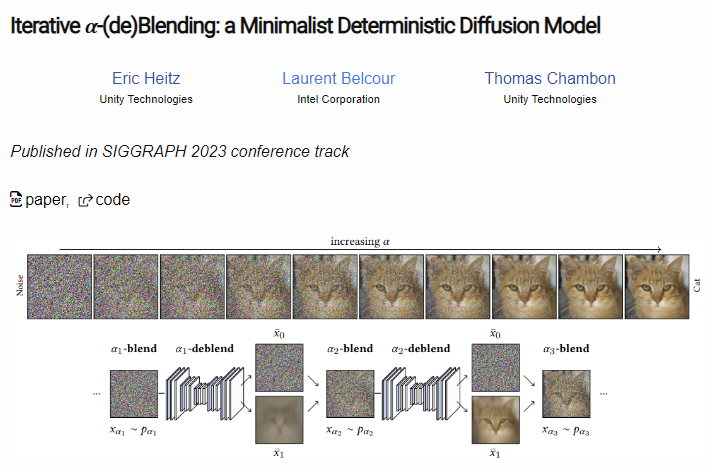
When @_Laurent and I started learning about diffusion models, we were puzzled by the amount of jargon and concepts.
So, we derived a model from scratch with our own graphics-people intuitions. Simple derivation, simple implementation, SOTA quality.
https://t.co/o9V6lbNl1o
GGX team simplifies the concept of diffusion models to make it acceccible to more people around the world. As a bonus, it makes a connection to well-known graphics concepts. Check our this new work as a good way to start your journey in diffusion models https://t.co/iyTjErE044
I can finally share our CGF paper MesoGAN! We train a 3D GAN with a novel representation to allow generation of arbitrary extent 3D textures. We use these textures with shell mapping to create the appearance of mesoscale materials like fur or grass. More: https://t.co/BCLIXh0Am4