@buridansridge What if you already know the truth, but chasing it is so difficult that you risk losing sight of it altogether, and end up worse off than if you’d simply settled for what you had?
So now the left want to buy tanks, the right want to buy EVs, the UK Labour govt is pro-austerity, the Austrians have an affinity for QE, the Chinese are looking to boost consumption & the Germans are fiscal keynesians.
And Trump took office less than two months ago
6/ TL;DR: Stop gaslighting yourself into thinking your anxiety is always a mindset problem. Sometimes your discomfort is telling you exactly what you need to know.
1/ There's a growing recognition that our approach to personal development and mental health needs a serious rethink. Modern self-help and therapy often focus on "fixing" mindset, while overlooking a crucial truth: sometimes your anxiety isn't broken - your environment is.
Environmental Control (long piece, not markets related)
I read a lot of content online, ranging from “Atomic Habits” - to inspirational stories and so forth. And they’re pretty good, in some ways. But I’ve found that they don’t deal with root causes. They’re seldom asking why you’re in the position - to begin with - that you’ve reached a point of desperation. Why are you at the Tony Robbins seminar? Why are you taking Mushrooms to reset your reality? Why do you need completely new habits?
Now sometimes it’s trauma, and something you really need strong therapeutics to get through. But - a lot of the time it’s not. And for me - it's almost always the same thing.
Failure to identify serious environmental variables that are causing problems and change them
My basic premise - is that the things you’re stressed about, are actually things you should be stressed out about. And that the problems you have - and people you blame, are generally actually at fault for the problems you have. I think self-deception is actually more likely from optimism than pessimism. When you’re in pain, chances are you’re not lying to yourself about it. It’s not a mindset problem. You can shift your mindset, and if the problems stay the same - you’re not ever going to get out of the situation you were in.
In practice - there are three big sources of problems in life. Your job. Your romantic life. And your physical location. I call this your “environment”. My basic argument is that taking control of your environment is the most important thing you can do.
You can improve your mindset a lot but if your job is terrible, your wife yells at you every day and you live in a town you hate - you’re basically just lying to yourself. Part of the reason I’m writing this is because this is actually why all these self help products sell. They tell you, “Oh it’s a mindset problem.” But no - it’s really not a mindset problem. It’s really predictable things that are related to your environment. And unless you change those things, your life will stay the same.
The reason these self-help gurus are so rich - is because of a foundational lie. “You’re the source of your own reality.” But you’re not. Your reality is the source of your reality. You have some input. But you’re probably not the driving force. People want to believe the seductive lie. So they buy the books. But then the lie doesn’t work. Because it’s not true. So you buy another book. And the cycle goes on.
When you’re working out and your muscle spasms, or you’re running and you sprain your ankle - you should stop working out. You should stop running. The first step is always halting further injury. Then figuring out what's borked. And then addressing the problem.
Specifically - starting with the three categories - it’s worth simply asking: is my job the source of most of my problems? Is my romantic life the source of my problems? Or is my physical location the source of most of my problems? Or is it something else - and if so, what is it?
You probably already know the answer. For me, at various points I’ve had jobs where drinking is a big expectation of the job. Getting intel from people. Convincing them to buy things. I knew I was becoming an alcoholic. I didn’t have the strength to simply blame my job. I wanted to “shrug it off” or “mindset” my way out of it. Didn’t work. If you’re developing a problem, and your livelihood is tied to something that’s going to make that problem worse - you’re in trouble. Your mindset doesn’t matter.
The solution is figuring out a job that doesn’t involve drinking a lot. And - then, when you’re in the new job, ensuring the culture evolves in such a way as that stays the case.
This sounds easy but it - is in fact - extremely difficult to do. It requires months of planning, often-times, re-skilling. And potentially moving geographically.
And I know everyone doesn't have the luxury to just peace out of jobs because they require boozing. Part of the situation is telling yourself the truth about how much money you need to make. At one point - I tried leaving corporate America before I had a big enough bankroll. It was a terrible decision. The solution (after I was done lying to myself) was finding a job that paid a large amount of money and doing whatever it took to get that job, and to do well at it.
Once again this is oversimplified. But the core idea to get across is that there were two states. In state one, I was living this fake life - one where I was lying to myself about my financial requirements. Trying to make it in entrepreneurship. When there was college and medical debt. Mindset wasn’t the problem. Debts don’t pay themselves. Sometimes it’s not about living your dreams it’s about keeping it real and changing your situation to fit the circumstances, and the real source of pain.
Romantic life is often another really big source of issues. Most of the time - the problem comes from simply ignoring what the other person says. For example, if you say your life goal is to work in markets and be plugged in and they say earnestly - “I really hope you stop doing that and we can spend lots of time together”. Just take it at face value. Many times, people are more honest with you about what they want than they are even with themselves. We just choose to ignore their statements - because they're attractive. Because you’re lonely. Because it’s convenient, or - because your friends know them etc etc.
But someone else’s foundational preferences are something you can’t change. “My parents are traditional Koreans and you being culturally American is a problem unless you learn to speak fluent Korean, and we eventually live in an apartment adjoined with my parents apartment.” One girl I dated told this to me over the course of months and I was kind of like, “yea okay… it will work itself out, just have to have a positive mindset.” Typing it out, it’s fairly outrageous that I would think that. How embarrassing.
Your functional environment in a relationship is the other person’s ideal life. If that life is directly in conflict with your preferences and objectives, the respectful thing to do is end the relationship.
Finally is location. In 2021, I found myself really angry with the state of politics. I had to flee the “Chaz” area of Seattle - because it became a failed State during COVID. I got mugged outside of the office I was working in, and stalked once after working out in a downtown gym. In both situations I didn’t even bother filing a police report because I knew nothing would happen. And then Washington state decided to tack on a capital gains tax. I saw so much COVID stimulus fraud. The whole thing seemed cooked.
I could tell I was going to be really upset about politics for the foreseeable future given the state of government finances, and what was increasingly clear was just massive unprecedented economic grift. So I simply moved to Puerto Rico. It was a great call that lined up with my preferences, and my financial goals.
I’m not writing this to say “oh I’ve got it all figured out.” If anything - I’m writing it because there have been times when things were going terribly. And periods where things have gone really well. And the primary differences in these periods, is the extent to which I accurately diagnosed and altered my environment to fit my actual objectives.
Not pretending everything is fantastic, when it sucks. Or beating myself up unnecessarily when - I am, in fact not the problem - and the problem is just a bunch of things in my life that need changing.
This might even be common sense. But I’m chronically online enough to know that it - for some reason - isn’t common sense. We live in a society where people would rather get prescribed extremely expensive Ozempic than simply not having snacks lying around in their kitchen. Where people have to go to Burning Man to admit to themselves they don’t like their abusive boss and need a change. It’s so indirect. Constant overkill and complex solutions to small problems.
I wish people could just see their environments clearly. Is my job the right job? Am I with the right person? And am I in the right place? Or is something else seriously bad that needs addressing? And have the courage to listen to themselves, believe that the pain is real and not something to work through or accept- and make changes as needed. I think life would be better for many.
5/ This isn't about rejecting therapy or mindset work entirely but to highlight that sometimes the answer isn't another meditation app or therapy session. Sometimes it's changing jobs, leaving relationships, or rebuilding community connections.
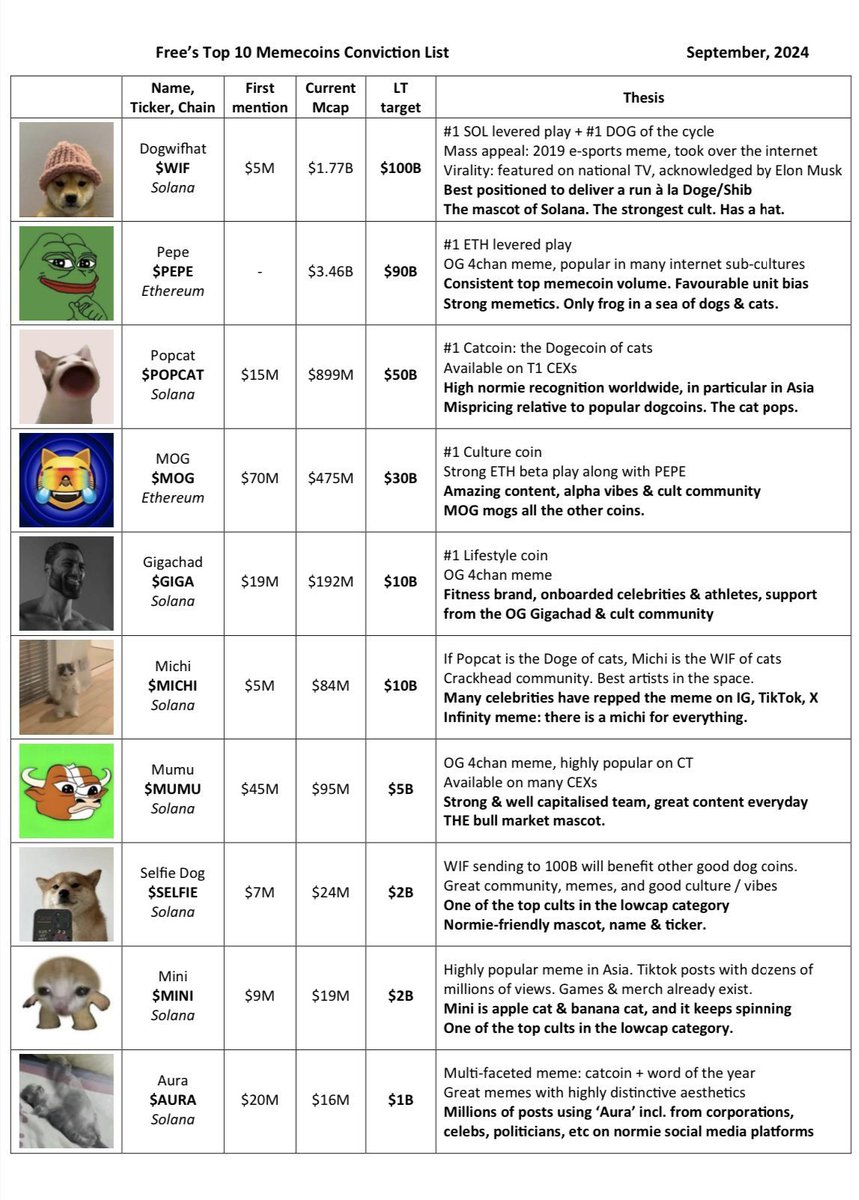
People seriously considering the whole memecoin frenzy a “new paradigm” and writing bullish theses on it in stead of seeing it as a giant red flag tells you everything you need to know about the state of the market.
If you see this and you think "yes!", I think you need therapy.
Mario Draghi's new report on EU competitiveness doesn't mince words.
"Across different metrics, a wide gap in GDP has opened up between the EU and the US, driven mainly by a more pronounced slowdown in productivity growth in Europe. Europe’s households have paid the price in foregone living standards. On a per capita basis, real disposable income has grown almost twice as much in the US as in the EU since 2000."
"First – and most importantly – Europe must profoundly refocus its collective efforts on closing the innovation gap with the US and China, especially in advanced technologies. Europe is stuck in a static industrial structure with few new companies rising up to disrupt existing industries or develop new growth engines. In fact, there is no EU company with a market capitalisation over EUR 100 billion that has been set up from scratch in the last fifty years, while all six US companies with a valuation above EUR 1 trillion have been created in this period. This lack of dynamism is self-fulfilling."
"There are not enough academic institutions achieving top levels of excellence and the pipeline from innovation into commercialisation is weak. [...] However, while the EU boasts a strong university system on average, not enough universities and research institutions are at the top. Using volume of publications in top academic science journals as an indicative metric, the EU has only three research institutions ranked among the top 50 globally, whereas the US has 21 and China 15."
"Regulatory barriers to scaling up are particularly onerous in the tech sector, especially for young companies. Regulatory barriers constrain growth in several ways. First, complex and costly procedures across fragmented national systems discourage inventors from filing Intellectual Property Rights (IPRs), hindering young companies from leveraging the Single Market. Second, the EU’s regulatory stance towards tech companies hampers innovation: the EU now has around 100 tech-focused laws and over 270 regulators active in digital networks across all Member States. Many EU laws take a precautionary approach, dictating specific business practices ex ante to avert potential risks ex post. For example, the AI Act imposes additional regulatory requirements on general purpose AI models that exceed a pre-defined threshold of computational power – a threshold which some state-of-the-art models already exceed. Third, digital companies are deterred from doing business across the EU via subsidiaries, as they face heterogeneous requirements, a proliferation of regulatory agencies and “gold plating” of EU legislation by national authorities. Fourth, limitations on data storing and processing create high compliance costs and hinder the creation of large, integrated data sets for training AI models. This fragmentation puts EU companies at a disadvantage relative to the US, which relies on the private sector to build vast data sets, and China, which can leverage its central institutions for data aggregation. This problem is compounded by EU competition enforcement possibly inhibiting intra-industry cooperation. Finally, multiple different national rules in public procurement generate high ongoing costs for cloud providers. The net effect of this burden of regulation is that only larger companies – which are often non-EU based – have the financial capacity and incentive to bear the costs of complying. Young innovative tech companies may choose not to operate in the EU at all."
More: https://t.co/x1d1ApvG2Z.