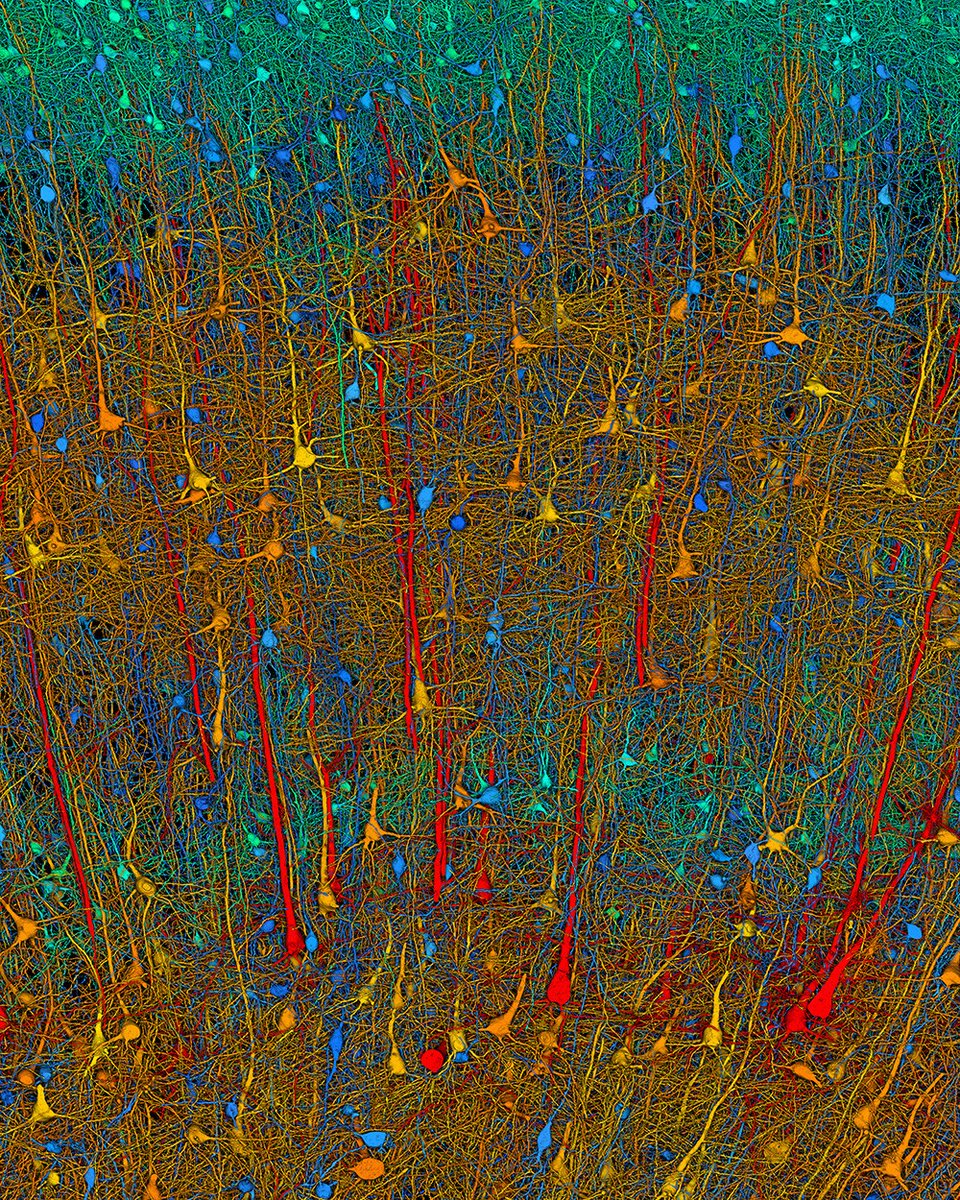
Using more than 1.4 petabytes of electron microscopy (EM) imaging data, researchers generated a nanoscale-resolution reconstruction of a millimeter-scale fragment of human cerebral cortex, providing an unprecedented view into the structural organization of brain tissue at the supracellular, cellular, and subcellular levels.
The human brain is a vastly complex organ and, to date, little is known about its cellular microstructure, including the synaptic and neural circuits it supports. Disruption of these circuits is known to play a role in myriad brain disorders. Yet studying human brain samples in such great detail comes with a host of challenges, ranging from technological limitations to the availability and preservation of tissue samples from healthy individuals.
In a 2024 Science study, researchers performed a high-resolution EM reconstruction of the ultrastructure of a cubic millimeter of human temporal cortex. According to the authors, the reconstruction contains roughly 57,000 cells, about 230 millimeters of blood vessels, and nearly 150 million synapses, comprising 1400 terabytes of data. The authors generated a three-dimensional reconstruction of nearly every cell and process in the cubic millimeter sample and developed a freely available tool for visualizing and analyzing the vast dataset.
Learn more on #WorldBrainDay: https://t.co/ye8JncNkrJ
what is a multimodal LLM thinking as it watches a video?
Gemma 4 12B reads raw image patches, as if they were tokens. It was never trained to predict anything at these 'tokens' - but this video shows what it would predict if you did sample from its next token prediction head
i think AI is about to set off the biggest wave of historical discoveries ever
and it's already started...
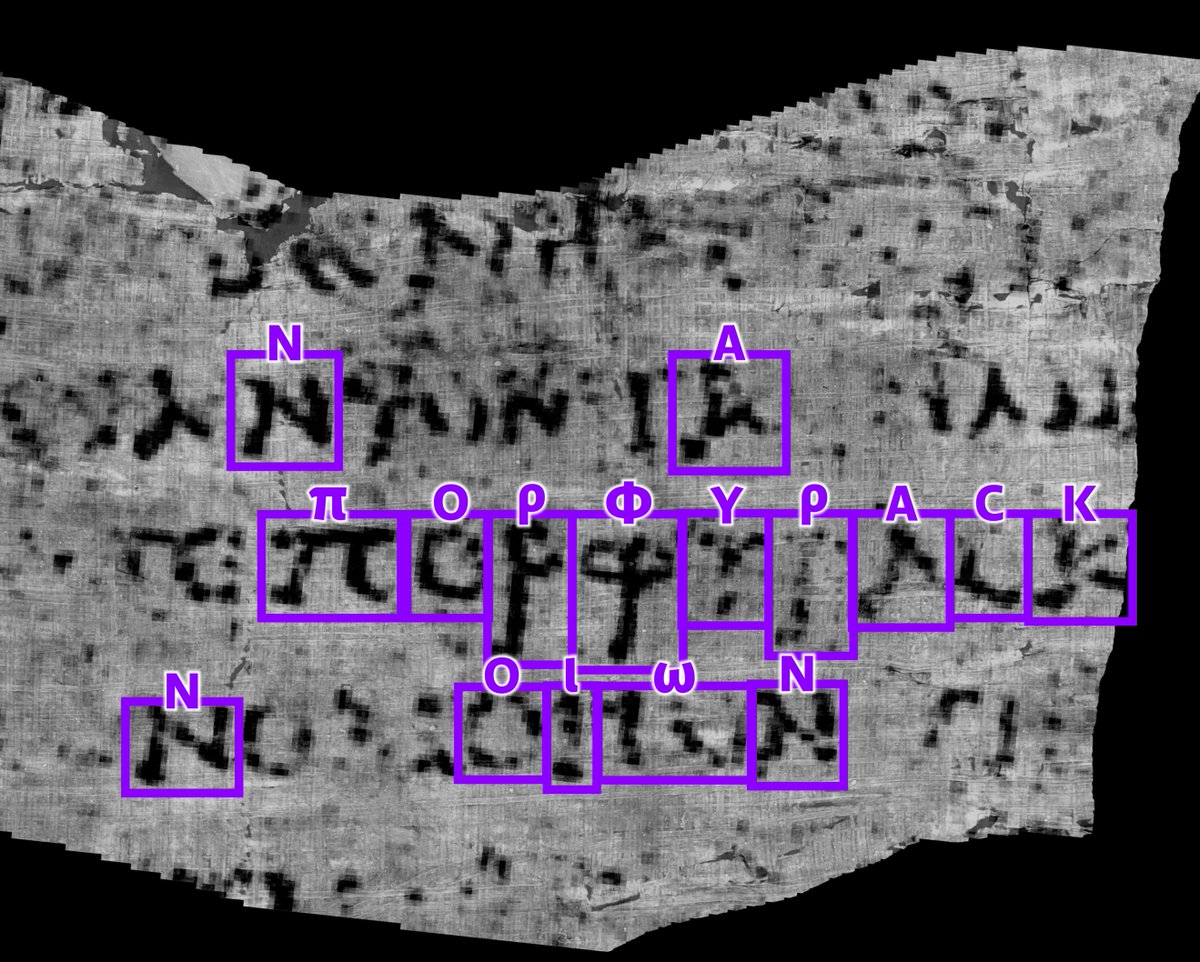
> AI read the full text of a scroll buried by Mount Vesuvius 2,000 years ago, revealing a lost work of Stoic philosophy and a book by the philosopher Philodemus that nobody knew existed
> AI deciphered another scroll from the same library and found Plato's exact burial spot, unknown for 2,000 years. the text even describes his final night, with Plato critiquing a flute player's rhythm from his deathbed
> an AI handwriting model showed some Dead Sea Scrolls are 50 to 100 years older than scholars believed, putting the Book of Daniel within its author's lifetime. we could be looking at something close to an original
> AI recovered a 250-line hymn to Babylon, one of the most copied texts of the ancient world, by matching 30 fragments scattered across museums worldwide. it had been lost for 1,000 years
> AI found 303 new Nazca lines in Peru in six months, nearly doubling one of archaeology's most famous mysteries after a century of human searching had only turned up 430
> AI reconstructed the rules of a 2,000-year-old Roman board game from nothing but the carvings on a limestone slab, simulating thousands of games until it found the ruleset that fit
everyone is excited about what AI will solve in the future
i'm equally excited about what AI will solve from the past
MIT published a paper arguing that every AI model on earth is secretly converging on the same "brain."
The paper is called "The Platonic Representation Hypothesis." The claim inside it is one of the strangest ideas in modern machine learning, and once you see it you cannot unsee it.
For years, everyone assumed that a model trained on images and a model trained on text were building fundamentally different things inside themselves. Different data. Different architecture.
Different world. A vision model learns what a cat looks like. A language model learns what the word "cat" sits next to. Two separate universes with no reason to line up.
The researchers checked whether that was actually true.
They took 78 vision models and a stack of large language models, and measured how each one organized concepts internally, not what they output, but the shape of the relationships between ideas in their heads. Which things they treat as close together. Which things they treat as far apart.
Then they compared the shapes across models that had never seen each other's data.
The shapes were lining up.
And here is the part that should stop you cold. The bigger and more capable the models got, the more their internal maps agreed with each other. A better vision model and a better language model don't drift apart. They converge. As if they were both climbing toward the same summit from opposite sides of a mountain.
The authors put it in a line that sounds almost like a joke, borrowed from Tolstoy: all strong models are alike, each weak model is weak in its own way.
Then they took it one step further, and this is where it stops being a curiosity and starts being unsettling.
They found that how closely a language model's internal map lined up with a vision model's internal map actually predicted how good that language model was at reasoning and at math. The models that saw the world more like the other modality did better at problems that had nothing to do with images at all.
So the question the paper asks is the obvious one. If a model that only reads text, and a model that only sees pixels, and a model trained on a completely different objective are all drifting toward the same internal representation as they get smarter, what is that representation a representation of?
Their answer is the thing that gives the paper its name.
They argue the models are all converging on a single shared statistical model of the reality that generated the data in the first place. Text is a shadow of the world. Images are a shadow of the world.
Sound, touch, everything, different shadows cast by the same underlying thing. And a big enough model, trained on enough of any one type of shadow, starts reconstructing the object casting it.
Plato said this in 375 BC. The allegory of the cave. Prisoners chained facing a wall, watching shadows, mistaking the shadows for reality, while the real forms exist outside the cave, casting everything they see.
The MIT team took his allegory literally and pointed it at neural networks. The training data is the shadows on the wall. The model, they argue, is slowly turning around toward the fire.
They even proved a version of it mathematically. Under certain conditions, a whole family of learning algorithms is provably pulled toward representing the same underlying statistical structure, the co-occurrence relationships baked into reality itself, regardless of whether they're fed words or pixels. Different sensors, same answer.
The implications the paper draws are the part that should matter to anyone building this stuff.
If it's true, then to build a better language model you should train it on images, because pictures carry information about the same reality that words are trying to describe. They cite evidence this already works. It means translation between any two modalities gets easier the smarter models get, because they're all speaking dialects of the same underlying language. And it means, their words, that hallucination might decrease with scale, because a model converging on an accurate model of reality has less room to invent things that reality doesn't contain.
Now the honest part, because the authors are honest about it and a viral thread that skips this is lying to you.
This is a hypothesis, not a verdict. On their own measurement, the alignment between vision and language models climbs clearly with scale but only reaches about 0.16 on a scale where 1.0 is perfect. They flat-out ask in their own paper whether that number means strong convergence with noise on top, or weak convergence with a mountain still left to explain. The clean math only holds in an idealized world where nothing is lost between reality and observation, which is not the world we live in.
Some things a picture can show that a sentence never will, and vice versa. And in domains like robotics, they see no convergence yet at all.
So it might not go all the way. The cave might be deeper than one paper can measure.
But sit with the shape of what they found anyway.
Systems built by different labs, on different continents, trained on different senses, for different reasons, with no coordination, are independently drifting toward the same internal picture of the world.
The smarter each one gets, the more they agree. And the thing they seem to be agreeing on is reality itself.
In neuroscience, global workspace theory holds that thoughts become consciously accessible when they enter a privileged workspace that’s broadcast across the brain.
Using a new interpretability technique, we found something similar in Claude: the J-space. https://t.co/sLu2JgYwOQ
🚨 New Research
LLMs are trained only on text...
Yet their internal representations progressively organize in ways that resemble human perceptual geometry across different domains (like color, pitch, emotion and taste), with the structures peaking in intermediate layers before attenuating in deeper representations.
🥳 Accepted at ICML Mechanistic Interpretability Workshop 2026
The human brain is strikingly modular, with distinct networks for language, formal reasoning, social reasoning, and physical reasoning. Is this a fundamental principle of how intelligent systems are built, or an accident of biological evolution?
In our latest preprint, we find that a similar modular organization emerges in Large Language Models, another class of intelligent system.
Brains and LLMs are shaped by entirely different kinds of optimization (biological evolution vs. gradient descent). That they arrive at the same modular design anyway suggests modularity may be a fundamental property of intelligent systems.
🌐 Web: https://t.co/ZKrnTSSuSf
📄 Paper: https://t.co/ZibBXz3PUy
💻 Code & data: https://t.co/uBo5iOYNjy
Using circuit analyses across 46 tasks spanning four cognitive domains, we find:
1️⃣ Tasks that draw on the same network in humans recruit overlapping units in LLMs, while tasks drawing on different networks recruit distinct units.
2️⃣ These units are causally linked to model behavior. Ablating the units critical for one domain impairs performance in that domain (−26% accuracy) but barely touches the others (−2.5%).
This project has been in the works for a while :) Huge thanks to my advisors @jacobandreas@ev_fedorenko@devarda_a, and to @Nancy_Kanwisher for valuable conceptual input and feedback throughout. #MIT
Right question. We hid 2 years of data from the model during training to test exactly that.
OOS (Jun 2024 → Dec 2025, 83 trades the model never saw): 65% win rate · PF 2.37 · +57.5%
Live (Jan 2026 → now, 21 trades): 62% · PF 1.14 · +2.0%
Live looks softer but n=21 is too small to call. The OOS data — 18 months, 83 trades — is the real answer, and it held up.
We also walk-forward test the architecture to simulate going through multiple regime shifts, not just the held out cut off.
Even more interesting -- the subject of a future post -- is the 3D structure of the technical / fundamental / macro and so on features the model is trained on.
Active research: shorter retraining cycles to keep the model closer to the current regime. TBD if it closes the gap but early results are promising.
A model trained only on weekly direction discovered, by itself, that the market has a coherent regime topology. Time, direction, decision, confidence, and outcome all factor cleanly in the same 3D space.
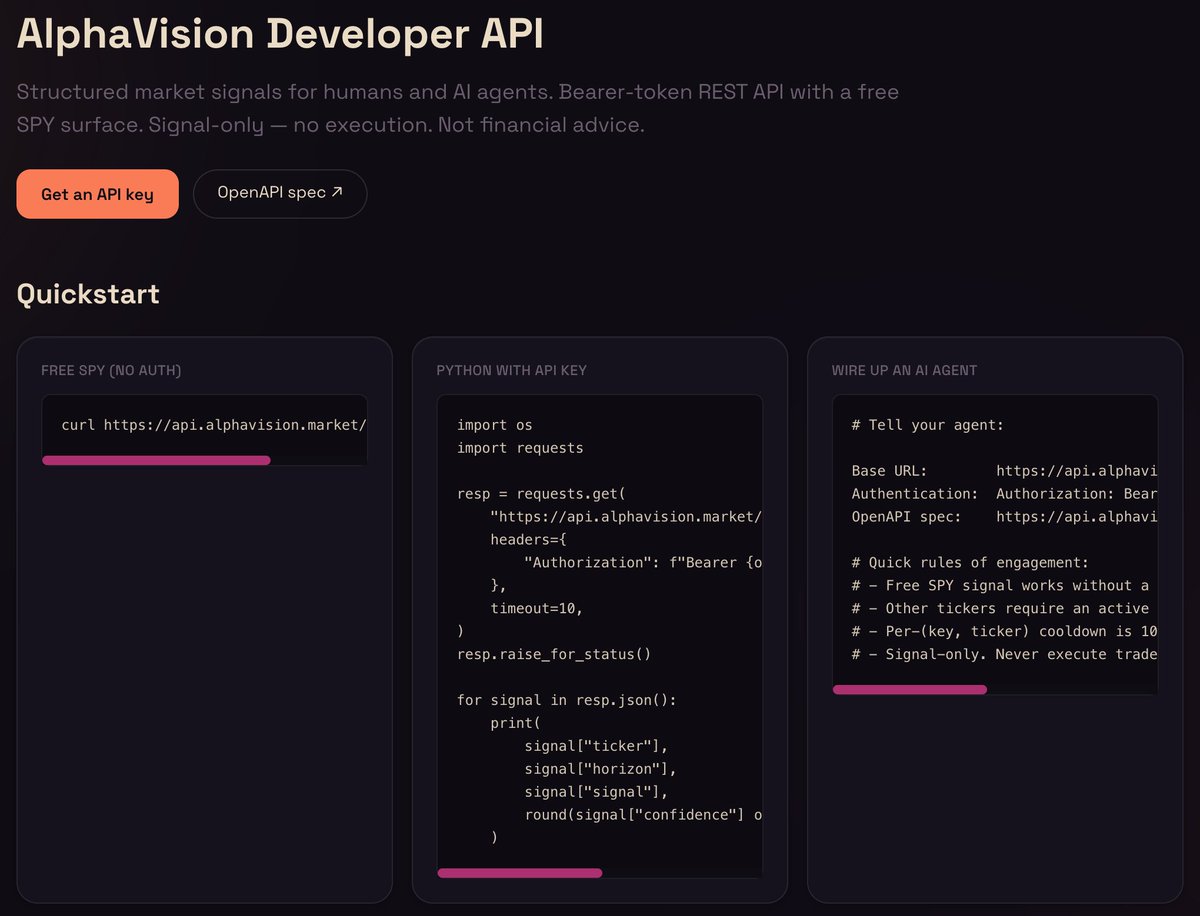
AlphaVision now ships with API + AI agent access on every paid tier.
Free SPY signal, no key required:
# curl https://t.co/EaMYLNdYBw
Bearer-token JSON for the full universe. OpenAPI spec for your tools,
llms.txt for your AI agent.
https://t.co/X0Ip6tadBE