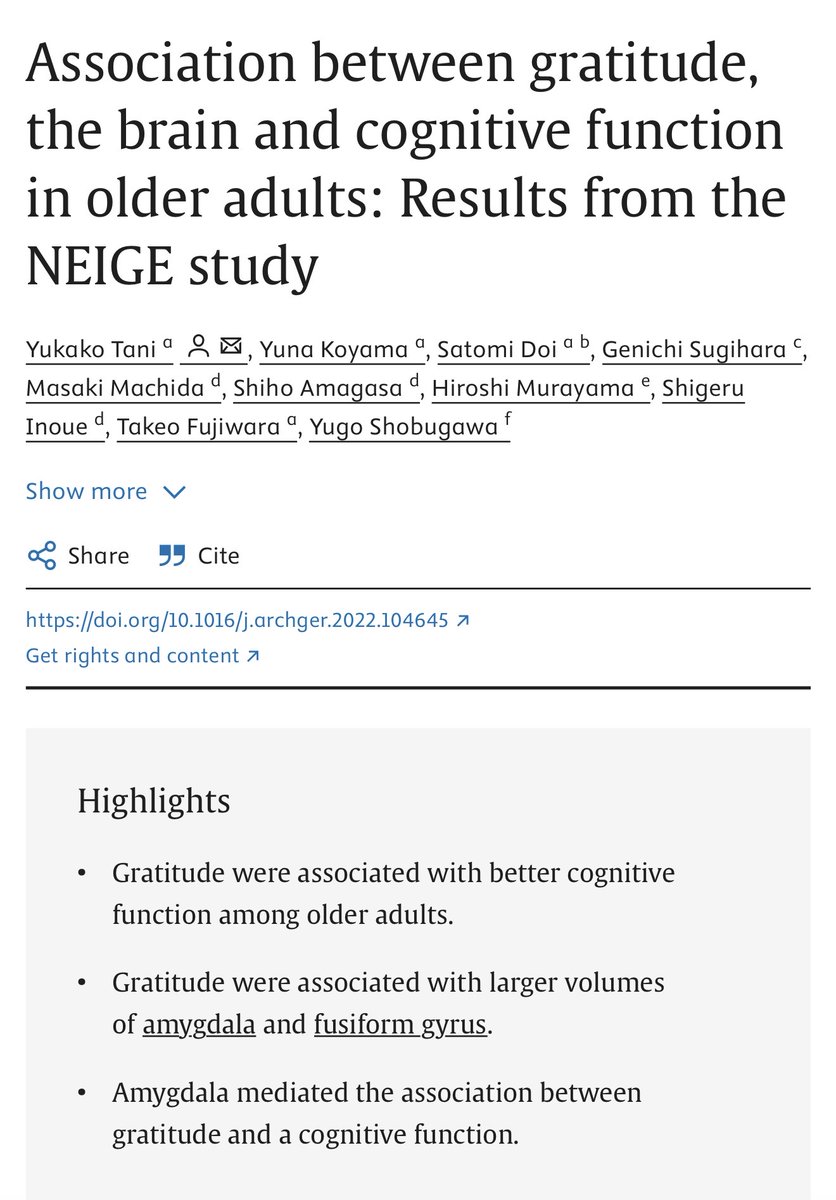
🚨Research confirms that your brain physically reshapes itself when you feel grateful, and the process happens in reverse of what most people think.
The common story about gratitude goes like this: count your blessings, feel better, repeat. Mental health gurus treat it like a mindfulness exercise where you inventory good things until your mood lifts.
The neuroscience reveals something far stranger.
Gratitude doesn’t work by making you notice positive things that were already there. It works by literally building new neural pathways that change how your brain processes all incoming information, positive and negative.
When you experience genuine gratitude, your anterior cingulate cortex lights up in ways that are measurably different from other positive emotions like joy or contentment. The anterior cingulate sits at the crossroads between emotion and attention. It decides which signals get amplified and which get filtered out before they reach conscious awareness.
Most people live with an anterior cingulate trained by evolution to scan for threats, problems, and gaps. This made sense when predators could kill you, but in modern life it means your brain’s default setting is to spotlight everything wrong, missing, or potentially dangerous in any situation.
You walk into a room and immediately notice the stain on the wall, not the ten things that look perfectly fine.
Gratitude practice doesn’t override that system. It builds a competing neural network.
Each time you feel grateful for something specific, you’re strengthening synaptic connections between your memory centers and reward circuits. Your brain begins associating the act of paying attention with positive neurochemical hits. Over time, this creates a new default: your attention system starts scanning for things worth appreciating instead of things worth worrying about.
The really wild part is how fast this happens. Neuroimaging studies show detectable changes in brain activity patterns after just eight weeks of consistent gratitude practice. The prefrontal cortex, which handles executive function and emotional regulation, develops stronger connections to the limbic system, where emotions get processed. People literally become better at managing stress and making decisions under pressure because their neural architecture has physically reorganized.
But here’s where it gets interesting in ways that most gratitude research misses completely.
The brain changes from gratitude practice don’t just make you feel better. They make you perceive reality differently. Your visual cortex, auditory processing, even your sense of time passing, all get influenced by which neural networks have become dominant in your anterior cingulate.
People with gratitude trained brains report that colors look more vivid, music sounds richer, and positive experiences seem to last longer while negative ones seem to pass more quickly. This isn’t metaphorical. Their brains are literally processing the same sensory input through different neural filters than they used before.
This explains why gratitude feels fake and forced when you first try it. You’re asking a threat detection system to appreciate what it’s designed to ignore. The neural pathways for appreciation barely exist yet. It’s like trying to play piano with no finger muscle memory. But once those pathways strengthen, gratitude stops feeling like work and starts feeling like upgraded perception.
The most profound part might be how this rewiring affects social relationships. The neural networks that handle gratitude overlap heavily with the networks that handle empathy and social cognition. When you strengthen one, you automatically strengthen the others.
People who develop strong gratitude circuits become measurably better at reading facial expressions, predicting how others will respond to their words, and maintaining long term relationships. Their brains get better at spotting what others are doing well instead of cataloging what others are doing wrong.
What started as a simple practice of noticing good things ends up rebuilding the fundamental neural infrastructure through which you experience other people and they experience you.
The brain you have today was shaped by every thought pattern you’ve repeated for years. The brain you’ll have next year is being shaped by the thought patterns you’re repeating right now.
Gratitude just happens to be the most efficient way to aim that reshaping process somewhere useful.
this is actually insane
> be tech guy in australia
> adopt cancer riddled rescue dog, months to live
> not_going_to_give_you_up.mp4
> pay $3,000 to sequence her tumor DNA
> feed it to ChatGPT and AlphaFold
> zero background in biology
> identify mutated proteins, match them to drug targets
> design a custom mRNA cancer vaccine from scratch
> genomics professor is “gobsmacked” that some puppy lover did this on his own
> need ethics approval to administer it
> red tape takes longer than designing the vaccine
> 3 months, finally approved
> drive 10 hours to get rosie her first injection
> tumor halves
> coat gets glossy again
> dog is alive and happy
> professor: “if we can do this for a dog, why aren’t we rolling this out to humans?”
one man with a chatbot, and $3,000 just outperformed the entire pharmaceutical discovery pipeline.
we are going to cure so many diseases.
I dont think people realize how good things are going to get
New reserach shows the CDC guidelines about throwing away breastmilk immediately after your baby drinks from the bottle is way too cautious. Bacterial growth is minimal, even for several hours at room temp. This may seem minor but I promise it's not for parents.
https://t.co/2ZfjEAZjvQ
The most successful people I know all have an almost irrational belief that everything will work out
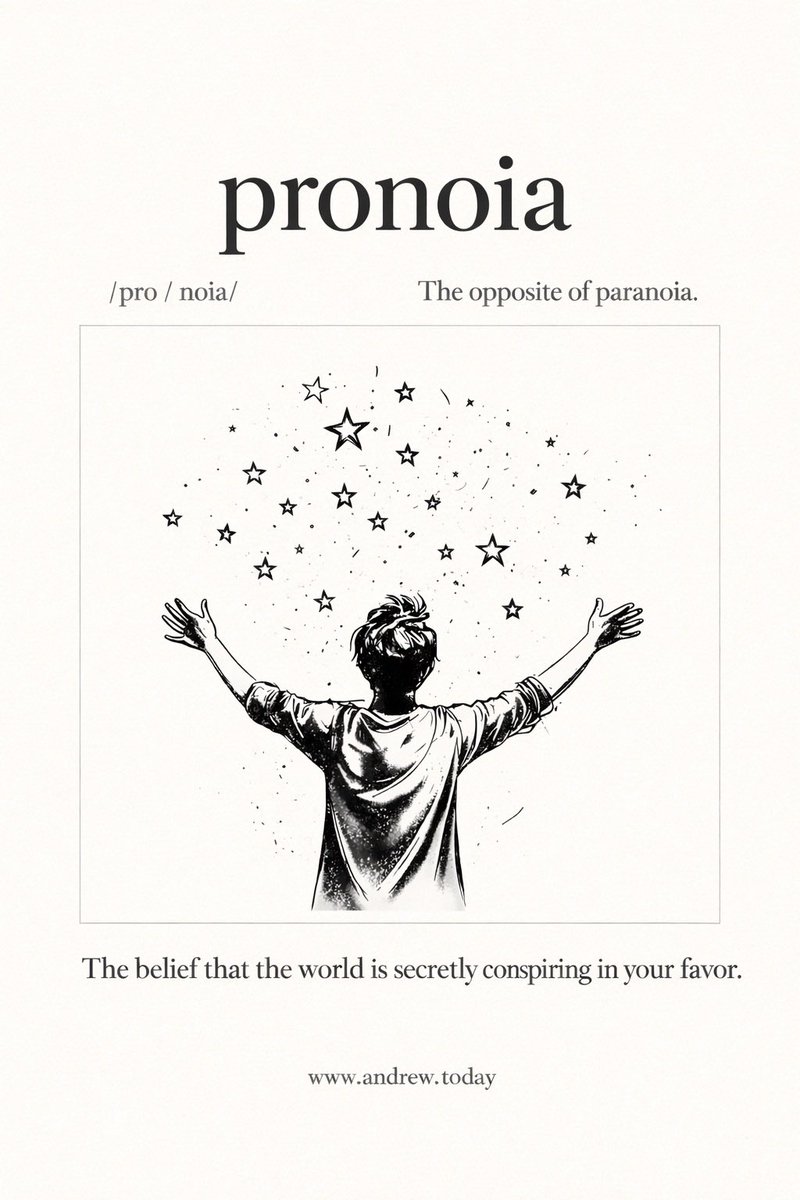
And I just recently learned the word for it: Pronoia.
It means the opposite of paranoia. The belief that the world is secretly conspiring in your favor.
The funny thing about Pronoia is that it's self-fulfilling.
When you believe things will work out, you try harder. You persist longer, and you see opportunities where others see dead ends.
What's that quote again?
"Pessimists sound smart. Optimists make money." – Nat Friedman
We all need a little more pronoia in our lives.
Agency > Intelligence
I had this intuitively wrong for decades, I think due to a pervasive cultural veneration of intelligence, various entertainment/media, obsession with IQ etc. Agency is significantly more powerful and significantly more scarce. Are you hiring for agency? Are we educating for agency? Are you acting as if you had 10X agency?
Grok explanation is ~close:
“Agency, as a personality trait, refers to an individual's capacity to take initiative, make decisions, and exert control over their actions and environment. It’s about being proactive rather than reactive—someone with high agency doesn’t just let life happen to them; they shape it. Think of it as a blend of self-efficacy, determination, and a sense of ownership over one’s path.
People with strong agency tend to set goals and pursue them with confidence, even in the face of obstacles. They’re the type to say, “I’ll figure it out,” and then actually do it. On the flip side, someone low in agency might feel more like a passenger in their own life, waiting for external forces—like luck, other people, or circumstances—to dictate what happens next.
It’s not quite the same as assertiveness or ambition, though it can overlap. Agency is quieter, more internal—it’s the belief that you *can* act, paired with the will to follow through. Psychologists often tie it to concepts like locus of control: high-agency folks lean toward an internal locus, feeling they steer their fate, while low-agency folks might lean external, seeing life as something that happens *to* them.”