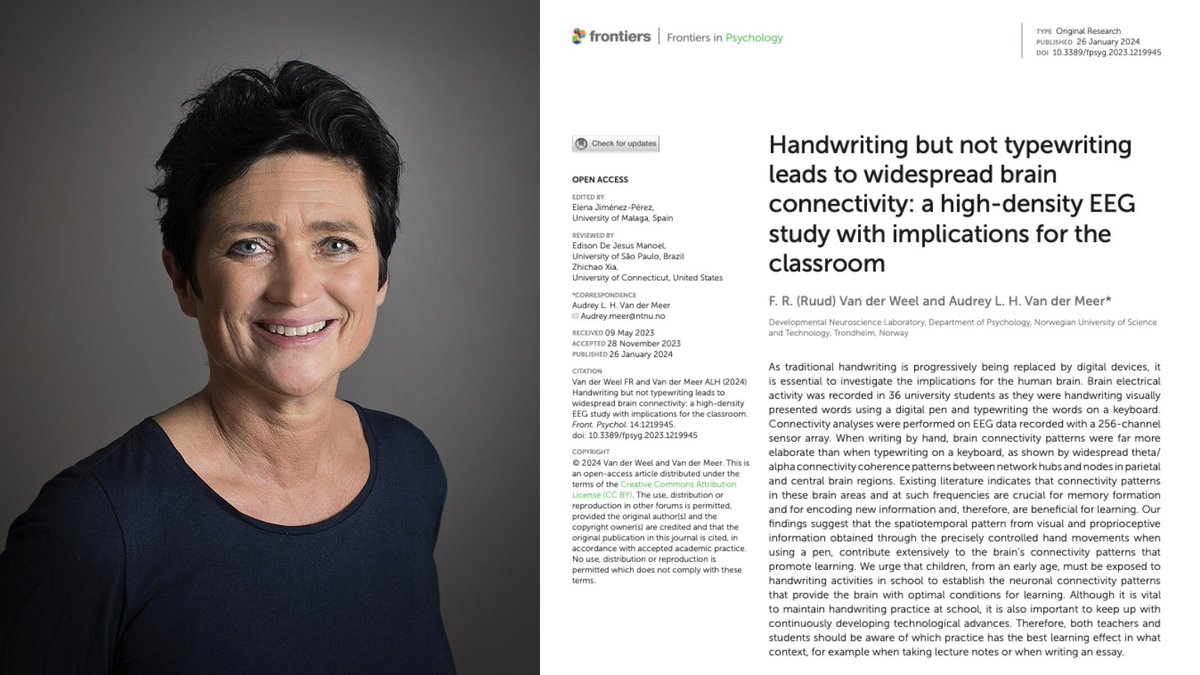
A Norwegian neuroscientist spent 20 years proving that the act of writing by hand changes the human brain in ways typing physically cannot, and almost nobody outside her field has read the paper.
Her name is Audrey van der Meer.
She runs a brain research lab in Trondheim, and the paper that closed the argument was published in 2024 in a journal called Frontiers in Psychology. The finding is brutal enough that it should have changed every classroom on Earth.
The experiment was simple. She recruited 36 university students and put each one in a cap with 256 sensors pressed against their scalp to record brain activity. Words flashed on a screen one at a time.
Sometimes the students wrote the word by hand on a touchscreen using a digital pen, and sometimes they typed the same word on a keyboard. Every neural response was recorded for the full five seconds the word stayed on screen.
Then her team looked at the part of the data most researchers had ignored for years, which is how different parts of the brain were communicating with each other during the task.
When the students wrote by hand, the brain lit up everywhere at once.
The regions responsible for memory, sensory integration, and the encoding of new information were all firing together in a coordinated pattern that spread across the entire cortex. The whole network was awake and connected.
When the same students typed the same word, that pattern collapsed almost completely.
Most of the brain went quiet, and the connections between regions that had been alive seconds earlier were nowhere to be found on the EEG.
Same word, same brain, same person, and two completely different neurological events.
The reason turned out to be something nobody had really paid attention to before her work. Writing by hand is not one motion but a sequence of thousands of tiny micro-movements coordinated with your eyes in real time, where each letter is a different shape that requires the brain to solve a slightly different spatial problem.
Your fingers, wrist, vision, and the parts of your brain that track position in space are all working together to produce one letter, then the next, then the next.
Typing throws all of that away. Every key on a keyboard requires the exact same finger motion regardless of which letter you are pressing, which means the brain has almost nothing to integrate and almost no problem to solve.
Van der Meer said it plainly in her interviews.
Pressing the same key with the same finger over and over does not stimulate the brain in any meaningful way, and she pointed out something that should scare every parent who handed their kid an iPad.
Children who learn to read and write on tablets often cannot tell letters like b and d apart, because they have never physically felt with their bodies what it takes to actually produce those letters on a page.
A decade before her, two researchers at Princeton ran the same fight using a completely different method and ended up at the same answer. Pam Mueller and Daniel Oppenheimer tested 327 students across three experiments, where half took notes on laptops with the internet disabled and half took notes by hand, before testing everyone on what they actually understood from the lectures they had watched.
The handwriting group won by a wide margin on every question that required real understanding rather than surface recall.
The reason was hiding in the transcripts of what the two groups had actually written down.
The laptop students typed almost word for word, capturing more total content but processing almost none of it as they went, while the handwriting students physically could not write fast enough to transcribe a lecture in real time, which forced them to listen carefully, decide what actually mattered, and put it in their own words on the page.
That single act of choosing what to keep was the learning itself, and the keyboard had quietly skipped the choosing and skipped the learning along with it.
Two studies. Two countries. Same answer.
Handwriting makes the brain work. Typing lets it coast.
Every note you have ever typed instead of written went into your brain through a thinner pipe. Every meeting, every book highlight, every idea you captured on your phone instead of on paper was processed at half depth.
You did not forget those things because your memory is bad. You forgot them because typing never woke the part of the brain that would have made them stick.
The fix is the thing your grandmother already knew.
Pick up a pen. Write the thing down. The slower road is the faster one.
Pope Leo's Easter message:
"Let those who have weapons lay them down! Let those who have the power to unleash wars choose peace! Not a peace imposed by force, but through dialogue! Not with the desire to dominate others, but to encounter them!"
@douglist56@JoyceCarolOates It’s not about the daughter. That’s the point. You’ve just solidified the point of the movie. Mothers are invisible. Everyone cares about the children, neglecting the mother. This film spotlights the mother. Only the mother. For this very reason.
ADHD isn’t an “attention deficit.” It’s a profound developmental disorder of self-regulation.
Dr. Russell Barkley (one of the world’s leading ADHD researchers) explains why the name “ADHD” has done massive damage:
- It trivializes a condition as serious as autism, schizophrenia, or bipolar disorder.
- It makes people think “just drink coffee and focus” — when the real issue is far deeper.
The core problem isn’t just distractibility. It’s three interlocking executive deficits:
1. Persistence toward the future — inability to stay motivated by delayed rewards
2. Resistance to distractions — constant derailment by immediate temptations
3. Working memory — struggling to hold goals, plans, and consequences in mind
Together, these create a devastating impairment in self-regulation — the ability to consciously inhibit impulses, direct actions toward yourself (self-talk, self-monitoring), and align behavior with long-term welfare.
Barkley:
“This is not an attention problem. This is a disorder of self-regulation… as serious as manic depression, and in its own way, as autism.”
Parents often hear “he’s just lazy” or “she needs to try harder.”
The truth is far more compassionate and urgent:
The child’s brain is developmentally behind in the very mechanisms that allow other kids to stop, think, plan, and protect their future selves.
If we renamed it Self-Regulatory Developmental Disorder (SRDD), the conversation would change overnight.
How many adults do you know who still struggle with exactly these same three deficits — and were never properly understood as kids?
With generative AI becoming a key player in classrooms, schools are creating guidelines to help teachers and students navigate its use.
AI is Moving Fast. Here Are Some Helpful Ways to Support Teachers
https://t.co/z9FiI4ga6l
Today, members are stopping by McDonald’s locations throughout Waterloo Region to lend a hand on #McHappyDay to help raise funds for families who need it most.
Thanks to everyone who came out and showed their support!
@educator4ever36 Great idea. This mandate recognizes the other children’s rights to education and details how much class time was derailed by an out of control child. Lots happens at school to disrupt learning, especially in elementary school, & most parents are unaware and feel helpless. Not ok!
Today on #NationalMissingPersonsDay, we call attention to the MMIP crisis—a national emergency for Native communities.
Download our MMIP guide and join the movement for justice and healing: https://t.co/DVM5WG9DJ1
#MMIP#NoMoreStolenRelatives
I’m reading “brain rules” by John Medina. It’s about 10 years old. It’s research based and quite good. He writes: “One of the greatest predictors of performance in school turns out to be the emotional stability of the home.” EVERY teacher already knows this, so why do you still blame them. Why are we even try to fix schools when we should be fixing homes?
Holding back tears: “It was a terrible night for women, for children, for the hundreds of thousands of hard working immigrants who make this country great, for health care, for our climate, for science, for journalism, for justice, for free speech, for poor people, for the middle class, for seniors who rely on social security, for our allies in Ukraine, for NATO, for the truth, for democracy, for decency, for everyone who voted again him, and guess what—it was a bad night for everyone who voted for him too, you just don’t realize it yet” @jimmykimmel@JimmyKimmelLive