The discussion of the impact of AI on entry-level white-collar jobs has become somewhat cliché now, and with good reason: junior hiring is down 14% to 29% across the US, UK, Canada and Australia.
The most cited research explores whether generative AI is the main cause, which keeps putting the AI displacement story in the headlines.
But a new paper argues that bad news for entry level roles are likely misattributed to AI - something else could be driving what seems like its consequences for junior workers.
https://t.co/XVzVtJ114P
Economists Peter Lambert and Yannick Schindler point out that the occupations highest on AI exposure are broadly also the ones with highest exposure to the availability of working from home arrangements: software, finance, professional services, or accountancy.
When they include both shocks in their analysis, the WFH effect remains statistically significant; the AI effect does not .
What drives this is what the office does for workers still building up their human capital; the acquisition of expertise and know-how about their jobs.
Randomised trials of in-person versus remote work find office workers about 18% more productive than home workers, with two-thirds of the gap there from day one and the rest opening up because office workers learn faster.
Sitting near teammates raises the digital feedback engineers get on their code by 18%.
Some workers and companies are more productive when working from home is an option: hybrid work can be a big win for workers already established in their careers. They had their formative years in the office, and they now have the senior colleagues, the network and the tacit knowledge that let them be productive from home.
But there is now a cost that is borne almost entirely by the cohort that hasn't yet been given the same opportunities to build up their careers.
There is an uncomfortable implication in all of this. The workers with the most to gain from time in the office are also the ones with the least say in whether they get it. The current arrangement is largely determined by workers and companies that have adapted to hybrid forms of work, not those who may need the ability to acquire work experience the most to benefit from automation.
The argument from Part I of this puts this in sharper relief: AI struggles most with the parts of work that depend on tacit knowledge, the contextual judgement that has to be transferred in person.
https://t.co/Ux2LRX3sJN
Younger workers building human capital under hybrid are accumulating less of the kind of knowledge AI is worst at substituting for, and so will face a higher automation risk over time, as the technology evolves.
If the UK is to be prepared to capture and distribute the gains this new technology will bring, it needs to give young workers a better chance of harnessing these benefits.
We’re thrilled to lead Town’s $55M Series A.
Town is a personal AI assistant that works across the tools you already use - email, calendar, Slack, docs, WhatsApp, desktop, web. It learns how you work and starts proactively pitching in.
People are already leaning on Town for the kind of work that’s personal and operationally messy: running recruiting pipelines, juggling school logistics, processing handwritten grant requests, prepping summaries, drafting follow-ups, catching the stuff that would otherwise slip.
The longer you use it, the more it picks up: your voice, your relationships, your preferences, your routines, what you actually care about.
Jean-Denis Greze and Tony Vincent are the right team for something this hard. JDG was CTO at Plaid and an engineering leader at Dropbox. Tony led product and AI at Google and design at Dropbox.
Welcome, JDG, Tony, and the Town team, to the a16z family.I
By @arampell and @venturetwins
Your CEO should be strong.
Your CTO should be wise.
Your COO should be wicked, cunning, of mysterious origins, fluent in the dark arts, blurry in pictures,
Why people hate humanoid robots, by @alys_key
It’s the almost-ness that gets you. The heads are almost the right size, the hands almost lifelike — if often clothed in serial killer black gloves.
It may be that we’re too conditioned by science fiction horrors to accept humanoid robots. But the reason those fictional visions terrify us in the first place is because they tap into a primal fear — of a monster, or döppelganger.
Read more below ⬇️
https://t.co/Xt1Hf7OTbd
Until now, attempts to make AI and its effects feel urgent have been more reminiscent of climate predictions. In both cases, certain groups become convinced of an imminent risk and pushed for immediate action, but many others – even if they believe the warnings – are passive. As the Pope writes on AI, “while some are vying for the future of new technologies and others dedicate themselves to reflecting on the matter – most people are watching and waiting, observing from afar and merely hoping for the best”.
This year does feel different though. Relatives and friends and managers are becoming accustomed to outsourcing every decision to chatbots. Output from AI tools can now be found in published books, at the Cannes Film Festival, and all over the internet. To most of us, it now feels a lot more tangible. This might be the moment to intervene.
@alys_key
https://t.co/6CBgGpodbm
Simon Calder, The Independent’s resident travel correspondent, is leaving after 32 years at the publication.
First joining the paper in 1994, he has gone on to become one of the UK’s most trusted and recognised travel journalists.
We take a look at some of his best moments.
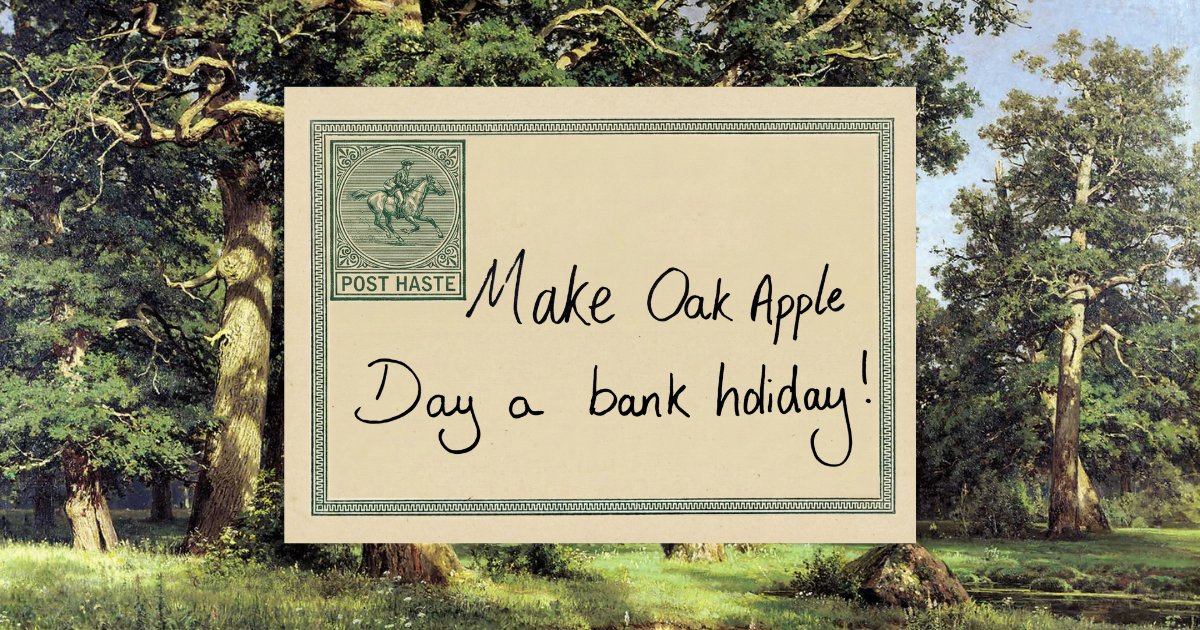
As we go into a tragically short two-day weekend, I took on the question of where to put an additional bank holiday.
I settled on Oak Apple Day, a forgotten holiday that is tied to royal history and folk traditions alike.
Looking to the Dutch holiday of Koningsdag for inspiration, I think the best way to make an extra bank holiday work would be to turn it into a distinctive celebration, one that provides a guaranteed boost to the hospitality industry.
I also had a look at the estimates for how much an additional bank holiday would cost and why statisticians actually find this so complicated to measure.
This year, Oak Apple Day (29th May) falls on a Friday. Anyone fancy a cider to celebrate?
What conditions need to happen for a London tech sector to expand and thrive?
This week, I tackled that question by talking to one of the fintech OGs, Clearscore's Justin Basini, about the mid-2010s moment and what went right.
Read on for our conversation about the similarities between today and the dot-com era, what's next for fintech, and he thinks why the next wave of interesting companies will sell the spades of of the AI gold rush https://t.co/RySmn9II7I
What conditions need to happen for a London tech sector to expand and thrive?
This week, I tackled that question by talking to one of the fintech OGs, Clearscore's Justin Basini, about the mid-2010s moment and what went right.
@thobbsjourno This happened to me when I was reporting on crypto (they in fact got a regular gig pretending to be me!), but it felt par for the course for that sector. I didn't realise it had become more widespread.
Wrote this week about SNL UK, @t_blom's diagnosis of why Brits take less risk, and the importance of structural support for careers - not just products.