I think this is a really timely and important article
There is a massive, coordinated push to make the entire company legible. But legibility is complex and it is not a default positive thing. While it may be good for AI, it can be actively bad for your company.
The simple fact of making a system legible permanently and irrevocably alters the system. And in altering the system it can destroy it.
This is broadly the theme of Seeing Like A State: How Certain Schemes to Improve the Human Condition Have Failed.
The very quest for legibility causes failure!
Of course, Silicon Valley read this book and took mostly the wrong message. Everyone read this book and said "Let's make our ecosystem legible so we can monitor it as if we were the state and harvest externalities like we are a state and tax activity like we are a state." AI is the logical extreme of this mentality
I like Brian's article because he hits on something essential - forced legibility 1) chokes innovation 2) introduces systemic risk
"The highest-value things to keep partially illegible are the things that make the company weird, specific, and hard to copy: taste, trust, timing, founder judgment, customer intimacy, negotiation instinct, informal power maps, and the contrarian beliefs that have not yet made it into the strategy."
Well said. There are all sorts of overcorrections occurring because of AI. I think we will look back on forced legibility as a big overcorrection.
I hear many reaching for the most recent analogies when trying to think about AI disruption: e-commerce/brick-and-mortar, online media/newspapers, streaming/cable, etc.
but these were mostly disruptions due to a massive reduction in the cost of *distribution*, new distribution models unseating oligopolies built around a distribution advantage
but AI doesn’t much change distribution. we already have the internet. mostly it promises to change production costs. more like shale or mini-mills but for information.
don’t really have a good sense for the implications of that yet but seems to me fundamentally different. which I suspect means impact to incumbents / which incumbents is fundamentally different.
Absolutely mind boggling..
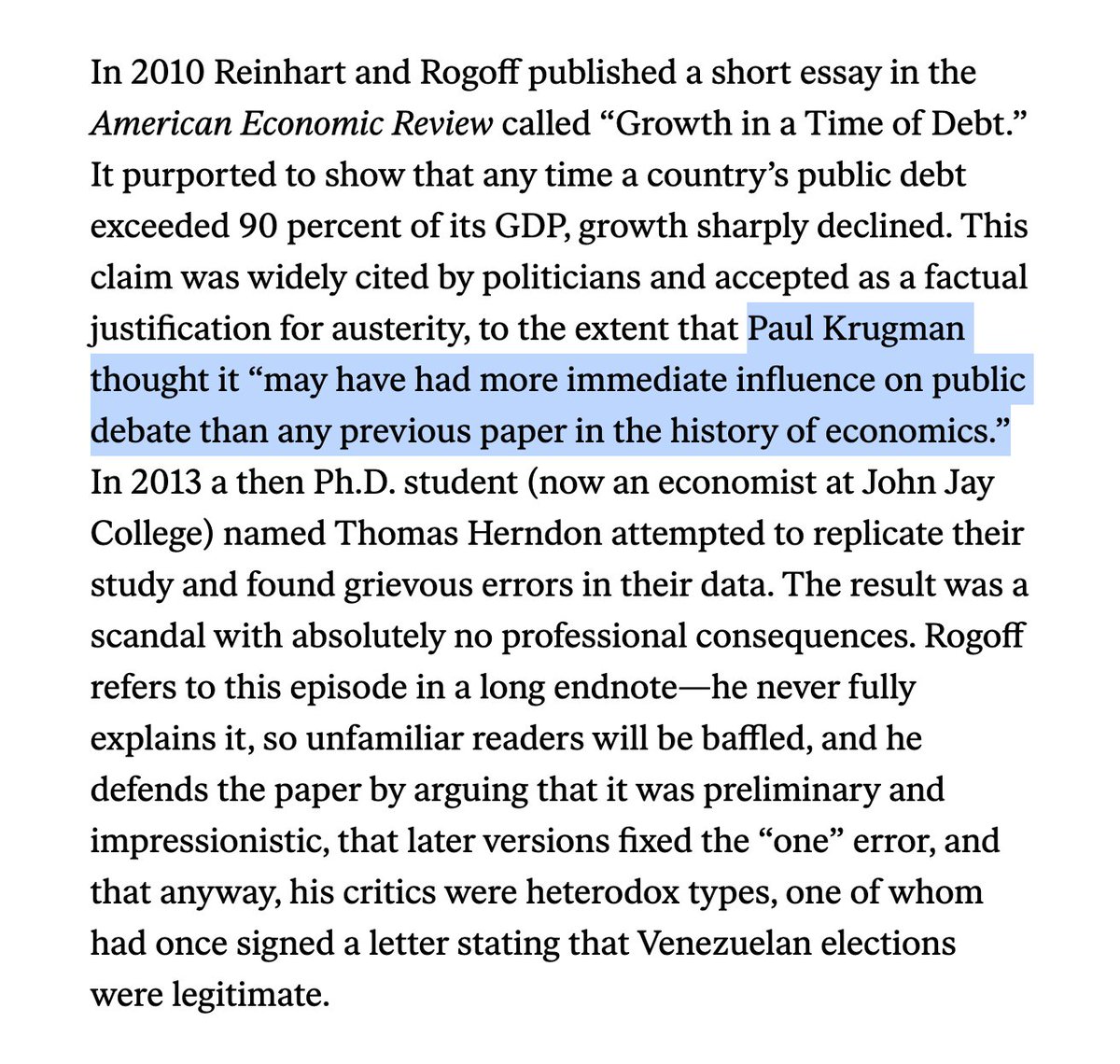
"in their Excel spreadsheet, Reinhart and Rogoff had not selected the entire row when averaging growth figures: they omitted data from Australia, Austria, Belgium, Canada and Denmark.
In other words, they had accidentally only included 15 of the 20 countries under analysis in their key calculation.
When that error was corrected, the “0.1% decline” data became a 2.2% average increase in economic growth."
And as the underlaying New York Review article notes, the erroneous "claim was widely cited by politicians and accepted as a factual justification for austerity, to the extent that Paul Krugman thought it “may have had more immediate influence on public debate than any previous paper in the history of economics.”"
Today, at 3:22pm, my life changed forever when I learned that the husband in Everything Everywhere All At Once is played by the same actor as Shorty in Indiana Jones Temple of Doom—in his first movie role in 37 years
Just published my latest #medium#playingtowin Practitioner Insights piece, this one on What Makes for a Great Strategist? https://t.co/1Atvn0pNns… #strategy#Mindset
An opinion I've been afraid to share: I think that DTC has failed, overall.
I've helped launch more brands than anyone else so maybe there's something to it.
The brands we hold up as beacons have been unprofitable for years. Every IPO tanks. Acquisitions are quickly sunset.
@andybudd Marketing is most definitely seen as a cost to be managed most of the time, and aggressively managed to efficiency (‘cost’ per acquisition). Convincing business that marketing is a value generator is an endless task.
I don’t understand stingy business owners.
If you want to attract world-class talent you have to be willing to share big upside, whether it’s a startup or real estate.
Hire right, incentivize right, and the pie will grow.
Zero sum thinking tends to manifest itself.
OK, hear me out.
What if we create like a fee or financial contribution or something - let's call it a 'tax', no wait, that's too generic, 'corporate tax' is better - and this 'corporate tax' was used to fund schools and colleges? Everyone would have to pay it. That might work.
I'm kicking off the year with a series of posts attempting to share a little of how I do brand strategy in case it helps you delvelop your practice. First up, I thought i'd commit to prose my strategy journey over the past 30 years. https://t.co/Ye1oiYmJH7