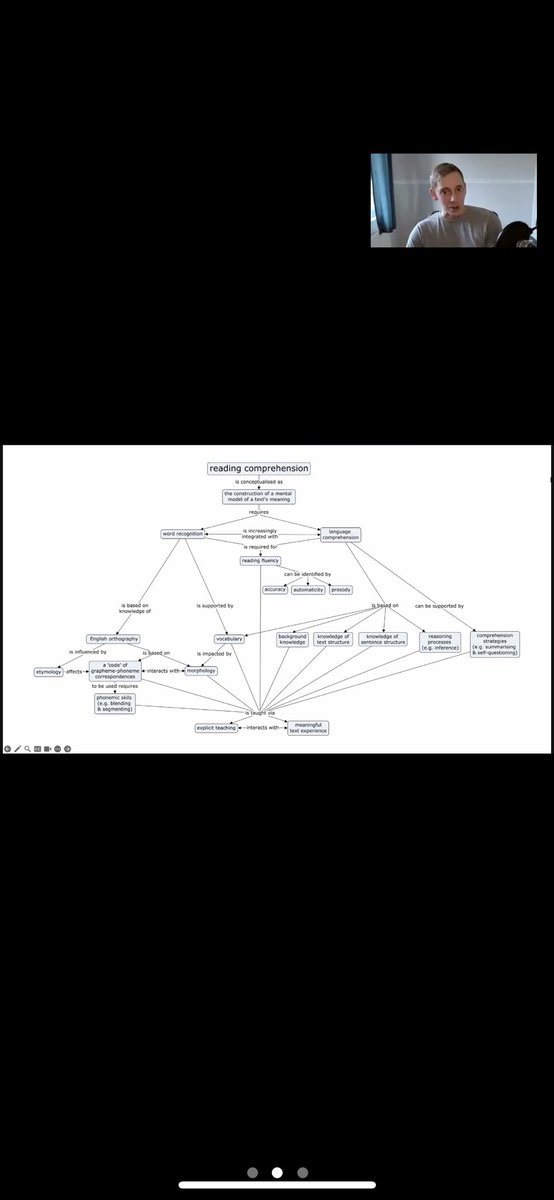
Thank you so much @Suchmo83 for your wonderfully informative seminar. Particularly enjoyed the emphasis on focusing on reading a range of stories and spoken language development to improve reading skills! Great stuff! 📚 ✨
It's May half-term, which means that I have two copies of The Art and Science of Teaching Primary Reading to give away.
Just **retweet** this tweet for your chance to win a copy.
“Understanding these components, how they build upon each other and come together, is a first step in developing effective literacy provision.”
@ally_wren, our Literacy Content Specialist, introduces a new tool to support literacy teaching.
👉 https://t.co/WPggvUFBFa
1 /2
As teachers, there is so much CPD that we are inundated with year after year. With the amount of time we have it’s so hard to squeeze this all in… however, if @HJayoosi is sharing anything inclusive, it’s something to tune in to. So much food for thought ✨
@HJayoosi in the @tes: Exploring flexible seating in classrooms - overwhelmingly positive results for all students. Improved engagement, behavior, comfort, mood, motivation, and collaboration. #InclusiveEducation 🪑✏️
https://t.co/xLptQ1eLcm
If we prioritise curriculum coverage over curriculum understanding then we’re just whipping away unfinished plates.
Everyone’s hungry, there’s loads of waste and no one quite knows what’s going on.
Fewer plates, more time to savour and digest.
Another way in which children have been demonised to sit and to ‘look like they are learning’ without understanding that looking you deadpan in the eye…doesn’t actually mean they are learning much ! 😔
Every school report said I talked too much in class and every lesson I doodled.
It was so hard to stay still and listen and both of these activities soothed me and made it easier.
But the shame stayed.
Why did I need people? Why wasn’t I ever ‘independent’? 1/
Learning the relationships between sounds and letters is *necessary* for reading development.
And this is the only bit of necessary learning in the entirety of education about which educators sometimes say, "If they haven't learned it by this point, give up trying to teach it."
"If we can get students interested in playing with words and language, then we are at least halfway to the goal of creating the sort of word-conscious students who will make words a lifetime interest." Michael F. Graves
Everyone in the sector needs to grow their subject knowledge, myself included. This can seem like a big ask. It is, but there are some ways to make it easier and more enjoyable.
An example from one school:
/1
Sunday 5:
This article really gets to the heart of what I’ve think knowledge-rich curriculum is.
“The curriculum is future-oriented in that it aims at the formation of autonomous and responsible individuals who can thrive and flourish in the present and future world.”
Finally got round to finishing this book! Most pedagogy books these days feel super gimmicky and ‘tick-sheety’ …but the first time have really internalised and been inspired to implement new techniques into my day-to-day literacy lessons⭐️💫⭐️ thank you @Suchmo83 📚🙏🏾
We are so incredibly proud of Sara who won first prize for her print artwork with the YLPP. It was amazing to see her artwork celebrated in Leicester Square today! #Boyce#UKS2#Art#Year6
Students need to know 20,000 words when they leave secondary. Beyond the most common 6,000 words, less frequently used words are more likely to be encountered through reading (@ThinkReadTweet)
Here are five ways to weave reading into the curriculum by @teacherhead and me.
I love the idea of a family reading a book together, everyone getting something different from it, but connected by it, sharing it. We accept that a film like Star Wars can be a "family film" - so why not a book? This is proof that children's books are really books for everyone!
The uber gifted @MrGoodwin23 has created this cool graphic of my session for @researchEDWarr
Some of the things that are overrated
And some of the things that are underrated
*Primary Context* I think we are surprised by pupils struggling with word problems in mathematics because of the way they are generally presented to pupils. Think about it. I do a few addition problems, we do a few addition problems and when it comes to ‘you do’, 1/