Co-Founder & Programme Designer @ThinkReadHQ | Intervention is only successful if students catch up completely | @IFERIorg AdGp | Instructivist | DI fan | Alfie
Here's a taste of our newly released podcast 'Inside the Reading Gap'. It's a challenging look at the stark divide between literate and illiterate outcomes in education (sound on🔉). It's also a message of hope.
Listen on our website (see bio) or wherever you get your podcasts.
This is one of the most famous paintings in the world, yet few people know the story of the woman holding the parasol…
It was painted by Claude Monet in 1875, and she was his wife, Camille, out for a walk with their young son Jean near their home in Argenteuil, just outside Paris. Monet painted them outdoors on a windy day, from below, so that Camille stands against the sky, her veil and dress caught by the wind, looking down at us as if we had just called her name.
It feels less like a moment a husband didn’t want to forget.
Four years later, Camille was gone. After a long illness, she died in September 1879, at just 32. Five days before the end, a priest blessed the marriage she and Monet had made in a simple civil ceremony nine years earlier. And there, at her bedside, the artist did the only thing he knew how to do: he painted her one last time. Years later, he confessed that even then, sitting beside her, he caught himself studying the colors that death was leaving on her face, a moment he never managed to forget.
By then, she had appeared in some fifty of his paintings: in a green silk dress at nineteen, standing at a window, walking through the poppies with their little boy. Without ever meaning to, he had painted the story of her whole life with him.
Monet lived almost fifty more years, but on this canvas it will always be that summer afternoon, with Camille turning to look at him in the wind…
@tombennett71 Yes! Couldn’t agree more, Tom.
Just last week an older friend forwarded a music video that had really touched her. It was so ´perfect’. Perfect looking audience. Touching reactions. Saccharine.
The manipulation really annoyed me. I hated having to tell her it wasn’t real.
Our first cohort of GCSE Latin students began their course in September, after three years of KS3 Latin teaching. We’re very proud of this. We are a school that is now over 70% PP. Don’t make Latin the preserve of the elite.
Looking for a new podcast to listen to on your commute tomorrow? Our podcast series "Inside the Reading Gap" is a succinct 4 part series. Reading problems are solvable and explain what it takes & we show that teaching can change lives. Listen wherever you get your podcasts.
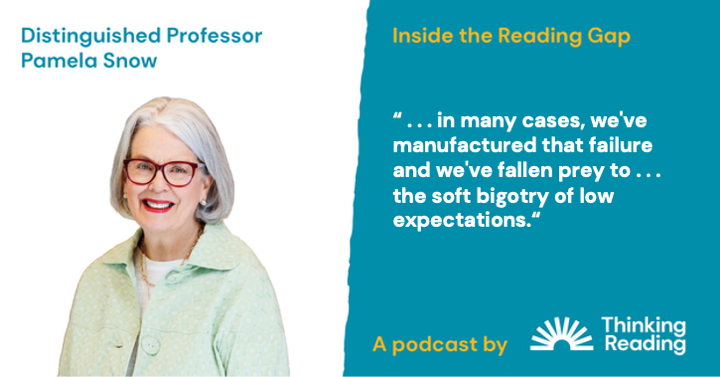
In Conversation with Distinguished Professor Pamela Snow : renowned internationally for her advocacy of evidence-based reading instruction. She talks about educational fallacies & what must change. Listen to "Inside the Reading Gap" wherever you get your podcasts.
If you would like an accessible overview of Direct Instruction theory, my second book might be of interest. With a foreword by Kurt Engelmann, it explores how DI selects, categorises and sequences knowledge.
Be inspired by people who committed 50 years of their lives to Direct Instruction.
They said over and over: I don’t make excuses for parents who are absent, that kids come in behind.
I will not blame you, label you, or pass you off. I will take responsibility for your learning.
History catches up with the education establishment in this important Season 2 of Sold a Story. Meaningful education advances could have been made in the last 50 years, as has occurred in other fields, where evidence is weighed more carefully and objectively. But they weren’t, and socioeconomic status continues to drive education outcomes, where classroom instruction should have the upper hand on this.
The one thing I’d want everyone to know about Direct Instruction is that the methods, materials and routines are far less important than the underlying drive behind it: the unswerving belief that EVERY child can achieve, regardless of circumstance.
DI is based on a deeply held conviction that if a child didn’t learn, it was because the teacher (or curriculum) didn’t teach them properly. In that sense, it is a movement rooted in social justice but one which takes responsibility for outcomes.
In the 60s and 70s, there was a view in the education academic establishment that formal academic work was premature for 4-year-olds, and doubly so for poor ones; so what they needed was enrichment and play.
Worse still, in the early 70s, some academics described DI as a racist enterprise*. Engelmann's own memoir notes that he and Bereiter were called “Nazis” and “kid-haters.”
Despite this, Engelmann taught disadvantaged 4 year olds to factor and to solve simultaneous equations, and filmed it. Bereiter and Engelmann’s argument, set out in ‘Teaching Disadvantaged Children in the Preschool’, was that the disadvantaged child was not “behind” in some general developmental sense but behind in specific, teachable things, that all kids could learn with the right scope and sequence.
The preschool they opened in the mid 60s ran for two hours a day, with three twenty-minute lessons in language, arithmetic and reading, taught to small groups by a teacher following a specific DI sequence. Those kids made huge gains which faded when they went to normal public schools.
DI has its limitations like everything but the drive behind it is sincere. As #SoldAStory season 2 will show, it has been portrayed as something very different to what it actually is and the animating principles behind it.
*Baratz and Baratz, ‘Early childhood intervention: the social science base of institutional racism.’
Celebrating 10 years of @unlockedgrads and also the end of an era. Every single member of staff has stayed to the very end and I could not be more grateful to the huge support we have had over so many years to do something so incredibly hard, but so worthwhile. #ForeverUnlocked
If you're planning to talk about Sold a Story with your colleagues or friends, you can try out a draft version of our new discussion guides. Give us feedback. We're still working on them. Final version will be out with Ep 7. https://t.co/OarCBUQb4D
The new season of Sold a Story is coming tomorrow. I've seen speculation about it. I think there will be some surprises. I'm interested to know what you think.
First two episodes tomorrow. Then one a week on Thursdays until Nov 19. https://t.co/F6Nd8mkMwt
When C.S. Lewis finished The Lion, the Witch and the Wardrobe, he realized something heartbreaking: the little girl he had written it for had grown up...
Her name was Lucy Barfield: she was his goddaughter, the daughter of his close friend Owen Barfield, and she gave her name to the bravest child in Narnia, Lucy Pevensie.
In May 1949, Lewis sent her the finished manuscript with a letter, and when the book came out the following year, that letter was printed on its first page.
He told her he had written the story for her, but hadn’t realized that "girls grow quicker than books." By now, he admitted, "you are already too old for fairy tales." And then he made her a promise: "some day you will be old enough to start reading fairy tales again."
We pat ourselves on the back that we’re well above average in reading and climbed to 10th globally.
Yes, that’s great. But is it good enough? I don’t think any of the 20% are celebrating 🤔
I’ll celebrate when EVERY child leaves school reading well 🥳
This podcast series will leave you with much to think about - including why did 20% of 15-year-olds score as functionally illiterate in the 2023 PISA report? And why doesn’t this seem to trouble the DfE as much as it should? Available wherever you get your podcasts. #EduTwitter