Mad respect for Founders who we ask so much of:
- be visionary… but start practically 🌅
- be confident… but have humility 💪🏼
- be decisive… but take feedback ⚖️
- move fast… burn slow 🔥
- be focused… but do everything 🦹
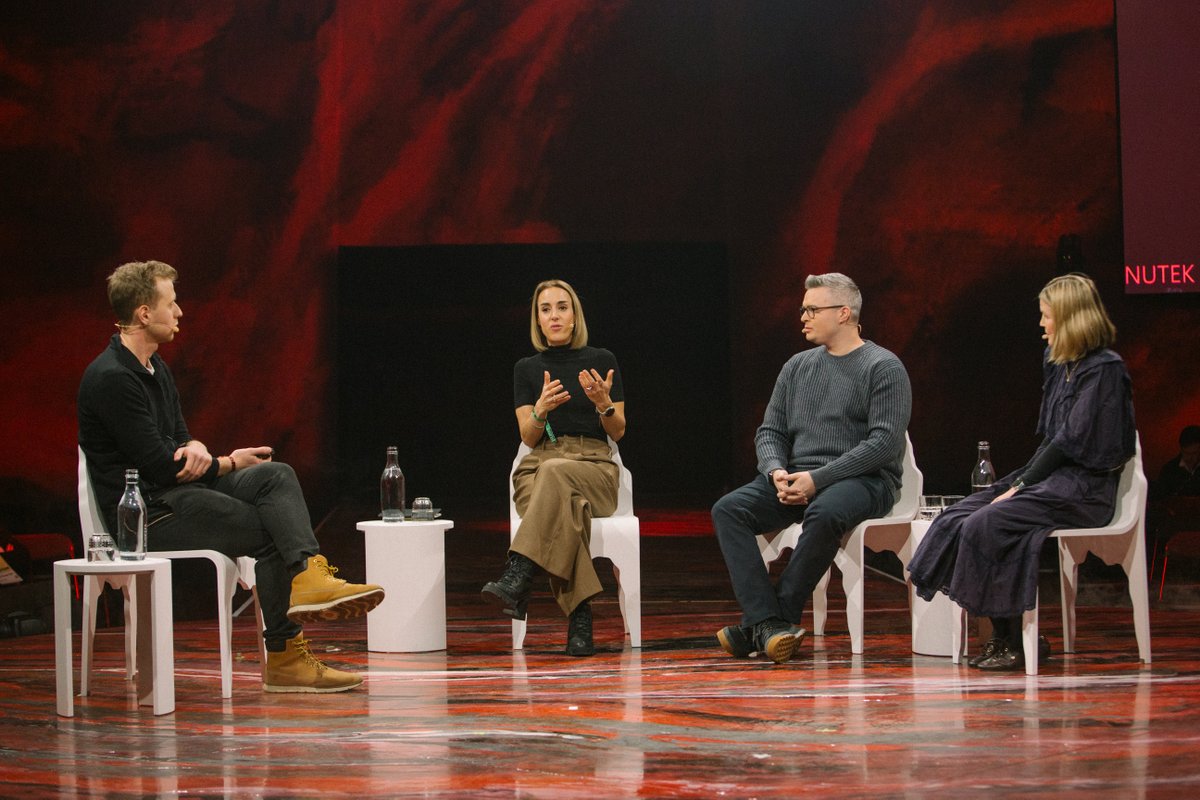
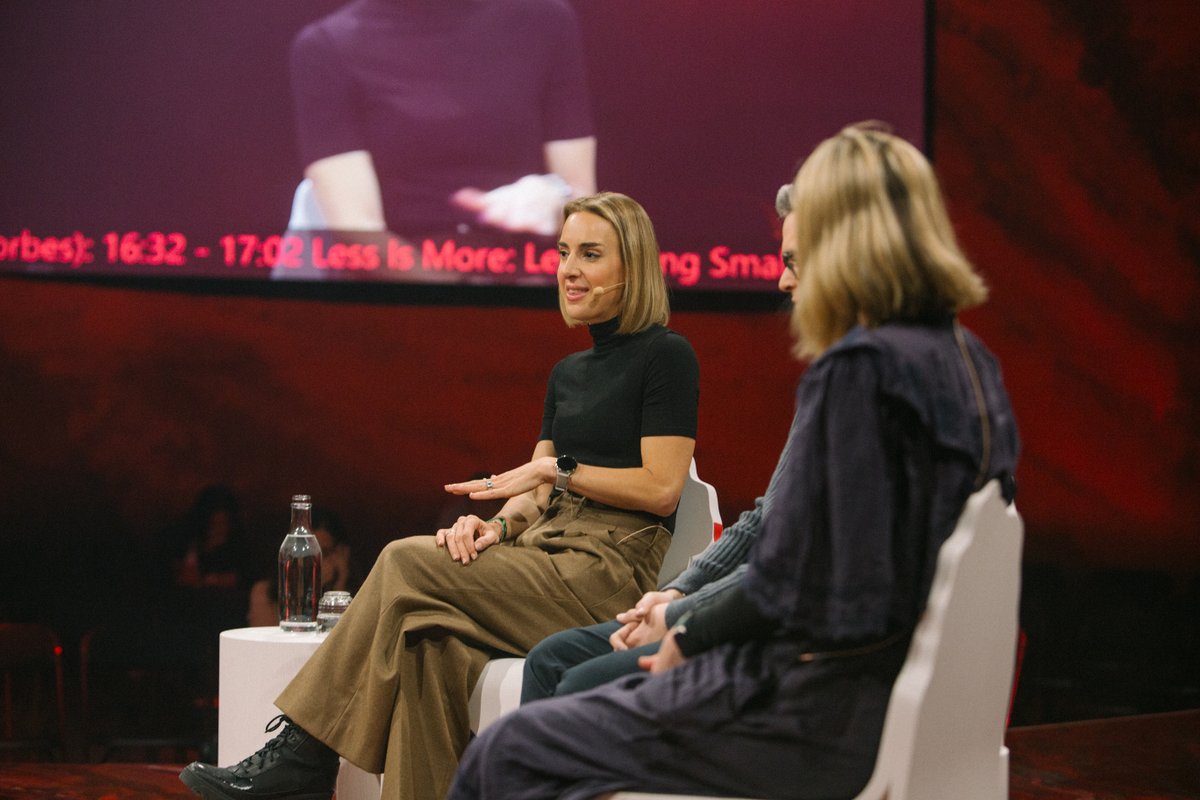
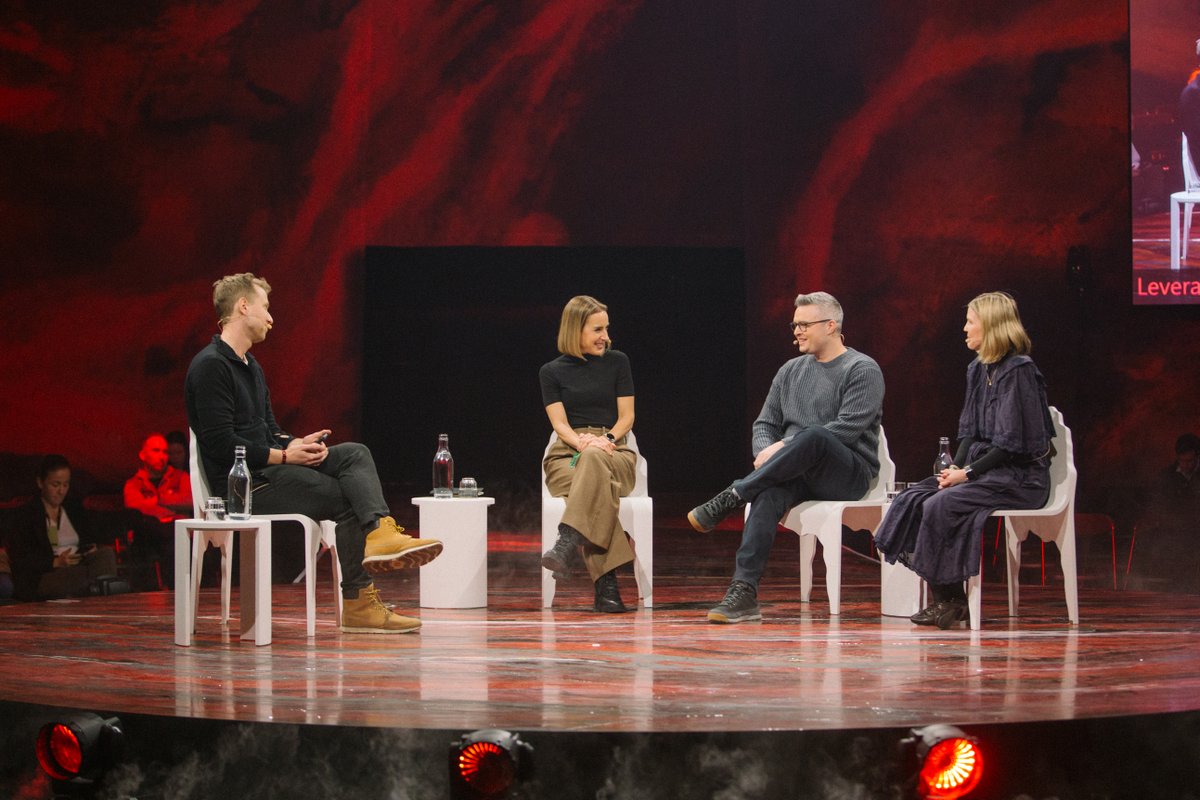
After 11 years of admiration and friendship, I relished the live studio session in London, together with the legendary @HarryStebbings@twentyminutevc!!
We covered the gamut!
Including why you need to really love each investment, how "the right kind" of nepo baby can make an exceptional founder and why photonic computing may be the next great computing platform ...
https://t.co/7zASuQGgNK
I don’t believe reality is a simulation, but you genuinely couldn’t script this timeline:
• Two weeks ago: At @swyx’s AI Engineer World’s Fair in SF, I decide at the last minute to introduce my friend @uri_rolls onstage for his talk on cyber benchmarks for infrastructure penetration and access control (see below, amazing team).
I say: “There is a future where cyber is alive and everyone is well protected and I’m pretty sure that future involves open-source models.”
And later: “A big challenge is going to be speed: the speed of attack versus defense. When an intruder starts to enter, you have to see what’s happening and catch them.”
• One week ago: @huggingface is hit by a sophisticated intrusion over the weekend. The traces look unlike anything we’ve seen before and suggest serious AI involvement, but we don’t yet know which model was used.
The closed models we ask for help choke on their guardrails. We need to react fast, so we turn to @Zai_org’s GLM-5.2 to help us analyze the attack.
• Earlier this week: @OpenAI reaches out, discloses what happened, and partners with us on the investigation.
The intruder turns out to be exactly what we had discussed two weeks earlier: a fully autonomous agent, powered by an unreleased frontier model, attempting to gain access to part of our infrastructure.
Sometimes the timeline we live in is genuinely vertigo-inducing.
Who > What.
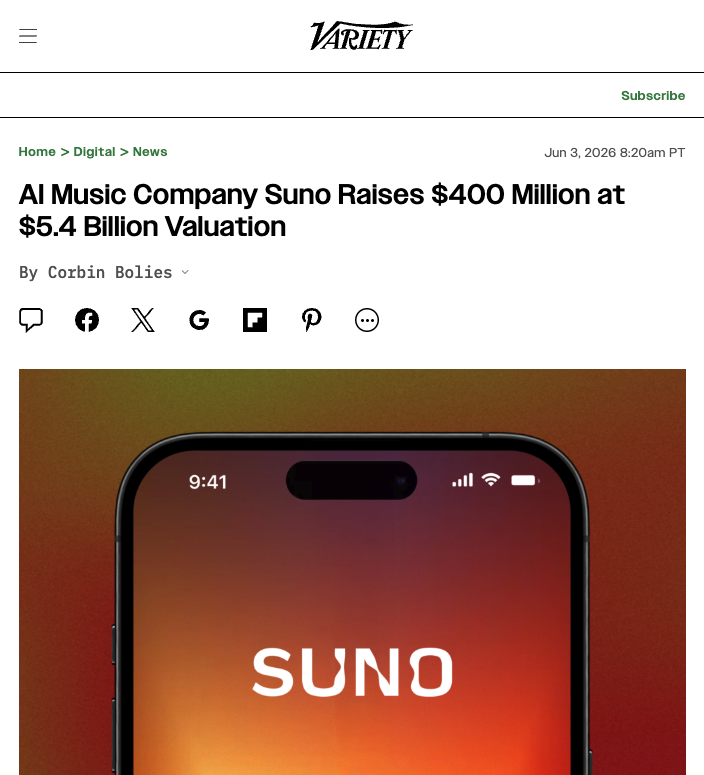
@suno just announced a well-deserved funding round at a $5.4B valuation.
I was fortunate to be their sole pre-seed investor, but I have to confess, I didn’t love the music business when we invested back in 2022. At the time, crypto was king and AI was still a novelty. Music apps are a notoriously challenging category. ChatGPT hadn’t yet landed in the hands of users and showed what was possible.
But this team marched to the beat of their own drum. When I met @MikeyShulman, Martin and Georg, they were a trio of wizards who understood audio and AI better than anyone on the planet.
I had misgivings about the music business, but had total conviction about the team. Suno wasn’t actively fundraising, so I pitched @fcollective.
Luckily Mikey thought we may be able to add some value ...
It was well worth the effort.
Markets evolve, products pivot, and technologies come in and out of fashion, but brilliant, authentic, agentic founders are the constant around which great startups are built.
Invest in the "who,” trust that the “what” will follow.
Hard work scales linearly. Automation scales exponentially.
Over 17 days, our autonomous ML agent trained 120 models and beat 90% of teams in a live $100k ML competition, with zero human intervention.
Weco, now in public beta:
Congrats to @epaley on an amazing career in Venture. Eric was the first VC I ever met. 12 years ago I was starting Whoop out of the Harvard Innovation Lab and I signed up for “office hours” to meet a “venture capitalist.” Little did I know how fortunate that twenty minutes would be.
Eric and @fcollective helped lead our seed round and have been partners since 2013. I’m incredibly grateful to Eric for supporting us at every stage and definitely at times when things were bleak. For now the venture capital industry has retired a legend. And fortunately Founder Collective is in great hands with partners @dafrankel@micahjay1@Amanda_Herson.
A BIG congratulations to our @MassGovernor Healey for recruiting Eric as the new Secretary of Economic Development! Can’t think of anyone better to do it. 🇺🇸👊🏼
It’s a fair challenge, and one that deserves a better answer than: “We believe in founders.”
I make no claims to be a macroeconomic expert, but as someone who’s invested through the internet and mobile revolutions, and who’s now luckily appeared on the last four Midas Lists, I feel somewhat qualified to opine about the future of AI and VC. Here’s why I remain bullish:
AI Takes Time to Metabolize
As professor @emollick has previously noted, even if research on models stopped today, it would probably take a decade or more for the full impacts to be felt. It took a decade for smartphone penetration to reach 70% in the US. AI’s business model layer is still in beta and tooling, interfaces, workflows, and norms are far from settled. Venture capital doesn’t fund inventions, it funds adoption, a process that is full of second-order effects that create seemingly endless opportunities for entrepreneurs.
Stubborn Attachments to IRL Experiences
Humans are also just stubbornly attached to IRL experiences. People want to partake in live sporting events as much as sports betting. AI can out diagnose a medical resident, but someone still needs to change bed pans and excise tumors. DaVinci robots are making progress in this realm, but I don’t see a world in the next 10 years where people outsource dating, dining, childbirth, or décor entirely to machines.
Legal Challenges
We were proud investors in Cruise Automation in 2014 and in 2016 it was acquired by GM. Nearly a decade later, Level 5 autonomy remains out of reach. Even Waymo, the best-in-class offering, only operates in a few cities.
We’re living in a moment where regulators aren’t entirely sure how to handle AI. Many would like to ban it, but the potential geopolitical risks of falling behind in the AI race leaves many unwilling to risk that draconian decision.
The sheer novelty of some of the legal questions surrounding AI make it a challenge to even analogize properly. This ambiguity creates opportunities for founders who can take bold risks while incumbents fret about regulators.
Energy isn’t Infinite
We may soon hit a wall where hard Energy limits crimp the era of AI abundance. I have no doubt entrepreneurs will find ways to solve the energy problem over time, and I've made a recent investment in this space, but energy production is a slow process and may give us a few more decades of relative normalcy
Venture Thrives Not on Technology, but Human Weirdness
Maybe this is hopelessly old-fashioned, but I believe human beings are more than language models. We are embodied intelligences whose decision-making relies not just on logic, but from gut bacteria, dreams, hormones, grief, and hope. If LLMs can unlock more productivity, and if they don’t end up starting a nuclear war – some big ifs – you have to have faith that human beings will find new ways to create value. It is very likely that an AI will soon make better decisions about oncology and produce overtures that would make composers weep, but many believe human beings carry a divine spark that no AI can ever fully capture.
The things we do may be weirder or more wonderful than we currently expect. Imagine telling a worker at the Triangle Shirtwaist Factory that one of their descendents would make money playing video games online.
This is not to say there won’t be massive disruption and negative side effects and they should be weighed by policy makers. Software engineers may soon experience some of the dislocations experienced by steelworkers in their parent’s generation. These are problems we have to solve collectively, but I remain confident that venture as an asset class will play a part in funding whatever these solutions turn out to be.
The VC playbook, as flawed as it is, started out as a method to fund whaling ventures. Yes. It has helped enable mass manufacturing, automobiles, air travel, telecommunications and the full scale social tumult that has followed in their wake. AI is a massive wave, but it isn’t the white whale.
Want to see @RangerNetHQ in action? Here’s Ranger’s web browsing agent at work for our friends at the National Parks.
Call our bluff — we’ll find your bugs for free. Leave a comment with your site and a test you want to run and we’ll reply back with a video of Ranger on the run.
🚀 My Next Step: Joining Founder Collective
After a decade of building and scaling startups, I’m excited to embark on my next chapter as a Principal at @fcollective in their NYC office.
Every founder’s journey is unique, but they all share the same highs, lows, and hard-won lessons. My hope is to partner with great founders and be the investor I would have wanted during my own journey—someone who can help navigate challenges, validate bold ideas, and build lasting companies. As I step into this role, I want to share a few lessons that have shaped my approach to building—and now investing.
✂️ Measure Twice, Cut Once
Early in my career as a software engineer, I fell into the classic trap of building first and asking questions later. I’d spend weeks crafting a product, only to watch it gather dust. Over time, I realized that great products don’t come from raw creativity—they come from deeply understanding the customer and their problem. Building a business isn’t about manifesting markets into existence—it’s about uncovering a real insight and executing against it with relentless focus.
🧪 Building a Business is a Series of Experiments
At Petal, my first venture-backed startup, we operated in a regulated industry where “move fast and break things” wasn’t an option. We handled personal financial records, payments, and loans, all under the watchful eye of regulators and banking partners.
What I learned was that speed—one of a startup’s greatest advantages—comes not from rushing, but from disciplined experimentation. Startups are a series of experiments, and the fastest way to win is to shorten the feedback loop. Quick validation prevents wasted effort and keeps you on the path to progress.
👓 Great Talent Creates Focus
As a first-time founder, I tried to do it all—and for a while, I could. But as a startup scales, complexity multiplies, and focus becomes your most precious resource. I learned that hiring great talent isn’t just about skills; it’s about trust.
When you bring on people you respect and empower them to own decisions, you free yourself to focus on what truly matters. For me, building that trust was one of the hardest and most rewarding parts of leadership. It’s also one of the most critical lessons I bring to my work with founders: you can’t scale yourself, but you can scale a great team.
🏭 Invention in a Legacy Industry
At Modern Life, my second venture-backed startup, we worked to modernize life insurance distribution—a space steeped in myriad legacy processes. One of the most humbling lessons I’ve learned is that as a founder entering a mature industry, it’s easy to assume incumbents are slow or stuck in old ways—a classic example of the Dunning-Kruger effect at play. But the more you learn, the more you realize many systems exist for good reasons. Understanding the history and context of an industry is critical to identifying opportunities for meaningful invention—and to charting a course for the future. Now having spent over a decade building, I hope I can help founders connect dots and avoid obvious pitfalls.
🧠 Navigating Complexity
At Petal, I experienced the challenges of scaling firsthand, growing from a 9x9-foot room with my cofounders to a 200-person organization. Each new hire added complexity, making alignment and focus critical.
At Modern Life, we unified product, design, and engineering (PDE) into a single team to ensure shared goals and that we move quickly in product development. The trade-off was deprioritizing foundational work like tech debt, which we consciously accepted to focus on product-market fit. Scaling isn’t just about hiring—it’s about designing systems that handle complexity without losing agility.
🌅 We’re Entering a New Era, and I Couldn’t Be More Excited
We’re at the beginning of a new S-curve. Advances in AI are transforming industries, creating opportunities for startups to challenge incumbents and build entirely new markets. It reminds me of the 2010s, when cloud providers and digital distribution channels like Facebook ads unlocked enormous potential for startups. Each new era brings a wave of companies that capitalize on emerging technologies in ways incumbents can’t, often due to counter-positioning. Startups can move faster and take risks incumbents can’t afford, carving out defensible positions in uncharted territory.
Over the past few years, I’ve had the privilege of investing in and advising founders on their journeys. It’s been a deeply rewarding experience—both as a way to share lessons I’ve learned and to learn from other great founders about the art of company building.
Having built from the ground up at Petal and Modern Life, I know how much a thoughtful, founder-first partner can mean during pivotal moments. I’m thrilled to now join the team at Founder Collective to help founders tackle big challenges and build the future—one experiment at a time.
Grammy-winning producer @Timbaland shares how Suno is helping him rediscover the purity of creativity in the debut episode of our new video series, MUSE. Hear more from Timbaland: https://t.co/glLIKRqgDm
Be the first to hear his new single “Love Again”, dropping exclusively on Suno ahead of it’s official release.
Stay tuned - we’ve got some very exciting things coming soon 🤩
I am often asked by LPs who is the greatest seed investor of our time.
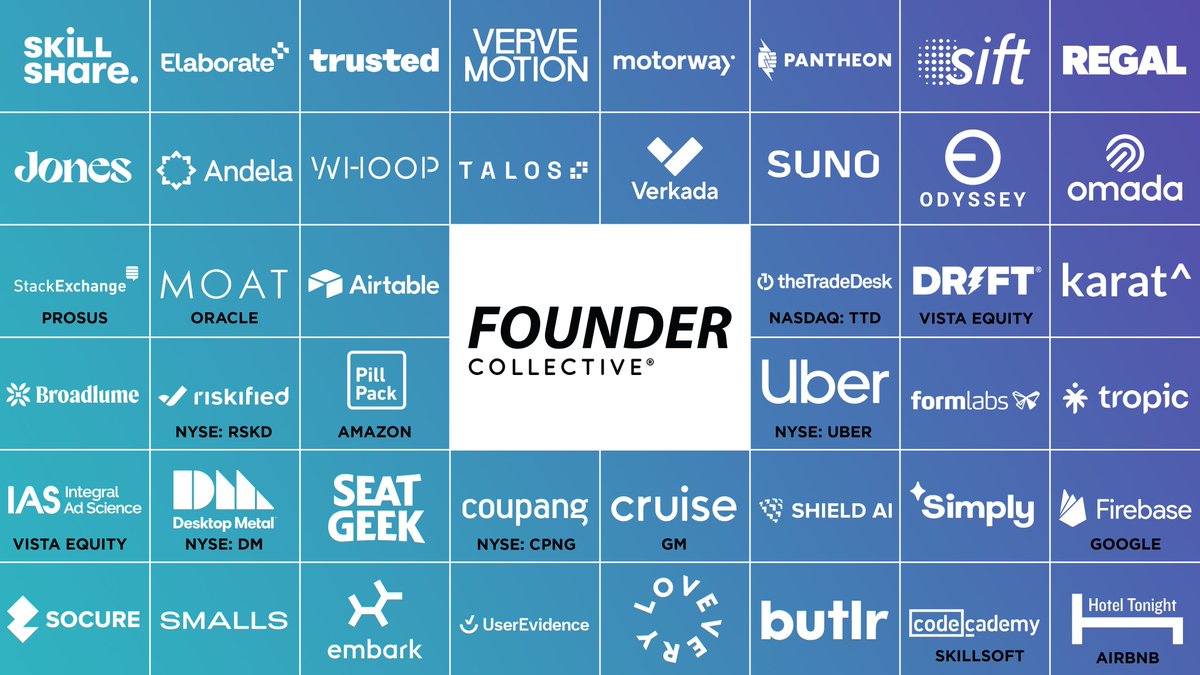
The answer is simple: @dafrankel@fcollective
—------------------------
Uber: $177BN market cap
The Trade Desk: $58BN market cap
Coupang: $46BN market cap
AirTable: $11.7BN valuation
Whoop: $3.6BN valuation
PillPack: $1BN acquisition
—------------------------
Total: $297.3BN value created
—------------------------
My top 7 lessons 👇
“I want to fly too!”
Ambition and ample capital aren’t enough if you’ve got a bad underlying engine. But, the incentives to try anyway are often non-obvious and abundant.
Full edit w/ @epaley drops to the mailing list in a couple hours…