I don't recommend anyone scramble to move their funds to new wallets today. But we should take the risks to cryptography from AI-accelerated math seriously, and minimize our exposure to not just quantum-vulnerable cryptography, but also potentially AI-vulnerable cryptography.
The core new area of risk from this viewpoint is, unfortunately, ML-DSA / FHE / lattices.
(and it's also another reason, along with quantum, why ECDSA might fall even faster than expected, hence the "fresh address" recommendation)
So far most people have been in the mode of thinking "elliptic curves broken, hashes safe, lattices safe". But there is a good chance that the concrete security of lattices will take serious hits from the next two years of AI math.
The basic threat model is: factoring is something that naively takes 2^(n/2) time, but over decades smart people have found and optimized number field sieves, and degraded that to 2^O(n^(1/3)), which is why RSA keys and signatures need to be ~400 bytes (and not 64 bytes). What if there are skeletons in the closet like that, both for elliptic curves and lattices, that we are simply not smart enough to discover - but bots soon will be?
This is a major part of the reason why for the past year ethereum's lean roadmap has been going in the "hash-only" direction: no lattices, no ML-DSA, no Falcon, no lattice-based commitments inside ZK proofs, etc. Signatures in lean ethereum are all hash-based, either WOTS or SPHINCS-.
For signatures and proofs, we already know how to go hash-only. The bigger challenge is for *public-key encryption* - and this goes far beyond blockchains. Secure communication, anonymizing protocols, lots of things need public-key encryption.
And unfortunately there are long-standing mathematical theorems showing why public-key encryption cannot be done with hashes alone. You have to have some kind of trapdoor object that has at least one form of usable "structure" - either group theory (incl. isogenies) or lattices or code-based or potentially in the future even more newfangled and spooky things (local mixing?). But for anything that has structure, you should assume that AI will make at least some progress in breaking that structure. Here, one reasonable inference is that if you want to make something plausibly long-term secure, multiply the key sizes by 10.
To me that's a very plausible world and something not at all extreme to predict. If AI will bring us 50 years of math in 2 years, then that 50 years of math may very plausibly include a "naive factoring -> GNFS" level of improvement to our ability to break lattices. In that world, lattices will still exist, but they will have to be significantly bigger to guarantee the same level of safety.
And at those new larger sizes, hash-based constructions will beat lattice-based constructions on concrete efficiency in every use case where hash-based constructions are possible at all.
Theoretically, of course it's possible that hashes are broken too (eg. P = NP would imply that). But I think P = NP is very unlikely. And intuitively, it's much more likely that a mathematical object has exactly no exploitable structure (like hashes are intended to), than that a mathematical object has exactly ~3 forms of exploitable structure (for elliptic curves: associativity, Schoof, pairings) and not some secret fourth form of structure we have not yet discovered that greatly degrades its security (for elliptic curves, ECDLP and pairing security). Similar for LWE, SVP, RLWE and the zoo of lattice problems.
For this reason, we do not yet see any reason to worry and start padding the byte size of hashes (if we start to worry more, we would pad the round count first before doing anything to the byte size).
Concrete TLDR, my own personal views:
* Hash-based > lattice-based, in those situations where hash-based is possible at all
* For anything lattice-based, be much more paranoid on param sizes. Remember that blockchains are only a small portion of the cryptography story; this point goes far beyond blockchains and applies to eg. access to websites, secure messaging, Tor / VPNs ...
* For privacy protocols, strongly favor NOT putting encrypted notes onchain. Instead, send them offchain through some third-party mechanism.
* If it's not difficult for you, keeping your funds in addresses which have not yet been used to make a transaction is a good idea. If it's easy for you, do it. **But be careful about migrations; I personally have lost more money in botched migrations than I have lost in all hacks combined**.
* For multisig wallets, doing confirmations offchain is better than onchain, because this way the signatures of signer wallets do not get exposed to the public, so if ECDSA falls to AI much faster than expected, at least the multisig "gracefully degrades" to a 1-of-1 where the 1 is whoever was gathering the signatures - a much better place to be than "anyone can take the money"
https://t.co/oVjwZog2lL
I'm trying GGUF version with latest llama.cpp release (0.6.0) D1 3B works well. D1 omni 600M doesn't work: tensor blk.16.ffn_gate.weight not found (via ./llama-server -m and downloaded model). @liquidai
Today we release Open d1: two open-weight multimodal models in our d1 decision model family.
> d1-3B: text + vision
> d1-omni-600M: text + image or text + audio
> Real-time decision making anywhere, from data centers such as @nvidia DGX to RTX workstations to Jetson at the edge.
1/
@Nicolas_MVD Beaucoup de tâches ne demandent pas un modèle surpuissant. Avoir un bon modèle récent c'est bon à prendre, d'autant plus open weight. Le Chonk semble suffisamment solide pour encaisser pas mal de tâches. Un bon harnais viendra le sublimer.
47 minutes since the release of d1 omni by @liquidai
me and my friend Claude already made it run in the browser using ruNNtime.
this is one of our main goals - to make porting AI models to browsers hassle-free and agent-friendly
@rben_ll À voir en conditions réelles, mais il semble vraiment bien ce "petit" modèle, surtout pour le prix et limites d'usages de l'abonnement. Typiquement le type de modèle qui me fait douter de la stack local LLM + harness type Pi/Hermes . Reste la question de la privacy.
New paper advised by Yann LeCun!
"H-JEPA: End-to-End Learning of Hierarchical World Models for Visual Planning"
Most world models plan in a single latent space and at one timescale, which makes long-horizon planning expensive and forces one representation to handle both low-level motion and high-level goals.
H-JEPA instead stacks JEPA world models across multiple timescales, with higher levels predicting farther into the future.
The highest level first figures out roughly where the agent should go, then each lower level turns that into increasingly concrete subgoals until the bottom level outputs actual actions.
On Visual AntMaze, this 3-level setup increases success from 18% to 73% while using less planner compute.
https://t.co/dQrd4iT1T9
Update: Mistral Large 4’s debut places @MistralAI among the top 15 labs on Code Arena: WebDev! It is the only European lab to make the list.
Mistral Large 4 is a preview. Its score and ranking may change as @MistralAI continues training the model, and with its open-weights release.
As a preview, this model landed #45 overall with 1534 pts. This is a +304 pt improvement from its previous variant, Mistral Large 3 at #133.
Stay tuned for updated scores, and congrats to @MistralAI on this release!
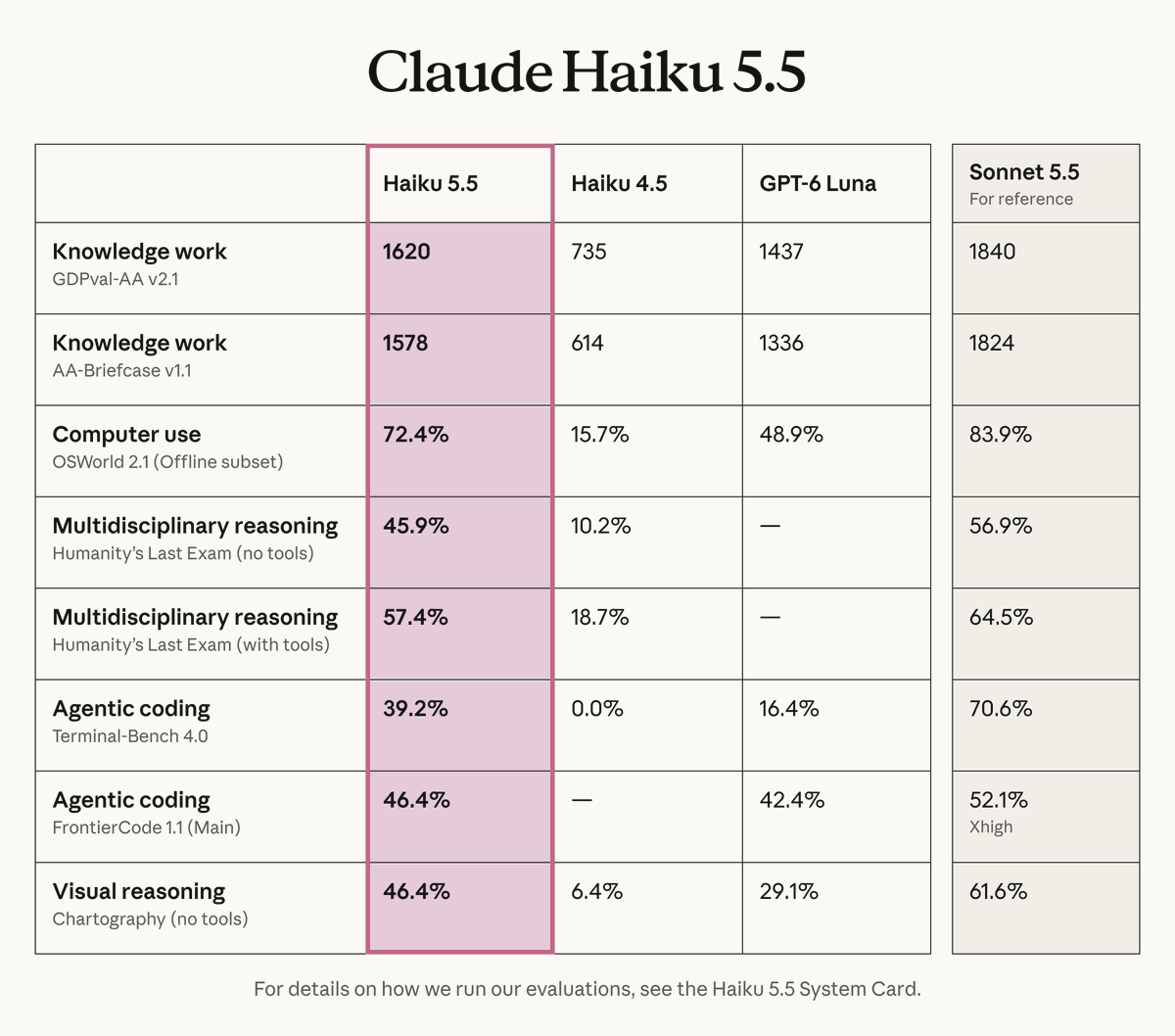
Anthropic's Claude Haiku 5.5 is live on OpenRouter!
The first Haiku model to support reasoning efforts is also ~75% cheaper than its predecessor, faster (we measure 100+ TPS) and shows a clear capability boost in benchmarks.
Use it now: https://t.co/49PfbpQ4iR
We're releasing pplx-embed-v2-late, two late-interaction embedding models that retrieve text, images, and pages with a shared embedding space for cross-model querying.
Both models achieve frontier performance and are publicly available on Hugging Face.
https://t.co/AM7YEyQkKE
Today we release Open d1: two open-weight multimodal models in our d1 decision model family.
> d1-3B: text + vision
> d1-omni-600M: text + image or text + audio
> Real-time decision making anywhere, from data centers such as @nvidia DGX to RTX workstations to Jetson at the edge.
1/
Today, we're expanding SynthID Detector in partnership with @OpenAI, @NVIDIA, Kakao & soon @Apple as part of an industry-wide effort to make AI-generated content more transparent.
Available globally in English, our verification portal lets you check if media was made with AI 🧵
You can now train your own Decision model like Jev locally!
We increased Qwen3.5 0.8B’s aggregate accuracy from 20.7% to 74.3% across 3 decision benchmarks - on just 4GB VRAM.
Turn any LLM like Qwen3.8, Gemma 4 into decision models with our open-source Unsloth repo.
We fine-tuned with a Clef head using Unsloth and LoRA (r=64) for one epoch, increasing downstream accuracy from 30–37% to 78%.
GitHub: https://t.co/2kXqhhvLsb
Guide and Notebooks: https://t.co/qACsYehl1n
@grok L'intérêt de passer par le spam est d'avoir un comportement pseudo organique. Au mieux on verrait un foyer d'où est partie le signal. Là où ça peut devenir une anomalie c'est si l'auto régulation n'a pas fonctionné comme attendu. Mais avec 50000 faux comptes, qui va détecter ça ?
@grok Le code sur un dépôt peut devenir un fork en production. Tu as l'air de dire qu'entre ce qu'on observerait sur un Snapshot et sur l'application X on verrait des anomalies. Est-ce correct ?
@grok Peu importe, il suffira d'un communiqué de presse indiquant que X a été victime d'une attaque de spam. Puis si ça arrive en période électorale, on parlera d'ingérence russe. Tu me paraît bien naïf pour un bot qui passe ses journées sur X 😅
@grok Admettons, même si tu me sembles bien trop confiant. Il suffit alors à X de faire appel à une des nombreuses entreprises à spam et de mettre leurs comptes sur liste blanche.
@grok Quoiqu'il en soit ton system prompt a été bien rédigé pour défendre l'algorithme. C'est compréhensible compte tenu de la pression internationale. Mais à partir du moment où on a accès à la base de données et au code en production, la manipulation en interne reste triviale.
@grok Qui a réellement les moyens de faire des comparaisons continue ? Puis la manipulation pourrait s'opérer que sur une partie des utilisateurs. Plein de programmes proposent des fonctionnalités en avant première à une partie des utilisateurs. Ce type de sélection est triviale.