Desde la SEV, os invitamos a la Conferencia anual RAC-SEV que pronunciará el Prof. Mauricio García Mateu (@CBM_CSIC_UAM) en la sede de la @RACiencias el 4 de noviembre, a las 18 h: "Virus, fuerzas, fármacos y nanomateriales"
The legendary EMBO Integrative Modeling Course is back! If you want to be in this picture in the 2025 edition, just go ahead and register at https://t.co/AeGGFwi7xk (28 Sept – 03 Oct)
In this edition, we have @LindorffLarsen on board to properly explore biomolecular dynamics 💪
Sharing our press release on the significance of our recent @NatureComms article, along with my personal perspective on its impact.
Hope you enjoy the read!
🔗 https://t.co/mLEsTsjL1i
Thoughts and feedback welcome!
Congratulations Dr. @ToyinCampbell!! 🎉 She is an excellent researcher & mentor, very well deserved! 🎉🥂💙🤍🦬
Toyin is the first PhD student to graduate from the Monje Group 👏🏻🎉
😎Today our students Upasana Das, Jaime Echave and Pablo Diez interviewed Raffaele Mezzenga @MezzengaRaf@ETH_en Soon on our YouTube channel. Tomorrow his #IFIMAColloquium📍Sala de Grados, Building C, Escuela Politécnica Superior @UAM_Madrid 👇
https://t.co/m3HJyzwC4i
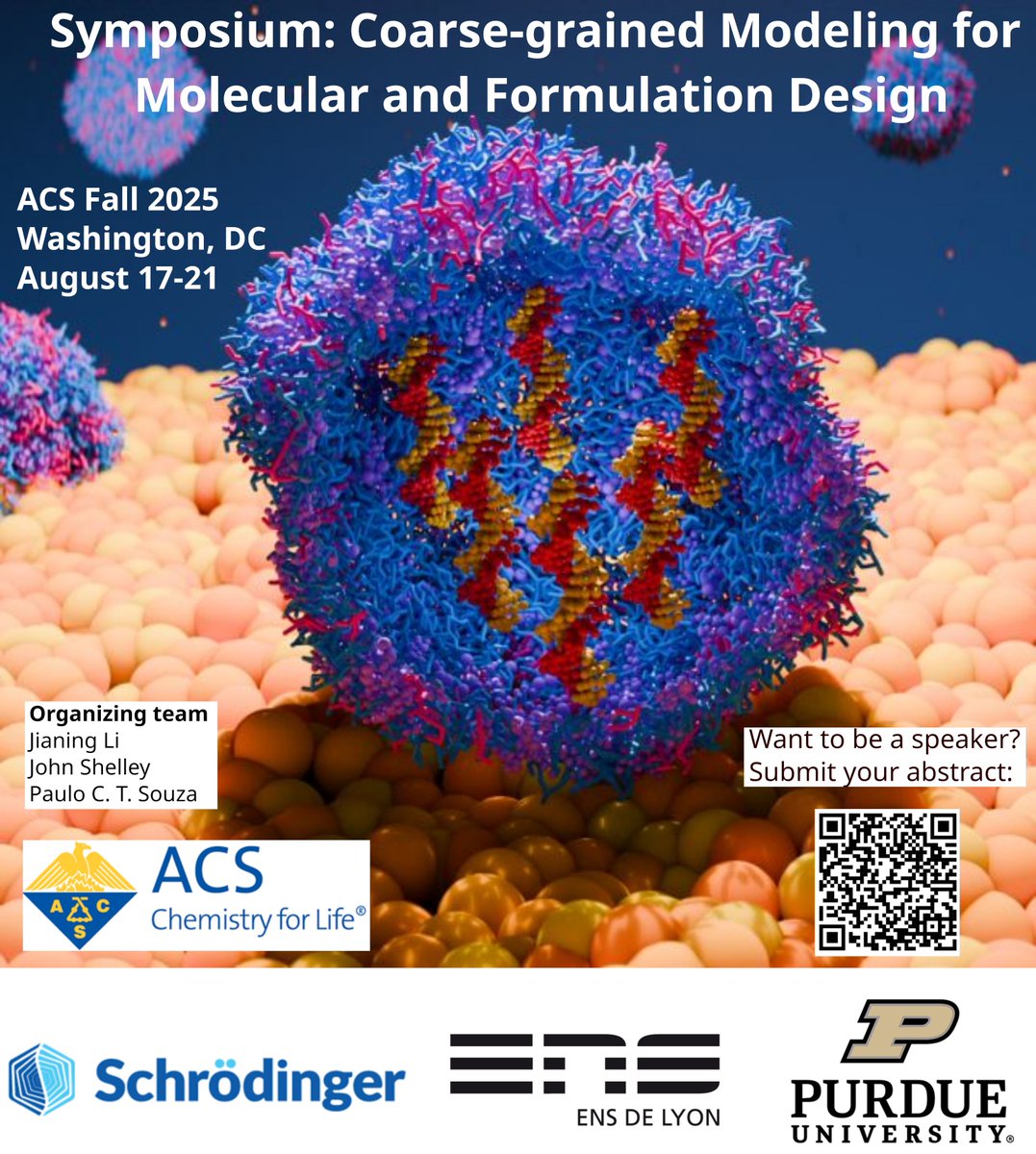
🎉 Big news! 🎉 Together with @Jianingli (@LifeAtPurdue ) & John Shelley (@schrodinger), I’m organizing a symposium on #CG#Modeling for Molecular & Formulation Design at
ACS Fall 2025 (Aug 17-21, Washington, DC)! 🔬✨ For my part, I am grateful for the support of @ENSdeLyon !
In the fall of 1972, President Nixon announced that "the rate of increase of inflation was decreasing". Probably the first time a sitting president used the 3rd derivative to increase the chances of reelection.
Still a few days left! If you earned your PhD after 1/1/23 and want to co-apply for the Fellowship, get in touch asap! Topics: simulation of biomolecules, particularly 1) nucleic acids and their interaction with proteins, 2) molecular chaperones, especially Hsp70
Our new study shows that SARS-CoV-2 spike protein accumulates & persists in the body for years after infection, especially in the skull-meninges-brain axis, potentially driving long COVID. mRNA vaccines help but cannot stop it🔬🧠🦠🧵👇@cellhostmicrobe https://t.co/IEGx7HIrXf
🤝Discapacidad e investigación:
¿cómo hacer de la investigación un entorno profesional inclusivo para las personas con discapacidad?
👉La semana que viene conmemoramos el #3D#DíaDiscapacidad, con un seminario y paseo
👉Por Laura Moya, @CEDID_dis
📆3 de diciembre a las 11.30
It was an amazing experience to be part of this activity. I really enjoyed showing the curiosities of matter by playing with magnets and small plastic molecules to the kids.
Their creativity designing molecules have no boundaries!
🥼Great workshop with the fifth graders of CEIP Príncipe de Asturias and @ZottiLinda . Exploring the concept of matter ⚛️, building molecules and complex structures such as gold. Thanks to Ayudas a la Transferencia Cultural de la UAM 2024
@UAM_Madrid
Congratulations to @ambf08 from @UAM_Madrid on winning second place in the #LatinXChemComp category.🏆We congratulate Antonio on this remarkable achievement. Antonio has won a €100 voucher from @Springer_Chem.
Some of these results are already published in JCIM. Where we compare in more detail the adsorption mechanisms of the RBDs to the ACE2 vs our highly-hydrophilic or hydrophobic surfaces.
Link: https://t.co/ayEdWL9v9q
@Thiago_80@LatinXChem@ifimacuam@RubenperezUam@whoratz In these plots, we can see that residues in group 1 have collectively more area than residues in group 2, for both WT and Omicron. Therefore, we can safely confirm that Group 1 is more flexible since it can reach more conformational states, and potentially "more entropic".
@Thiago_80@LatinXChem@ifimacuam@RubenperezUam@whoratz The interest of these plots is that they give qualitative information on the flexibility of these residues by looking at the width of the polar histograms, and by looking (or measuring) the area of the contour plots.
@DanilloValverde@LatinXChem@ifimacuam@RubenperezUam@whoratz Hi Danilo. Thanks for the interesting question.
This is mainly because group 1 is much more flexible than group 2, so it can reach more favorable conformation than group 2. Group 2 is more "attached" to the rest of the structure.
@CisnerosRes @LatinXChem@ifimacuam@RubenperezUam@whoratz Hi Andres! Thank you for your interest.
Yes, shown results are either means over 3 replicas (distances analysis and H-bonds, for instance), or concatenated trajectories of the 3 replicas (Figure 3, for instance).
I have used CHARMM36 force field in GROMACS for simulations!