Un nuevo estudio del NIH encontró una posible alteración cerebral en el COVID persistente y el ME/CFS:
🧠 Deficiencia de noradrenalina en el sistema nervioso central.
🧵 En Español, agradezco RT
Actualmente, la positividad a SARS‑CoV‑2 ronda el 4%, frente al 11% registrado hace un año. Sin embargo, la próxima semana el valor de referencia ya será del 15%, correspondiente a estas mismas fechas.
Niveles bajísimos de covid en Estados Unidos.
Prevalencias comparables a la de la gripe en verano.
👇
Razón para pensar que el tímido aumento de casos que estamos viendo en España será como máximo una olita.
Pancreatic cancer: Experimental pill promises new hope
The drug is called daraxonrasib and it blocks a mutated protein that fuels tumor growth in more than 90 per cent of pancreatic cancer cases — a target that had eluded treatment for decades.
https://t.co/xLByaYfyrt
💊‼️Long COVID could be, at least in some patients, an autoimmune disease occurring alongside chronic infection, antigenic persistence, or viral reactivations.
Okay.
So now what?
Are there treatments?
Can autoantibodies be removed?
Can this autoimmunity be “switched off”?
Are we close to a cure?
The honest answer is this: we are not facing an immediate cure , although possibly a future one, but we are facing a huge shift in how we think about the disease.
Because if part of Long COVID, and possibly also ME/CFS, has an autoimmune basis, then it would no longer make sense to treat it as a diffuse syndrome with no therapeutic direction. We would need to do the same thing we do in other autoimmune diseases: classify patients properly, identify biomarkers, and design a stepwise treatment approach.
Not all patients would have the same mechanism.
Not all patients would respond in the same way.
And not all patients would need the same level of treatment.
But for the first time, a more logical therapeutic map is starting to emerge.
A clearer logic is beginning to appear: identify which patients have a real autoimmune component and, from there, think about which therapies could make sense.
At present, what is accessible would not be a cure, but treatments already known from other autoimmune diseases that could help reduce autoantibody activity, modulate the immune response, or decrease part of the immunological damage.
In the best-case scenario, these would be treatments to improve, stabilize, or reduce autoimmunity. Not to completely “erase” the disease.
If I had to rank the options in an orientative way, thinking about potential usefulness and safety profile, I would do it like this:
1. IVIG
The most reasonable short-term option would probably be IVIG, meaning intravenous immunoglobulin.
IVIG does not directly eliminate all autoantibodies as such, but it can modulate the immune system, compete with pathogenic autoantibodies, block part of the inflammation, and dampen the immunological attack without requiring such intense immunosuppression.
In many autoimmune diseases, it is used precisely because of this immunomodulatory effect. Among this type of therapy, it is probably one of the options with the best balance between potential usefulness and safety profile.
That said, it is not free of side effects, it is expensive, and access is limited.
2. FcRn inhibitors
Next, I would place FcRn inhibitors.
These drugs are very interesting because they reduce the total amount of circulating IgG and, with it, they can also reduce the burden of pathogenic autoantibodies.
The advantage is that they are quite targeted toward the humoral component of autoimmunity, meaning the antibody-mediated part.
The disadvantage is that they are not yet truly established for Long COVID or ME/CFS, and it would still be necessary to demonstrate very clearly which subgroup of patients would benefit the most.
Even so, conceptually, if we are talking about an autoantibody-mediated disease, this is one of the most promising strategies.
3. Immunoadsorption
At the next level, I would place immunoadsorption.
This technique consists of filtering the blood to remove immunoglobulins, especially those that may be participating in the autoimmune process.
It is a more targeted strategy than systemic immunosuppression and, in diseases mediated by autoantibodies, it can make a lot of sense.
Its main limitation is logistical: it is not a simple therapy, it requires specialized centers, and its effects may not last if the immune system continues producing the same autoantibodies afterwards.
(1/3)
🔵Continued in the next post.👇🏻
Un nuevo estudio del NIH encontró una posible alteración cerebral en el COVID persistente y el ME/CFS:
🧠 Deficiencia de noradrenalina en el sistema nervioso central.
🧵 En Español, agradezco RT
Un nuevo estudio del NIH encontró una posible alteración cerebral en el COVID persistente y el ME/CFS:
🧠 Deficiencia de noradrenalina en el sistema nervioso central.
🧵 En Español, agradezco RT
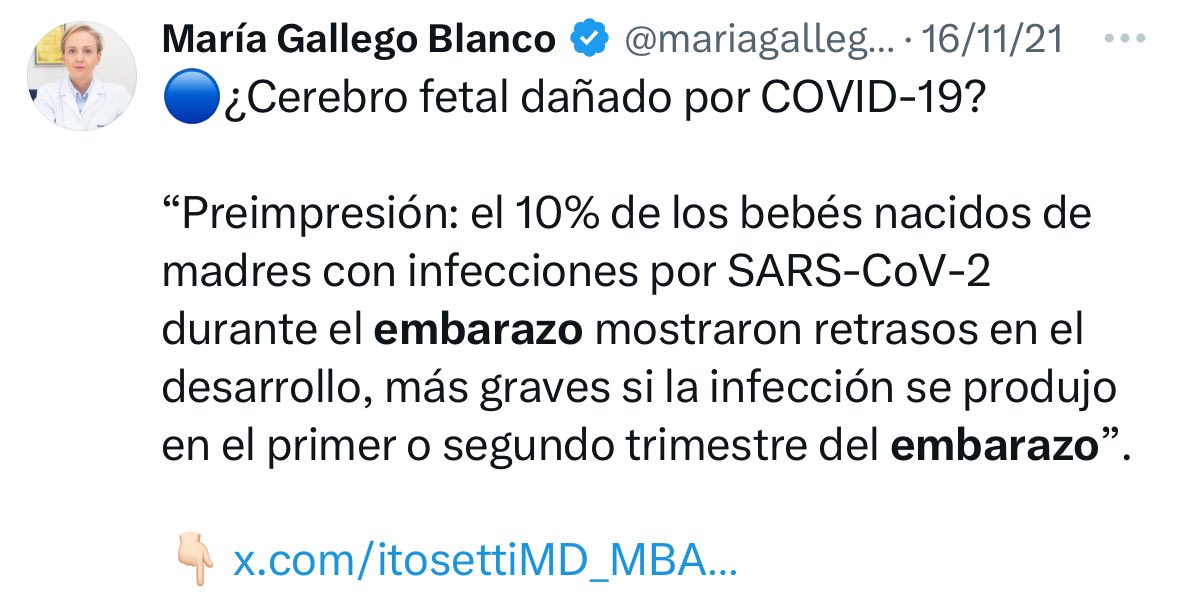
🔴 RETRASO DESARROLLO CEREBRAL
- NIÑOS - EMBARAZO COVID
NO SERÁ PORQUE NO AVISAMOS
Si me pongo a buscar bien, probablemente encuentre tweets desde 2020, y muy posiblemente haya varios
de @fitterhappierAJ
El mensaje era intentar proteger a las embarazadas de las infecciones.
Explicar medidas simples que habrían funcionado y no lo que se hizo (un absurdo de principio a fin).
Al menos informar bien a la población, para que cada uno hiciese lo que estimase oportuno.
Porque la gente bien informada no se suele equivocar.
Pasen, lean y fijense en las fechas de las imágenes. Son sólo un pequeño ejemplo.
Y así con todo. La lista es interminable.
¿Ignorancia, negligencia o manipulación?
Cualquiera sabe.
Muchos leemos ciencia a diario. Ciencia al alcance de todos ustedes.
Y llegó 2020 y, en este sentido, marcó un antes y un después.
Ya no hacía falta leer @Nature o @ScienceMagazine, por ejemplo, porque ese fue el año en el que los científicos de verdad (esos que publican en las revistas más prestigiosas y no son altavoces de nadie) salieron de sus laboratorios, despachos y congresos para contarles desde Twitter (otros lugares estaban vetados y los titulares bailaban al son de terceros) lo que realmente pasaba y qué había que hacer.
Ingenieros, físicos, químicos, biólogos, mis queridos veterinarios, algunos médicos y otros profesionales de bien … entendieron que debían bajar a la calle (Twitter) para acercarnos ciencia de verdad. De esta manera explicaban sus hallazgos, debatían entre ellos y estaban accesibles para todos.
Era ciencia en directo de un modo absolutamente novedoso.
Lo nunca visto.
Y ciudadanos anónimos arrimaron el hombro.
Gracias a todos vosotros. Ya sabéis quiénes sois. Siempre fuisteis (fuimos) por delante.
El tiempo termina poniendo las cosas en su sitio y al final, aunque sea 5 años más tarde, leemos con tristeza un titular más.
Muchos no nos asombramos con noticias como esta, o con “nuevos” hallazgos sobre consecuencias en endotelio, cáncer y un largo etc.
Es un goteo duro, que no sé cómo deja dormir a algunos.
Aquí el artículo de ayer en prensa.
👉🏻https://t.co/WknJBcOz9o
Acojonante 😱😱😱
(Lo siento, pero no hay otra palabra que defina la progresión de la prevalencia de la alergia alimentaria)
Fte: “El fin de las alergias alimentarias” Dra Nadeau (Univ. Stanford)
👉🏻Señores: el lobo no viene, ya está aquí.
#AlergiaAlimentaria#Alergofarmacia