Iran has attacked three vessels in the last 24 hours in Hormuz, one of which is a Qatari LNG carrier (!). It is much more dangerous than attacking a plain crude oil carrier, out of the simple fact that LNG is flammable, crude oil is well... crude.
This is the key first quote by the Qatari government: "We hold it fully legally responsible for this attack & for any resulting damages & consequences".
The key rationale behind this coordinated attack is that Iran is trying to shutdown the US-Omani Southern Corridor and attain control over the Straits. In other words: Iran wants to make it too dangerous for ships to transit far from its shores -- where its easier for them to control and to attack. Oman is 20+ miles from Irani coastlines - almost too far for radars and binoculars from Iranian coastline (especially at night, and this is the US Navy -NCAGS recommended route). So this is a really well planned path to push ships to sail close to Iran and later on pay them for passage.
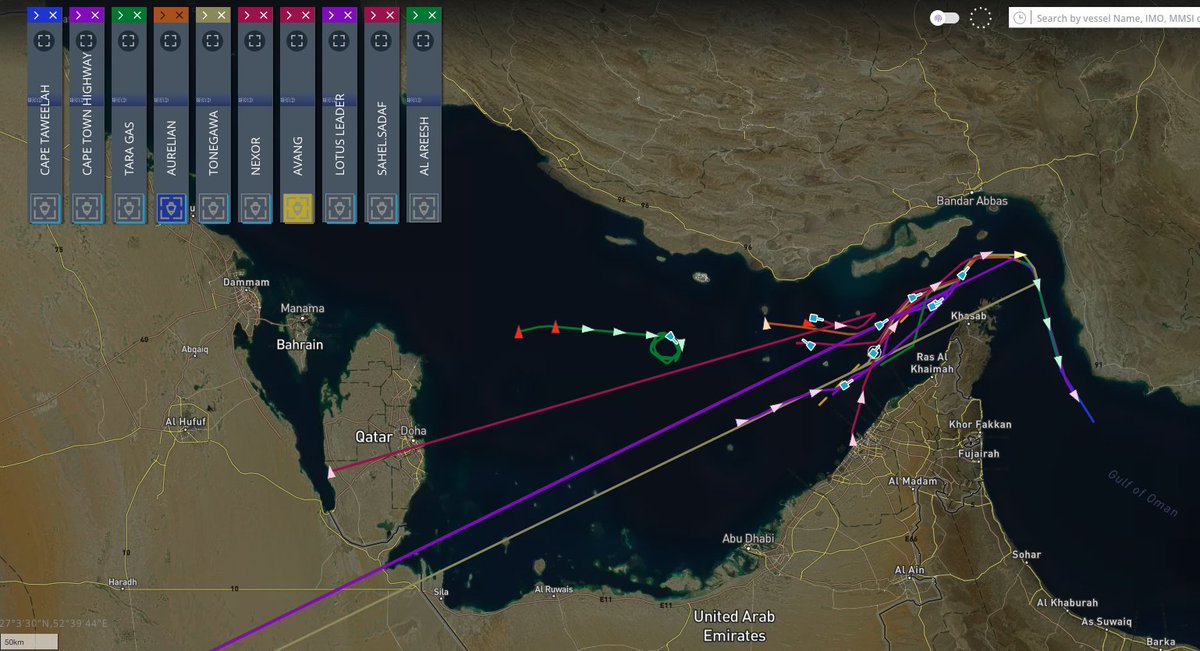
Specifically, according to @WindwardAI data, six vessels rerouted from the southern corridor to the central corridor: Tara Gas, Aurelian, Nexor, Lotus Leader, Avang, Capetown Highway and one additional LNG tanker (Al Areesh) halted its transit and anchored halfway to the Strait.
Strait of Hormuz transits stand at 40 today (28 outbound, 12 inbound), with the southern corridor capturing 27 total movements. Outbound flows are dominated by 17 tankers and 7 bulk carriers, tracking 6.9M bbl of oil and products, per @Vortexa.
Notably, one center-corridor outbound tanker successfully completed its transit after being briefly turned back by the IRGC.
Daily tracker & analysis: https://t.co/06pdXCMlyP
Windward Co-Founder & CEO @AmiDaniel1 joined @CNBC's @MorganLBrennan live to break down tanker traffic in the Strait of Hormuz as the situation turns volatile again.
Watch the full interview: https://t.co/3ywd2er8Ww
🇮🇷 One region is eating 98% of the world's GPS chaos.
The Persian Gulf has crossed 1 million jamming incidents since the war started, according to Windward.
Over 1,100 ships went blind in the first 24 hours. Their screens put them in deserts, over airports, on land.
Gulf states are frying signals to stop drones and missiles from finding their targets. Iran is doing the same thing for a different reason, to make the Strait unnavigable without ever admitting it.
Source: Sky News
🚨 First LPG carrier observed at Kharg’s South LPG Berth since the start of Epic Fury.
→ 20 tankers now drifting or anchored east of the island, a peak count, up from 18 at last check.
→ Zero crude departures for six straight days.
LPG loading operations have resumed at the South LPG Berth, the first observed activity of any kind at Kharg since Epic Fury began. Crude flows remain frozen, and the queue of waiting tankers is still growing.
Live Strait of Hormuz tracker → https://t.co/TZhCCKfMiQ
🚨 First confirmed loading at Kharg Island since May 7.
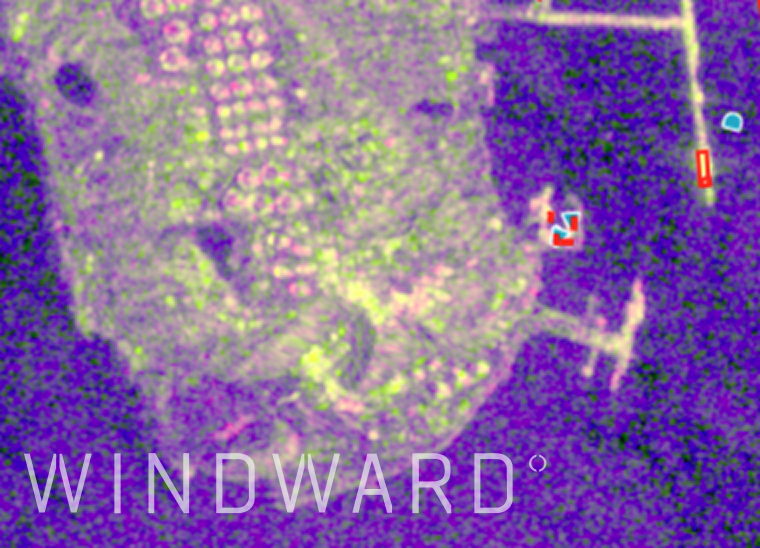
Windward SAR imagery shows a ~180m Panamax-class tanker alongside the Kharg Island east terminal.
@WindwardAI remote sensing intelligence detected an oil slick off Kharg Island starting May 6 afternoon local time. In subsequent sightings it’s drifting towards the UAE and if not dispersed could hit their coastline in 13 days.
How does this get together with the reports by the The Wall Street Journal that Iran still has storage for months? Is it intentional? Looks to big to be a mistake. Thoughts?
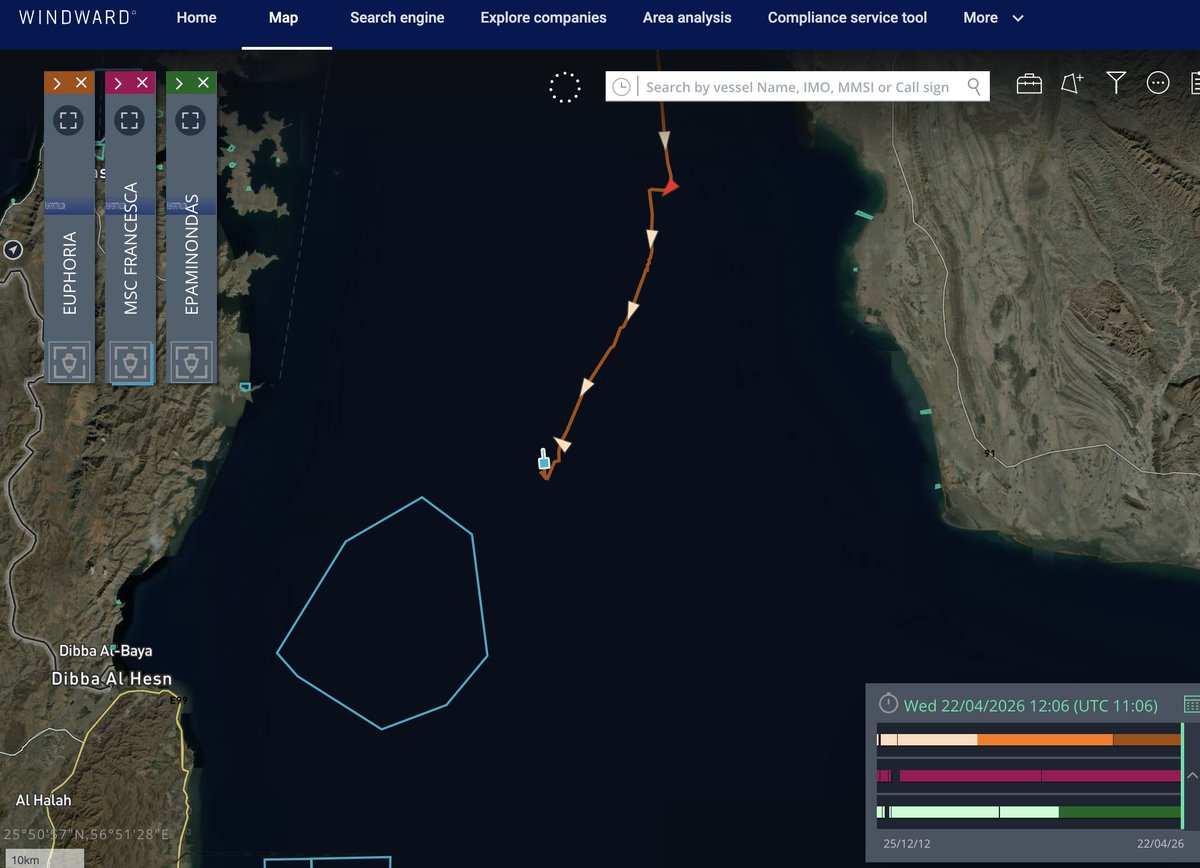
The IRGC attacked three ships today. It also captured and took in two of them- the MSC Francesca and the Epaminondas while the Euphoria managed to get away.
This is a "tit for tat" exercise by the IRGC, which , along with the Houthis , has long claimed MSC is connected to Israel (Aponte, owner and chairman has a Jewish wife and MSC calls in Israel). However so do all major liners.
The takeaway I think is that the US blockade creates a lot of pressure, and a ticking time bomb for Iran. It blocks the imports (!) to Iran . It also blocks the exports of oil. With oil, you can't just turn the tap off for a day. Once onshore storage and floating storage runs out (could happen in a week) then you need to turn the tap off - - and it can take 2-10 weeks to restart it.
So if that time comes , and they are turning it off- - they won't be just losing the money for the oil they didn't sell. They will also lose the money for future 2+ months of exports. So at 2m barrels a day * 100 usd per barrel - that's 200m a day. For 2 months you're talking about 12 B USD (!). And that's the game that's played. So as long as the world's economy is sustaining the goal, this is basically a big game of "chicken".
Images : @WindwardAI data .
Did we see an escalation last night with the US and Iran?
Earlier last week Secretary Hegseth with Admiral Cooper and General Cane all said they will enforce the blockade. They said they will consider going after Iranian oil outside of Iran.
Bear in mind: I ran a blockade myself. And @WindwardAI is supporting also other operations globally. The US ran a blockade on Venezuelan oil (and interdicted 6-7 ships) , as well as running a limited operation in Cuba.
Not once did we see a shot fired. Not once. Not a warning shot but a shot to the engine room. This is what's different this time.
The world's economy is at stake. Iranian vessels are sailing as close as possible to the Iranian coastline and within Iranian EEZ (where allegedly there won't be authority to board them). However with 150m barrels + of oil on the water, and many imports from China , there is a lot for the US to go after. Different reports show this container vessel and other similar ones were involved in importing precursor materials for ballistic missiles previously.
I don't know where this will go . What I do know is we're seeing two very very serious sides which are quite adamant not to give up. This is why real fire was shot on the engine room.
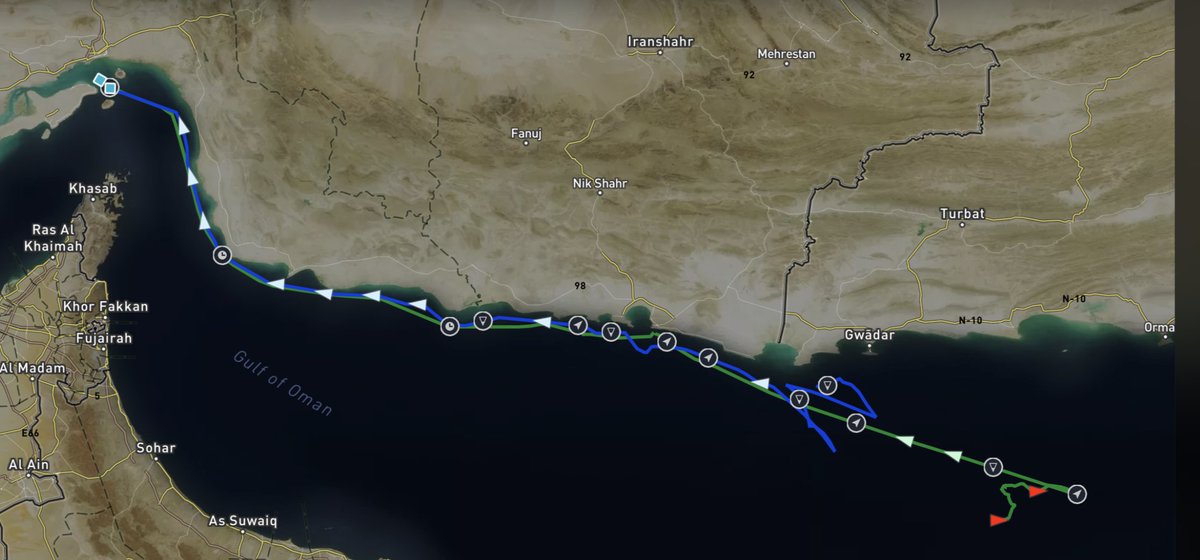
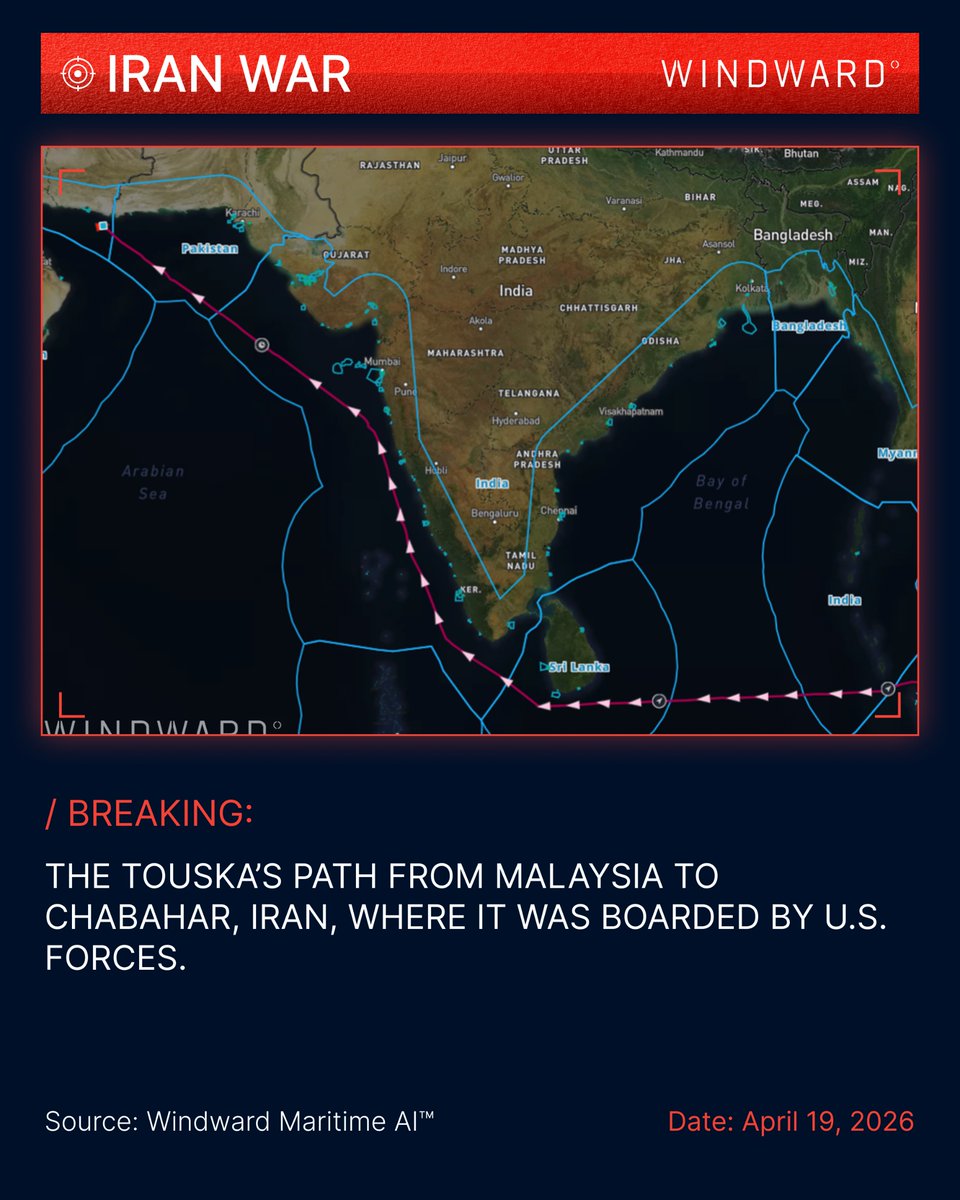
🚨 First U.S. interdiction of the blockade: Iranian-flagged container ship TOUSKA obstructed ~45NM southeast of Chabahar.
The OFAC-sanctioned, IRISL-linked container vessel was en route from Port Klang to Chabahar when U.S. naval assets forced it to reduce speed and reverse course at 13:00 UTC.
This marks the first confirmed U.S. intersection of an Iranian vessel since the blockade began.
Why TOUSKA was a priority target:
→ OFAC Level 3 sanctioned under IRN, NPWMD, SECON, and IFSR programs.
→ Operated by IRISL from September 2023 to September 2025.
→ 16 Iranian port calls in the past 12 months.
→ High Windward smuggling risk score, with dark activity, loitering events, and meetings with Iran-flagged vessels.
TOUSKA is not an isolated profile. Windward has identified three additional vessels sharing near-identical ownership structures, sanctions status, and behavioral fingerprints. All three remain active in the Arabian Gulf and Gulf of Oman corridor.
Enforcement credibility is now being established on the water.
We started Windward before Maritime was in the news. Before the Dark Fleet. Before the Straits of Hormuz were blocked.
We started it at a time when you had to *apologize* for building a technology for the public sector. I recall we were one of @aleph first investments, and @eden saying they are a "contrarian investor".
Fast forward to 2026 - Maritime is not niche anymore, DefenseTech is something we all appreciate and need and is as hot as the AI market. Thanks to @ViolaGroup and to @AShmulovich for including me in such a great list of leaders ahead of Israel's independence Day. It's a great honor to be honest , and amazing people on that list. Also kudos to my good friends @Shalevhulio , @noamfriedman, @hamutalm and @davidmchinn for making the list.
It's such a great opportunity to make an impact and contribution in such an important time in the world. Here is the full list: https://t.co/7bhP8Imllx