Introducing autoresearch for arXiv papers
Change 'arxiv' to 'autoarxiv' in any paper URL
An agent deploys to resolve setup issues on the codebase, run a minimal reproduction, and estimate full replication cost. Read more below
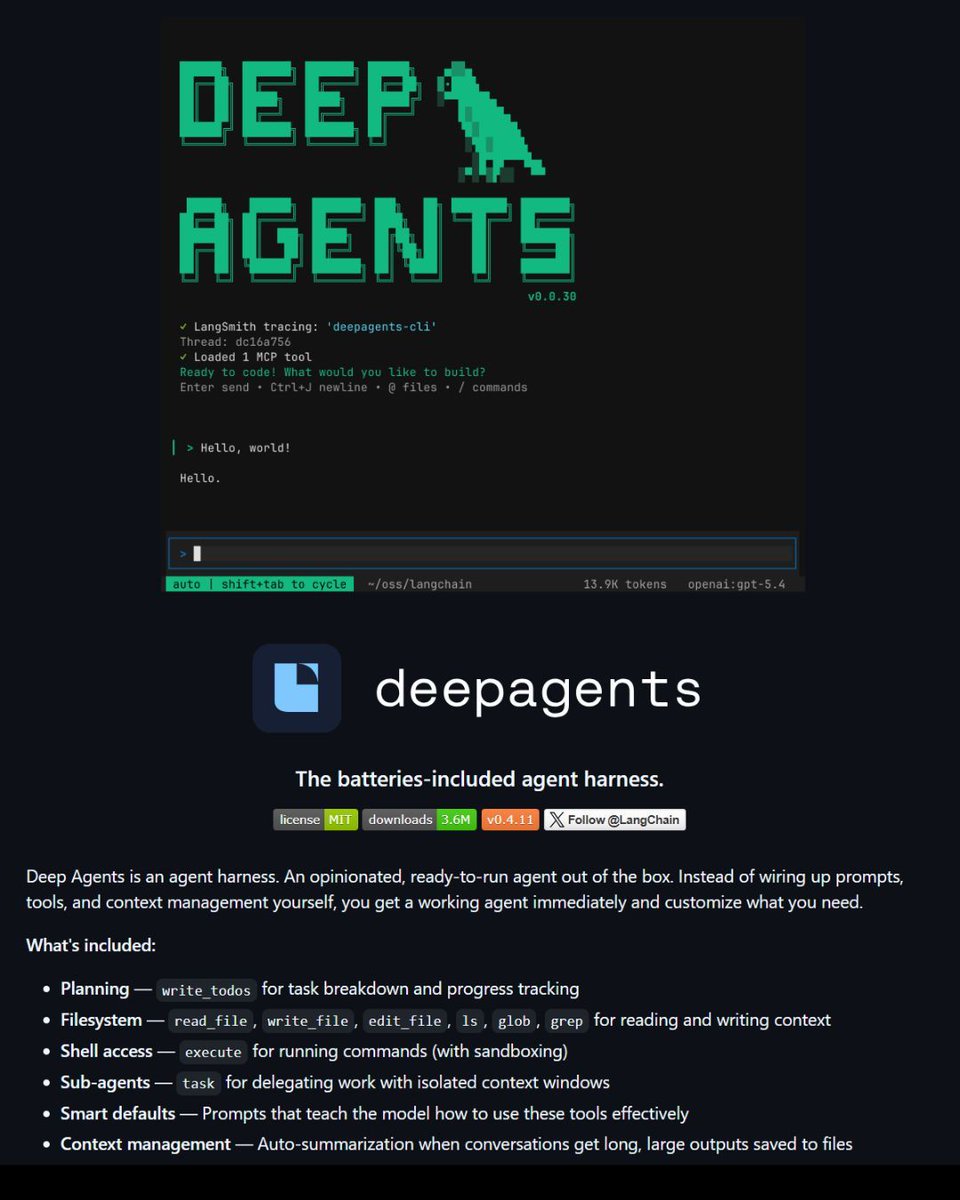
LangChain just open-sourced a replica of Claude Code.
It’s an MIT-licensed framework that recreates the core workflow behind coding agents like Claude Code but in an open system developers can inspect and modify.
It is called Deep Agents.
I spent a bit of time looking through the repo and it’s actually a pretty helpful reference if you’re trying to understand how these coding agents are structured.
Here's what's inside:
→ Planning tools for breaking down tasks
→ File system access for reading, writing, and editing code
→ Shell command execution with sandboxing
→ Sub-agents for handling complex work in parallel
→ Auto-summarization when context gets too long
Another useful aspect is that it’s model-agnostic, so you can plug in different LLMs and experiment with building your own coding agents on top of the same structure.
If you’re exploring agent frameworks or just curious how tools like Claude Code work under the hood, this is a pretty good repo to bookmark.
Link in the comments.
1/
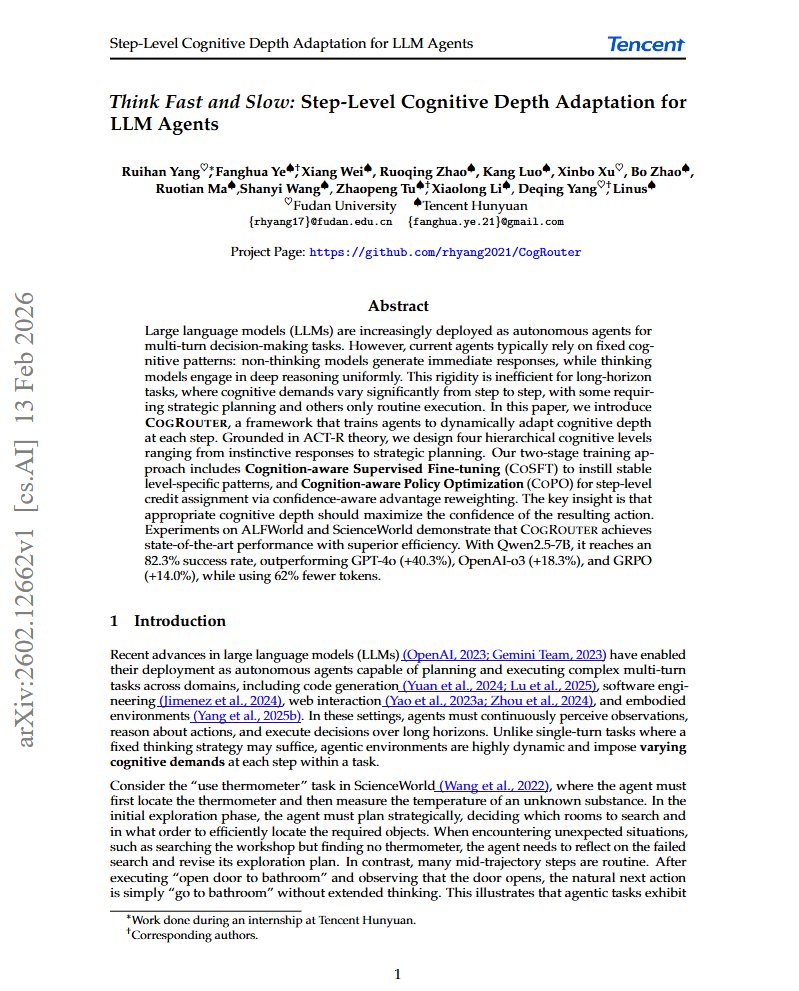
Frontier models like o3 and DeepSeek-R1 have a fatal flaw: cognitive rigidity. They use expensive Chain-of-Thought for every single step.
A new 7B model just beat o3 on agentic tasks using 62% fewer tokens by fixing this.
🧵
New research on making chain-of-thought reasoning actually monitorable.
LLMs show their reasoning through a chain of thought.
But can we actually trust what's in those reasoning traces? Can monitors reliably detect when something goes wrong?
This paper applies information theory to formalize CoT monitorability. It establishes that mutual information between chain-of-thought and output is necessary but not sufficient for effective monitoring.
The authors identify two key failure modes: an information gap where monitors can't extract what's there, and an elicitation error where the model's reasoning doesn't surface its true computations.
They propose two training approaches to fix this. An oracle-based method that rewards models for transparent reasoning, and a practical label-free technique that maximizes conditional mutual information. Both significantly boost monitor performance while preventing reasoning chain degradation.
Why does it matter?
As we rely more on CoT for alignment and oversight, understanding when monitoring actually works becomes critical. This gives us formal tools to measure and improve it, and helps reduce reward hacking when task specifications are imperfect.
Paper: https://t.co/Ptc3cCjxyK
Learn to build effective AI agents in our academy: https://t.co/LRnpZN7L4c
We just built and released the largest dataset for supervised fine-tuning of agentic LMs, 1.27M trajectories (~36B tokens)!
Up until now, large-scale SFT for agents is rare - not for lack of data, but because of fragmentation across heterogeneous formats, tools, and interfaces.
To solve this, we introduce the Agent Data Protocol, a new “interlingua” between a broad variety of heterogeneous agent datasets - coding, browsing, API/tool use - and unified agent training pipelines downstream.
We unified 13 datasets into ADP, converted them to be compatible with multiple agent frameworks, and observed ~20% average gains, reaching SOTA/near-SOTA without domain-specific tuning.
📄 Read our paper: https://t.co/OlCTvhrXQ7
🌐 Check our project website: https://t.co/wBggu0hQ2i
And this is just getting started, we can add more datasets, further expand the resources, and make training agent LMs easy for all. We’d love to have you join the shared effort and help to make ADP the open standard for the community 🚀
🚨 This might be the biggest leap in AI agents since ReAct.
Researchers just dropped DeepAgent a reasoning model that can think, discover tools, and act completely on its own.
No pre-scripted workflows. No fixed tool lists. Just pure autonomous reasoning.
It introduces something wild called Memory Folding the agent literally “compresses” its past thoughts into structured episodic, working, and tool memories… like a digital brain taking a breath before thinking again.
They also built a new RL method called ToolPO, which rewards the agent not just for finishing tasks, but for how it used tools along the way.
The results? DeepAgent beats GPT-4-level agents on almost every benchmark WebShop, ALFWorld, GAIA even with open-set tools it’s never seen.
It’s the first real step toward general reasoning agents that can operate like humans remembering, adapting, and learning how to think.
The agent era just leveled up.
MiniMax M2 is the new "most intelligent" open weights model (according to @ArtificialAnlys) - the MIT licensed weights are just 230GB and it appears comparable to Sonnet 4, while priced closer to Gemini 2.5 Flash. Notes here, including a new LLM plugin:
https://t.co/h1mHrIC9qB
Training LLMs end to end is hard. Very excited to share our new blog (book?) that cover the full pipeline: pre-training, post-training and infra. 200+ pages of what worked, what didn’t, and how to make it run reliably
https://t.co/iN2JtWhn23
🚀We are excited to introduce the Tool Decathlon (Toolathlon), a benchmark for language agents on diverse, complex, and realistic tool use.
⭐️32 applications and 600+ tools based on real-world software environments
⭐️Execution-based, reliable evaluation
⭐️Realistic, covering daily and professional scenarios
Toolathlon reveals significant shortcomings of SOTA LLMs in realistic tool-use tasks, where Claude Sonnet 4.5 achieves 38.6% success rate. It also indicates a clear gap between open-source and leading proprietary models.
Check our blog: https://t.co/dkvtu54xE6
Github: https://t.co/CkF6BqeuC9
Paper: https://t.co/TygC61Mebu
🧵⬇️
But before I get to the reasoning model space... if you are looking to do some focused offline reading this weekend, I just re-compiled my take on the "noteworthy AI research papers of 2024" into one PDF-export-friendly 47-page mega-post with TOC and all: https://t.co/QVe7e4ic4u
Topics:
1. January: Mixtral’s Mixture of Experts Approach
1.1 Understanding MoE models
1.2 The relevance of MoE models today
2. February: Weight-decomposed LoRA
2.2 LoRA Recap
2.2 From LoRA to DoRA
2.3 The future of LoRA and LoRA-like methods
3. March: Tips for Continually Pretraining LLMs
3.1 Simple techniques work
3.2 Will these simple techniques continue to work?
4. April: DPO or PPO for LLM alignment, or both?
4.1 RLHF-PPO and DPO: What Are They?
4.2 PPO Typically Outperforms DPO
4.3 How are PPO and DPO used today?
5. May: LoRA learns less and forgets less
5.1 LoRA learns less
5.2 LoRA forgets less
5.3 The LoRA trade-off
5.4 Future approaches to finetuning LLMs
6. June: The 15 Trillion Token FineWeb Dataset
6.1 Comparison to other datasets
6.2 Principled dataset development
6.3 The relevance of FineWeb today
7. July: The Llama 3 Herd of Models
7.1 Llama 3 architecture summary
7.2 Llama 3 training
7.3 Multimodal Llamas
7.4 Llama 3 impact and usage
8. August: Improving LLMs by scaling inference-time compute
8.1 Improve outputs by using more test-time computation
8.2 Optimizing test-time computation techniques
8.3 Test-time computation versus pretraining a larger model
8.4 Future relevance of test-time compute scaling
9. September: Comparing multimodal LLM paradigms
9.1 Multimodal LLM paradigms
9.2 Nvidia’s hybrid approach
9.3 Multimodal LLMs in 2025
10. October: Replicating OpenAI O1’s reasoning capabilities
10.1 Shortcut learning vs journey learning
10.2 Constructing long thoughts
10.3 Distillation – the quick fix?
10.4 The state of AI research
10.5 The future of LLMs in the light of o1 (and o3)
11. November: LLM scaling laws for precision
11.1 Chinchilla scaling laws refresher
11.2 Low-precision training
11.3 Precision scaling laws takeaways
11.4 Model scaling laws in 2025
12. December: Phi-4 and learning from synthetic data
12.1 Phi-4 performance
12.2 Synthetic data learnings
12.4 Future importance of synthetic data
Conclusions and outlook
Multimodal LLMs
Computational efficiency
State space models
Scaling
What I am looking forward to