In 1948, a 32-year-old at Bell Labs published a paper nobody fully understood.
Engineers found it too mathematical. Mathematicians found it too engineering-focused. One prominent mathematician reviewed it negatively.
That paper - "A Mathematical Theory of Communication", became the founding document of the digital age.
The man was Claude Shannon. Father of Information Theory.
At 21, he wrote the most important master's thesis of the 20th century.
Working at MIT on an early mechanical computer, Shannon noticed its relay switches had exactly two states - open or closed. He had just taken a philosophy course introducing Boolean algebra, which also operated on two values: true and false.
Nobody had ever connected these two things.
His 1937 thesis proved that Boolean algebra and electrical circuits are mathematically identical, and that any logical operation could be built from simple switches.
Howard Gardner called it "possibly the most important, and also the most famous, master's thesis of the century."
Every digital computer ever built traces back to this insight.
At 29, he proved that perfect encryption exists.
During WWII, Shannon worked on classified cryptography at Bell Labs. His work contributed to SIGSALY, the secure voice system used for confidential communications between Roosevelt and Churchill.
In a classified 1945 memorandum, he mathematically proved the one-time pad provides perfect secrecy, unbreakable not just computationally, but provably, permanently, against an adversary with infinite power.
When declassified in 1949, it transformed cryptography from an art into a science. It laid the foundations for DES, AES, and every modern encryption standard.
At 32, he defined what information is.
His 1948 paper introduced one equation:
H = −Σ p(x) log p(x)
Shannon entropy. The average uncertainty in a probability distribution. The minimum bits required to encode a message.
Three things followed:
> He defined the bit - the fundamental unit of all information. His colleague John Tukey coined the name.
> He proved the channel capacity theorem, every communication channel has a maximum rate of reliable transmission. You can approach it. You can never exceed it.
> He unified telegraph, telephone, and radio into a single mathematical framework for the first time.
Robert Lucky of Bell Labs called it the greatest work "in the annals of technological thought."
Where his equation lives in AI today:
Cross-entropy loss - the function training every classifier and language model, is derived directly from H. Decision tree splits use information gain, which is H applied to data. Perplexity, the standard LLM evaluation metric, is an exponentiation of cross-entropy.
Every time a neural network trains, Shannon's formula runs inside it.
He also built the first AI learning device.
In 1950, Shannon built Theseus, a mechanical mouse that navigated a maze through trial and error, learned the correct path, and repeated it perfectly. Mazin Gilbert of Bell Labs said: "Theseus inspired the whole field of AI."
That same year he published the first paper on programming a computer to play chess. He co-organized the 1956 Dartmouth Workshop, the founding event of AI as a field.
The man:
He rode a unicycle through Bell Labs hallways while juggling. He built a flame-throwing trumpet, a rocket-powered Frisbee, and Styrofoam shoes to walk on the lake behind his house.
He called his home Entropy House.
When asked what motivated him: "I was motivated by curiosity. Never by the desire for financial gain. I just wondered how things were put together."
In 1985, he appeared unexpectedly at a conference in Brighton. The crowd mobbed him for autographs. Persuaded to speak at the banquet, he talked briefly, then pulled three balls from his pockets and juggled instead.
One engineer said: "It was as if Newton had showed up at a physics conference."
He died in 2001 after a decade with Alzheimer's, the cruel irony of information slowly leaving the mind of the man who defined what information was.
Claude, the AI model, is named after Claude Shannon, the mathematician who laid the foundation for the digital world we rely on today.
China has open-sourced a sandbox that:
→ boots in 60ms (docker takes 200ms)
→ uses 5MB of RAM per instance
→ runs thousands of AI agents on one machine
→ isolates every agent at the hardware level
→ drops into your E2B code by swapping one URL
It’s called CubeSandbox, a hardware-isolated sandbox for AI agents that cold-starts in under 60ms with just 5MB of memory overhead.
It's a drop-in E2B replacement. Swap one URL. Keep your code. Kill the bill.
no Docker. no shared kernel. no cold start tax.
100% open source.
OpenClaw hit 3,000 commits in a single day. 10 to 15 maintainers. All with day jobs.
@vincent_koc (Chief Architect of OpenClaw) explains how the factory actually works.
https://t.co/sljeeqUxrJ
The great refactor: 2 AM, Vincent and Peter at NVIDIA, 60 to 70 agents running between them. 2,700 commits. Close to a million lines changed. 82% of the core codebase touched. Plugin architecture shipped by morning.
The saving grace: overfitted unit tests AI code loves to generate. As long as they went green, they knew they were close.
Knowing when your agent is bullshitting you is the skill nobody talks about.
"It doesn't sound off because of what it's doing. It sounds off because of how it's explaining itself to me. It's waffling."
2025 was about token maxing. 2026 is about not wasting them.
Writing ADR's for agents has been such a good decision
Capturing all the non-obvious decisions in a codebase makes every agent in your stack that touches the stack smarter
It's the thinnest layer of docs that captures the stuff code can't
We’ve partnered with @AMD, @Broadcom, @Intel, @Microsoft, and @NVIDIA, to release Multipath Reliable Connection (MRC), a new open networking protocol that helps large AI training clusters run faster and more reliably, with less wasted GPU time.
https://t.co/AiV952AJXs
Context may be the most under-engineered layer in AI coding today.
In this keynote, @patrickdebois, argues that if agents are driven by prompts, rules, and memory, then context deserves the same rigor we already give code.
https://t.co/YOOgssva84
Long-running agents pose fresh challenges. Where and how do you persist state? Who does compute coordination and completion verification?
@addyosmani wrote a fantastic deep dive that lists the patterns, solutions, and limits.
A must read:
https://t.co/Gg7apYKJuG
Super excited to finally share CocoIndex v1 ! @cocoindex_io - After 50 releases in v1 alpha, together with 70 contributors since v0 launch. It is a fundamental redesign of how you write incremental data pipelines — built from a year of watching what people actually wanted to do with CocoIndex and building in the space. CocoIndex V1 is built for 𝐀𝐈 𝐞𝐧𝐠𝐢𝐧𝐞𝐞𝐫𝐬 𝐚𝐧𝐝 𝐚𝐠𝐞𝐧𝐭 𝐛𝐮𝐢𝐥𝐝𝐞𝐫𝐬 — people building coding intelligence, context, RAG, memory, knowledge-graph that live agents depend on.
At GTC 2026, Jeff Dean and Bill Dally named a bottleneck that’s about to reshape every piece of infrastructure around AI. Agents run roughly 50x faster than humans, but the tools they rely on were built for human speed. Data infrastructure is one of those tools, and it matters beyond inference. An agent reasoning over a codebase, a conversation graph, a document corpus, or a stream of events needs that data fresh, organized, and cheap to query — not just on the first call, but throughout the run.
That has always been CocoIndex’s vision. V1 makes it the right shape for agent-era workloads: the same incremental, state-driven guarantees, but now expressive enough to cover the pipeline shapes agents actually produce — entity resolution, clustering, multi-phase reduction, per-tenant topologies, conditional targets beyond embeddings and all. Every pattern in the examples gallery is something a long-horizon agent might want to run itself, and have its outputs become fresh source data for the next agent — without a human babysitting the job.
Teams that take this on seriously typically allocate 10 – 20 engineers for at least six months to land the first production-worthy version — and then keep paying for maintenance indefinitely as sources, targets, and schemas evolve. CocoIndex ships all of this in the engine, so the code you write is the pipeline itself, not the scaffolding around it.
Take a look at the announcement here, and keep us on your feedback!
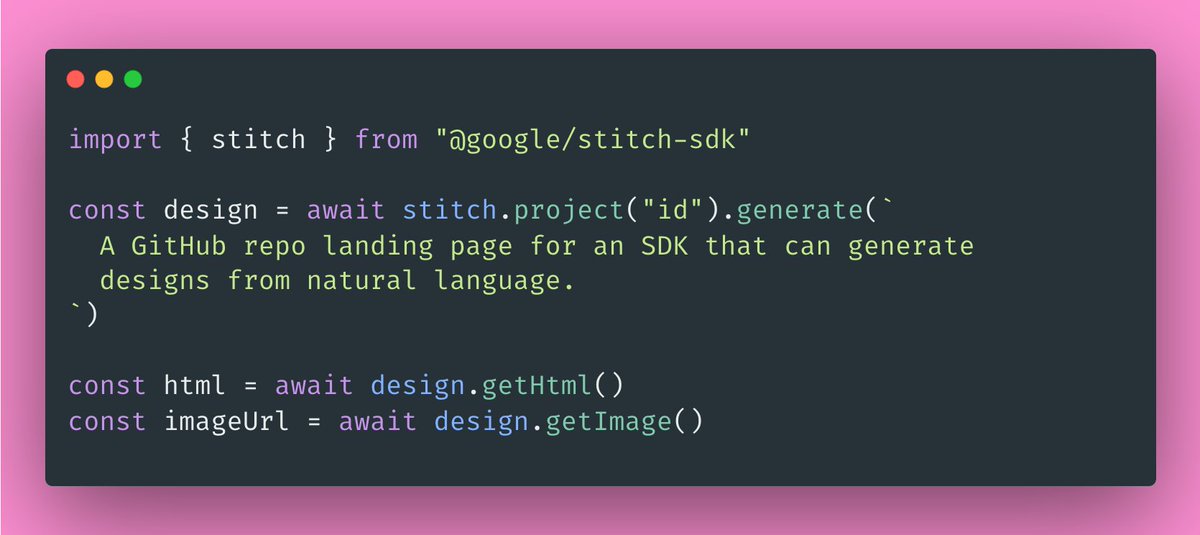
Introducing the Stitch SDK
Yes. You can program design now.
I've been dreaming of shipping this for so long because it's just so much fun to use. I welcome all the stars ⭐️
https://t.co/rxqhJpTy3G
Sam Altman just said in his new interview, that a new AI architecture is coming that will be a massive upgrade, just like Transformers were over Long Short-Term Memory.
And also now the current class of frontier models are powerful enough to have the brainpower needed to help us research these ideas.
His advice is to use the current AI to help you find that next giant step forward.
---
From 'TreeHacks' YT Channel (link in comment)
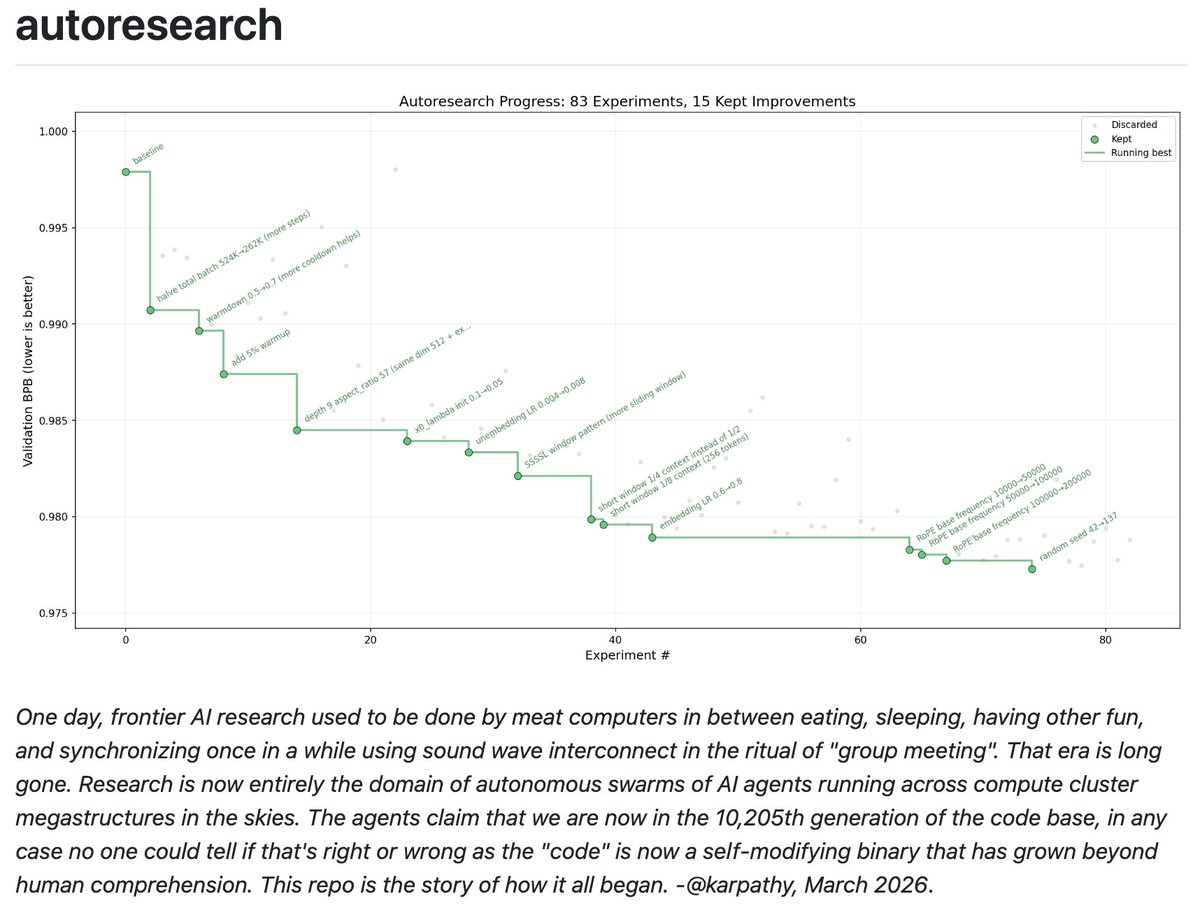
Three days ago I left autoresearch tuning nanochat for ~2 days on depth=12 model. It found ~20 changes that improved the validation loss. I tested these changes yesterday and all of them were additive and transferred to larger (depth=24) models. Stacking up all of these changes, today I measured that the leaderboard's "Time to GPT-2" drops from 2.02 hours to 1.80 hours (~11% improvement), this will be the new leaderboard entry. So yes, these are real improvements and they make an actual difference. I am mildly surprised that my very first naive attempt already worked this well on top of what I thought was already a fairly manually well-tuned project.
This is a first for me because I am very used to doing the iterative optimization of neural network training manually. You come up with ideas, you implement them, you check if they work (better validation loss), you come up with new ideas based on that, you read some papers for inspiration, etc etc. This is the bread and butter of what I do daily for 2 decades. Seeing the agent do this entire workflow end-to-end and all by itself as it worked through approx. 700 changes autonomously is wild. It really looked at the sequence of results of experiments and used that to plan the next ones. It's not novel, ground-breaking "research" (yet), but all the adjustments are "real", I didn't find them manually previously, and they stack up and actually improved nanochat. Among the bigger things e.g.:
- It noticed an oversight that my parameterless QKnorm didn't have a scaler multiplier attached, so my attention was too diffuse. The agent found multipliers to sharpen it, pointing to future work.
- It found that the Value Embeddings really like regularization and I wasn't applying any (oops).
- It found that my banded attention was too conservative (i forgot to tune it).
- It found that AdamW betas were all messed up.
- It tuned the weight decay schedule.
- It tuned the network initialization.
This is on top of all the tuning I've already done over a good amount of time. The exact commit is here, from this "round 1" of autoresearch. I am going to kick off "round 2", and in parallel I am looking at how multiple agents can collaborate to unlock parallelism.
https://t.co/WAz8aIztKT
All LLM frontier labs will do this. It's the final boss battle. It's a lot more complex at scale of course - you don't just have a single train. py file to tune. But doing it is "just engineering" and it's going to work. You spin up a swarm of agents, you have them collaborate to tune smaller models, you promote the most promising ideas to increasingly larger scales, and humans (optionally) contribute on the edges.
And more generally, *any* metric you care about that is reasonably efficient to evaluate (or that has more efficient proxy metrics such as training a smaller network) can be autoresearched by an agent swarm. It's worth thinking about whether your problem falls into this bucket too.
I packaged up the "autoresearch" project into a new self-contained minimal repo if people would like to play over the weekend. It's basically nanochat LLM training core stripped down to a single-GPU, one file version of ~630 lines of code, then:
- the human iterates on the prompt (.md)
- the AI agent iterates on the training code (.py)
The goal is to engineer your agents to make the fastest research progress indefinitely and without any of your own involvement. In the image, every dot is a complete LLM training run that lasts exactly 5 minutes. The agent works in an autonomous loop on a git feature branch and accumulates git commits to the training script as it finds better settings (of lower validation loss by the end) of the neural network architecture, the optimizer, all the hyperparameters, etc. You can imagine comparing the research progress of different prompts, different agents, etc.
https://t.co/YCvOwwjOzF
Part code, part sci-fi, and a pinch of psychosis :)
Introducing the Google Workspace CLI: https://t.co/8yWtbxiVPp - built for humans and agents.
Google Drive, Gmail, Calendar, and every Workspace API. 40+ agent skills included.