@TamGamUpsc Randomness don't develop it should be in a systematic way...
When I have said training than training is not random it is a systematic & intigrated efforts
The challenge in UPSC Mains is not just writing answers. It is knowing what to write when an unfamiliar question appears under pressure.
You cannot memorise answers to every possible question. You must train your mind to recall, connect and apply knowledge in the right context.
Prepare your mind, not just your notes.
How will you decode this?
VIZELLOPSIDITES MIOCENICUS — How should we read current affairs for UPSC?
Current affairs does not mean merely collecting facts. Its value lies in connecting new information with basic concepts and using those connections to reason.
Here, a fossil fungus becomes a link to ancient vegetation, climate, fossil preservation and ecology. Instead of stopping at “What was discovered and where?”, ask: “What can this discovery help us understand about the past?”
The question below illustrates this approach. It connects the distribution of river dolphins with an argument about ancient river connections. The fact becomes useful when we understand what it may indicate.
A similar thinking-based question could connect fossil organisms with past environmental conditions. UPSC may ask a direct fact, but preparation should also build the ability to apply fundamentals.
Read the news → connect it to fundamentals : understand the evidence → apply the reasoning.
Take Nupur Goyal, who secured AIR 11, and Shakti Dubey, who secured AIR 1 in her fifth attempt. Their journeys remind us that success doesn't follow a fixed timeline.
In my opinion “Never give up” shouldn't be a universal rule, just as “Quit after 3/4 attempts” shouldn't be one either.
It depends on your family support, financial background, preparation level, and the opportunities you're sacrificing along the way.
At the same time, there are plenty of people who chose to quit UPSC preparation and went on to build successful careers and businesses elsewhere. Vinay, the founder of KOREAGRO, is one such example, and there are many others who found success beyond the civil services examination.
Introspection is essential. Are you improving? Do you have the resources to continue? Is another attempt worth the cost? What other opportunities are you giving up by continuing?
Persistence matters, but so does understanding your circumstances. Continuing isn't always a sign of courage, and quitting isn't necessarily a sign of weakness. Sometimes, the courage lies in trying again; at other times, it lies in accepting that your potential can be realised on a different path.
Whether you continue or choose another direction, make a thoughtful decision one that you can look back on without regret or remorse.
Every aspirant's journey is different, and so are the right decisions for each one. Success is not limited to one examination, one career, or one timeline.
One thing I wish the UPSC community would stop telling every aspirant is, "Never give up."
When a student asks me whether they should give UPSC one more year, I ask them a different question.
What exactly will change this time?
Your strategy? Your revision? Your test scores? Or just the calendar?
Because after 3–4 years of preparation, another attempt isn't a small decision. It can mean another year of financial dependence, family pressure and missed opportunities.
I genuinely admire persistence. But I don't believe repeating the same mistakes year after year should be celebrated as dedication.
Have we romanticised the UPSC struggle so much that quitting has become more shameful than failing?
First, understand what Current Affairs means in UPSC preparation is it a collection of standalone facts or a tool to develop conceptual clarity, identify correlations and recognise patterns reflected through recurring developments?
In my observation of the last 10 years, one year of Current Affairs, studied intelligently, is more than sufficient. Preparing 2/ 3 years of compilations is often unnecessary and can become fear mongering.
Take the Strait of Hormuz it has been in the news for years. Understanding its strategic importance and related patterns matters more than memorising every update. Similarly, Madhav National Park can be covered through strong static notes supplemented by relevant current developments.
Current Affairs should develop intellect, not information overload; analytical ability, not anxiety.
Teach aspirants to connect concepts, analyse issues and recognise patterns not fear missing a fact.
Build understanding, not fear. Teach them to think, not just remember.
पहले अच्छे काम से सम्मान मिलता था, अब कई बार दबाव बनाकर सम्मान हासिल किया जाता है।
पहले शिक्षक पढ़ाते थे, अब Marketing करने वाले शिक्षक होने का दावा करते हैं।
पहले कोचिंग की तारीफ़ छात्र करते थे, अब कोचिंग ख़ुद अपनी तारीफ़ करती है।
जो सम्मान के हक़दार नहीं, वे भी माहौल और दबाव बनाकर सम्मानित हो रहे हैं। और जो सच में शिक्षा के लिए समर्पित हैं, वे हाशिये पर खड़े हैं।
विडंबना यह नहीं कि बाज़ार शिक्षा पर हावी है, विडंबना (Paradox
) यह है कि अब दिखावा ही योग्यता का प्रमाण और दबाव ही सम्मान का आधार बनता जा रहा है।
Why are we misleading aspirants not just with answers, but with questions too?
UPSC questions are framed to invoke thought, not trigger a coached template. The exam is not asking for a fixed introduction, 3 dimensions, and a manufactured conclusion.
Look at the UPSC notification:
“Intellectual Capability.”
That means the ability to understand, analyse, question, connect, reason and arrive at a judgement not merely reproduce a predecided or rote learnt answer structure.
If we teach aspirants how to fit every question into a template instead of how to think through the question, we are defeating the very spirit of the examination.
UPSC needs thinkers, not template dependent writers.
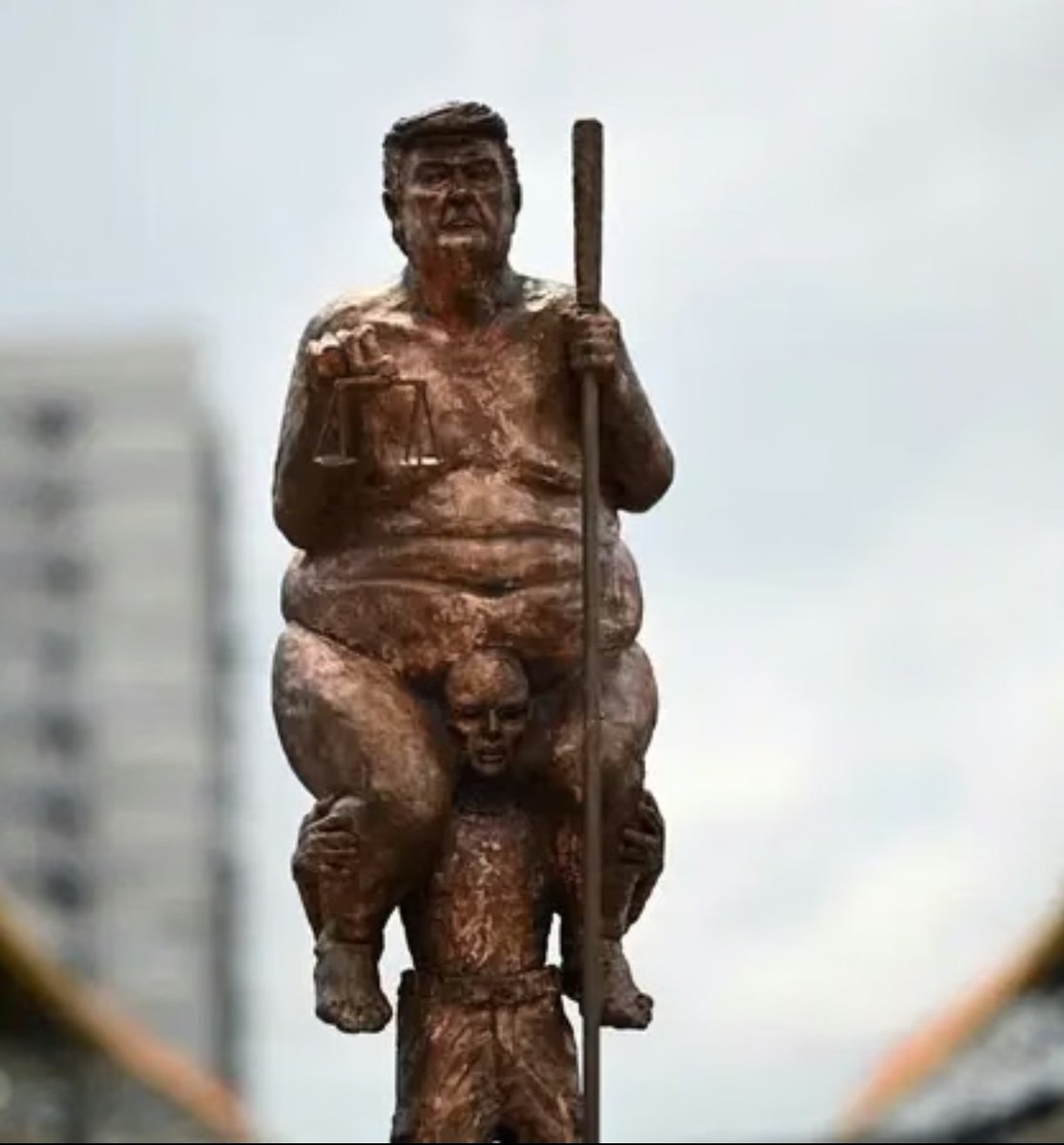
What comes to mind when you see Galschiøt’s newly unveiled sculpture at the European Parliament?
What's your understanding comment?
Art can provoke, mock, disturb—and sometimes force us to confront questions about power, responsibility and the people who bear its weight.
Agree with the message or not, this one is hard to ignore.
No one can claim to know everything, nor can everyone be the best. But our inability to achieve perfection should never stop us from chasing it.
A descriptive exam is not mere rote learning; it is an expression of thought, where clarity, originality and creativity can be tested. With a genuine search, we can identify capable professors, build a robust pool of evaluators, and gradually create a system that can be strengthened further. There is also scope for developing a meaningful mentor–mentee relationship with UPSC to continuously improve the process.
I have never opposed Descriptive as principle for state civil services exam evaluation but MPSC lacks wherewithal to handle this much of task.
How many state university professors or people like them read the newspapers; prepare the notes on daily basis. These Evaluators will blindly rely on model answers for GS & In GS students can quote different facts; analysis; info which might not be there in their model answers. I have seen my own college professors of different subjects from humanities to BCA; MCA; Commerce; Science & interacted with them on multiple times . So I know their limitations.
Unless MPSC build a pool of neutral Evaluators who are well acquainted with current affairs,you can't risk the career of lakhs of Aspirants.
सोशल मीडिया पर आजकल सच जानना ज़रूरी नहीं,
बस कमेंट करना ज़रूरी है।
तथ्य बाद में आएँगे,
पहले फ़ैसला सुनाया जाएगा।
जाँच-पड़ताल की जगह राय होगी,
और समझ से ज़्यादा “फ़सादी” शोर होगा।
कुछ लोग आग नहीं लगाते—
बस हवा इतनी ज़ोर से देते हैं
कि धुआँ ही उन्हें “सच” दिखाई देने लगता है।
थोड़ा रुकिए, थोड़ा सोचिए, थोड़ा आत्ममंथन कीजिए।
हर वायरल बात सत्य नहीं होती,
और हर तेज़ आवाज़ सही नहीं होती।
वरना कल इतिहास भी
कमेंट सेक्शन देखकर लिखा जाएगा। 🙂
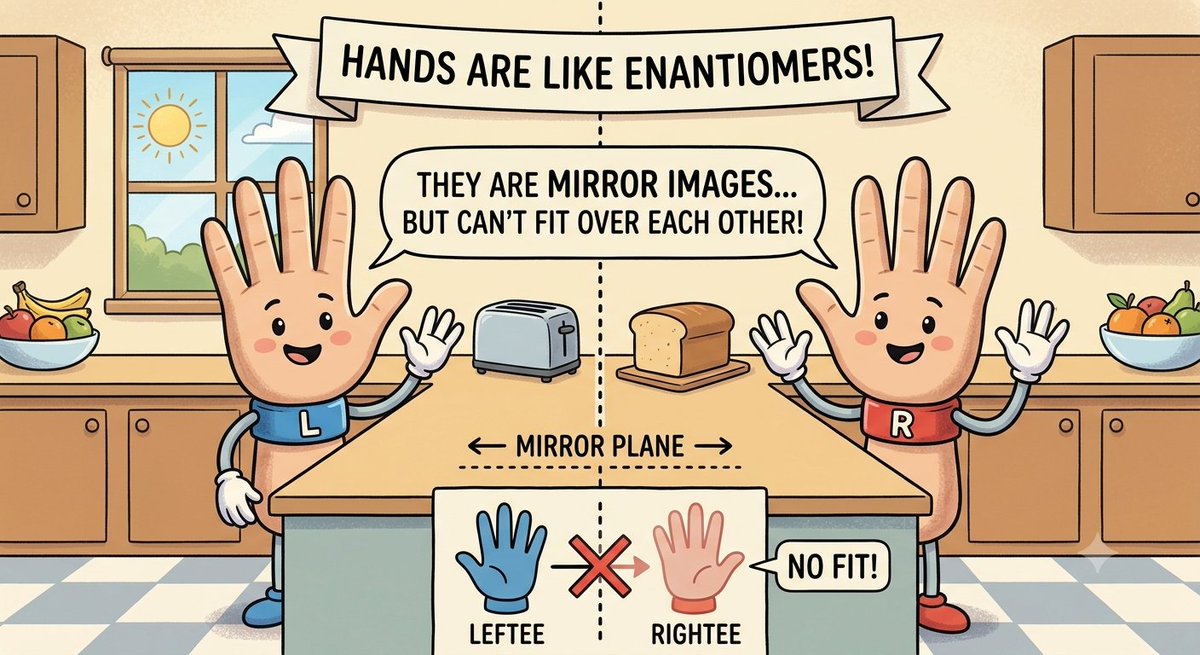
Nobel in Chemistry : So what are Enantiomers?
Enantiomers are molecules that are mirror images of each other, just like our left and right hands. They look similar but cannot be perfectly placed on top of each other.
Application:
They are very important in the pharmaceutical industry, because two enantiomers of the same drug may have different effects in the body. One may be useful, while the other may be less effective or cause unwanted effects.
Orangutan was in the news.
But for Prelims, don’t read it as a standalone fact.
News → Species → Habitat → Conservation Status → Threats → CITES → India angle → PYQ connection
That’s how you turn current affairs into Prelims-ready knowledge.
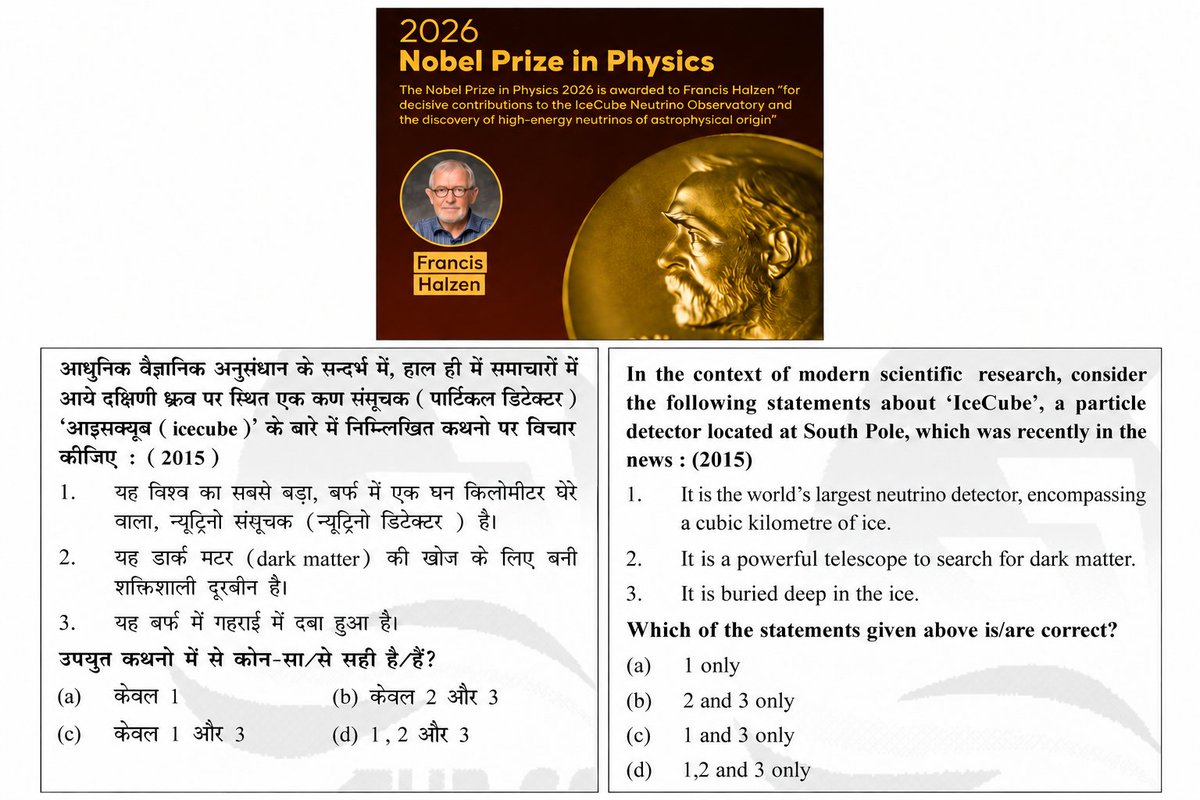
The Nobel Prize fact is NOT the preparation.
The framing is.
“Neutrinos won the Nobel” — knowing this is useless if you cannot handle the question UPSC builds around it.
UPSC can take one current-affairs fact and test:
→ What are neutrinos?
→ Do they have electric charge?
→ Do they interact strongly or weakly?
→ Can they pass through matter?
→ Are they affected by gravity?
→ Do they oscillate between flavours?
→ What does neutrino oscillation tell us about their mass?
Most aspirants collect facts.
UPSC tests whether you can unpack them.
That is the difference between reading current affairs and preparing for Prelims.
NEUTRINO — PROPERTIES TO KNOW
• Electrically neutral
• Extremely small mass
• Interact primarily through the weak nuclear force and gravity
• Pass through ordinary matter with very little interaction
• Exist in three known flavours: electron, muon and tau
• Can undergo neutrino oscillation — changing from one flavour to another
• Oscillation establishes that neutrinos have non-zero mass
Don't just ask: “What happened?”
Ask: “How can UPSC frame this?”
Current Affairs सिर्फ पढ़ना काफी नहीं है।
मुद्दे समझें, Static से जोड़ें और PYQs से सीखें कि UPSC सवाल कैसे पूछता है।
Prelims में फर्क सिर्फ इस बात से नहीं पड़ता कि कितना पढ़ा है, बल्कि इससे भी कि उसे सवालों में कैसे apply किया है।
#UPSC#Prelims#CurrentAffairs
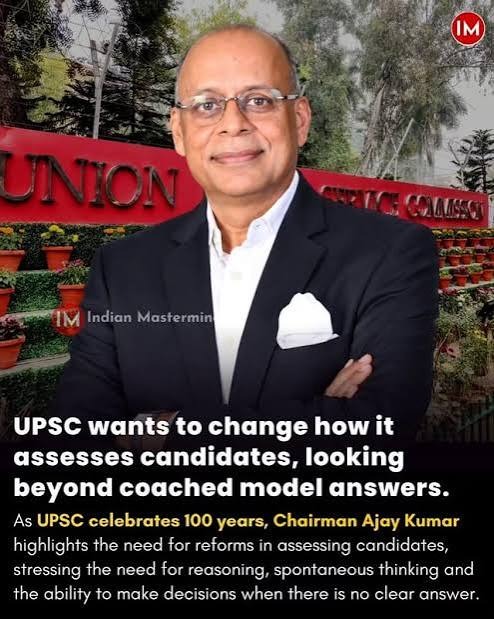
“Spontaneous thinking” is not a new UPSC experiment.
UPSC has always tested whether candidates can think, analyse and respond to unfamiliar questions, rather than reproduce coached answers.
What may be new is the Chairman’s explicit emphasis on it.
So the message for aspirants is simple:
Don’t prepare only answers. Prepare your ability to think when the question changes.
UPSC has always tested that.
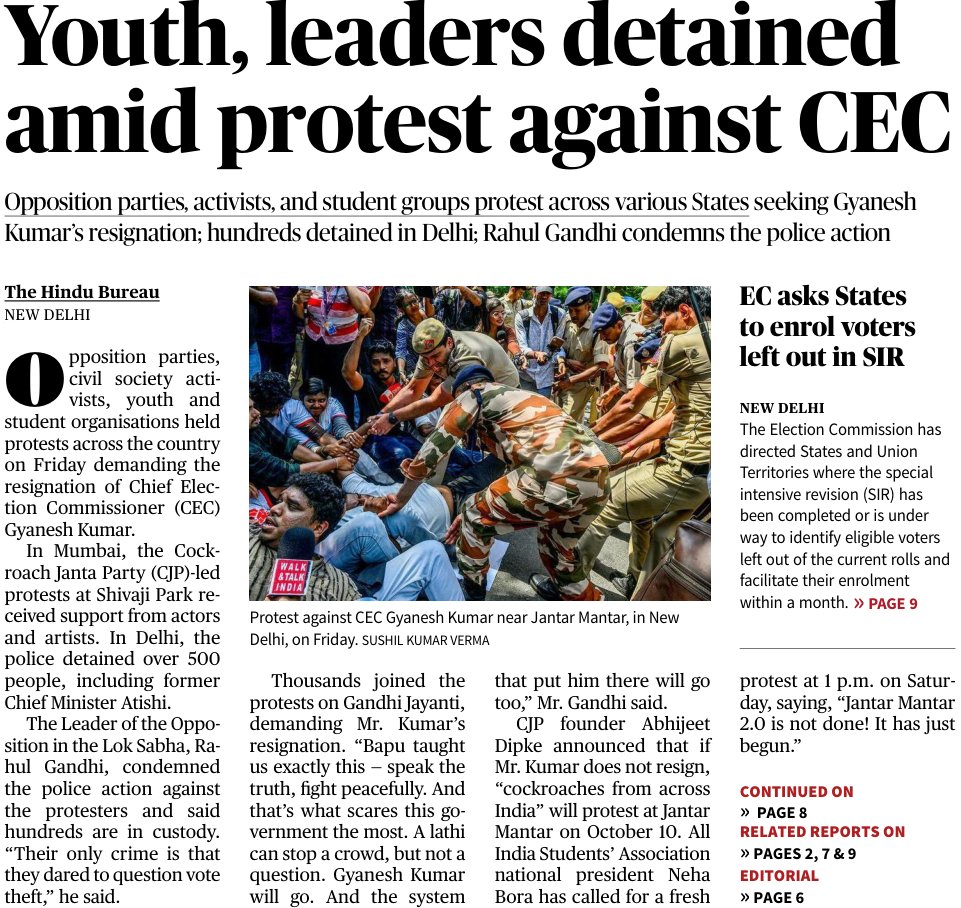
Protests against the CEC can illustrate how pressure groups voice grievances. Then ask: Whose voices gain access—and does corporate wealth crowd out excluded interests or weaken institutional autonomy? That’s the Mains lens.
Ask Yourself — 2026 Mains
To what extent do pressure groups, social movements, and corporate lobbies deepen pluralistic democracy in India by representing excluded interests? Analyse whether the growing convergence of corporate wealth and political power poses a threat to the autonomy of formal democratic institutions.
(Answer in 250 words) — 15 marks