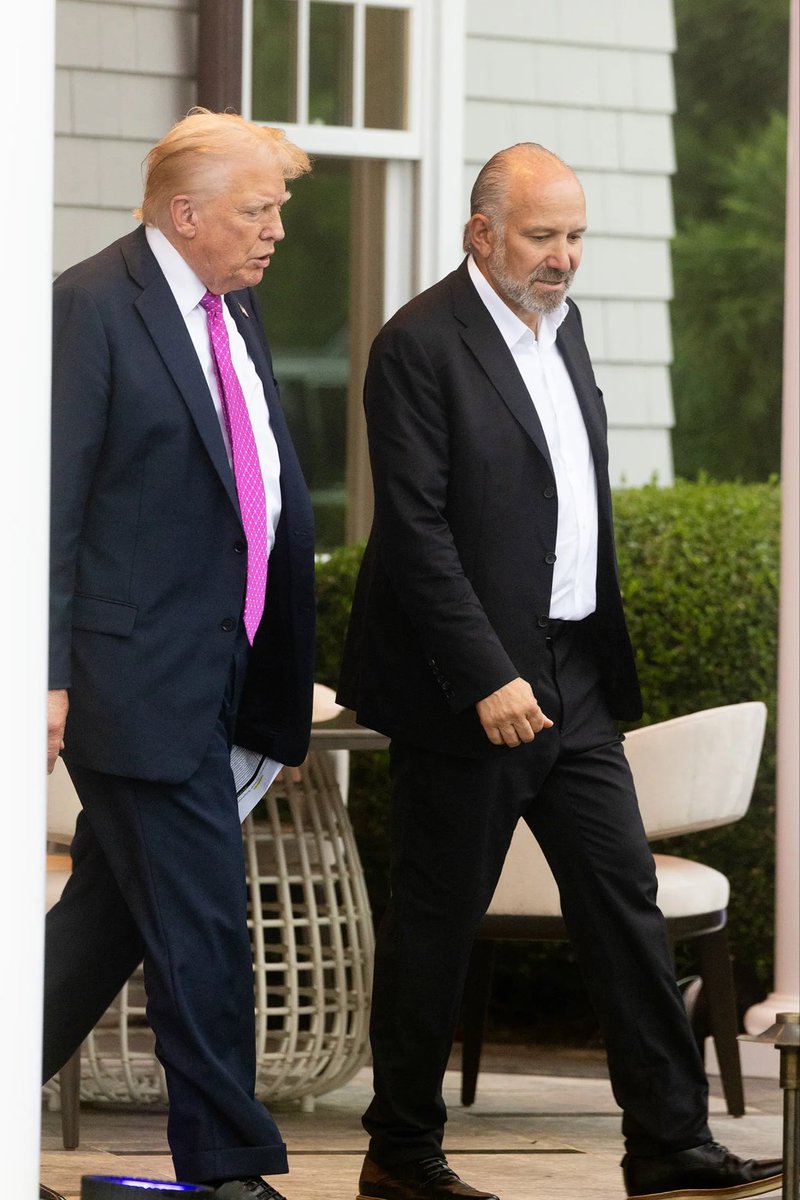
BREAKING: President Trump says Iran has informed the US that there are no tolls, insurance costs, or other charges being "sought or received by Iran" on ships traveling through the Strait of Hormuz.
Trump also says he will be releasing Iranian funds to US farmers and ranchers.
"Food is desperately needed in Iran, and we will be purchasing it for them exclusively from the United States," Trump says.
🚨 EVERYTHING THAT COULD GO WRONG FOR MARKETS WENT WRONG TODAY.
S&P 500 down -1.65%, wiping out $1.14 trillion.
Nasdaq down -2.60%, wiping out $1.11 trillion.
Gold down -3.38%, wiping out $1 trillion.
Silver down -6.9%, wiping out $280 billion.
Bitcoin down -6.31%, wiping out $80 billion.
In total $2.5 TRILLION wiped out in a single session. These were not isolated moves. Everything started breaking at the same time.
It started with the jobs report this morning.
The US economy added 172,000 jobs in May. Wall Street expected 88,000. That is almost double.
On any normal day, strong jobs is good news. But inflation is already at 3.8% and oil is sitting at $90. A labor market this strong tells the Fed it cannot cut interest rates and may actually need to raise them.
The probability of a rate hike this year went from 40% to 57% in a single day. That spooked every investor holding tech and growth stocks because higher rates mean those stocks are worth less today.
Then the AI trade started cracking.
Yesterday Broadcom reported record earnings: revenue up 48%, AI chip sales up 143% and the stock still crashed 12.6%. The reason was simple.
Broadcom did not raise its AI revenue targets for the year. Investors had expected it to. That single miss made people ask a question they had been avoiding for months: are we paying too much for AI stocks?
That question got louder today when a research firm called SemiAnalysis revealed that Nvidia's next-generation AI chips will need significantly less memory than everyone assumed, roughly half of what the market was pricing in.
Memory chips are what companies like SK Hynix and Samsung make. SK Hynix fell nearly 10% today. Samsung fell over 6%.
South Korea's entire stock market crashed 5.5% in a single session. Japan's semiconductor stocks did the same.
And then Anthropic added fuel to the fire by publishing a report warning that AI is getting close to the point where it can improve itself without human help and calling for a global pause in AI development.
Coming on the same day as the memory demand news and Broadcom's miss, it fed a single growing fear across the market: what if the AI boom is moving faster than the business models can keep up with?
Underneath all of this, there is a liquidity problem nobody is talking about.
SpaceX goes public next week at a $1.75 trillion valuation. Anthropic just filed to go public. OpenAI is next.
These three companies together are worth $4 to $5 trillion. Fund managers need cash to buy into these listings.
But cash levels are already at their lowest since early 2024. The only way to raise cash is to sell what they already own. That selling is happening right now.
The new Fed Chair Kevin Warsh will also hold his very first policy meeting in 11 days. He was appointed by Trump with the expectation of cutting rates.
He is now walking into a situation where inflation is high, oil is high, and the job market is running hot. Investors do not know what he will do.
When nobody knows what the most powerful central banker in the world will decide in less than two weeks, the safest move is to reduce risk today.
Everything that could go wrong, went wrong at the same time. A hot jobs report, a collapsing ceasefire, a crack in the AI trade, a trillion dollar liquidity drain, and a Fed meeting with no clear outcome.
Nvidia is pulling off the most sophisticated financial loop in tech history.
They invested $40 BILLION in its own customers in just 5 months.
Here's why this could blow up the entire AI economy:
Nvidia generated $97 billion in free cash flow last year. Instead of sitting on it, Jensen started writing checks to every company in the AI supply chain.
Not small checks. We're talking about billions at a time.
And almost every single one of those companies turns around and spends that money on Nvidia chips.
Follow the money:
$30 billion into OpenAI. OpenAI is one of Nvidia's largest GPU customers and spends billions annually on Nvidia hardware through cloud providers.
$2 billion into CoreWeave, a company that exists exclusively to rent out data centers full of Nvidia GPUs.
$2 billion into Marvell for silicon photonics that connects Nvidia systems.
$2 billion into Lumentum for optical tech that powers Nvidia data centers. $2 billion into Coherent for the same thing.
$2 billion into Nebius, an AI cloud company deploying Nvidia infrastructure.
$3.2 billion into Corning, the glassmaker building three new US factories specifically to make fiber optic cables for Nvidia's next-gen systems.
$2.1 billion into IREN, a data center operator that just agreed to deploy 5 gigawatts of Nvidia-designed infrastructure.
And the list goes on.
Every single recipient either buys Nvidia chips directly, builds infrastructure that runs on Nvidia chips, or manufactures components that go inside Nvidia systems.
Matthew Bryson, an analyst at Wedbush Securities, said in a research note that Nvidia's dealmaking fits "squarely into the circular investment theme."
Bloomberg even published an entire interactive feature this week titled "AI Circular Deals: How Microsoft, OpenAI and Nvidia Keep Paying Each Other."
The piece maps how capital flows between the same handful of companies and gets counted as revenue multiple times along the way.
But here's the part that makes this genuinely complicated:
Nvidia's $5 billion investment in Intel from September is now worth over $25 billion. That's a 5x return in months.
Their private company portfolio went from $3.4 billion to $22.3 billion on the balance sheet in a single year. They booked $8.9 billion in gains from equity investments alone.
So when critics say "circular investing," Nvidia can point to Intel and say "we turned $5 billion into $25 billion, this is just smart capital deployment."
And they're not wrong. Some of these bets ARE paying off like crazy.
The real question is whether Nvidia is a chipmaker that happens to invest, or a venture fund that happens to sell chips. Because right now Jensen is doing both at a scale that has never existed in the semiconductor industry. No chipmaker in history has EVER invested $40 billion in its own ecosystem in five months.
Last fiscal year Nvidia invested $17.5 billion in private companies. Their SEC filing literally says those investments include "AI model companies that purchase its products directly or through cloud service providers."
They're saying it themselves: We invest in companies that buy our products.
On Nvidia's last earnings call, Jensen told investors their investments are focused on "expanding and deepening our ecosystem reach." Translate that from CEO-speak and it means "
we're funding the companies that fund us.
The bull case says Nvidia is building an unbreakable moat by financing the entire AI supply chain and ensuring it all runs on Nvidia hardware. The bear case says this is the most elaborate circular revenue scheme since the subprime mortgage era and it all breaks apart the moment one domino falls.
Both cases use the exact same evidence.
Herkes BAE'nin OPEC çıkışını konuşuyor. Petrol fiyatını konuşuyor.
Ben başka bir şey görüyorum.
Asıl mesaj Bitcoin'de.
Size bir zincir göstereceğim.
İlk halkası BAE'nin OPEC masasından kalkması. Son halkası Bitcoin'in, hissenin, altının fiyatı.
Aralarında doğrudan bağlantı yok gibi görünüyor.
Ama o zinciri takip eden çok az kişi var.
Anlatıyorum.
Önce OPEC'i anlamamız gerekiyor
OPEC 1960'ta kuruldu.
Çalışma mantığı çok basit. Her üyeye bir kota verilir. Hepsi sınırın altında üretir. Az petrol piyasaya gider. Fiyat yüksek kalır.
Bu sistem 65 yıldır işliyordu. Bugün ilk kez bir üye masadan kalktı.
BAE'nin pozisyonu
BAE OPEC'in 3. büyük üreticisi. Suudi Arabistan ve Irak'tan sonra.
Günde yaklaşık 3 milyon varil pompalıyor. Asıl kapasitesi çok daha fazla, 5 milyon varilin üzerinde.
Kapasitenin yarısı atıl duruyor. Sadece kota yüzünden.
Neden şimdi çıktı?
Zamanlama tesadüf değil.
BAE petrol sonrası bir ekonomi inşa ediyor. Yapay zeka, finans, gayrimenkul, turizm. Dubai dünyada en hızlı büyüyen turizm ve finans merkezlerinden biri.
Bu dönüşüm sermaye istiyor. Sermaye bugün petrolden geliyor.
Şimdi son aylara bakın.
İran-İsrail-ABD geriliminde Körfez kaynak noktası oldu. Hürmüz'de tankerler hedef alındı. Drone saldırıları görüldü. Sigorta primleri yükseldi.
Sonuç: bölgeye yönelik turizm geriledi. Dubai havalimanı yolcu sayısında düşüş yaşadı. Otel doluluk oranları indi. Yatırımcılar sermaye akışını yavaşlattı.
BAE'nin üç ana gelir kalemi var: petrol, turizm, finans. Turizm sarsıldı. Finans tedirgin oldu.
Geriye büyütülebilecek tek kalem kaldı: petrol.
Ama OPEC kotası buna izin vermiyordu.
Bugünkü ayrılık bu sıkışmanın çözümü.
Zincirin birinci halkası: piyasaya ek arz
BAE artık kotaya bağlı değil. Kapasitenin sonuna kadar pompalayabilir.
Günlük 1-2 milyon varil ek arz piyasaya akabilir.
Kritik kısım rakam değil, sinyal.
Bir üye gidebildiyse diğerleri de düşünür.
Irak yıllardır kotaya kızgın. Kazakistan kotaya uymuyor. Kongo'nun kotası bütçesini karşılamıyor. Hepsinde aynı sıkışma var.
Disiplin tek bir taşıyıcıya değil, herkesin uyumuna dayanıyor.
Zincirin ikinci halkası: petrol fiyatı baskıya giriyor
Petrol piyasası tam bu noktada. BAE serbest pompalarsa fiyat düşer. Diğer üyeler ya pazar payı kaybeder ya kotadan çıkar.
İki yol da fiyatı aşağı çeker.
Zincirin üçüncü halkası: enflasyon iniyor
Petrol pahalandığında sadece benzin etkilenmiyor. Kargo pahalanıyor. Gıda pahalanıyor. Üretim pahalanıyor.
Ucuzladığında zincir tersine işliyor. Ulaşım ucuzlar, lojistik ucuzlar, gıda ucuzlar.
Zincirin dördüncü halkası: Fed'in eli rahatlar
Fed son yıllarda enflasyon yüzünden faiz indiremiyordu. Powell her toplantıda aynı cümleyi tekrarladı: "Verilere bakıyoruz."
Veriler değişirse dil değişir.
Petrol baskısı azalır, enflasyon iner, Fed'in manevra alanı genişler.
Faiz indirme yolu açılır.
Zincirin son halkası: Bitcoin, hisse, altın
İşte son halka burada.
Fed faiz indirirse:
Borçlanma ucuzlar. Şirketler kredi alır. Hisse senedi yükselir. Bitcoin yükselir. Altın yükselir. Dolar kontrollü şekilde zayıflar.
Trump'ın 2026'da yenileyeceği 10 trilyon dolarlık tahvil ucuza gelir.
Risk varlıkları için aylardır beklenen pencere açılıyor.
Zincir BAE'nin OPEC çıkışından başlıyor. Bitcoin'in fiyatına kadar uzanıyor.
Siz bu konu hakkında ne düşünüyorsunuz?
Gelişmeleri takip ediyorum, sizi bilgilendireceğim.
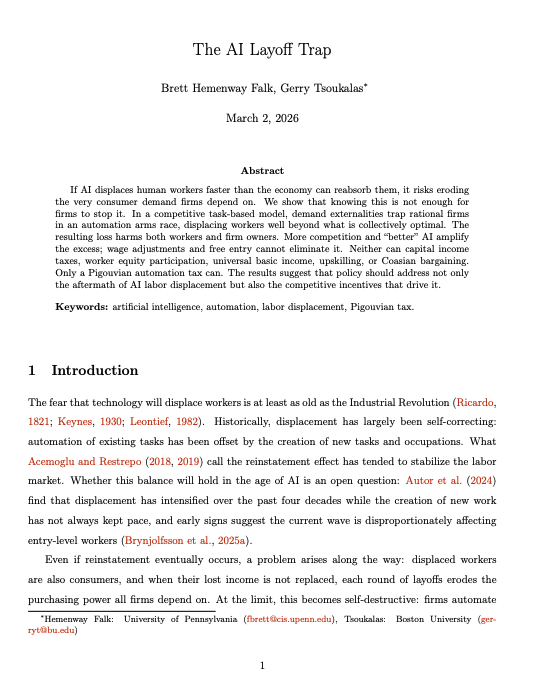
🚨RESEARCHERS JUST MATHEMATICALLY PROVED THAT AI LAYOFFS WILL DESTROY THE ECONOMY.. AND EVERY CEO ALREADY KNOWS IT.. BUT NONE OF THEM CAN STOP..
Two researchers from UPenn and Boston University just published a paper called "The AI Layoff Trap"..
They proved something terrifying..
Every company replacing workers with AI is also firing its own customers.. Every laid-off employee is someone who used to spend money.. When enough people lose their jobs.. Nobody can afford to buy anything.. And the companies that fired everyone go bankrupt selling products to an economy with no purchasing power..
Every CEO can see this coming.. The math is obvious.. Fire workers.. Lose customers.. Lose revenue.. Collapse..
But here's the trap..
No company can afford to stop..
If you don't automate.. Your competitor will.. They cut costs.. Undercut your prices.. Steal your market share.. And you die anyway..
So every company automates.. Knowing it's collectively suicidal.. Because the alternative is dying alone while everyone else survives..
It's a Prisoner's Dilemma.. And the researchers proved it mathematically..
The numbers are already stacking up..
Block cut nearly half its 10,000 employees this year.. CEO Jack Dorsey said AI made those roles unnecessary and that "within the next year, the majority of companies will reach the same conclusion"..
Salesforce replaced 4,000 customer support agents with AI..
Goldman Sachs deployed an AI coder that lets one senior engineer do the work of a five-person team..
Over 100,000 tech workers were laid off in 2025 alone.. AI was cited as the primary driver in more than half the cases..
80% of US workers hold jobs with tasks susceptible to AI automation..
And here's what should scare policymakers..
The researchers tested every proposed solution..
Universal Basic Income.. Doesn't fix it.. It raises living standards but doesn't change a single company's incentive to automate..
Capital income taxes.. Don't fix it.. They change profit levels but not the per-task decision to replace a human..
Worker equity and profit sharing.. Narrows the gap but can't close it..
Collective bargaining.. Can't fix it.. Because automating is a dominant strategy.. No voluntary agreement between companies is self-enforcing..
Only one thing works.. A Pigouvian automation tax.. A per-task charge that forces every company to pay for the demand it destroys when it fires a worker..
The researchers call it a "Red Queen effect".. Better AI doesn't solve the problem.. It makes it worse.. Because every company sees a bigger market share gain from automating faster than rivals.. But at the end.. Everyone automates equally.. The gains cancel out.. And the only thing left is more destroyed demand..
The paper's conclusion is devastating..
This isn't a transfer from workers to company owners.. Both sides lose.. Workers lose their income.. Companies lose their customers.. It's a deadweight loss that harms everyone..
And no market force can break the cycle..
The AI layoff trap isn't a prediction.. It's already happening.. And the math says it won't stop on its own.
South Pars is not just a gas field. It is the largest natural gas reservoir on the planet.
And on March 18, 2026, Israel bombed it.
But this story starts way before March.
June 2025. Israel hits South Pars Phase 14 for the first time. An onshore processing facility in Bushehr catches fire. Iran is already bleeding: 50% hyperinflation, chronic power blackouts.
After that strike, 155 Iranian cities erupt in protest. The chant was three words. “No Light. No Water. No Future.”
Israel watched. Waited. Then hit harder.
South Pars and Qatar’s North Field are not two separate gas fields. They are the exact same underground reservoir, split by a maritime border. One field. Two countries. Two completely different fates.
Qatar’s side: 18.5 billion cubic feet per day. 20% of global LNG supply. 80% of Qatar’s entire government revenue. $120 billion in annual exports.
Iran’s side: Sanctioned. Underinvested. Barely breathing. Iran exports just 9 billion cubic meters a year against Qatar’s 120 billion.
Iran had planned three LNG projects, one with TotalEnergies, one with Shell. Sanctions killed every single one.
The third project at Asaluyeh, the exact site of the March 18 strike, was 20 years under construction and weeks away from completion when the bombs fell.
Same field. One side became the world’s LNG capital. The other became what sanctions do to a nation’s future.
Israel did not bomb a military target. It bombed the source of Iran’s domestic gas. The gas heating Iranian homes. The gas keeping hospital lights on. 80% of Iran’s domestic gas comes from South Pars.
An Israeli official was asked about the intent. The answer was cold: “There will be power and gas outages. The regime will reduce supply to consumers. From there, the pressure will increase.”
This is not military strategy. This is political engineering. Freeze the population. Starve the regime of legitimacy. Let the streets do the rest.
It gets more calculated.
Israel’s strike forced Iran to retaliate against Qatar’s Ras Laffan, the world’s largest LNG export facility, that same night. Qatar, which hosts America’s most critical Middle East airbase at Al Udeid, had been quietly maintaining ties with Iran. Within 24 hours of that retaliation, Qatar expelled every Iranian military and security attaché from the country.
Israel didn’t just bomb a gas field. It rewrote Qatar’s foreign policy in a single night.
Iraq received 50 million cubic meters of Iranian gas daily, powering 6,000 megawatts of electricity. After the strike, flows stopped completely. 3,100 megawatts offline, right before summer, in a country where power cuts already bring people onto the streets.
Ras Laffan took extensive damage. Europe’s gas benchmark jumped 7% overnight. Brent crude crossed $108. Every LNG exporter outside the Gulf, Cheniere, Woodside, Equinor, woke up to a windfall they never had to earn.
Nikola Tesla once said that when the world becomes an energy-based economy, wars will end. Because no nation destroys what it depends on.
Trump proved him wrong.
West Asia was a decade away from becoming the world’s energy superpower. Iraq, Turkey, Qatar, Iran, all building toward it. One week of strikes pushed every single one of them years backward.
Dark homes. Empty pipelines. Families in countries with no army in this war, no vote in this conflict, paying the price in their electricity bills.
When you weaponise energy, you don’t just destroy your enemy.
You destroy everyone who was quietly depending on the lights staying on.
Meet Professor Shivanand Mankekar.
India's most Reclusive Investor.
> Born in Mumbai in late 1950s in a Maharashtrian household.
> Taught Financial Management at JBIMS (Jamnalal Bajaj Institute of Management Studies) Mumbai for over 30 years.
> Two of his Famous students include the Billionaire banker Mr. Uday Kotak and Mrs. Chanda Kochhar (Ex-CEO ICICI Bank).
> Today his disclosed portfolio is worth Rs. 2,050 Crores. Worth more than Rs.2,300 Crores in entirety.
> He shot to fame when his stake in Pantaloons rose from Rs. 30 Lakhs in year 2002 to Rs. 190 Crores in 2007.
> In 2012, he bought 1.02% in United Spirits for Rs. 300 Crores which he sold for Rs. 450 Crores in 2014.
> Uday Kotak once spoke of Mankekar’s first lecture. “Professor asked ‘How do you value a company?’ Someone said, “By net profit”, somebody else said, “By assets”. He said, ‘All wrong. You value a company on its cash flow.’
> He bet very early on L&T, Castrol, and Sesa Goa, and later, Infosys, Wipro, and Bharti Airtel.
> He stayed in a 700sqft apartment in Mahim, Mumbai while having portfolio running into thousand crores.
> As per reports, Neighbours knew him only as a simple, routine-driven professor, very few had any clue about his massive investment success.
> Today he and His son Kedar, who is also a professor at Welingkar College in Mumbai, invest through family owned HUF.
> They believe in concentrated portfolio and pay a huge importance to ROCE and Free cash flow in a company.
Truly Inspiring person. 👏🏻🙌🏻
"India Has a Great Opportunity in AI, Period" – Dr. Vishal Sikka (Ex-Infosys)
1. TCS has partnered with him to fight its existential crisis
2. PM & officials have met him multiple times
3. Oracle, GSK, BMW, Stanford have him on their Boards for AI
What is Vishal Sikka Saying:
Vishal Sikka – India’s World-Beating Asset in Silicon Valley
a. Sikka did his Stanford PhD thesis on AI in the 90’s when no one had even heard of AI.
b. As Infosys CEO from 2014 to 2017, he forewarned in every speech, meeting, shareholder’s letters (and resignation letter) that AI would disrupt IT Service Companies.
c. He took 3 steps at Infosys to lead the AI race for India. (Next Section)
Sikka’s 3 Steps Which Led to His Exit from Infosys
a. In 2015, he decided to be an early investor in OpenAI along with: Sam Altman, Peter Thiel (PayPal), Reid Hoffman (LinkedIn), and Elon Musk (Tesla). Infosys promoters backed out of this risky bet.
b. Sikka acquired Israeli AI firm Panaya for $200M in 2015. The sycophants and jealous Board members within Infosys spread a rumour that the acquisition was overvalued and Sikka had taken a cut. Internal investigation was ordered, nothing wrong was found.
c. Last Straw: In April 2017, Sikka launched the next-generation AI platform NIA at Infosys. The goal was to take lead in “proprietary AI” and build own models in India rather “live on rented AI” forever and enrich Google, OpenAI, etc.
Infosys Board was reluctant to go “all in” with NIA. Sikka resigned in August that year.
Sikka’s 2019 AI Presentation at NITI Aayog
a. In Sept 2019, all major Indian newspapers carried this PTI headline: “India Can Become World Leader in Artificial Intelligence: Vishal Sikka”
b. At a time when there was no ChatGPT, Gemini, or self-driving cars, Vishal Sikka gave a presentation on AI before NITI Aayog at the PM’s request, where officials of 20 Union Ministries were gathered.
c. He proposed a two-pronged strategy: (1) Train the world’s largest AI talent pool in Indian schools and universities; and (2) Invest and build AI systems in India at a very large scale to leap-frog in the AI race.
Nobody in India understood in 2019 what Sikka was saying.
Vishal Sikka is Back: What is He Saying in 2026
a. Last month Sikka had another meeting with the Indian PM and team. He is going to be a key participant at the India AI Impact Summit 19~20 Feb, 2026, which is a massive event with all top tech global leaders invited.
b. Indian IT Services: TCS has entered into a major partnership with Sikka’s AI firm and he recently met TCS CEO and top management. He told them it is not too late to join the AI race; the race has barely begun.
c. Margin Erosion in Indian IT Companies: Indian IT’s original model was labour arbitrage. If a client wanted 200 engineers on a project, India could supply the cheapest.
Now the same project can be done with 50 engineers + AI at much cheaper cost. So, to survive, Indian IT profit margins have already come down from 25% to 15%, and are rapidly declining further.
d. Sikka’s Advice to IT Services Companies: You have to shift the delivery model from labour arbitrage to “Labour + AI” arbitrage. It means, the AI component (AI platform, LLM models, AI applications) must be your own proprietary technology, and not rented from others.
e. If you rent AI, you lose the arbitrage – and then the Indian IT industry’s end is near. “There will be a lot of blood on the streets,” his exact words. (“Rent” also means foreign dependence forever in strategic technologies.)
f. Building Own AI Models: The idea that India is too late in the AI race, so let other people build AI – is a stupid idea, he says. “God has not pre-ordained that only certain people can build foundation models, and Indians are not one of them.”
India has 18% of the world’s population. We have to build our own foundation models, our own large-scale AI systems, and our own world-class applications on top of them. (Note: That’s exactly the way China thinks.)
g. “Skill Gap” is a Loser’s Excuse: Out of 8 billion people in the world, only about 1.5 million are able to build AI applications. The number of people who can deploy AI in production is just a few hundred thousand.
And the number of people who can build a frontier foundation model is less than 25,000 on the whole planet (concentrated in San Francisco, London, and a few Chinese cities.)
These are basic skills, and not skills pre-ordained by God for a chosen few.
ENDQUOTE [By Vishal Sikka]
Legendary computer scientist Alan Kay used to say:
“In the country of the blind, the one-eyed man (with half-baked knowledge) is king, but the two-eyed man (who is a visionary genius) is in for a hell of a ride (suffers a backlash and is called a fool.)”
@arabicatrader
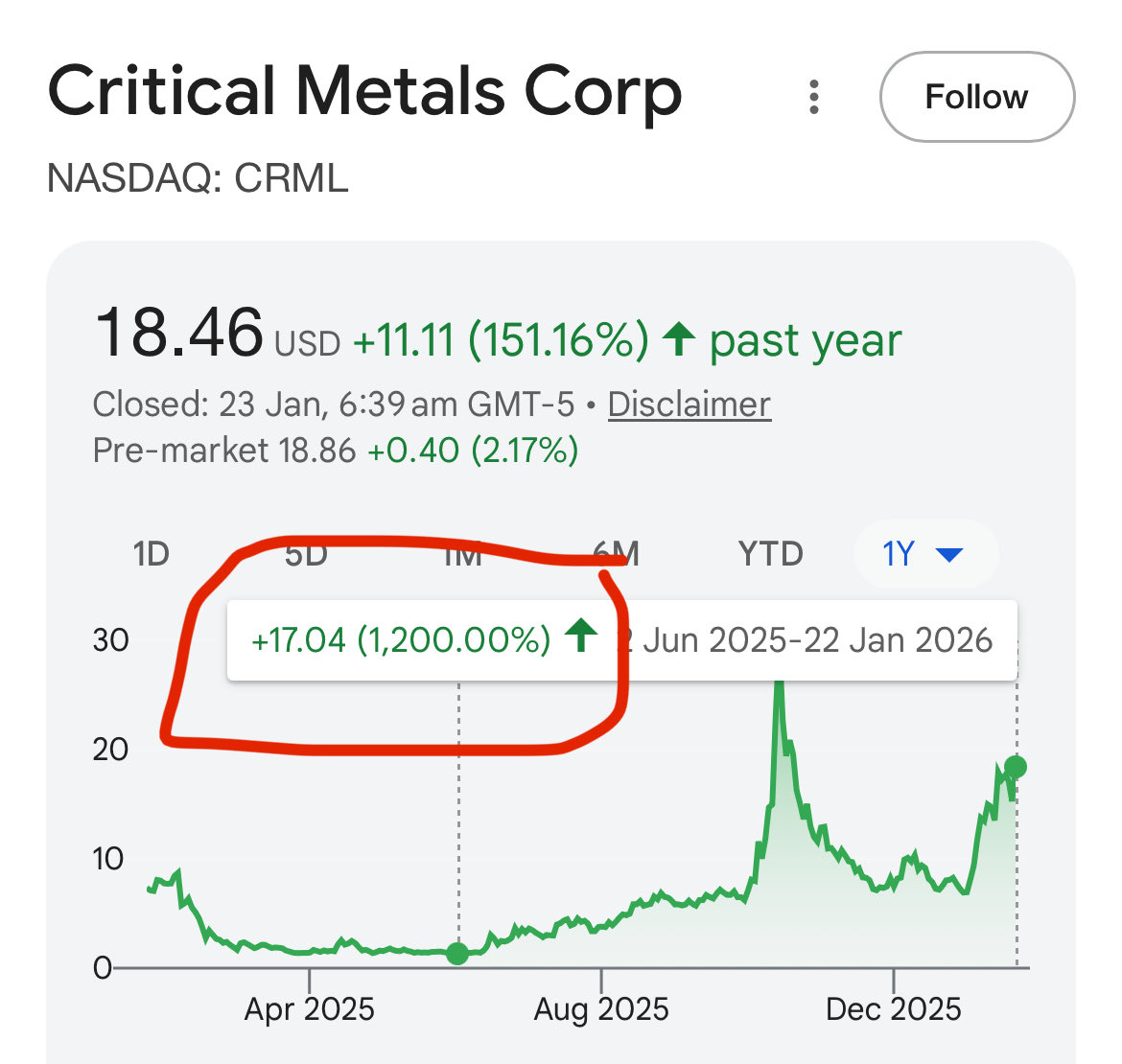
US secretary of commerce, Howard Lutnick acquired $2 billion worth of Critical Metals Corp. $CRML back in Feb 2024.
He was underwater -90% until Trump won the election.
The Tanbreez project in southern Greenland is one of the largest heavy Uranium (REE) deposits globally.
In last 6 months $CRML gaye 1200%
Human interaction with tech went from "writing code" to "touchscreen inputs." The next revolution in human-machine interaction: SOUND! - Mr. Kumar Abhishek, Founder & CEO @tonetag
Panel III: Tech-Driven Businesses
@ravidharamshi77@sameervq#Tech#PEInvestorDay2025#VQ