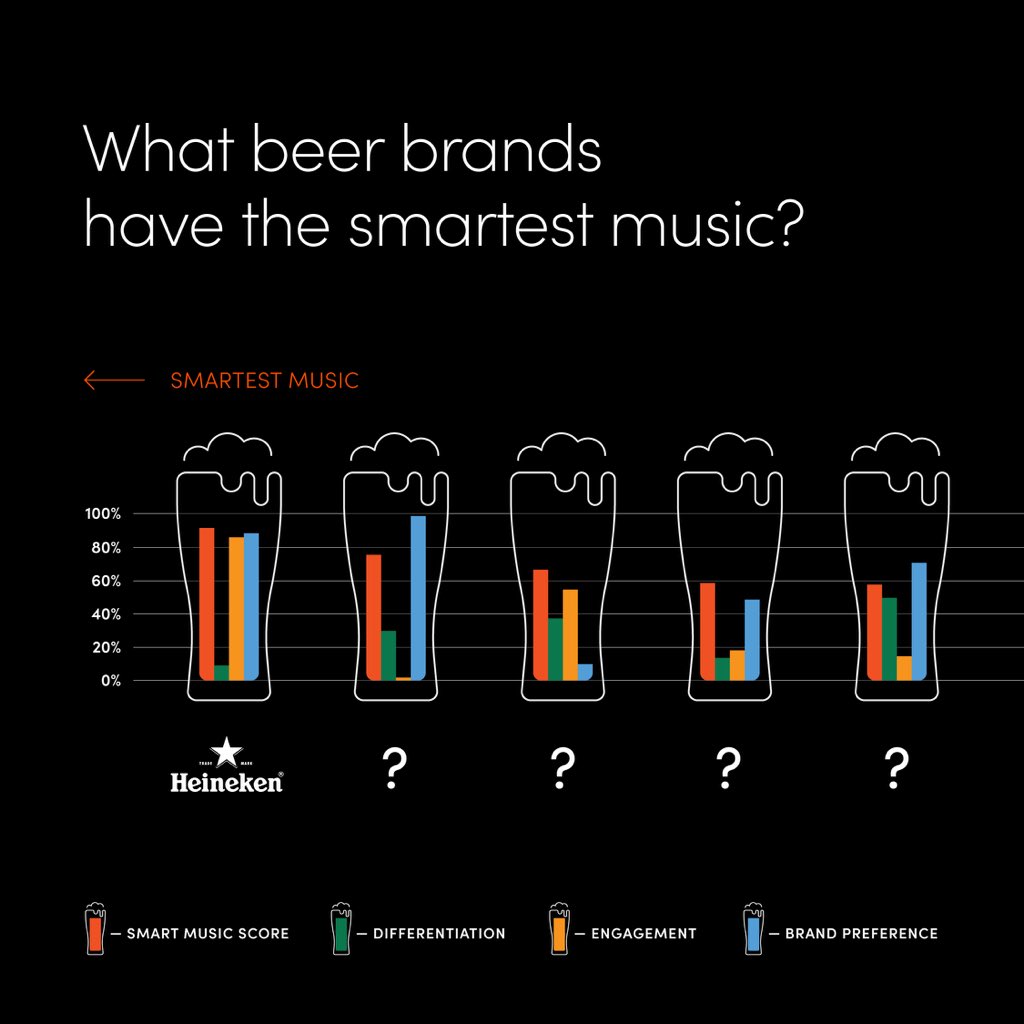
Very proud to be part of the team on this. Not only do we have the coolest AI music analysis tech, but combining the music data with real human brand preference gave a whole new level to this study...
What beers brands have the smartest music?
Our Smart Music team, who has been busy piloting a new AI based methodology for measuring the effectiveness of music in advertising, analyzed ten of the top-selling beer brands in the US to find out.
New article published on @songtradr this afternoon, focusing on how media companies can use sound to counteract post-pandemic subscription drop-off.
https://t.co/bKq9h201Ke
Imagine the possibilities if we can prove that changing the sound of an ad makes it more "acceptable" on certain platforms, and combine it with musical metadata engines like @songtradr that will be able to match music to target demographics.
Read more: https://t.co/7nqMwEHA56
These "Chat GPT for Music" engines are certainly potentially disruptive. And it's not just Google - timbreCLIP, ADP and noise2music are coming too. Google will likely always win the AI race though since they have most training data at their fingertips.
Cool paper - I love seeing the "change of music over time" papers. Reminds me of the Serrà, 2011 paper that empirically showed "a progressive homogenization of the musical discourse". At least we all move together!
New article alert! "A comparative analysis of melodic rhythm in two corpora of American popular music" is now live at the Journal of Mathematics and Music.
With #corpusAnalysis, we show that post2000s music... 1/x
If you use it right, Google is the most powerful tool in the world.
But the truth is most people suck at it.
Here are 8 Googling tips that you probably don't know👇
Gamification in academics! Fun approach to implicit research, sort of similar to the pleasure people get from their first exposure to the Deutsch Illusions.
Great job @DavidJohnBaker and others :)
Great to finally meet @TomMiddleton__ in person when I was in London a few weeks ago!! All we needed was the man who first put us in contact - @audioalchemist_.
In a recording of a group of singing wood frogs, an acoustic camera can be used to identify the location and audio frequency of individual frogs! Listen here: https://t.co/OGlhe2BRCd
Garden-path sentences are a cool enough concept on their own (“The horse raced past the barn fell” being my fave) but applying it to musical “language” is fascinating…
Our latest paper on the retrospective revision of syntactic interpretations in music is now available in open access in Cognitive Science! [https://t.co/96vduy3fXk](https://t.co/96vduy3fXk)
@SteffenHerff@cogsci_soc@DCML_EPFL
New research uses #eyetracking and #fNIRS as a potential approach for hedonic taste evaluations and perceptual/ mental processing when exploring food marketing.🍋🍉
#context#neuroscience#marketing
https://t.co/u7jNgGNVmI
What are some audio perception differences between demographics/individuals? I can think of the Deutsch Illusions but are there other (fast/slow, happy/sad etc.) insightful differences out there about how people hear?
Check out my literature-backed take on "Why Do Sonic Branding" and other industry questions, written for @massivemusic: https://t.co/U0RdmVWS6f
#SonicBranding#Music#Marketing
8 months and thousands of emails later, our partnership w/ Slane Whiskey and the FADER has finally gone live! I'm really proud of the team that helped to curate this playlist and I'm glad to have met all these wonderful up and coming artists along the way. https://t.co/p0GowYYtfs
Love this article and more generally seeing the world strive to learn about the power of sound!
@west_research teaches how music, sound influences politics: https://t.co/EYhW2Pyq8q