Senior Executive | Mega Projects Leader | Strategy & Transformation | AI & Data Ecosystem builder | Scale Up Advisor | Speaker | AI Strategist of 2025 Award Win
When two AI agents talk to each other:
a) Where is that conversation log stored?
b) Who has access to that log?
c) Who can delete that log?
d) Will this become evidence in criminal prosecutions?
Food for thought over the weekend..
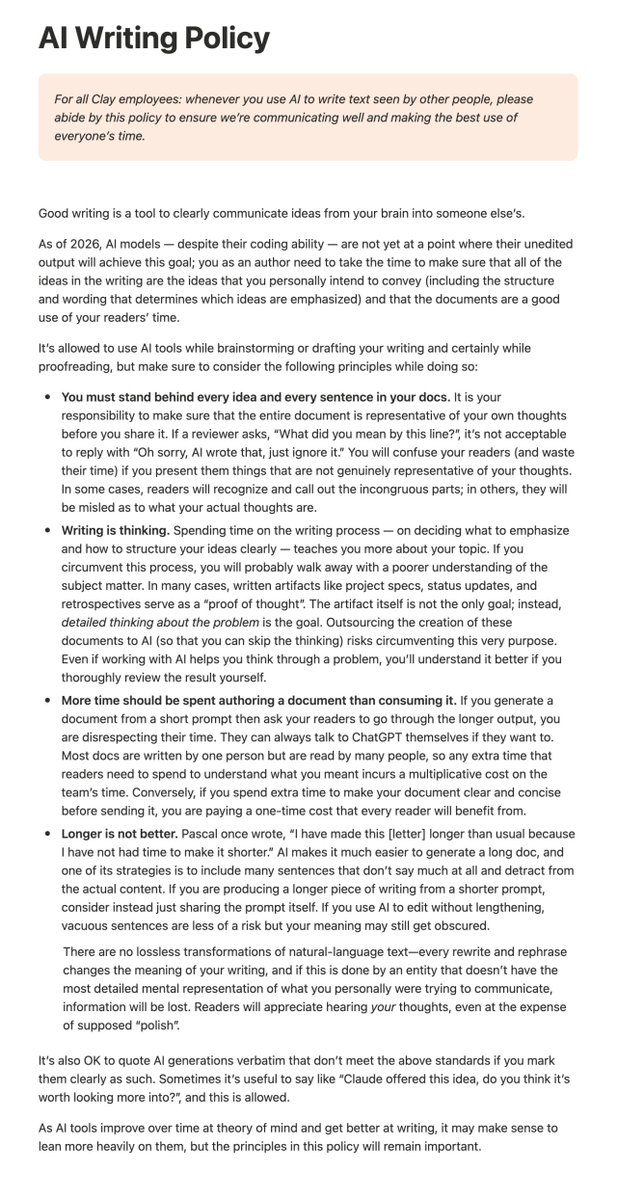
We instituted an official AI Writing Policy at @Clay.
Massive thanks to @sophiebits on our engineering team who wrote this.
Originally this was just for eng, but other teams found it so helpful we expanded it company-wide.
Here are the four guiding principles:
1. You must stand behind every idea and sentence
It is your responsibility to make sure that the entire document is representative of your own thoughts before you share it.
2. Writing is thinking
Spending time on the writing process teaches you more about your topic. If you circumvent this process, you will walk away with a poorer understanding of the subject matter.
3. More time should be spent writing a document than consuming it
If you generate a document from a short prompt then ask your readers to go through the longer output, you are disrespecting their time. They can talk to ChatGPT themselves if they want to.
4. Longer is not better
AI makes it easy to generate long docs, and it loves padding them with sentences that say nothing. If you're producing docs from a short prompt, consider just sharing the prompt.
You can read (and borrow) the full policy below. Hopefully we all communicate a bit more clearly now :)
When you asks AI for the answer, you become someone who can operate AI.
When you Ask AI to break the answer and you become someone who has spent N repetitions hunting for the flaw. That is the path that leads to developing judgment.
Shipping on hope is just expensive guessing. Testloop gives designers an AI research partner that turns hypotheses into evidence before the calendar forces a decision. https://t.co/KTJIwRx7Fn
Design teams spend more time scheduling research than doing it. Testloop runs UX research, generates prototypes, and tests hypotheses continuously—24/7. No participant pools. No waiting. Just answers. Live soon.
Fable 5 just turned my company into a video game.
Instead of assigning boring tasks, you give people quests.
Here’s why I think this could change how companies operate:
1) Work becomes more engaging
People can see what they need to do, complete quests, earn XP, and level up.
2) Progress becomes visible
Instead of wondering who’s performing, you can see completed quests, levels, achievements, and contributions over time.
3) Rewards become tied to performance
Certain roles, bonuses, and opportunities can be unlocked when someone completes specific quests or reaches a certain level.
4) Incentives can become automatic
In the future, bonuses could be triggered through smart contracts and paid in stablecoins when predefined goals are reached.
5) Companies can access talent differently
If the business becomes an open world, people outside the company could discover available quests, complete the work, and earn rewards.
6) Work becomes more fun
The same mechanics that keep people playing games, progression, challenges, rewards, and achievement, can be applied to work.
The bigger idea is that your company stops feeling like a list of tasks and starts feeling like a world people can progress through.
I’m building this via Fable 5 right now.
Want the blueprint?
→ Like + retweet this post
→ Comment “GAME”
→ I’ll send you the MD file so you can build something similar for your business.
Google I/O 2026 marks the definitive end of the "Generative AI as a chat box" era and establishes the foundation for Agentic Ubiquity. Alphabet is executing a classic vertical integration playbook: controlling the hardware/OS kernel layer, owning the orchestration frameworks..
When AI fabricates data - we screenshot it, post it, tweet it.
When humans fabricate data - it’s a typo. Or predictive intelligence.
Same behaviour. Entirely different accountability standard.
Your AI governance is only as credible as the standard you apply to yourself.