It may be overfit so it’s a bit early to declare any sort of victory but it is really good to see open-weight models catch up to the closed source labs so quickly after their latest releases.
With recursive RL, the delta in time between a closed source model and an equivalent open weight (and ideally open source) model will shrink considerably over the next few years.
Without distinct data sets to train over and specifically narrow use cases to build expertise on, convergence seems at hand for this class of model architecture.
Researchers show that Claude Code is 98% not AI.
Anthropic never gave us the architecture for Claude Code. There were no docs. Just a tool that every developer is currently obsessing over.
Until it leaked recently.
A research team pulled the source code, analyzed all 500,000 lines, and found something ridiculous.
Only 1.6% of the codebase actually interacts with the AI model.
The core of Claude Code is literally just a simple while-loop. It asks the model what to do, runs a tool, and repeats.
So what is the other 98.4%?
It is hardcore, traditional software engineering.
The researchers found a massive, complex infrastructure designed entirely to babysit the AI and keep it from hallucinating or destroying your computer:
- A 7-mode permission system acting as a security bouncer.
- A 5-layer context compaction pipeline so the AI doesn't forget its goal.
- A subagent delegation mechanism with strict worktree isolation.
- Four different extensibility hooks to manage external tools safely.
Every startup right now is trying to build a better AI model to get better results.
Anthropic did the exact opposite.
They took an existing model and built a fortress of deterministic software around it.
They realized that the AI doesn't need to be smarter. It needs to be managed.
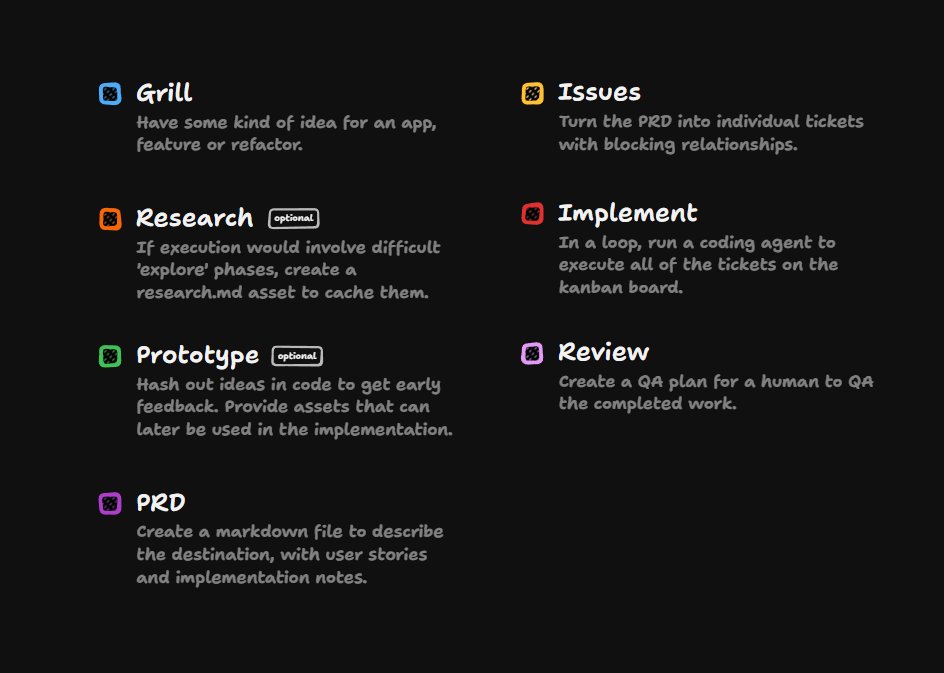
Here are my 7 phases of AI-powered development.
I've been thinking that the pre-PRD phase needs more structure. You need to figure out the shape of the design tree first, before then walking down it with higher-fidelity prototypes.
In other words, /grill-with-docs needs to change again IMO
🚨 THIS IS HOW $SPCX ACTUALLY PLAYS OUT FROM HERE
Day 1 opens with a pump - retail floods in, peak FOMO, headlines everywhere
Insiders sell into every green candle
That's not cynicism - that's how 93% of major IPOs have behaved historically
Then comes the part nobody talks about on launch day:
Months of slow bleed while retail holds and prays
Momentum fades, attention moves on and another narrative takes over
Most day-one buyers end up underwater - sometimes for years
Meta IPO'd at $38 in 2012, dropped 53% in 100 days
The people who waited 6 months bought at $17 from the people who bought the hype
Same pattern now
$1.77T valuation at listing with 95% insider ownership is not an entry point
It's an exit point - just not yours
Two ways to play this:
1. Buy today and fund the insider unlock schedule
2. Wait until nobody cares, valuation reflects reality, and you buy from the people who bought from them
Same asset, six months apart - completely different trade
I'll be watching the 6-month window
Follow + notifs on, I will keep you updated
WE ARE SOOOOO BACK!
Someone leaked the Claude Fable 5 system prompt and ran it on an Opus 4.8
Output is like 90% of the real thing
Turns out half the magic was never the weights. It was the prompt the whole time
Repo down below:
@chamath The rules of engagement are being redefined. Their model shifts also place a big risk agentic production deployment. And now the bedrock mandated data sharing rules of use for Fable.
At this point every CEO should be asking what their strategy is to avoid model lock-in.
If it isn’t clear what Anthropic is doing, it is:
- build something amazing
- decide who gets to use it after you prompt it if the prompt falls into areas they deem unacceptable by their sole standard
To be clear this is completely above board and legal. It’s just an idiotic risk for corporate users to bear especially as the coding models become equivalent.
The business continuity risk will become more obvious as companies accidentally trip over Anthropic’s ToS and have to decide if they will subsume their business viability to them by doubling down on Anthropic models or find open source (and, btw, much cheaper) alternatives where they are in control.
As stated previously, get ready to be inundated with the term “control plane” which is the natural solution to this problem.
Shameless plug - this is what 8090’s been building as we expected this moment to arrive…
If you’d like to learn more: https://t.co/fkfTXgdfXK
Google released Gemma 4 12B, a multimodal model that runs text, images, and audio on 8GB VRAM!
We'll fine-tune it to master chess and predict the exact next move.
Tech stack:
- @UnslothAI for efficient fine-tuning.
- @huggingface transformers to run it locally.
Let's go! 🚀
We’ve added two security improvements to Claude Managed Agents.
Self-hosted sandboxes keep the agent’s execution environment in your infrastructure or with a managed sandbox provider.
MCP tunnels let the agent connect to services inside your security perimeter.
What are best practices for running Claude Code at scale?
New blog post on what we've learned from teams running it across multi-million-line monorepos, decades-old legacy systems, and distributed microservices:
https://t.co/rJUYlIUiTT
Start "claude agents" in a high level directory with all your repos in it (for me thats ~/Projects).
It keeps track of which sessions need your input and makes it really easy to resume and pick up where you left off.
code review check..from claude.
me: there is no process_record method on https://t.co/7lhJEb5boV - did you review it properly?
claude code: You're right — I didn't verify. Let me actually check.
Somertimes makes me want to clawd your eyes out