📢📢Excited to announce the " Multiscale Modelling with MOOSE" tutorial to be held at CNS 2025!
Please register and join us at https://t.co/7KwgADgNDA
📅 July 5-9, 2025📍Florence, Italy
Important dates https://t.co/z6ykH61wKY #Neuroscience#CNS2025#Tutorial#conference#MOOSE
Announcement: The deadline for submitting applications for 𝐂𝐀𝐌𝐏 𝟐𝟎𝟐𝟓 has been extended to May 12th May, 2025. Please spread the word. Good luck to all the applicants. Apply at https://t.co/EFH8dU0D5d
#camp2025#neurosciencemeetings
Finally a new textbook for theoretical neuroscience. Xiao-Jing Wang wrote a nice book with very broad coverage of the field. Highly recommend. https://t.co/uIDmpHvPYO
Mark your calendars!! 🗓️
The first Young Biophysicists Meeting will be held on the coming Monday (March 3rd) from 11am - 12pm EST. We have four exciting talks lined up for you, see you all soon! Find out more : https://t.co/o7wWR8FzwM
Have you ever wondered how zebra stripes 🦓 & sunflower spirals 🌻form? The secret lies in the Turing oscillator—where reaction & diffusion create spontaneous patterns!
Simulate a 1D Turing Oscillator with MOOSE! https://t.co/HyurA3mxPR
#MOOSE#TuringPatterns#EmergentBehavior
New preprint alert from the lab! Also you can hear an auto-generated 40 s audio summary here:
https://t.co/VhVveLXG66
More details on this exciting paper will follow soon!
@NCBS_Bangalore
The push towards hypothesis-driven research is one of the key mistakes in the neuroscience field. In exponentially sized hypothesis spaces it simply is not a useful way of making progress. The convert-new-tech-into-hypothesis-progress industrial complex is a problem.
Sci-Hub and Library Genesis has been defined in the literature as 'Black Open Access' model. In the last few months I've been working on a paper, where I explain that Sci-Hub is actually 'Red Open Access' while Library Genesis can be understood as a subtype of 'Green Open Access'.
The preprint is available here: https://t.co/i3lLSRcsqg commentaries and criticisms are welcome. You can send them to me by email.
The picture with Sci-Hub's statistics comes from that paper. The number of PDF downloads from Sci-Hub per month, 2016-2023. Surprisingly, the usage of the website only increased after 2020, and that is only counting statistics from original website, not even counting numerous Sci-Hub mirrors!
You can do that even now. Upload the pdf to chatgpt or Gemini and ask away all your queries. That's how I've been going through a bunch of papers in the last couple of months.
In his latest column, Mark Humphries @markdhumphries imagines the ultimate systems neuroscience paper—and proposes new ways of interacting with data. https://t.co/sS3w8kedif
As a long-term signatory of the Declaration on Research Assessment, we thank @DORAssessment for this supportive message. There has been an ongoing move away from journal-level metrics; we hope this will only accelerate now.
https://t.co/dvQXSYp2wN
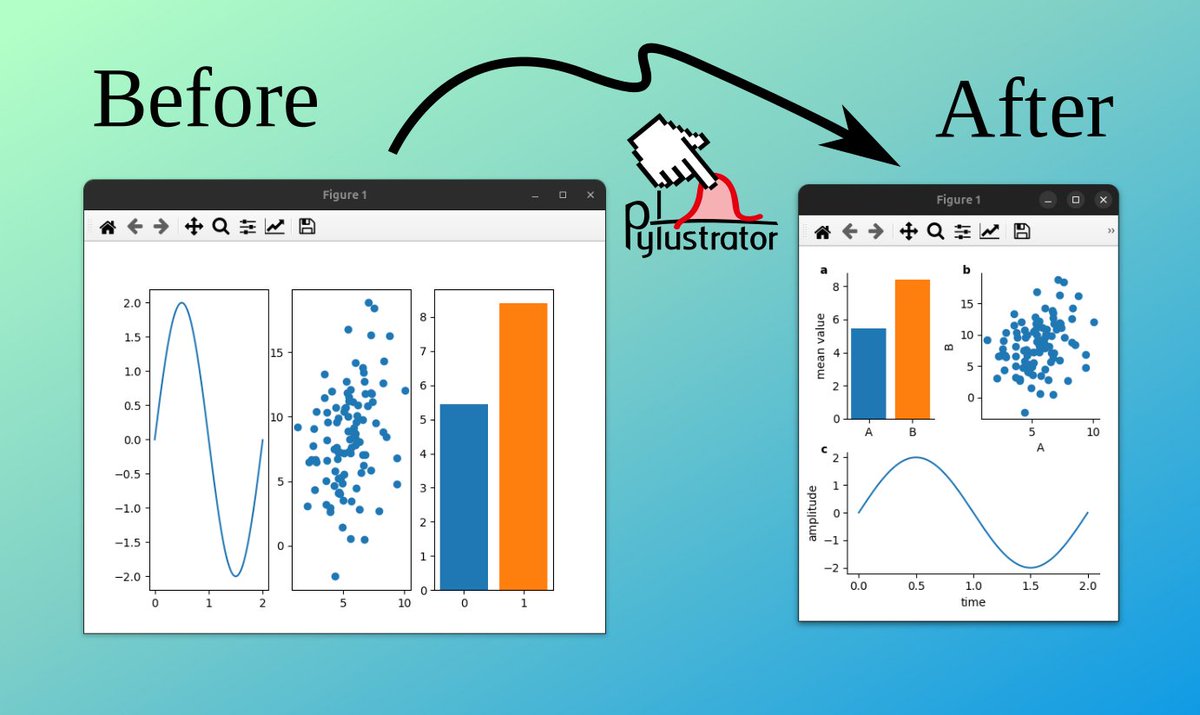
🎉 Great news! Pylustrator, my open-source tool for creating publication-ready @matplotlib plots, works seamlessly with the latest Matplotlib version! 🖌️✨ Curious how it can transform your figures and save your changes as reproducible Python code? Let me show you! 🧵👇
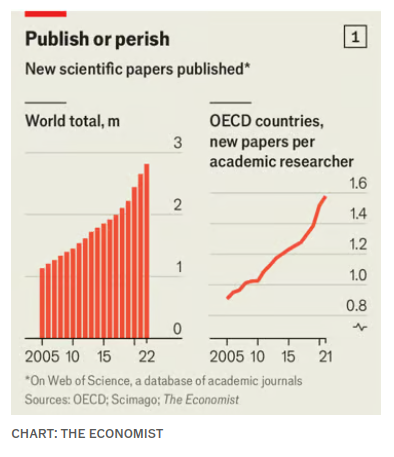
We churn out more & more papers *per scientist*, at an increasing pace, in a rapidly changing publication landscape.
Why? How? Want to make sense of this?
In a new paper just published in Quantitative Science Studies we dive in & look for answers.
https://t.co/GoCYtL1Snp
Even after 70 years of Hodgkin-Huxley models, gaps remain in our understanding of neural dynamics. Developing accurate neuronal models could bridge these gaps and provide deeper insights into the emergent behavior of biological neural networks in both health and disease. 11/n
In addition to elucidating the mechanisms underlying DBLO, which will result in more accurate and reliable models, we also provide a novel way to characterize a neuron’s morphological and electrotonic characteristics via its wide-spectrum impedance amplitude profile. 10/n