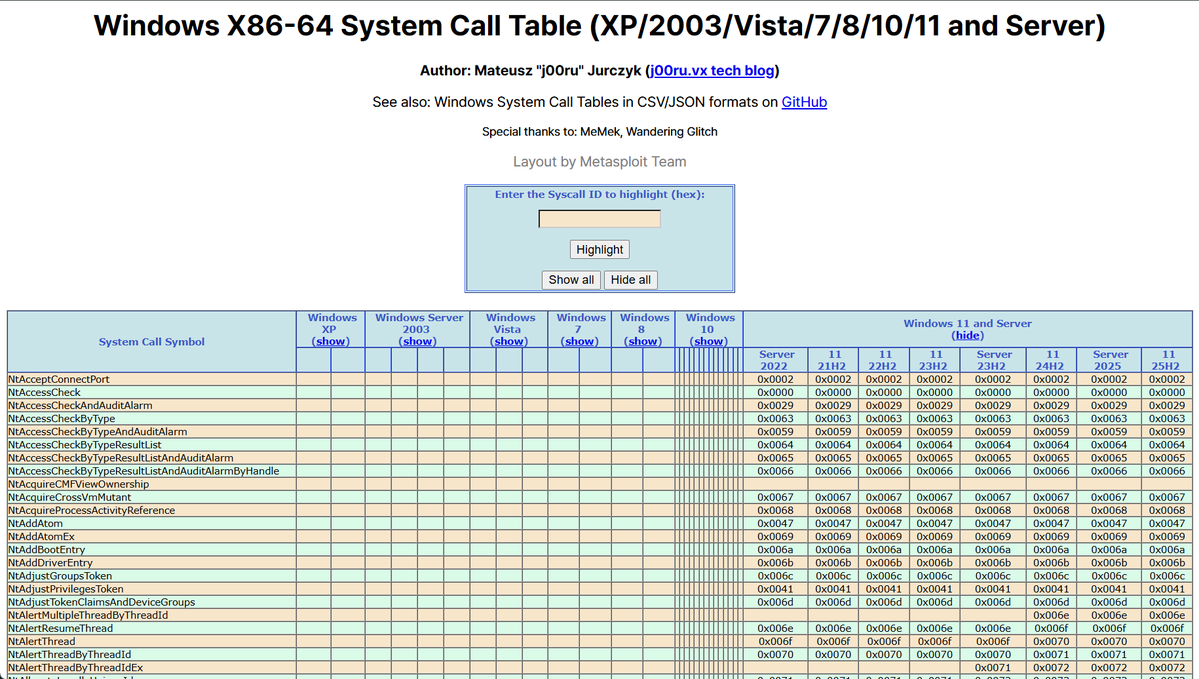
If you do Windows internals / reversing, bookmark this.
@j00ru's syscall table tracks x86-64 Nt* syscall IDs across Windows XP all the way through modern Windows 11/Server builds.
Great for version diffing, old sample analysis, syscall-stub validation and generally answering “what the hell was 0x72 on this build?”
https://t.co/POXiAnTN2n
Dual-ISA CPUs are weird, but surprisingly common in IBM land.
The 615 was one of their worst bets.
In the 90s, the company deeply deeply thought PowerPC was going to win. The problem was, the existing corpus of software was all written for x86.
IBM envisioned a brief “middle period” where customers would want to dip their toe into PPC, but weren’t 100% committed.
So, they designed a CPU that could run both.
Supposedly, switching x86 to PowerPC supposedly only took 5 cycles! Kind of amazing tbh, esp when you think about how much state would have to be saved/restored.
The idea was DOA however, because Microsoft absolutely refused to give any level of OS support. The chip is now only found in employee’s “pendants, earrings and the like” (lol).
The funny part is, IBM literally can’t keep the idea out of their heads. Their idea of a “universal OS” with “universal hardware” that can run any customer workload has been a recurring theme for over 50 years!
I’m not *insanely* surprised with their modern Dual-ISA cpu they just announced (ARM+Power) at hot chips…but it is pretty funny to see it crop up again and again.
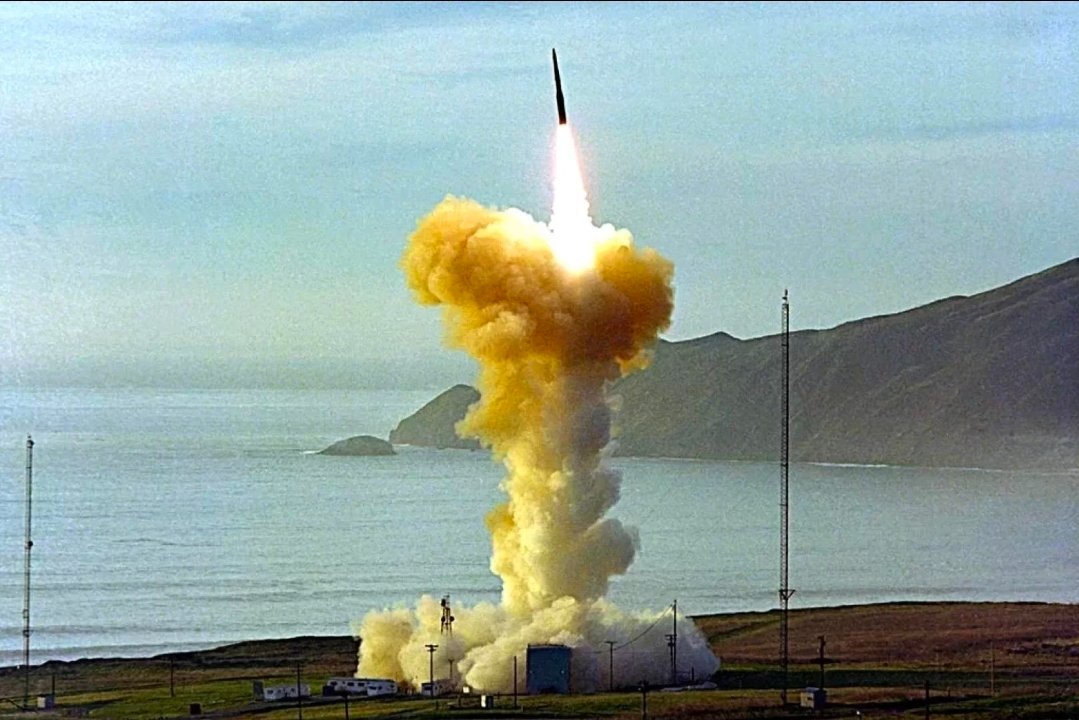
The Minuteman III's original guidance system was built around technology from an entirely different era of computing.
Its D37D flight computer was eventually replaced by the newer NS-50 guidance computer, beginning in 2000.
The D37D used a serial digital architecture and had an incredibly small amount of memory by modern standards.
Yet it performed real-time guidance and flight-control calculations, generated steering commands, and controlled critical flight functions.
Imagine a nuclear missile relying on a computer whose technology was designed in the 1960s.
@10xMikasa i have stopped using reinterpret_cast and static_cast also stopped understanding the drama behind it, just use plain c typecasting it's less powerful but at least predictable
On April 19, 2021, NASA's Ingenuity helicopter completed humanity's first powered, controlled flight on another planet.
The brain behind the flight? An open-source Linux kernel running NASA JPL's F′ flight framework on a standard, off-the-shelf smartphone processor.
From consumer smartphones to the surface of Mars, open-source software continues to push the boundaries of where technology can take us.
https://t.co/iJNvhqquLh
Video Credit: NASA/JPL-Caltech
#Linux35
We analyzed and distilled the whole tpot, and discovered that all developers fall into one of four quadrants.
Each quadrant is represented by an archetype: @tsoding , @dhh@ThePrimeagen, or @theo.
Where do you belong?
a physically based ray tracer fits in just 99 lines of C++
real reflections, refractions, soft shadows, and color bleeding
using just vectors, rays, spheres, and one recursive radiance() function
give it thousands of samples per pixel and it renders a Cornell box with mirror and glass spheres
this is smallpt by Kevin Beason, 2008
This book is a gem released early this year. By Victor Eijkhout, the mind behind "The Art of HPC" book series. If you love modern c++ and HPC this is a must