If Israel’s defense-industrial base becomes structurally fused with America’s, weapons pipelines, joint R&D, shared data infrastructure, then cutting off or conditioning military support becomes an act of self-harm to US defense capability too, not just a foreign policy choice. That’s the whole point of building it this way. It makes future leverage over Israeli conduct, on settlements, on Gaza, on anything, much harder to exercise, because pulling that lever now damages both sides’ military infrastructure, not just Israel’s.
@iang_fc@ThatHemiKid@EvanWritesOnX Macro structural incentives doesn’t mean everything micro is theatre and a “act” such as tensions, conflicts etc
Evans macro perspective eats micro geopolitical events and spits it out to confirm his macro world view
@Geopolitics_AoE Future proofing the alliance against public opinion shifting
Israels plugging into the largest military ecosystem with a trill+ budget
It gets scale, decades of procurement, politically more protected so isn’t just one sided
Imaging landing the largest investor on earth
NETANYAHU CONFIRMS US-ISRAELI MILITARY MERGER
In a recent appearance on Fox News, Isr*eli Prime Minister Benjamin Netanyahu confirmed that the US and Isr*eli militaries will effectively emerge, saying that their relationship is transitioning “from aid to partnerships”
Netanyahu described a model of "co-investment" in new defence technologies, aiming to integrate Isr*eli military research directly into the Pentagon’s capabilities.
But while this is framed as a move toward a more balanced "two-way" cooperation, the announcement signals an unprecedented entrenchment of the Isr*eli military apparatus within the US' defence architecture.
This official confirmation comes as the US Congress has already begun quietly facilitating this integration behind closed doors.
The timing is notable, given how the deepening of the US-Isr*el alignment is advancing even as public support for Isr*el hits historic lows across the American political spectrum.
As funding from the pro-Isr*el lobby increasingly becomes an electoral liability for mainstream candidates, this move appears designed to bypass democratic dissent by locking Isr*el into the bedrock of American military infrastructure.
Thus, by moving from aid to deep institutional co-dependency, Isr*el is insulating its security requirements from shifts in US public opinion.
Amid a growth of sentiments against unconditional US military aid to Isr*el, even within an American Right that has been a traditional source of support for Israel, the US-Isr*eli military merger secures Isr*el's role as an extension of US power projection, effectively cementing the military alliance regardless of the political climate in Washington.
@Geopolitics_AoE Oh so Iran secretly sent the weapons to get caught so Syria could use those supplies to destroy their own ally..
Thing is they were trying to tie the MOU to include a ceasefire in Lebanon also so doesn’t seem it’s their intent
@EvanWritesOnX Wouldn’t a sanction free Iran emerge stronger based on this logic? Rather than submitted to Saudi.
It has raw ingredients (educated population, industry, resources, geography) = latent potential that’s been kneecapped.
China started competing with the people who invested in it
@EvanWritesOnX Contradictory word salad: hardliners are defeated AND capable of derailing the deal/transition.
“It bets that the resulting regional fire will either force the American patron to flip to broader Israeli freedom of action or collapse the US-Iran framework before it consolidates”
@TheAnalysisMan @EvanWritesOnX Got there via different scenario 2?
Oil was hitting 140
Energy is the base of the system = shock has cascading affects = structural pressure for off-ramp
Didn’t need a master plan for this to be a short war.
Falls in line with JP Morgan’s timeline too 4-6 weeks before pain
LOL on March 3rd he wrote that Scenario 2, escalation, gulf infrastructure strikes, brent above $100, conflict extending from weeks to months, would make his theatre thesis "functionally irrelevant."
By his own standard, his thesis is now functionally irrelevant.
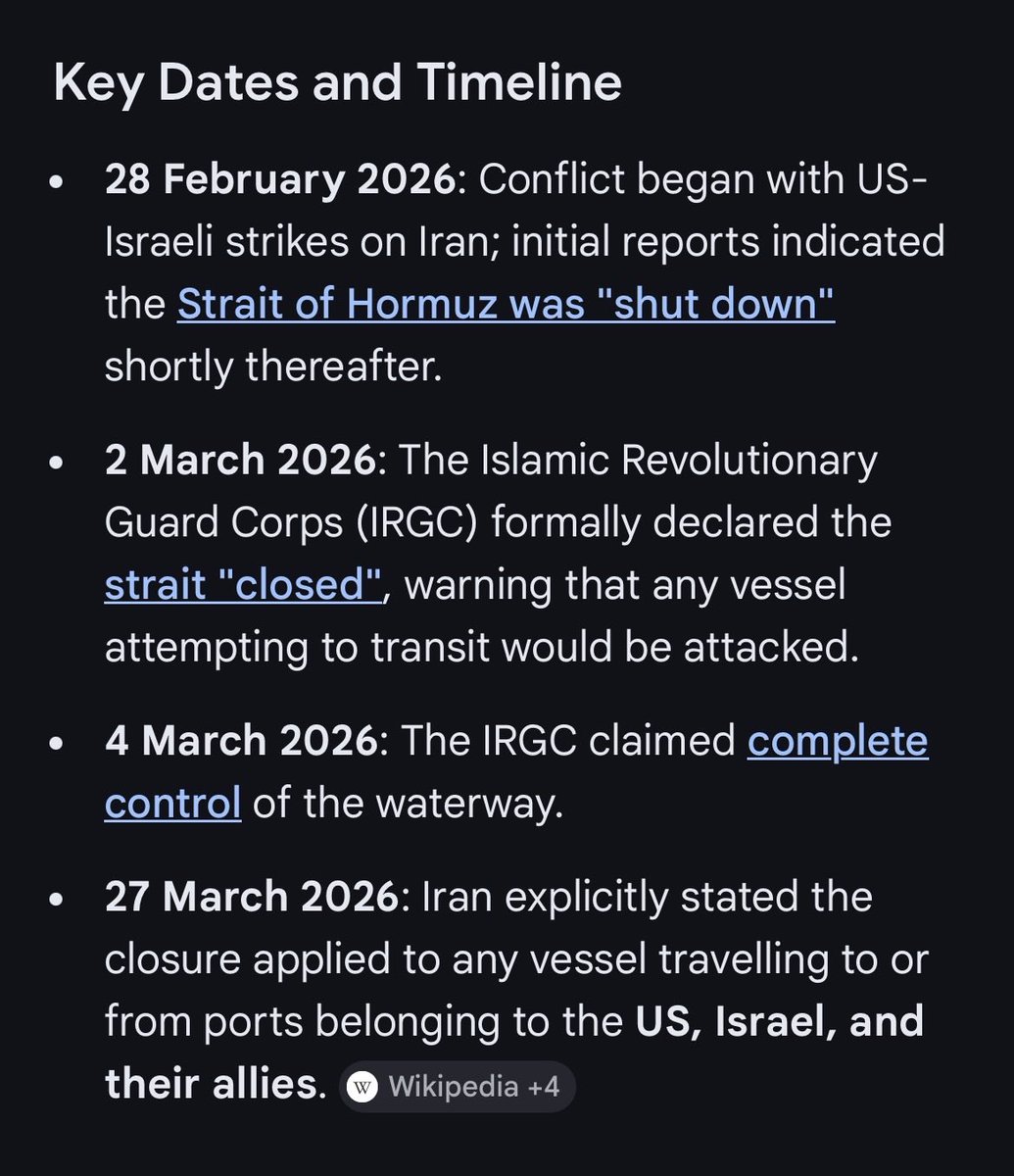
We have a 48 hour ultimatum to open Hormuz. We have brent above $100. We have Ras Laffan extensively damaged, Qatar in force majeure, Kuwait's refinery struck, UAE infrastructure hit repeatedly, and an American pilot that was being hunted by Iranian civilians in Kohgiluyeh province. The Israeli ground operation in Lebanon is taking daily losses without consolidating a single town. Three US Army generals including the commander of Special Operations were fired yesterday. Iran has not tapered. It has escalated horizontally across eight simultaneous domains for 33 days.
The deeper analytical error in his framework is the complete removal of Iranian ideology from the Iranian calculus. A predetermined managed outcome requires both parties to accept the management. You modeled the IRGC as a rational financial actor. The IRGC is a revolutionary institution that has been attacked, bombed, and had its Supreme Leader killed. Revolutionary institutions under existential pressure do not optimize for managed outcomes. They fight.
He identified the structural incentives correctly. He misidentified who controls the outcome.
@EvanWritesOnX Semantics / technicalities aside, it’s closed enough to have US scrambling to open it, which they may give up on and spin as a win
Game theory doesn’t mean fake
Technically Putin also calls his war a special op. Russia also seeks leverage at the table via the battlefield.
@lebkitt@0xcoked@EvanWritesOnX How can one be wrong if they say anything less than WW3 is thatre when WW3 is already the least likely due to MAD. Ukraine is theatre too then.
He’s providing clarity in fog of war, but the lens itself is oversimplifying things to one causal factor behind them - TPS
@frc7150@abdelhakimc26@EvanWritesOnX That’s a major flaw then, because every Western gov move is being explained as TPS behind it when it could just be states doing their thing.
Hence the need for theorising things.
He said anything less than WW3 is theatre , then everything is theatre as WW3 is unlikely (MAD)
@abdelhakimc26@frc7150@EvanWritesOnX I thought the TPS captured Western govs and they want Saudi / multipolarity. So then that means they obviously haven’t to the degree Evans lens suggests.
@IconusClustus@savonarolapitas@EvanWritesOnX Game theory is just observing human behaviour,
conspiracy theory is assuming every event is done by colluding elites
though elites do coordinate events in real time to bring those events to a end once they’ve begun
Evan’s bar for fake war is anything less than WW3
@daveunder101@EvanWritesOnX Russia hasn’t taken out entire grid or decapitated leadership.
Wars are conducted with selective targeting and constraints.
It would be a dumb, not dominant strategy for Iran to hit third party (allies) interests and drag in other actors.
Alternate universe to think otherwise
What people thought America could be - a beacon of democracy - was the last thing it became. In reality, it’s a corporate machine that has given rise to the Transnational Private Sector (TPS).
The TPS is a coalition of corporate giants, led by the Financial-Industrial Complex (FIC) with firms like JPMorgan, Goldman, and BlackRock, alongside the Military-Industrial Complex (MIC), Consumer-Industrial Complex (CIC), and Techno-Industrial Complex (TIC).
This collective force operates beyond borders, transcends nationality, and prioritizes profit over public welfare.
When Jamie Dimon, JPMorgan’s CEO, warned in October 2024 that wars in Ukraine and the Middle East could destabilize the global economy, he wasn’t just forecasting. He was asserting the TPS’s dominance over policy.
To understand this power, you have to examine the game theory driving the TPS’s clash with nations.
This concept that I have developed deliberately sets aside the idea of good, evil, right, or wrong. Geopolitical dynamics are examined through the lens of incentives, power, and measurable outcomes, not moral judgments. The focus is the strategic interplay of actors, stripped of ethical narratives.
___
Game theory provides a framework for understanding geopolitical strategies by analyzing the incentives that drive actors’ decisions.
There are two distinct game types: finite and infinite. Both these games shape global interactions. Finite games are zero-sum with defined endpoints, and clear winners and losers. It’s akin to a corporate quarter where profit maximization is the sole objective.
One player wins, the other loses.
Infinite games, conversely, lack a conclusion, have no end, prioritizing sustained participation through long-term stability, akin to a nation’s multi-generational survival strategy.
States operate within infinite games.
They do not expire. They do not tap out.
Their permanence compels them to prioritize enduring stability over immediate gains. For instance, China’s $1 trillion Belt and Road Initiative, spanning decades, secures global trade networks to ensure long-term economic influence. BRICS nations, through $10 billion in yuan-based trade, foster mutual economic resilience for mutual prosperity.
This cooperative approach engenders a form of morality rooted in reciprocity: mutual support today ensures mutual survival tomorrow. Such strategies reflect a commitment to societal development and stability, as states must maintain legitimacy and resources for their populations over time.
The TPS operates as a corporate entity, fundamentally detached from societal obligations. Unlike states, the TPS bears no responsibility to citizens, public welfare, or long-term development. Its imperative is profit maximization within finite time horizons, driven by shareholder demands and market cycles.
This corporate structure compels the TPS to engage in finite games, where immediate financial returns supersede all else. For example, the TPS’s imposition of significant tariffs on global nations in 2025 aimed to secure economic leverage, prioritizing short-term gains over regional stability. Such actions reflect a rational, amoral calculus: profit is the sole metric, unburdened by considerations of societal impact or ethical norms.
Finite games, by their nature, foster amorality. The TPS’s focus on short-term victories - such as market dominance through military coercion, currency wars, tariffs, and resource extraction - disregards long-term consequences, as corporate entities are not accountable for societal fallout.
In contrast, infinite games cultivate morality through sustained cooperation, as states must invest in trust to ensure their longevity.
The TPS has been playing finite-game rules in an infinite-game arena. When this happens, we have a mixed, unbalanced game.
A mixed game provokes backlash.
Picture a player disobeying the rules.
That's your TPS.
And it is banding states together against it to rebalance the game. The BRICS formation or the systematic de-dollarization initiatives are a strategic response, realigning global power to counter TPS dominance.
It's the game recorrecting itself.
This interplay of mixed-game dynamic is where the TPS’s amoral, zero-sum, profit-driven maneuvers clash with states’ cooperative, stability-oriented strategies.
A payoff matrix illustrates this easily.
1. The TPS secures immediate profits but risks isolation as states band together.
2. States achieve gradual stability but sacrifice short-term gains.
The TPS’s corporate nature - unencumbered by societal duties - locks it into finite games, while states’ obligations to their populations drive infinite-game cooperation.
This tension, rooted in divergent incentives, underscores the global struggle between short-term profiteering and long-term resilience, setting the stage for the TPS’s operational framework.
___
What is the TPS?
Picture the TPS as a colossal corporate skyscraper, its gleaming glass facade reflecting trillions in valuation that makes entire economies appear as a speck of dust.
At its pinnacle, the FIC - JPMorgan, Goldman, BlackRock, Vanguard, etc. - occupies the C-suite, a sleek executive suite where profit reigns supreme.
Below, the building hums with activity: the MIC (Lockheed , Raytheon, etc.) fortifies the security wing, the CIC (Exxon, Coca-Cola, Pfizer, Walmart, etc.) drives the bustling sales floor, and the TIC (Apple, Amazon, Microsoft, Nvidia, etc.) powers the innovation labs.
Each department operates with calculated precision, yet all answer to the FIC’s shareholder-driven directives, tethered to a singular goal: maximizing returns, unbound by borders or public welfare.
This skyscraper’s foundation is the United States, not as a sovereign nation but as a subjugated platform, meticulously engineered to amplify the TPS’s global reach. Decades of deregulation - culminating in the 1999 Glass-Steagall repeal - dismantled barriers, granting the FIC unchecked freedom to amass trillions.
Tax breaks and billions in defense budgets fuel the machine, while the US government, reduced to an extension of the TPS, prioritizes corporate efficiency over its citizens.
These American citizens are left to navigate the fallout. Mounting debt, eroding wages, while the TPS pursues wealth on a global stage. The Federal Reserve, calibrating monetary policy to stabilize markets, stands ready to pivot when BRICS’s multipolar trade order emerges, ensuring the TPS remains a formidable force in a restructured economy.
Unlike states, bound to their people and long-term development, the TPS owes nothing to society. Its corporate essence - divorced from public accountability - drives its finite-game strategy, where profit trumps all. This skyscraper doesn’t serve nations; it commands them, reshaping the global order to its design.
Let’s rewind back to the post-World War II era, when the MIC commanded the C-suite of the TPS. In those days, the MIC titans like Lockheed Martin and Raytheon held the ultimate power, with ample defense budgets out of taxpayer pockets fueling a war machine that defined America’s global reach. Fresh off its victory as a superpower, the US wielded unmatched military might, and the MIC capitalized on this dominance to shape foreign policy.
Every contract, every missile, reinforced its grip.
When nations resisted the TPS’s economic orbit, the MIC responded with unrelenting force. Iraq’s Saddam Hussein dared to sell oil in euros in 2000; by 2003, a NATO-led invasion, backed by $100 billion in MIC contracts, dismantled his regime, securing $500 billion in oil reserves. Libya’s Muammar Gaddafi pushed anti-dollar policies in 2011; NATO’s barrage, fueled by $160 billion in oil deals, reduced his government to rubble. The MIC’s dominance stemmed from a simple truth: war was profitable, and its C-suite reign ensured the TPS thrived on conflict, unburdened by societal costs.
The tide started to shift in the 1980s, as financial deregulation reshaped the skyscraper’s power structure. The 1999 Glass-Steagall repeal, among other reforms, unleashed the FIC to amass unprecedented wealth, with their trillions in collective asset pool out-sizing economies by the 2000s. The FIC mastered hedging, by betting on every market outcome - guaranteeing profits whether markets soared or crashed.
Unlike the MIC, reliant on wars, or the CIC, vulnerable to disruptions, the FIC thrived in any climate, pocketing billions in equities trading during stability or significant derivatives profits amid chaos. By 2015–2020, the FIC, sensing greater collective returns, orchestrated a quiet coup, redirecting the TPS toward diplomacy through billions in Gulf energy deals that bolstered TIC’s innovation and CIC’s margins.
The FIC is unique in the sense that its role transcends coordination. It hedges against its own departments, ensuring profits even if they falter. If the CIC’s retail collapses or the MIC’s wars misfire, the FIC shorts their stocks, securing significant derivatives profits. This ruthless pragmatism drives its push for Middle East stability, as war disrupts the lucrative Gulf partnerships. The FIC is also accelerating the BRICS’s $10 billion yuan-based trade order, positioning itself to profit in a multipolar future.
Consequently, within the TPS skyscraper, an inner game theory unfolds - cooperative yet fiercely competitive.
When cooperative, the TPS is absolutely devastating. In Iraq, Libya, and Ukraine, the MIC’s destruction paved the way for CIC’s cheap imports and FIC’s oil bets, reaping billions while nations crumbled. It threatens Iran with MIC-led war to sweeten billions in Gulf deals, boosting TIC’s tech contracts. It instigates currency wars on Turkey, devaluing the lira, so CIC’s Marriott locks in tourism profits.
Competitively, the FIC wields departments as leverage. It will coordinate with other departments for collective gain but it will also defect for better return on investment. It will conduct tariffs adversely affecting the CIC if it means vassalizing states in the future. It possesses calculated pragmatism capable of supplanting the MIC’s warlord era to steer the skyscraper toward stable profits in any climate.
Not just wars and destruction.
___
Today, the FIC commands the C-suite, and it is orchestrating a strategic trifecta that reshapes the global order with calculated precision.
From its executive suite, the FIC surveys a world in flux, deploying three interconnected maneuvers.
Consolidation. Vassalization. BRICS alignment.
The goal?
To secure unrivaled dominance in a multipolar world.
Each move, executed with the amoral pragmatism of a finite-game strategist, positions the TPS to thrive in the present while engineering a lucrative foothold in the emerging future.
First, the TPS consolidates power within the US, its subjugated platform, by acquiring struggling small and medium enterprises (SME's) battered by tariffs and policies championed by its FIC mouthpiece, President Trump. In 2025, these tariffs - essentially taxes on imports - have spiked costs, squeezing SMEs reliant on global supply chains. The FIC, sensing opportunity, sweeps in, buying up these firms at bargain prices, folding them into the TPS’s vast empire. This consolidation strengthens the CIC and TIC, ensuring the skyscraper’s domestic foundation remains robust while smaller players falter. It’s a ruthless finite-game play: the TPS absorbs weakened assets, bolstering its retail engine without regard for local communities or economic equity.
Second, the TPS vassalizes vulnerable nations, tightening its global grip. Tariffs targeting over 20 export-dependent countries - not accounting for the EU - have crippled their economies, crashing markets and eroding confidence. The FIC steps forward with predatory aid, offering loans and significant bond investments, like BlackRock’s new stake in German bonds last quarter, to stabilize budgets. These lifelines come with ironclad strings: debt binds nations to TPS agendas, transforming them into exploitation hubs stripped of autonomy. Governments, desperate to survive, cede control over resources and policies, their sovereignty reduced to a footnote in the FIC’s ledger. This vassalization mirrors the MIC’s historical conquests but swaps bombs for bonds, a subtler yet equally devastating finite-game victory.
Third, the TPS accelerates the rise of a BRICS-led trade order, not as a rival but as a future arena for profit. By fracturing the dollar’s dominance through tariffs, the FIC paves the way for BRICS’s $10 billion yuan-based trade system, a multipolar framework gaining traction. This is no accident. The TPS is positioning itself to dominate this new order. Investments like significant stakes in BRICS bonds and billions in Gulf partnerships ensure the FIC’s influence spans both systems. The Federal Reserve, attuned to this shift, stands poised to recalibrate monetary policy when the time comes, keeping the TPS’s financial arsenal sharp. In vassalized nations, the TPS entrenches itself, ready to dictate terms when BRICS consolidates.
The TPS’s trifecta is operating with surgical precision and chilling efficiency. Small and medium enterprises, crushed by tariffs, vanish into the TPS’s portfolio, bolstering its domestic empire. Export-dependent nations, along with Europe, kneel under the weight of FIC debt with their economies reeling, reduced to vassalized hubs serving corporate whims. The BRICS’s new trade order, quietly fueled by the TPS’s tariff-driven fracture of the dollar system, rises with the FIC’s fingerprints all over it.
This is game theory’s mixed-game dynamic unfolding: the TPS’s finite-game trifecta pursuing immediate profits, where its amoral payoff structure prioritizes short-term dominance over societal stability.
Yet, each of these zero-sum moves provokes states to embrace the infinite-game cooperation model.
The BRICS’s trade bloc iterates strategies to counter TPS hegemony, by seeking long-term equilibrium through reciprocal trust. The FIC, anticipating this, adopts a dominant strategy: hedging with Gulf partnerships and BRICS bonds by dangling MIC threats to profit in any outcome.
The FIC envisions a future of a restructured skyscraper, with its C-suite commanding a BRICS-aligned trade order, with vassalized states as mere cogs in the machine.
This isn’t adaptation.
It’s the TPS leveraging finite-game aggression and infinite-game foresight to rewrite the global rules once again, ensuring its dominance in a multipolar world.