The era of System One Vision Model is here! Introducing VFlash: parsing the visual world in parallel at unmatched speeds for Physical AI.
Most embodied prediction tasks like object localization, robot trajectory planning, and dense 3D motion are fixed-length float vectors. For example, a bounding box is always 6 tokens, a 10-waypoint robot arm trajectory is 54: we know these beforehand. Instead of decoding one token at a time, we can output the entire geometric shape in one go.
VFlash enables up to 12x faster action decoding and a 5.1x overall robot inference speedup on edge GPUs like the Jetson Thor and DGX Spark. What’s surprising is that it ends up even more accurate than the VLM backbone, with up to 61% lower 3D trajectory error. The intuition is that VFlash avoids the cascading errors of autoregressive decoding, where every coordinate is written in ink and every later point loses the chance to backspace.
Everything that moves will be autonomous, and everything autonomous will need to think on its own chip. The next inference revolution is physical reasoning at the speed of reflex.
And as always, it’s open paper, open source! Link in thread:
Your AI videos look cheap? Send Opus 5.5 these 14 repos
HyperFrames. Blender. Remotion. GSAP. FFmpeg.
Voice, captions, 3D and render, all from code
Everything below is free:
Remotion Skills → official video-building guidance for your agent
https://t.co/eNG5a2aQJc
Blender → models, rigs and real 3D renders
https://t.co/QbeymTJoMy
faster-whisper → captions from any voiceover
https://t.co/yiMYGYEzYs
Chatterbox → open-source voiceovers from plain text
https://t.co/YahcFUYzYr
GSAP → UI motion and kinetic type on a timeline
https://t.co/8B97Y22Tkg
Blender MCP → Claude controls the Blender scene
https://t.co/QWCqTa15R2
Chrome DevTools MCP → your agent sees its own render and fixes it before export
https://t.co/FP7VMEEGC1
FFmpeg → encode, inspect and ship the MP4
https://t.co/HlJpuzR3nn
Remotion → compose and render video in React
https://t.co/znpMp7SpNi
Impeccable → polish, critique and audit any design
https://t.co/LUVwZwOvKe
Three.js → 3D in the browser, rendered on your GPU
https://t.co/BgbvnRcMUt
ComfyUI → the image and video generation pipeline
https://t.co/RN6kGEDwOT
yt-dlp → pull reference clips and audio from the web
https://t.co/3PYRYbzfqr
HyperFrames → write HTML, render video, built for agents
https://t.co/dOZZVJZopQ
Editor, voice actor, 3D artist → $0
Give the list to your Opus 5.5
Then go to the article below, it's my full Opus 5.5 motion design guide ↓
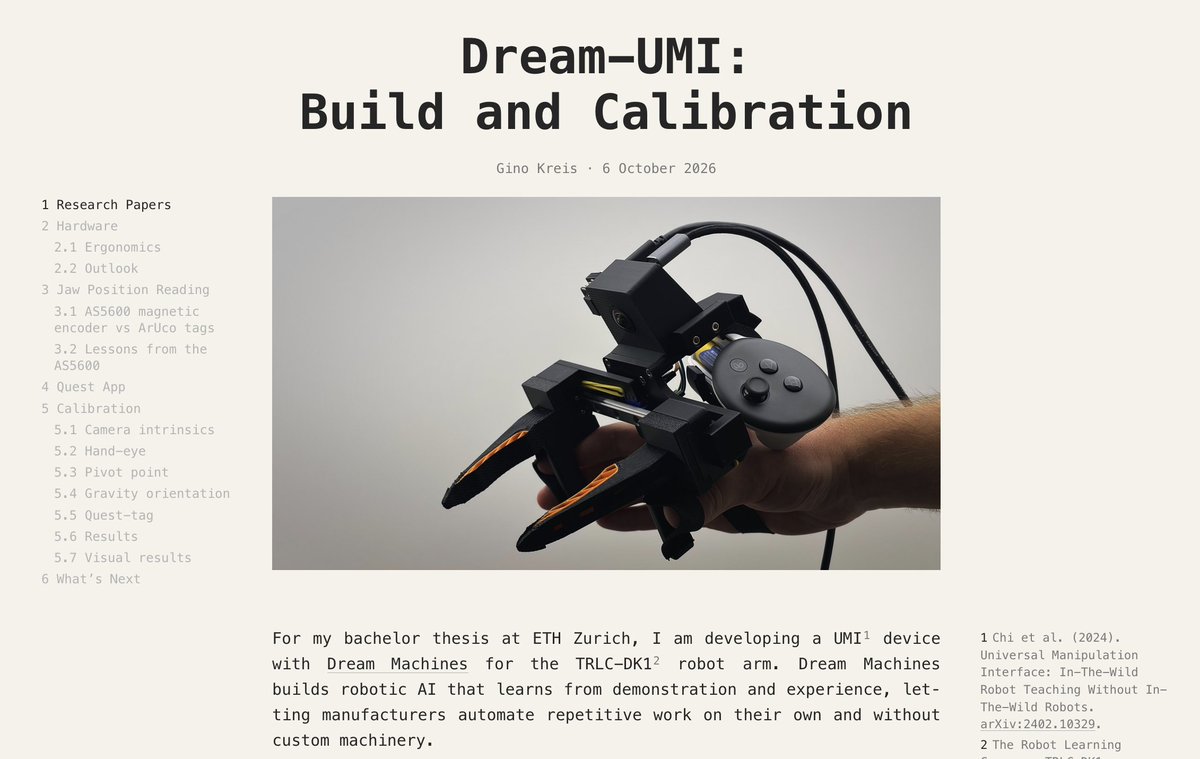
I've been building my own UMI gripper for the past month. Papers usually skip that initial phase, so I put everything in a blog post. https://t.co/w1gpL6IoCO
Unsure whether to use ArUco tags or an encoder? Unsure how to calibrate the VR controller? Have a read!
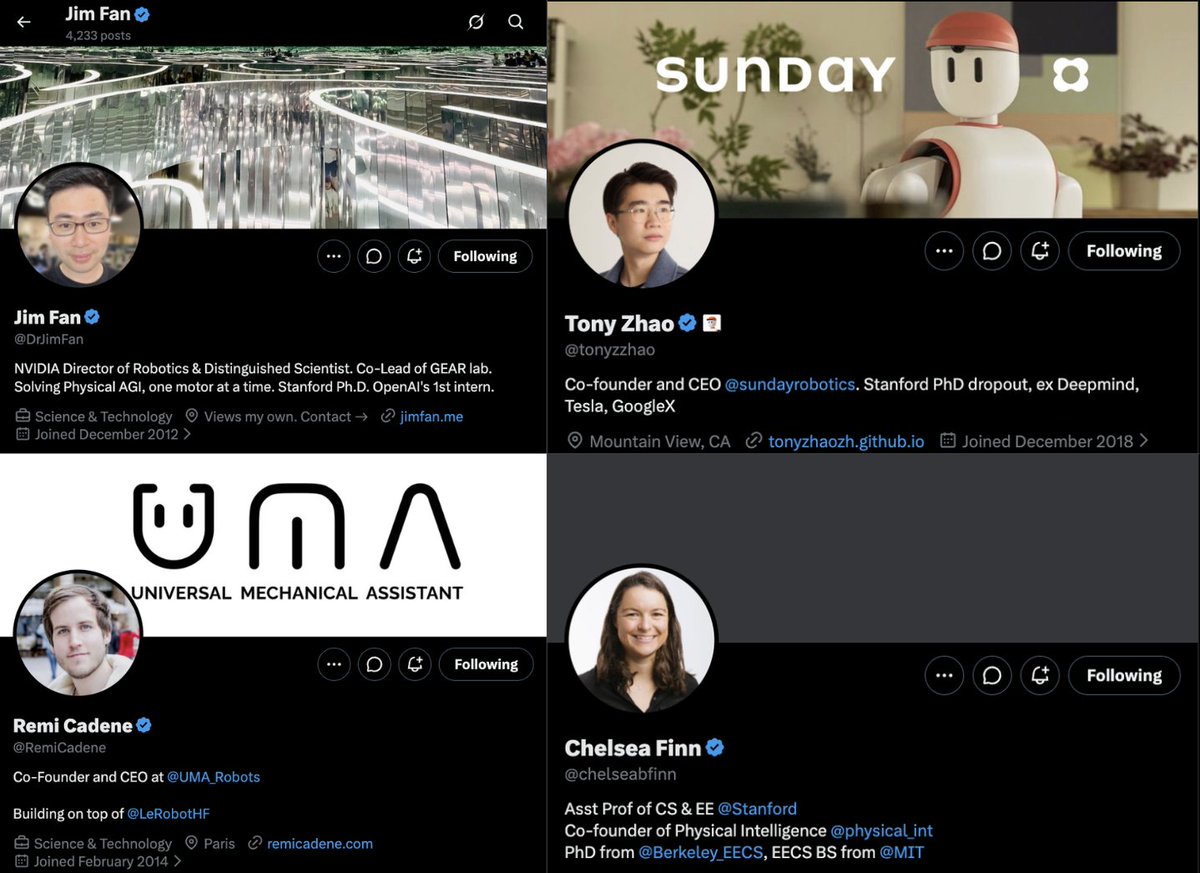
My top 5 robotics profiles that are 6 months ahead of the timeline:
- @DrJimFan
NVIDIA's Director of Robotics. co-leads the lab behind GR00T, NVIDIA's open humanoid brain
- @chelseabfinn
Stanford professor + co-founder of Physical Intelligence. teaches the free RL course, builds the robot brain
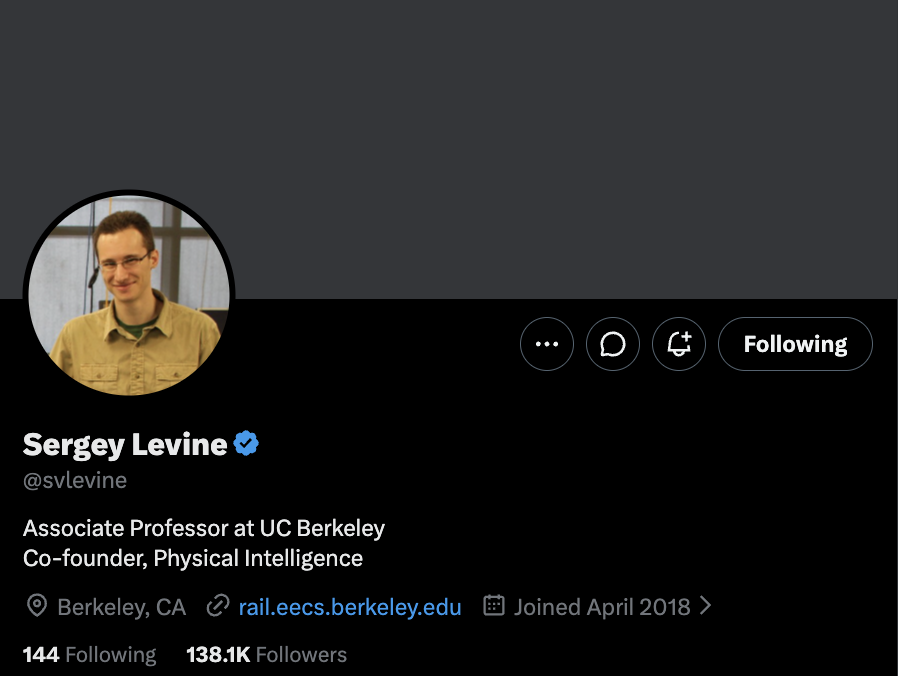
- @svlevine
Berkeley professor + also a co-founder of Physical Intelligence. one of the most cited names in robot learning
- @tonyzzhao
built ALOHA, then dropped out of a Stanford PhD to start Sunday Robotics
- @RemiCadene
started LeRobot at Hugging Face, now building robots on top of it at UMA
follow all 5 and you'll stop being surprised by robot videos
What can Astra do when given a humanoid embodiment?
We built HomeBody to find out. Controlled by GPT Astra, it carries out long-horizon tasks in a previously unseen kitchen—from tidying up across the room to retrieving remembered objects from ambiguous requests—without environment-specific training data or additional policy learning.
Here's how we did it 👀: https://t.co/FFGS2F7VtI
Introducing OM-1, our first robot foundation model, zero-shot generalizing to any robot: table-top arms, industrial arms and humanoids.
- learned directly from human manipulation data
- no teleop/robot data
- close to human-level dexterity and efficiency
- multi-robot collab
i gave astra a robot, a paint brush, and a camera then asked it to paint the golden gate bridge in real life!
it figured out how to control the robot, and progressively got better throughout its attempts. the timelapse is sick
We just hit 100M ARR within 10 months of starting deployments.
We are in factory lines. On construction sites. In kitchens. In data centers.
Cleaning. Welding. Building. Cooking.
Deploying.
GPT-6 does real2sim end to end from robot demonstrations.
I gave it only multi-view RGB and robot actions, and one simple prompt.
It calibrated the cameras, built the object assets, performed physics system-ID, ran MuJoCo, and rendered in Blender.
Transformer Transformer will be presented at #CoRL2026 🚀 See y'all in Austin!
Website: https://t.co/s7eimKcHbb
Video: https://t.co/YGQXUSZWLY
Paper: https://t.co/Biyu0r1J7N
Today, Figure is partnering with Nscale to deploy up to 100,000 GPUs on the NVIDIA Vera Rubin Platform
We're committing $3.5 billion initially, with plans to scale beyond $6 billion
To ship a robot into every home, we need a massive amount of compute
Atlas understands both the spatial structure of the world and how it evolves over time.
This lets us turn a handful of ordinary cameras into a "bullet time" multiview capture studio, capturing dynamic moments frozen in time.
Robot actions can be represented as motion in pixel space.
NVIDIA Research introduces Hydra-0, a generalist world model conditioned on action flow: image-plane trajectories that enable one model to learn across human hands, handheld grippers, single-arm robots and bimanual systems.
Explore the project 📄 https://t.co/pWnVAB4uSE