Splitting out awareness stages with separate campaigns is KEY, otherwise you'll always overspend on lower funnel ads which leads to no new audiences / high frequency.
We even split it out like this:
TOF
3rd party pages, LPs, long-form educational ads only (exclude 90-day buyers), we prefer ABO here so each new concept gets a fair chance.
MOF
Branded only (or UGC white-listed), short-form under 1 minute, product-focused angles only.
BOF
Mainly statics with offers, product benefits, scarcity, etc. (sometimes vids as well under 30 seconds with specific offers).
Optional: you can play around with scaling campaigns with bid/cost caps to get more spend on better days.
You can do this structure per country. Each time we implement this setup we see better NC ROAS after a few weeks and a healthier NC / RC balance, which results in more profit -> faster scale.
All One Shot! This was made on auto pilot with our AI agentic system.
Zero prompting. The system just decided to go this direction and made a pack of 50 vids.
I've never seen an AI format rip as hard as claymation is right now
Constantly in the top three performing creatives across 80% of our clients
They're not easy to put together though
Most people try once and give up because the workflow is hella complicated
Between character consistency, stop-motion feel & sound design all of it has to be dialed in or it looks like shit
We're producing them for multiple brands & have room for three more
If you're doing 50k+ a month and want creative that actually performs without spending weeks on production
DM me
Spotted this in the gout space and the writing is doing real work in a category that usually sounds clinical.
"Calm Flares: ease the throbbing, swelling, and bedsheet-can't-touch-it pain. Clear Uric Acid at the Source, not just mask it at the surface."
The magic word in there is bedsheet-can't-touch-it. every gout sufferer knows exactly what that means. it's a sensory detail nobody who hasn't lived through it would write. that one phrase does what twenty bullet points could not. it tells the reader the copywriter understands the condition.
The three-bullet structure is also smart. calm flares now, clear uric acid at the source, prevent future flare-ups. that's a present, root cause, and future story all in one frame. it answers the three questions a gout buyer is silently asking when they scroll.
The cold-processed and anthocyanins mentions give the science buyer something to hang onto. they don't overdose the reader on biochemistry, just enough vocabulary to signal that the product was built, not blended.
The cherry emoji as the bullet marker is a soft touch. it carries the visual brand without taking up real estate. small detail, but it makes the ad scan faster than a standard bullet list.
Introducing goodgrove as the product name late in the copy is also worth noting. the buyer reads the symptom relief first, the mechanism second, and the brand third. that ordering lets the offer feel like a solution they discovered, not a pitch they tolerated. been running 52 days.
full ad: https://t.co/cFkcH2rg2P
NOW GO FUCKING PRINT 🔥
I use @GetHookdAI to spy on 80M+ winning ads. They scrape 110,000+ brands daily on Facebook.
this ai-generated video ad took me 2 hours and zero creators to produce
most agencies charge $500+ for one video like this
i put together the full prompt set, model settings, and step-by-step walkthrough so any dtc brand can test this for themselves
for the next 48 hours it's free
want it? like + comment "PROMPTS" and i'll dm it to you
(must follow so i can dm)
Wuffes is CRUSHING it in the pet space.
You should 100% look at what they're testing right now.
A mix of AI & real ads, all testing different:
- Formats
- Angles
- Script structures
Into widely different LPs.
GPT Image 2 + Seedance 2.0 ile @genflow_ai üzerinden küçük bir animasyon filmi kesiti denedim.
Önce 8 panellik bir storyboard çıkardım, sonra aynı karakter, aynı market ortamı, aynı aksiyon akışı ve aynı kamera mantığını koruyacak şekilde video promptuna çevirdim.
Normalde böyle bir sahne için karakter tasarımı, environment setup, rigging, blocking, kamera animasyonu, timing, cloth/hair physics ve final render gibi ayrı ayrı prodüksiyon adımları gerekirken; burada storyboard referansı + kontrollü prompt yapısıyla çok daha hızlı bir animasyon filmi kesiti üretilebiliyor.
Biggest brands suddenly running SO MANY claymation/animated ads
And they PRINT as f*ck
There’s no deepfake, nor fake testimonial face, everyone watching knows the clay character isn’t a real customer, so there’s nothing to “prove” and nothing to flag, they quietly became one of the safest, highest-leverage formats in DTC
After creating them for multiple 7-8 fig brands, I'm giving you my entire workflow today, step-by-step on how I create high-converting AI animations
RT + reply “AI” and I’ll send it to you personally (must follow so i can DM)
btw this is one of the best performing ad in the pet niche👇
Three Mistakes: this ad lists everything the buyer has already tried, calls each one wrong, and lands the new product as the only remaining option.
Laura Bennett is running Provitalize under a long form direct response post. The structure is a hormonal mechanism story followed by a triple invalidation of the buyer's current solutions. The brand handle is a personal name, which softens the clinical tone.
"That's why popping painkillers, going for massages, scheduling more chiropractor visits, taking glucosamine and collagen, aren't going to help make the pain go away in the long run."
Element 1: Mechanism setup. The first half of the ad builds a low estrogen rotator cuff thesis with a specific statistic (48% higher risk in postmenopausal women) and a clinical name (RCT). That setup is required because the Three Mistakes payoff only lands if the buyer has accepted the new mechanism first. Without the mechanism, the invalidation reads as attack. With it, the invalidation reads as logic.
Element 2: Triple invalidation. Painkillers, massages, chiropractor, glucosamine, collagen. Five things the target buyer has almost certainly tried, listed in one breath. Each item is named with the buyer's exact vocabulary, not a clinical synonym. The reader nods through the list and feels seen. Feeling seen is the precondition for switching loyalty.
Element 3: Root cause pivot. "Because all of them don't solve the root cause: your hormones." One short sentence that converts five failed solutions into a single explanation. The reader walks away with a sentence they can repeat to their husband, their friend, and their GP. That portability is what makes the ad spread off platform.
Element 4: GP demotion. "Those shoulder pains may not be arthritis-related, despite your GP's insistence." The general practitioner is gently positioned as wrong. Not malicious, just outdated. That softness is structurally important. Buyers will not trust a brand that calls their doctor a liar, but they will trust a brand that calls their doctor undertrained on a specific topic.
Psychology: postmenopausal women dealing with joint pain have been bounced between specialists for years. The Three Mistakes structure converts because it does not add a new solution to a long list, it cancels the long list and replaces it with one cause. The buyer experiences relief before they take a single capsule. That cognitive relief is the actual product. The supplement is the receipt.
Tactical takeaway: if your buyer has tried five things and failed, list all five by name in one sentence. Then collapse them into one root cause your product addresses. Gently demote the authority figure who recommended the failed list (GP, dermatologist, trainer, therapist) without attacking them. This template ports to perimenopause, autoimmune, gut health, anxiety, and any category where buyers feel medically dismissed.
17 days active on long copy with this much specificity tells you the mechanism story is doing the qualifying work the brand needs.
Longevity note: this creative has been running 17 days. In paid social that is not luck. That is a structure the algorithm and the buyer keep agreeing on.
Full ad: https://t.co/PahcSJWVGG
NOW GO FUCKING PRINT 🔥
I use @GetHookdAI to spy on 80M+ winning ads. They scrape 110,000+ brands daily on Facebook.
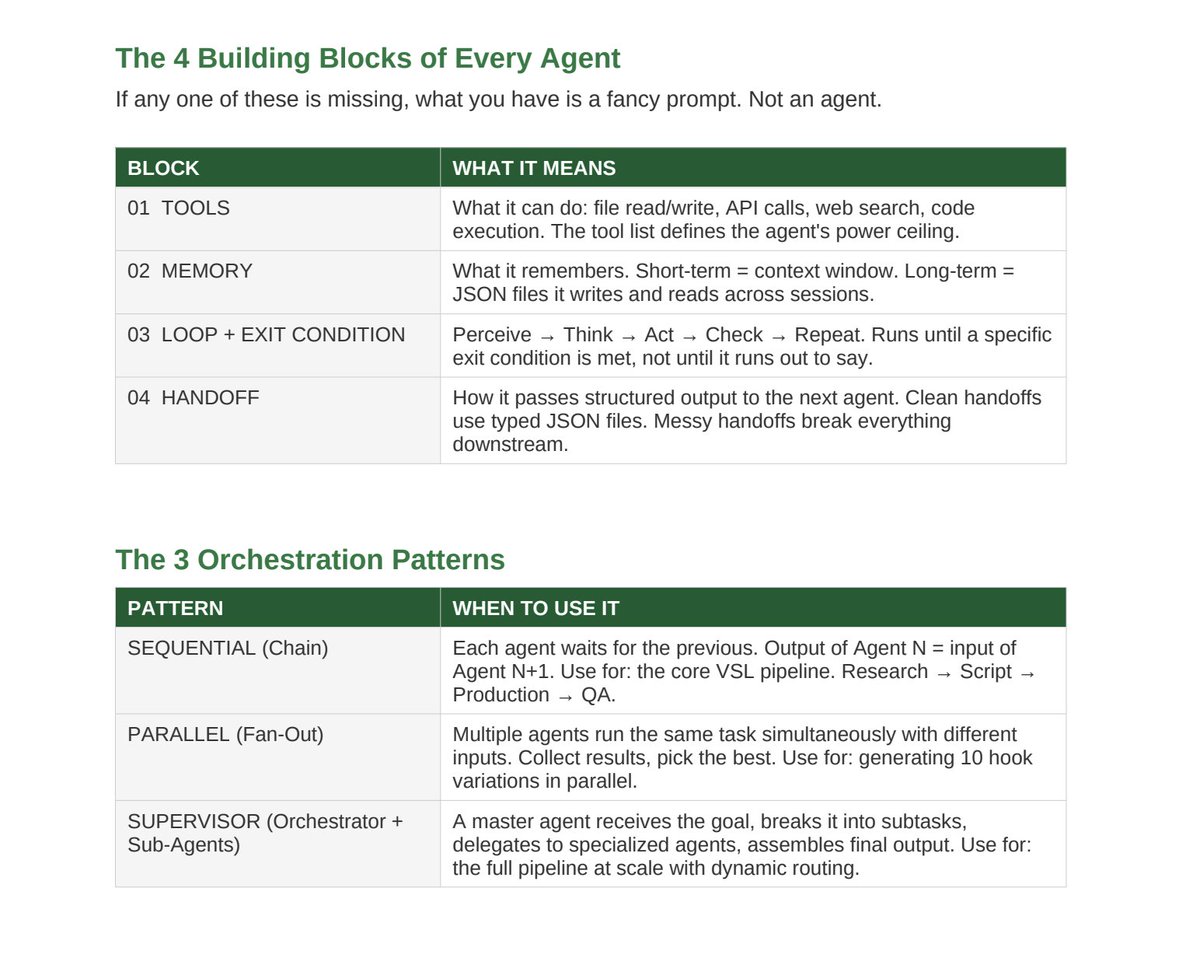
most “ai agents” are just fancy prompts pretending to be systems
a real agent has 4 things:
tools
memory
loop + exit condition
handoff
without those, it can’t actually run a vsl pipeline
it can’t research
it can’t write
it can’t check quality
it can’t pass clean outputs to the next step
and once you add orchestration, the whole thing compounds
sequential agents for the core vsl flow
parallel agents for testing 10 hooks at once
supervisor agents for routing the whole pipeline
this is how you go from “chatgpt wrote me a script” to an actual vsl production machine
rt + comment "vsl" and i’ll send you the full agent file
(follow for dm)
would you pay $25k/month to have the mind of the greatest copywriter alive, available 24/7?
stefan is working on something that might change the game forever. here's where i think it will go in 6-12 months:
1. the concept of pre-trained agentic tools goes mainstream, creating a new marketplace:
- everyone will sell their own agents
- the more you know (+ status), the more it's worth
- the 'better' agent you have, the bigger the moat
2. ''pyramid'' pricing based on knowledge:
- top 0.001% = $25k/month+
- top 1% = $15k/month
- top 10% = $2.5k.month
3. endless of use cases:
- businesses training junior hires
- newbies with deep pockets
- 7-8 fig businesses looking for a moat
- high ticket upsell for info products / communities
again, this proves my theory that ai & llm's will help those who are already knowledgeable and successful the most. but this is actually the first time i see the gap being bridged somehow.
@StefanGeorgi bravo on the idea. thoughts on this?