Este es el efecto que producirían las 5 medidas del decreto MariCarmen que quiere imponer el sindicato de inquilinas.
1. Escudo antidesahucios estructural. Prohibir desahuciar a personas vulnerables sin alternativa habitacional.
Resultado: Tirar debajo del autobús a todas las familias monoparentales, mujeres maltratadas, madres solteras, sin papeles, gente con precariedad laboral que quieran acceder a una vivienda. Para siempre.
2.Limitar el alquiler de temporada y por habitaciones. Reforma de la LAU con "protecciones antiestafas" para priorizar el alquiler habitual.
Resultado: Estudiantes,trabajadores temporales, inmigrantes recién llegados, debajo del autobús.
Menos oferta de vivienda, esos pisos no vuelven al alquiler habitual, se venden.
Más economía sumergida.
3.Congelación de rentas vigentes. Congelar los alquileres en vigor.
Medida salvaje para fulminar la oferta de pisos en alquiler de larga estancia.
Resultado: Congela la rotación. Nadie tiene incentivos a buscar vovienda. Divergencia entre personas y creación de pobreza extrema sin solución habitacional alguna para los que están fuera.
4. Prórroga generalizada, incluidas las renovaciones tácitas. Según estimaciones, alrededor de un millón de contratos vencen entre 2026 y 2027.
Impacto brutal en el dinamismo del mercado, justo cuando más contratos iban a salir al mercado. Menos pisos liberados significa menos oferta visible para quien busca ahora.
5.Renovación automática y fin de las expulsiones sin causa. Contratos que se renuevan solos, prohibiendo echar al inquilino sin motivo. De facto son contratos indefinidos.
Resultado: El pequeño propietario pierde la opción de recuperar el piso, lo que empuja a vender todo en vez de alquilar.
Conclusión: Todas las medidas buscan blindar a un segmento de población que tiene vivienda, solvencia y ahorros (entre los que me incluyo) para destrozar a toda la gente sin recursos, vulnerable y en situación crítica que no pueden alquilar.
La izquierda caviar.
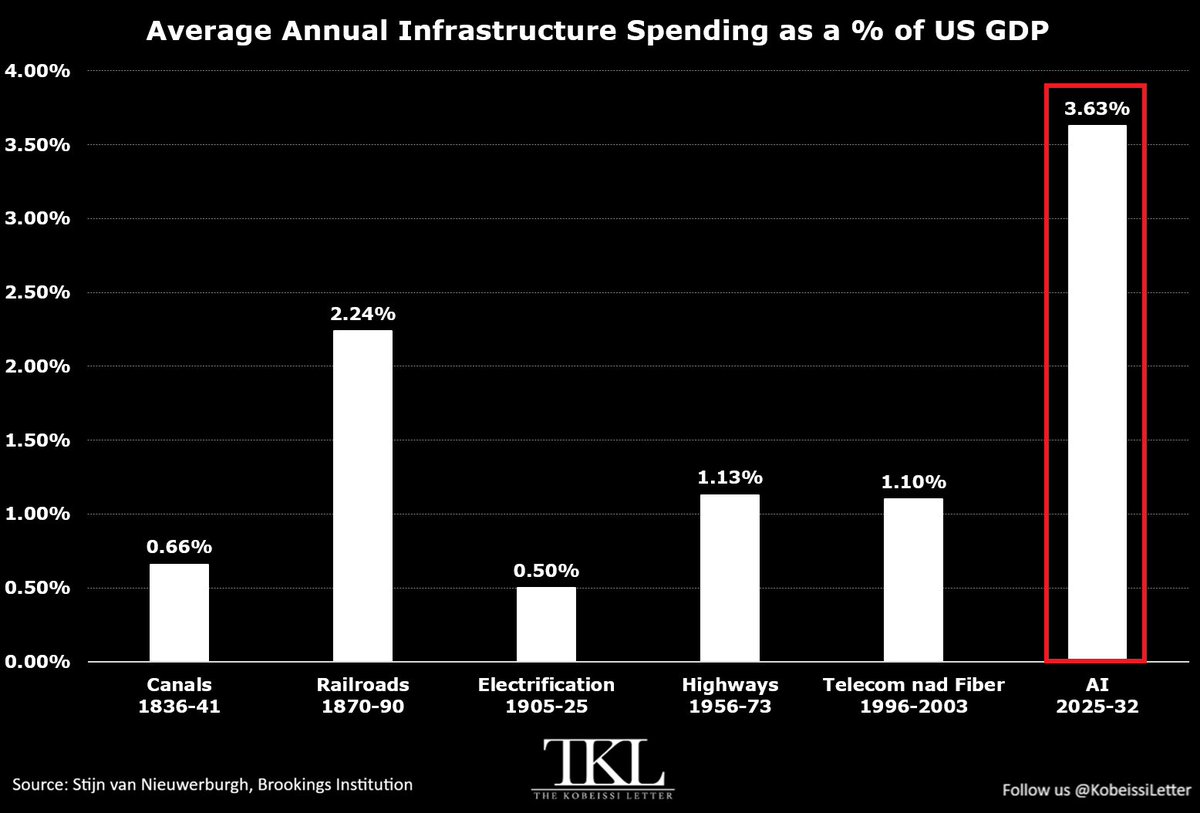
We are officially witnessing the biggest wave of infrastructure investment in modern US history.
Total investment in data centers and AI infrastructure is projected to average 3.63% of US GDP per year from 2025 to 2032, the highest proportion among major infrastructure buildouts since the 1800s.
The previous largest investment, railroad infrastructure, represented 2.24% of GDP per year in 1870-1890.
This was followed by highway investment that averaged 1.13% of GDP in 1956-1973, while telecommunications and fiber infrastructure averaged 1.10% in 1996-2003.
By comparison, electrification stood at just 0.50% of GDP in 1905-1925, while canal investment accounted for 0.66% in 1836-1841.
This comes as AI and data-center infrastructure investment is projected to total ~$10.3 trillion between 2025 and 2032.
The AI buildout is the largest infrastructure investment in modern US history.
Warsh Fails the Oil-Shock Test
An oil shock is not a monetary-policy failure. It is a tax imposed by producers abroad, a supply disruption, or both. The Federal Reserve cannot drill another barrel, reopen a shipping lane, or make gasoline cheaper by raising the cost of a mortgage.
Yet Kevin Warsh’s response to the current energy-price surge suggests that he would do exactly what the Fed has too often done: hike into a supply shock, sacrifice the interest-rate-sensitive economy, and call the resulting contraction a victory over inflation.
That is a dangerous misreading of both the facts and history.
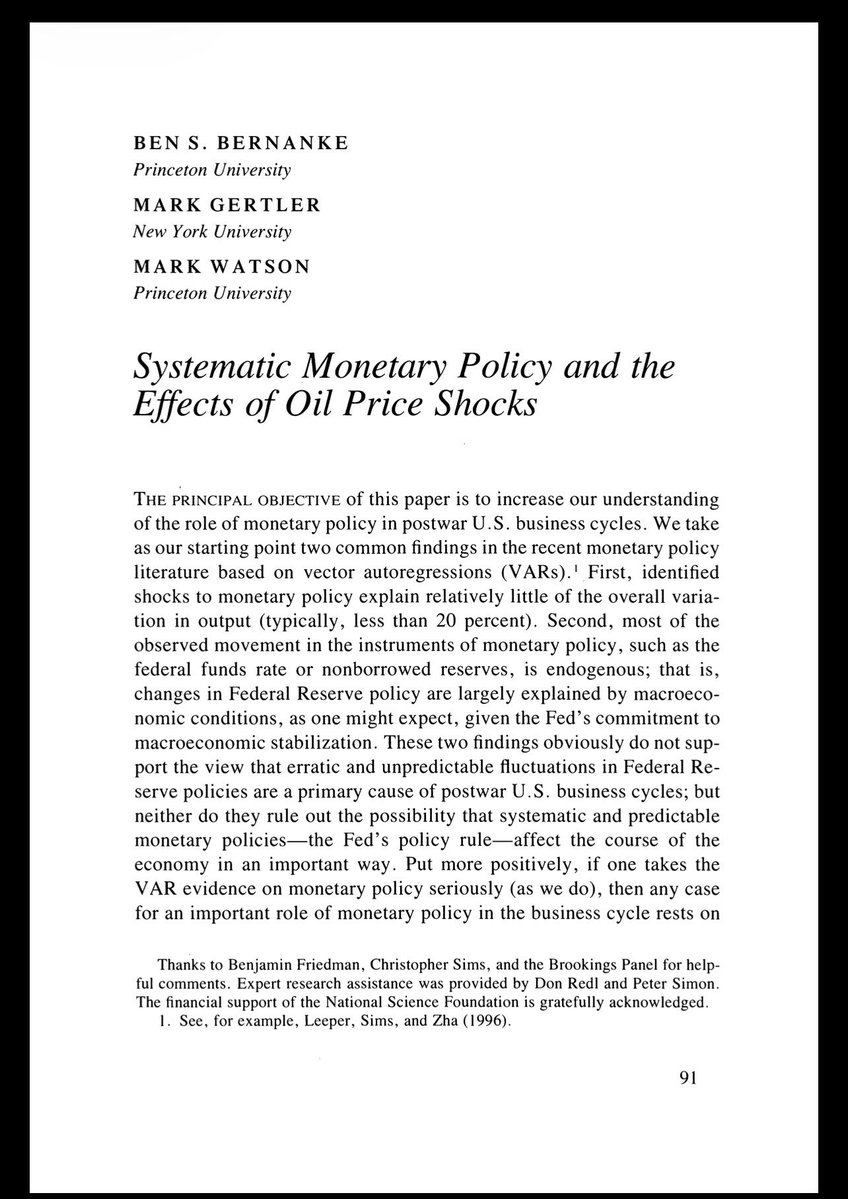
In their landmark 1997 paper, Ben Bernanke, Mark Gertler, and Mark Watson found that much of the economic damage following postwar oil-price shocks stemmed not from oil itself, but from the Fed’s systematic response higher interest rates. Oil was the trigger. Monetary tightening was the amplifier. Their work does not say that central banks should disregard inflation. It says they must distinguish an inflationary regime from a one-time jump in a key relative price.
That distinction is central today. A rise in energy costs can lift headline inflation and strain household budgets without producing a self-sustaining inflation process. The relevant questions are whether expectations are becoming unanchored, whether wage growth is accelerating in response, and whether price increases are spreading broadly through core services and goods.
If expectations remain anchored and there is no persuasive evidence of durable second- or third-round effects, a rate hike would be an act of economic vandalism. It would not lower the price of oil. It would simply add a credit shock to an energy shock.
Housing, commercial real estate, construction, autos, durable goods, and business investment have already borne the brunt of restrictive policy. These are not abstract lines on a Bloomberg terminal. They are the sectors where rate hikes become layoffs, cancelled projects, unaffordable homes, and weaker capital formation.
Warsh is as bad as Powell: both mistake a rigid response to headline inflation for credibility.
Warsh reacted to Wall St prediction market.
Warsh is making a policy decision based on what geopolitical events could be. Again classic mission creep.
Wall Street may cheer, of course. The Bloomberg bros crowd always admires the theater of a central banker promising resolve. But that is a Hall of Mirrors markets congratulating themselves for embracing a policy that may validate a fashionable narrative while weakening the underlying economy.
The test of a Fed leader is not whether he can raise rates. Anyone can raise rates. The test is whether he can change the reaction function when the facts demand it: recognize a supply shock, protect credibility without chasing oil prices, and avoid turning transitory inflation into a recession.
Warsh failed that test. Investors should take note.
https://t.co/nGq6qGsPgE
Defeco en casa antes de salir, pero aguardo a limpiarme el ano en el trabajo, para así no gastar papel higiénico. Lo que ahorro lo meto a un fondo indexado al SP500 y, si todo va bien, en 85 años a un 10% de interés compuesto anual, puedo acumular unos 2,5 millones de euros.
i work at nebius, so take the following with that in mind.
today @PalantirTech named @nebiusai its preferred sovereign ai infrastructure partner.
most people will screenshot the logos (and this is a big one). The real story is where the compute sits.
most “sovereign AI” talk still means a region dropdown: same closed model, different flag on the rack.
but that is not this.
sovereign ai, in this deal, is two halves that finally touch:
1. who is allowed to touch the data and the model
2. where the model actually runs
palantir’s half is the authorisation and isolation layer, aip, ontology, foundry, apollo. Who can see what, which model can touch which data, how an org keeps the advantage it trains instead of leaking it into someone else’s frontier system.
what a lot of their commercial customers still lacked was the other half: ai-native compute and inference that lives inside that perimeter, not bolted on as a separate hyperscaler account.
that’s the half we build.
After the integration period, eligible Palantir customers get our compute and inference endpoints inside the palantir enterprise perimeter. open models, adapted on their own data, for their own domain. Control of compute, data, and the model that comes out the other side.
Karp put it cleanly: our infrastructure powers your ability to run your own models under conditions you control. ontology + infra undergird the sovereignty partners are demanding.
Arkady’s complementary line is the one i hear from customers every week: they need performance at scale and control. most buyers have been forced to pick one.
what this does for palantir:
the sovereign ai operating system stops ending at software. Preferred infra inside the perimeter is how you sell sovereignty to commercial orgs that never had a clean option.
-> their distribution. our runtime. one boundary
what this does for us:
it puts capacity where the hard buying decision already happened. Not only startups chasing gpus, enterprises that already standardized on foundry/aip and were still stuck on where the tokens actually run.
Preferred partner status plugs ai-native infra into a sales motion that already exists. Training and inference land next to the data loop that lets open models beat generic closed ones on a specific domain.
We’ll work together to bring new capacity online faster, including modular data center deployments at sites where power is already available.
not infinite cloud, power-first capacity. The physical constraint named inside a software partnership.
Sovereignty without isolation is cosplay
Isolation without compute is a brochure
Compute without power is a waitlist
today is the claim that those three can be sold as one stack
We are partnering with Palantir to bring trusted AI cloud infrastructure to Palantir’s commercial customers.
Palantir has named Nebius its preferred sovereign AI infrastructure partner.
Nebius compute and inference endpoints will run inside the Palantir enterprise perimeter – giving customers control over their compute, data, and models.
The partnership is based on a shared vision that open models, continually adapted using customers’ own data, can deliver better domain-specific intelligence while improving control and security.
Read the full press release: https://t.co/OxFxKSOrqr
Today I'm writing a weekend guide on how to do DD when shorting $NBIS:
First, you look at hyperscaler earnings for AI cloud read through:
> $GOOGL: reports record AI cloud demand + backlog + margin increases from earnings
> $AMZN: reports record AI Cloud demand + backlog + margin increases from earnings
> $META: reports higher than expected prices for available capacity from earnings.
Now, time to look at Nebius:
-> $NBIS: Growing hundreds of percent to $7-9B ARR by Q4. Growing margins, and guided 4GW+ contracted power.
-> Sees Uber/Waymo splitting, putting more focus on Avride
-> Sees Clickhouse growing rapidly every quarter.
Okay looks bad! But next, you need a hedge?
-> Wow! A $NIKE brand executive, after the stock dropped 75% over the past 5 years, went to $LULU to save that brand next? Lululemon seems good.
Conclusion: Short Nebius and go long on $LULU
$NBIS Q1 Earnings Report is out.
Revenue $399M vs. $388.6M est. (+684% YoY)
Adj. EBITDA $129.5M vs. $90.5M est.
ARR $1.92B (+674% YoY and +54% QoQ)
2026 outlook:
Year-end ARR of ~$7-9B (reaffirmed)
Raised contracted power from >3GW to >4GW
Druckenmiller: 30% annualized returns. zero losing years from 1981 to 2010.
his take on contrarianism: "it's overrated."
"Soros used to say the crowd's right 80% of the time. you just can't be caught in the other 20%."
"i don't care if a trade is crowded if the thesis is right and the trend is with me."
most retail traders try to be contrarian on every trade. the best macro investor alive says stop doing that.