Really excited to open source a new project: Omnigent, a meta-harness for AI agents.
It lets you build multi-agent coding and custom agents, sitting above Claude Code, Codex, Pi, and agent SDKs to let you compose them. It also adds live collaboration and rich control policies.
In awe of SpaceX and its story - past, present and the future. You can think about it in 10+ different ways and continue re-blowing your mind in circles. Huge congrats to the team! 🚀
Personal update: I've joined Anthropic. I think the next few years at the frontier of LLMs will be especially formative. I am very excited to join the team here and get back to R&D. I remain deeply passionate about education and plan to resume my work on it in time.
I strongly believe there are entire companies right now under heavy AI psychosis and its impossible to have rational conversations about it with them. I can't name any specific people because they include personal friends I deeply respect, but I worry about how this plays out.
I lived through the great MTBF vs MTTR (mean-time-between-failure vs. mean-time-to-recovery) reckoning of infrastructure during the transition to cloud and cloud automation. All those arguments are rearing their ugly heads again but now its... the whole software development industry (maybe the whole world, really).
It's frightening, because the psychosis folks operate under an almost absolute "MTTR is all you need" mentality: "its fine to ship bugs because the agents will fix them so quickly and at a scale humans can't do!" We learned in infrastructure that MTTR is great but you can't yeet resilient systems entirely.
The main issue is I don't even know how to bring this up to people I know personally, because bringing this topic up leads to immediately dismissals like "no no, it has full test coverage" or "bug reports are going down" or something, which just don't paint the whole picture.
We already learned this lesson once in infrastructure: you can automate yourself into a very resilient catastrophe machine. Systems can appear healthy by local metrics while globally becoming incomprehensible. Bug reports can go down while latent risk explodes. Test coverage can rise while semantic understanding falls. Changes happens so fast that nobody notices the underlying architecture decaying.
I worry.
The post by @mitchellh gave me the final push to finish my GitHub "obituary". I originally started writing it after the Zig to Codeberg move. It's just a retelling of how I remember OpenSource pre GitHub and what it gave us. https://t.co/D0QUdJHxKq
We asked Claude to find a bug in Vim. It found an RCE. Just open a file, and you’re owned. We joked: fine, we’ll switch to Emacs. Then Claude found an RCE there too.
Full story: https://t.co/nQo9MF1Npe
Introducing TigerFS - a filesystem backed by PostgreSQL, and a filesystem interface to PostgreSQL.
Idea is simple: Agents don't need fancy APIs or SDKs, they love the file system. ls, cat, find, grep. Pipelined UNIX tools. So let’s make files transactional and concurrent by backing them with a real database.
There are two ways to use it:
File-first: Write markdown, organize into directories. Writes are atomic, everything is auto-versioned. Any tool that works with files -- Claude Code, Cursor, grep, emacs -- just works. Multi-agent task coordination is just mv'ing files between todo/doing/done directories.
Data-first: Mount any Postgres database and explore it with Unix tools. For large databases, chain filters into paths that push down to SQL: .by/customer_id/123/.order/created_at/.last/10/.export/json. Bulk import/export, no SQL needed, and ships with Claude Code skills.
Every file is a real PostgreSQL row. Multiple agents and humans read and write concurrently with full ACID guarantees. The filesystem /is/ the API.
Mounts via FUSE on Linux and NFS on macOS, no extra dependencies. Point it at an existing Postgres database, or spin up a free one on Tiger Cloud or Ghost.
I built this mostly for agent workflows, but curious what else people would use it for. It's early but the core is solid. Feedback welcome.
https://t.co/IPhieopOSP
Three days ago I left autoresearch tuning nanochat for ~2 days on depth=12 model. It found ~20 changes that improved the validation loss. I tested these changes yesterday and all of them were additive and transferred to larger (depth=24) models. Stacking up all of these changes, today I measured that the leaderboard's "Time to GPT-2" drops from 2.02 hours to 1.80 hours (~11% improvement), this will be the new leaderboard entry. So yes, these are real improvements and they make an actual difference. I am mildly surprised that my very first naive attempt already worked this well on top of what I thought was already a fairly manually well-tuned project.
This is a first for me because I am very used to doing the iterative optimization of neural network training manually. You come up with ideas, you implement them, you check if they work (better validation loss), you come up with new ideas based on that, you read some papers for inspiration, etc etc. This is the bread and butter of what I do daily for 2 decades. Seeing the agent do this entire workflow end-to-end and all by itself as it worked through approx. 700 changes autonomously is wild. It really looked at the sequence of results of experiments and used that to plan the next ones. It's not novel, ground-breaking "research" (yet), but all the adjustments are "real", I didn't find them manually previously, and they stack up and actually improved nanochat. Among the bigger things e.g.:
- It noticed an oversight that my parameterless QKnorm didn't have a scaler multiplier attached, so my attention was too diffuse. The agent found multipliers to sharpen it, pointing to future work.
- It found that the Value Embeddings really like regularization and I wasn't applying any (oops).
- It found that my banded attention was too conservative (i forgot to tune it).
- It found that AdamW betas were all messed up.
- It tuned the weight decay schedule.
- It tuned the network initialization.
This is on top of all the tuning I've already done over a good amount of time. The exact commit is here, from this "round 1" of autoresearch. I am going to kick off "round 2", and in parallel I am looking at how multiple agents can collaborate to unlock parallelism.
https://t.co/WAz8aIztKT
All LLM frontier labs will do this. It's the final boss battle. It's a lot more complex at scale of course - you don't just have a single train. py file to tune. But doing it is "just engineering" and it's going to work. You spin up a swarm of agents, you have them collaborate to tune smaller models, you promote the most promising ideas to increasingly larger scales, and humans (optionally) contribute on the edges.
And more generally, *any* metric you care about that is reasonably efficient to evaluate (or that has more efficient proxy metrics such as training a smaller network) can be autoresearched by an agent swarm. It's worth thinking about whether your problem falls into this bucket too.
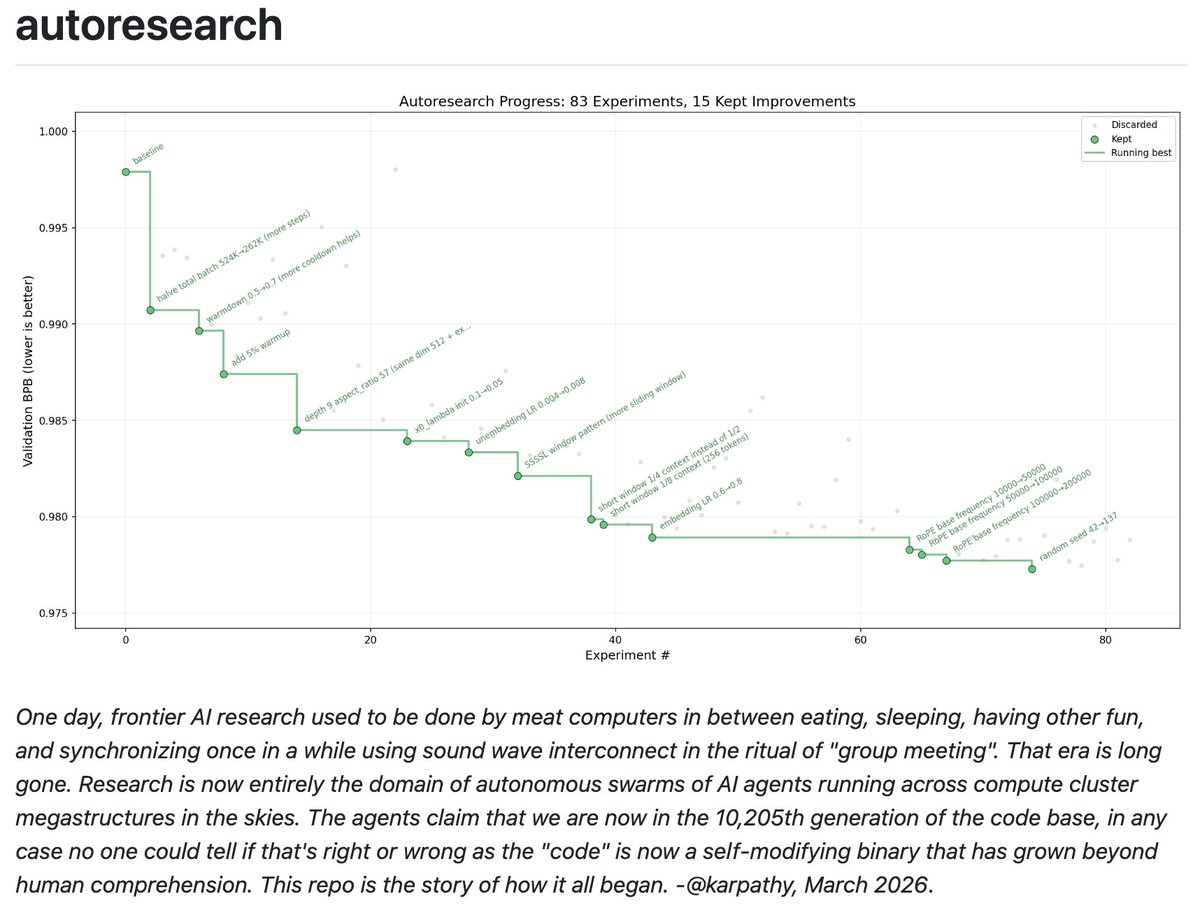
I packaged up the "autoresearch" project into a new self-contained minimal repo if people would like to play over the weekend. It's basically nanochat LLM training core stripped down to a single-GPU, one file version of ~630 lines of code, then:
- the human iterates on the prompt (.md)
- the AI agent iterates on the training code (.py)
The goal is to engineer your agents to make the fastest research progress indefinitely and without any of your own involvement. In the image, every dot is a complete LLM training run that lasts exactly 5 minutes. The agent works in an autonomous loop on a git feature branch and accumulates git commits to the training script as it finds better settings (of lower validation loss by the end) of the neural network architecture, the optimizer, all the hyperparameters, etc. You can imagine comparing the research progress of different prompts, different agents, etc.
https://t.co/YCvOwwjOzF
Part code, part sci-fi, and a pinch of psychosis :)
Ahhhh, Codex 5.3 (xhigh) with a vague prompt just solved a bug that I and others have been struggling to fix for over 6 months. Other reasoning levels with Codex failed, Opus 4.6 failed. Cost $4.14 and 45 minutes. Full trace plus includes original issue: https://t.co/DbBACN2HLj
I know this prompt is relatively bad. Honestly, our stable release is in a week, and I was throwing some Hail Marys at the frontier models to see if I could get a clean, understandable fix for some of these bugs. By using `gh`, it grabs much better context from the issue, so its not terrible.
The best thing that Codex did was eventually start reading GTK4 source code. That's where I ended up (see my GH issue), and I knew the answer was somewhere in there, but I didn't have the time or motivation to do it myself. The other models never went there, and lower reasoning efforts with 5.3 didn't go there either. Only xhigh went there. I think that was a critical difference.
The final fix was decent. It was small, all in a single file, and very understandable. It had one bug I identified (you can see in the trace), and then I manually cleaned up some style. But, it did a great job.
Definitely an "it's so over" moment. But at the same time, it feels amazing because now our next stable release will have this fix and I was able to spend the time working on other fixes as it went.
It is hard to communicate how much programming has changed due to AI in the last 2 months: not gradually and over time in the "progress as usual" way, but specifically this last December. There are a number of asterisks but imo coding agents basically didn’t work before December and basically work since - the models have significantly higher quality, long-term coherence and tenacity and they can power through large and long tasks, well past enough that it is extremely disruptive to the default programming workflow.
Just to give an example, over the weekend I was building a local video analysis dashboard for the cameras of my home so I wrote: “Here is the local IP and username/password of my DGX Spark. Log in, set up ssh keys, set up vLLM, download and bench Qwen3-VL, set up a server endpoint to inference videos, a basic web ui dashboard, test everything, set it up with systemd, record memory notes for yourself and write up a markdown report for me”. The agent went off for ~30 minutes, ran into multiple issues, researched solutions online, resolved them one by one, wrote the code, tested it, debugged it, set up the services, and came back with the report and it was just done. I didn’t touch anything. All of this could easily have been a weekend project just 3 months ago but today it’s something you kick off and forget about for 30 minutes.
As a result, programming is becoming unrecognizable. You’re not typing computer code into an editor like the way things were since computers were invented, that era is over. You're spinning up AI agents, giving them tasks *in English* and managing and reviewing their work in parallel. The biggest prize is in figuring out how you can keep ascending the layers of abstraction to set up long-running orchestrator Claws with all of the right tools, memory and instructions that productively manage multiple parallel Code instances for you. The leverage achievable via top tier "agentic engineering" feels very high right now.
It’s not perfect, it needs high-level direction, judgement, taste, oversight, iteration and hints and ideas. It works a lot better in some scenarios than others (e.g. especially for tasks that are well-specified and where you can verify/test functionality). The key is to build intuition to decompose the task just right to hand off the parts that work and help out around the edges. But imo, this is nowhere near "business as usual" time in software.
We shipped Claude Code as a research preview a year ago today.
Developers have used it to build weekend projects, ship production apps, write code at the world's largest companies, and help plan a Mars rover drive.
We built it, and you showed us what it was for.
Cloning any random piece of SaaS is something that could already be done before agentic coding, and the economics of it haven't changed meaningfully. Before, writing the clone would cost 0.5-1% of the valuation of the legacy SaaS company. Now it might be 0.1%. It doesn't make a difference -- if you can pull it off profitably today you could also have done it profitably in the past.
The code is a very small part of the process of making such a clone successful, and the reason legacy software has often bad UX is not because code was expensive to write.