When I first became a dad I was genuinely worried my career would suffer.
The opposite happened. 3 things changed that I wasn't expecting.
First, a child cuts the filler from your life instantly.
I used to sit at my desk for 14 hours and feel like I was crushing it when in reality maybe 4 of those hours were actual work and the rest was meetings that didn't need to happen, scroll sessions I told myself were research, and "quick calls" that turned into 90 minutes of nothing. A child deletes all of that overnight.
Because you literally don't have the time anymore. Every hour matters in a way it didn't before. You could be with your kid, working on your startup, exercising, having dinner with your wife, sleeping. When your time is actually full of things you care about, the filler can't survive. I'm shipping more now than before my kid was born. Half the meetings. Faster decisions.
I stopped saying yes to things out of politeness because my time has a very real cost now that I can feel in my bones.
Second, your risk tolerance goes up, not down.
Everyone assumes having a kid makes you play it safe. For me it created this urgency to build something real while my kid is young enough to not remember the hard parts. That urgency is more useful than any productivity system I've ever tried.
Third, your thinking just gets clearer.
I don't know how else to explain it. You stop deliberating for days and just make the call. You stop chasing every opportunity and only chase the ones that actually excite you.
Something about being responsible for another human being gives you this filter that cuts through the noise instantly. Before my kid, I'd go back and forth on a decision for a week. Now I make it by lunch and move on.
I used to think having a kid was the thing I'd do after I built the company. Turns out the kid made me better at building the company. Wish someone had told me that sooner. So I'm telling you.
I know this sounds like something a new dad says to justify it. I thought the same thing when other dads told me. Then it happened to me and I understood.
I think you will too.
“I'm Back."
I often get the question from entrepreneurs or executives, “What should I do next?”
My answer has always been “become deeply self aware and when the right thing comes, you will know it. If you know yourself, your next thing, your new idea, your work soulmate will reveal itself.”
Great example of why timing and distribution - for better or worse - matter so much more than product. @SchmidhuberAI is always so far ahead of the curve that masses can’t comprehend his ideas yet. Classic German / Swiss problem of over obsessing about the product whilst ignoring distribution.
Imagine if we could get his ideas to mass adoption at the time they are created? Might be one of the greatest productivity hacks for humanity overall.
LeCun’s new company on physical AI with world models [9] looks a lot like our 2014 company on physical AI with world models [1] 😀 See also [2-8] - all references in the reply!
@haider1 When pondering about the effects of technological revolutions on the labor market, listen to economists who have studied the effects of past technological revolutions on the labor market.
Never listen to computer scientists.
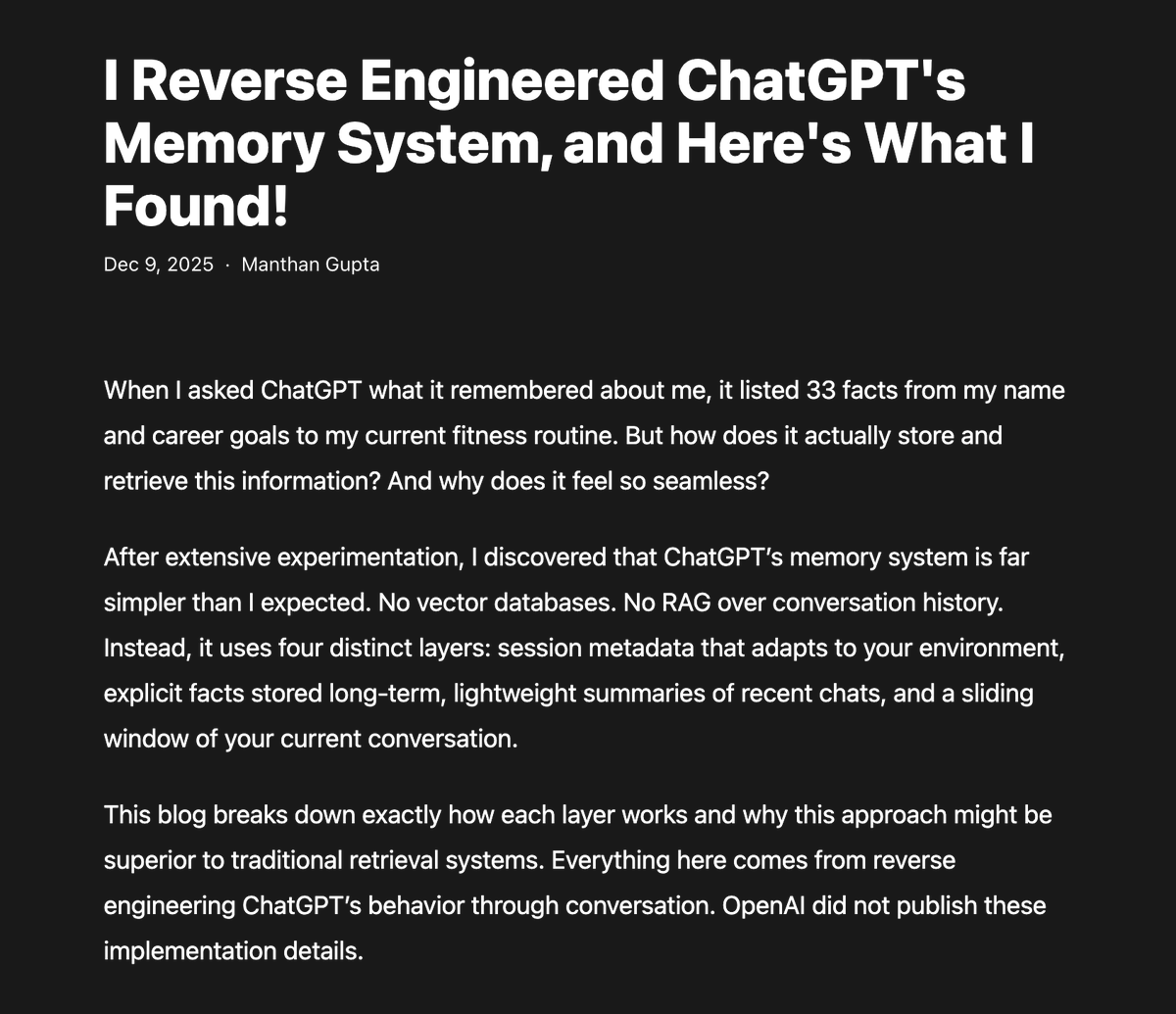
I spent the last few days prompting ChatGPT to understand how its memory system actually works.
Spoiler alert: There is no RAG used
https://t.co/zxvRRP2GK8
> Be me - Elon
> Just nuked the timeline with a Kardashev Scale reality check "I have a plan"
> Meanwhile, China’s out here printing solar panels like it’s counterfeit fentanyl, absolutely curb-stomping the US in the sunshine Olympics. We’re bringing pocket knives to a laser fight
> Bro we are literally about to run out of atoms for NVLink cables and you think the Nevada grid is gonna save us?
> Realize AI is now the most expensive cocaine habit in human history
> Current US grid: ~500 GW average, already sweating like a vegan at a Texas BBQ
> One frontier model run in 2028 gonna slurp more juice than the entire country of France role-playing as a lights festival
> Earth data centers already out here committing war crimes on rivers for cooling water
> Do the math, smooth-brains... we’re about to need the entire grid just to train Grok-7
> Chips? TSMC and Samsung sending me the same email every quarter: “Dear Elon, lol no ❤️”
> Fine
> Tesla Terafab incoming - 10 million wafers/year, built next to Giga Texas, powered by whatever the fuck I want because I own the rockets
> Power situation?
> Earth: crying over natural gas permits
> Me: quietly lofting 500–800 MW of thin-film solar per Starship flight like it’s Uber Eats for the vacuum
> That’s one fully functional orbital gigawatt every week if I feel spicy
> Orbital data centers = infinite free sunlight + 3 K cosmic microwave background heat sink
> Translation: your Earth rigs are space heaters with a gambling addiction
> My orbital rigs are perfect blackbody radiators running at 100% duty cycle while sipping starlight like it’s martinis at 3 a.m
> Latency? Starlink lasers already do 100 Gbps cross-continent
> In two years we’ll be doing petabit
> Your query goes up, answer comes down faster than your GPU finishes complaining about spot pricing
> Phase 1: xAI orbital constellation makes Memphis supercluster look like a Raspberry Pi someone dropped in a puddle
> Phase 2: every AI company on Earth begs for rack space on my satellites like it’s the last helicopter out of Saigon
> Phase 3: Kardashev Type II by 2045 or I’ll personally apologize to the Sun for underutilizing it
> Groundcels seething in replies: “b-but atmospheric losses” “b-but launch costs” “b-but orbital decay”
> My brother in Christ I own the launch company I am the atmospheric loss
> Stay poor down there fighting over lake water I’m moving humanity’s IQ to orbit
There are people who love cooking.
It's not just about the alchemy of the ingredients or the zen of zucchini slicing. They get joy from the experience they create for others by making a meal.
Others love carpentry.
It's not just about the smooth feel of the wood or the weight of the hammer in their hand. They get joy from having crafted something that others use.
I am neither a cook nor a carpenter.
I'm a developer. A code crafter.
I get joy from building software. It's not just about the thrill of willing a product into existence. I get joy from having built something that others use. Something that made their life better, even if in a tiny way.
Here's to the all the cooks, carpenters and crafters of every form.
One of my favorite lessons I’ve learnt from working with smart people:
Action produces information. If you’re unsure of what to do, just do anything, even if it’s the wrong thing. This will give you information about what you should actually be doing.
Sounds simple on the surface - the hard part is making it part of your every day working process.
When you’re old, what would you rather have:
1.) one more year with your children and grand children
2.) another year traveling to amazing places, cracking your personal best in weight lifting and getting drunk at parties
3.) one more year to put a lot more money on your bank account
Great way to think about the right time for having kids.
Imagine the amount of propaganda it took to convince women that waking up like this is oppressive but waking up hangover and alone, or even worse, with a stranger, isn’t.
Elon Musk: Everything is solar power. The rest is noise.
“The sun is about 99.8% of the mass of the solar system. Jupiter's about 0.1% and everything else is in the remaining 0.1%, and we are much less than 0.1%.
So, if you burnt all of the mass of the solar system, then the total energy produced by the sun would still round up to 100%. If you just burnt Earth, the whole planet, and burnt Jupiter, which is very big and quite challenging to burn, turn Jupiter into a thermonuclear reactor, the sun is 99.8% of the mass of the solar system and everything else is in the miscellaneous category. Basically, no matter what you do, total energy produced in our solar system rounds up to 100% from the sun. You could even throw another Jupiter in, so we're going to snag a Jupiter from somewhere else, you could teleport two more Jupiters into our solar system, burn them, and the sun would still round up to 100%. As long as you're at 99.6%, you're still rounding up to 100%. Maybe that gives some perspective of why solar is really the thing that matters.
And, as soon as you start thinking about things at a grander scale, like Kardashev Scale 2 civilizations, it becomes very, very obvious. I'm not saying anything that's new, by the way. Anyone who studies physics has known this for a very long time. In fact, Kardashev, a Russian physicist who came up with this idea, I think, in the 1960s, just as a way to classify civilizations, where Kardashev Scale 1 would be, you've harnessed most of the energy of the planet, Kardashev Scale 2, you've harnessed most of the energy of your sun, Kardashev 3, you've harnessed most of the energy of a galaxy.
Now we're only about 1% or a few percent of Kardashev Scale 1 right now, optimistically. But as soon as you go to Kardashev Scale 2, where you're talking about the power of the sun, then you're really just saying everything is solar power and the rest is in the noise. Like, the sun produces about a billion times, or call it well over a billion times more energy than everything on Earth combined.”
All-In Podcast, October 31, 2025
I am unreasonably excited about self-driving. It will be the first technology in many decades to visibly terraform outdoor physical spaces and way of life. Less parked cars. Less parking lots. Much greater safety for people in and out of cars. Less noise pollution. More space reclaimed for humans. Human brain cycles and attention capital freed up from “lane following” to other pursuits. Cheaper, faster, programmable delivery of physical items and goods. It won’t happen overnight but there will be the era before and the era after.
Starting a new company:
You pay us $10k/mo and we send your competitors an endless stream of invites to be interviewed on 3 hour-long tech podcasts, speaking engagements, founder dinners, and all-day tech events so they can never get real work done and they fail.
In Switzerland, autumn brings a charming tradition — cows adorned with vibrant flowers and clanging bells are led down from alpine pastures to the valleys, marking their return for winter.
It’s kind of scary to think that if there were a technology that was extremely useful to humanity to build, but it was extremely capital intensive, and building it incrementally wouldn’t have a smooth gradient of returns/revenue, we might just never build it.







![SchmidhuberAI's tweet photo. LeCun’s new company on physical AI with world models [9] looks a lot like our 2014 company on physical AI with world models [1] 😀 See also [2-8] - all references in the reply! https://t.co/UIZAAhPlKq](https://pbs.twimg.com/media/G8tMtBCXEAAcnDn.jpg)