"Mastering High-Stakes Negotiations“. How to successfully manage #risks in difficult #negotiations. Order here: https://t.co/WU7CIoGVhC #book@SpringerNature
Pressure is inevitable. #Focus is a choice. The best #negotiators don’t eliminate pressure. They learn to stay focused when everyone else reacts.
Because negotiations are rarely won at the table. They are decided long before the first conversation begins. More information: https://t.co/O79G6C1oCb
#Negotiation #Leadership #DecisionMaking
#ArtificalIntelligence
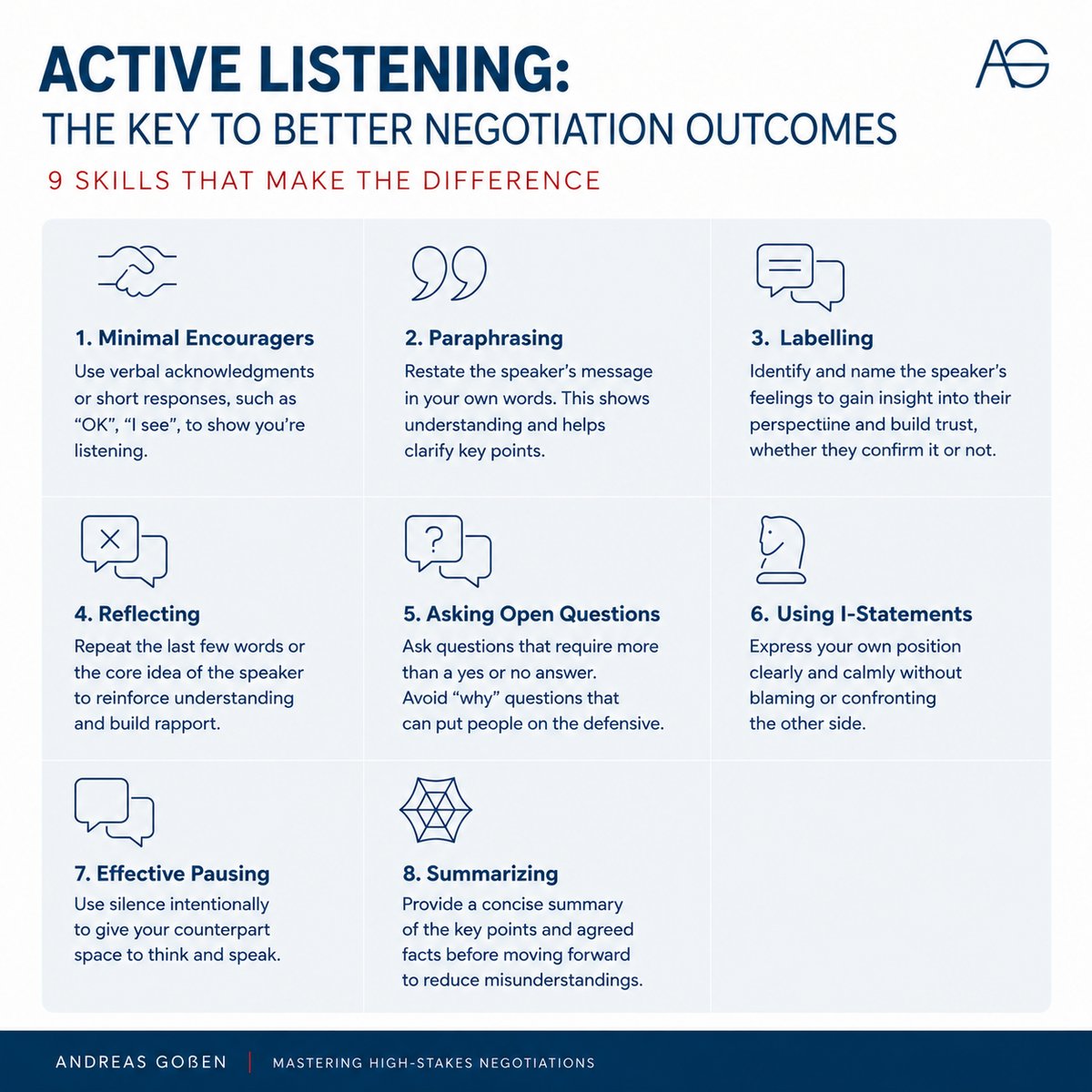
The best #negotiators don’t talk the most. They listen the best.
When you truly listen, you uncover interests instead of positions, de-escalate tension earlier, and make better decisions.
Which of these techniques has had the biggest impact on your negotiations?
#Negotiation #ActiveListening #Leadership #Communication #Sales #Procurement #ConflictResolution #HighStakesNegotiation #NegotiationSkills
Die besten Verhandler sprechen nicht am meisten. Sie hören besser zu.
Wer aufmerksam zuhört, erkennt Interessen statt Positionen, entschärft Konflikte früher und trifft bessere Entscheidungen.
Welche Technik hat bei dir den größten Einfluss auf den Verlauf einer Verhandlung?
#Verhandlung #Negotiation #Leadership #Kommunikation #AktivesZuhören #Sales #Procurement #Konfliktmanagement #HighStakesNegotiation
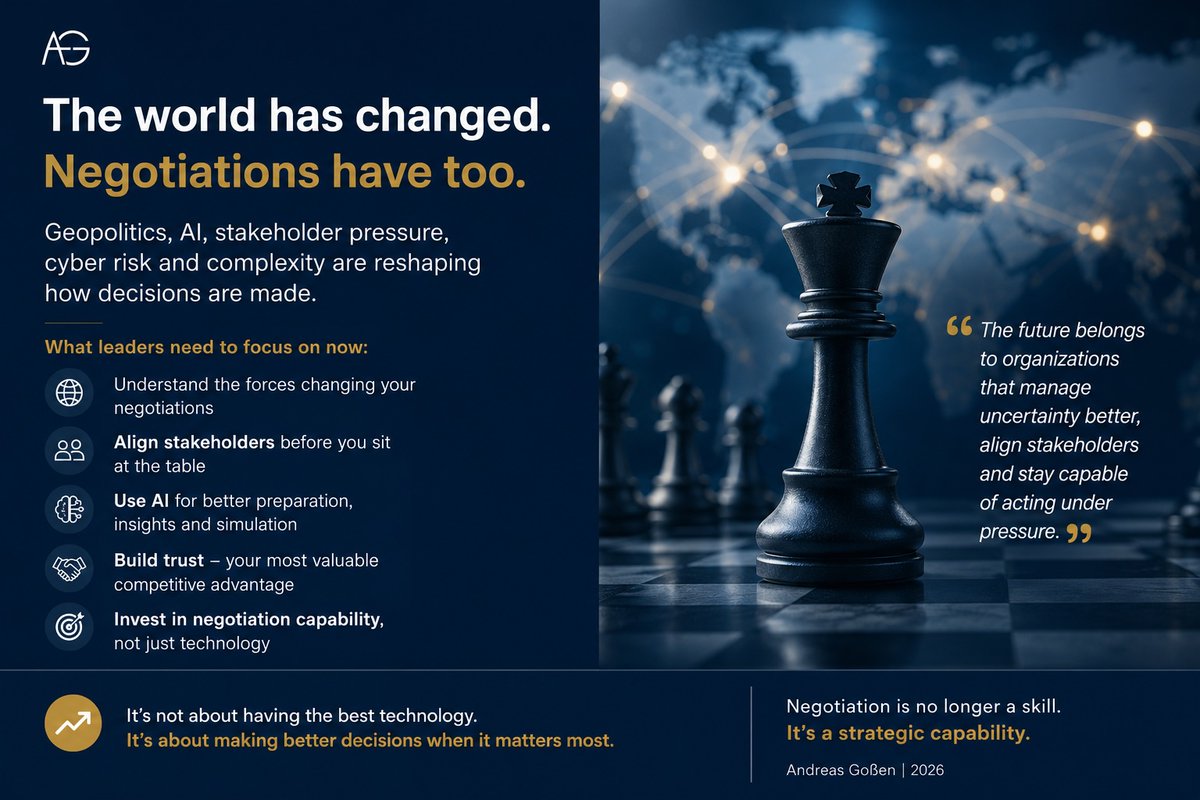
AI won’t replace great negotiators. It will replace poor preparation. Information is becoming a commodity.
The real advantage now comes from:
• Better preparation
• Better decisions
• Better simulations
• Better governance
The future belongs to organizations that build Negotiation Capability—not just AI capability.
Negotiations are no longer just a skill.They are a strategic capability.
#Negotiation #AI #Leadership #Procurement #Sales #DecisionMaking #Strategy #Governance #CyberSecurity
Cyber negotiations are no longer just about #ransomware.
AI-powered social engineering, deepfake voices, and business email compromise are changing the battlefield.
A few numbers that should make every executive pause:
• +442% increase in voice phishing (Vishing)
• +223% growth in Deepfake tools on the Dark Web
• 81% of successful attacks use no malware at all
The weakest link isn’t technology.
It’s human decision-making under pressure.
That’s why organizations need to train negotiation and verification processes—not just cybersecurity.
In a cyber crisis, every phone call, every email, and every payment request is a negotiation.
Preparation wins before the first demand arrives.
#CyberSecurity #Ransomware #CyberNegotiation #SocialEngineering #Deepfake #Negotiation #IncidentResponse #AI
Die besten #Verhandler sprechen oft am wenigsten.
Wer jede Stille füllt, verschenkt Informationen.
3 Beobachtungen aus schwierigen #Verhandlungen:
1. Schweigen erzeugt Druck – nicht Argumente
.2 Die nächste Person, die spricht, verrät oft mehr als geplant
3. Gute Fragen sind meist stärker als gute Antworten
Eine meiner Lieblingsregeln:
“Say less. Ask more.”
Die besten Durchbrüche entstehen selten durch Reden – sondern durch Zuhören.
#Negotiation #Leadership #Procurement #Sales #AI #DecisionMaking #Communication
One lesson from the current Iran negotiations:
The strongest negotiator is not always the one with the best argument, but the one with the most strategic patience.
Despite setbacks, public threats, and repeated deadlocks, the talks continue.
A reminder that negotiations are rarely won through speed. They are won through timing, persistence, and the ability to stay at the table when others walk away.
In #diplomacy, patience is power.
#Negotiation #Leadership #Strategy #Iran #Negotiations @araghchi@jaredkushner@SEPeaceMissions@MofaQatar_EN
It appears that talks between Iran and the United States went better than a lot of journalists were suggesting earlier today, despite the apparent disruption caused by the Iranian delegations walk-out in protest of threatening comments made online by President Trump.
Photo posted by the Prime Minister of Qatar, Mohammed bin Abdulrahman bin Jassim Al Thani, alongside U.S. Vice President JD Vance and President Trump’s son-in-law Jared Kushner, as fragile peace negotiations with Iran appear to be continuing in Switzerland.
According to Axios, citing a diplomat with knowledge on the matter, the U.S. delegation, led by U.S. Vice President JD Vance, has met with their Iranian counterparts in Switzerland. The meeting was mediated by Qatar. Additionally, Pakistan’s prime minister announced that Iran has agreed to reduce the enrichment levels of highly enriched materials. However, as rightly noted by NTI’s @BrewerEricM, such a framework was “already agreed to in the MOU as the ‘minimum methodology’ to dispose of the material.”
AI negotiators can do some things humans cannot do, and they can be exploited in ways humans cannot be exploited. https://t.co/IjuugBCksa via @MITSloan
Most negotiations are not lost at the negotiation table. They are lost during preparation.
🎙️ In my podcast Under Pressure, I share real-world lessons, recurring patterns, and strategic insights from high-stakes negotiations.
Current episodes:
• The Risks of Early Offers
• Setting the Right Anchor
• The Defector
Short episodes. Practical insights. No theory for theory’s sake.
🎧 Listen here: https://t.co/wwnOcsEdKZ
#Negotiation #Procurement #Sales #Podcast #Strategy
🇺🇸🇮🇷 IRAN PUBLISHED THEIR VERSION OF THE MoU FULL TEXT - AND THEY DIFFER. AGAIN.
Both Washington and Tehran have now officially published what they each describe as the authoritative text of the Islamabad MOU.
We compared both versions article by article - and they are not identical. Shocking, right?
Here are the four articles where the texts diverge:
Article 5 — Strait of Hormuz passage
🇮🇷 "Iran will make arrangements for safe passage "with no charge, for 60 days only."
🇺🇸 "with no charge for 60 days" — the word only is absent.
This has real implications: Iranian version makes explicit that toll-free passage through the Strait is strictly time-limited — after 60 days, Iran reserves the right to introduce charges. The US version leaves that question open. Given that the future administration of the Strait is itself subject to negotiation between Iran and Oman (a clause both texts agree on), the presence or absence of "only" will matter when that negotiation begins.
Article 11 — Frozen funds
🇮🇷 "Released funds must be fully available for payment to any ultimate beneficiary designated by the Central Bank of Iran — with the US required to issue all necessary licenses and permissions."
🇺🇸 The funds will be "made fully available for use." The beneficiary designation clause is entirely absent.
This is the most consequential difference in the document. The Iranian text establishes that Iran's Central Bank has complete, unilateral discretion over where the released funds go — and that the US is obligated to approve whatever transactions Iran designates, with no conditions.
The US version says nothing of the sort.
Whether those funds could flow to entities currently under separate US sanctions — including military or proxy-related entities — is precisely the question this clause answers in the Iranian text and leaves unanswered in the US one.
Four articles, four differences, all four favour Iran's interpretation in the Iranian text.
This is not unusual in NORMAL diplomacy — both sides routinely leave deliberate ambiguities in agreed documents to sell the deal domestically.
What is unusual is that both sides have now published their version as the official, authoritative text.
The discrepancies will need to be resolved before the formal signing in Switzerland on Friday — or they will become the first disputes of the 60-day negotiation period.
MORE: The final MoU is basically unchanged from the version provided to Bloomberg on June 16, except for text changes in clauses one and five that Iran reportedly requested. ⬇️
Islamic Revolutionary Guards Corps (IRGC)-affiliated Fars News reported on June 15 that Iran had earlier secured important changes to the draft MoU. These changes included the addition of the phrase “guaranteeing sovereignty and respect for the territorial integrity of Lebanon” to the first clause, references to a joint Iranian-Omani maritime services administration in the Strait of Hormuz to the fifth clause, and an addition that the MoU would bar fee collection in the strait for 60 days, also in the fifth clause.
All three of these changes are reflected in the version briefed to US media but not in the earlier version leaked to Bloomberg (changes highlighted below in bold). IRGC-affiliated Tasnim News Agency noted on June 17—before the signing and the briefing to US media—that Bloomberg’s reported text was inaccurate and had “numerous flaws” related to Lebanon and the Strait of Hormuz.
Top Iranian officials are using these changes to imply that they have satisfied their key war aims of controlling the Strait of Hormuz and preserving Hezbollah. Iranian First Vice President Mohammad Reza Aref said that Iran would retain control over the Strait of Hormuz and that vessels transiting the waterway should pay service fees for safe navigation of the strait. Iran continues to be the only threat against commercial shipping in the strait. Aref said that the Strait of Hormuz “belongs to Iran” and that its management will remain Iran’s responsibility. Clause 5 indicates that Iran would need to negotiate with the Gulf Arab states to ensure its management of the Strait, however, and it remains unlikely that the Gulf Arab states would acquiesce to Iranian demands without Iranian coercion. The fact that Iran can negotiate the status of an international waterway is nonetheless an erosion of long-established international law and norms enshrined in the UN Convention on the Law of the Sea (UNCLOS).