Had lots of fun working on this project with @MainoLuciano and @isogenies!
We build a brand-new isogeny-based PKE by constructively using the same techniques that enabled the SIDH attacks. The best part? We got to call it FESTA, which is party in Italian! 🎉
🚨 introducing LeOPaRd: more efficient #quantum-safe Oblivious PRF 🚨
- round-optimal, supports verifiability and partial obliviousness
- relies on a new interactive lattice problem, called iMLWER-RU
Full paper: https://t.co/8mBDmBc7Fb
Joint w/ R. Steinfeld, @erkantairi, J. Xu
Three decades after Shor's breakthrough paper, NIST has posted the first post-quantum cryptographic FIPS standards
203: ML-KEM https://t.co/DbjNkYmHYV
204: ML-DS https://t.co/86hrYzhrob
205: state-based hash https://t.co/LpOIPI3pBA
[New] Erebor and Durian: Full Anonymous Ring Signatures from Quaternions and Isogenies (Giacomo Borin and Yi-Fu Lai and Antonin Leroux) https://t.co/mlvo6UbCaU
Eurocrypt 2025 -- We have updated the website with:
📰Call for papers (Deadline Oct 2)
💡 Call for affiliated events (Deadline Sep 4)
🌍 Venue, travel, and visas info
➡️https://t.co/CesYABxVJH
Madrid🇪🇸 is waiting for you!
Are you curious where cryptographers work around the world? Here is a plot of the affiliations that people have listed in eprint: https://t.co/bPphlWnAVu I'm guessing that Russia is under-represented in this data set.
We're crowdsourcing a list of mainstream uses of "fancy" cryptography such as OPRFs, blind signatures, SNARKs and ZKP. Basically cryptography beyond symmetric ciphers, hashes, signatures, and KEM/PKE.
https://t.co/HnBYEpMV8a
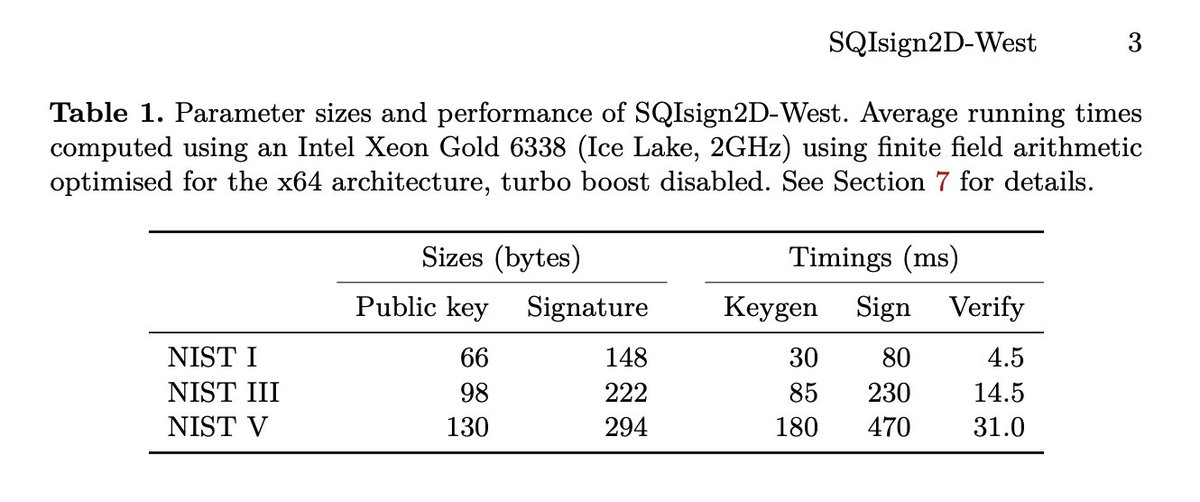
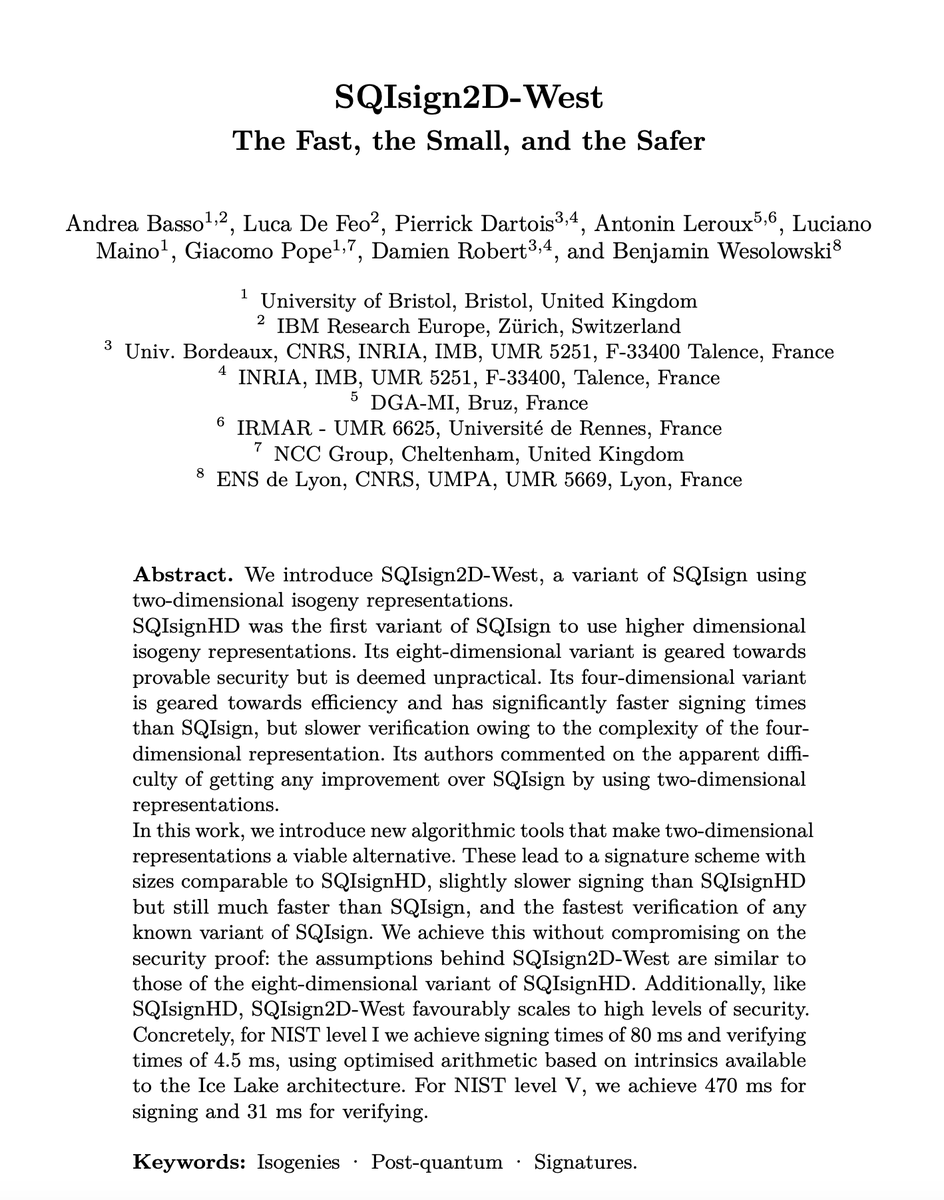
New work on improving SQIsign using two dimensional isogenies. A post-quantum signature scheme with compact public keys, signatures and the fastest verification of isogeny-based protocols so far.
https://t.co/9dXhdSeQ0u
📜Out now @NatureComms !😊
We show that what you learn & how you learn it can lead to important differences in neural activity structure + these differences play an important role in later adaptation https://t.co/j5gLu3TOKg
w/ @mattperich@LeeEugene57@JAlGallego@ClopathLab 🧵
Chen’s paper has a bug, independently discovered by Hongxun Weng and Thomas Vidick, that he doesn’t know how to fix. If I understand correctly, in its current form the paper doesn’t yield any improvement on prior algorithms.
https://t.co/aZ0hxecjrL
@SherVn31 To apply, you can just fill in the form on the job description page. If you have any additional questions, feel free to reach out to either of us
After a long slog, by many, many people, the first issue of the Communications on Cryptology is out.
This is a new Diamond Open Access (free to publish, free to view) journal from the IACR.
https://t.co/GezyiDgbtb