The way I achieved my success and my dreams was. I started with a vision and then spent my life moving a tiny bit in that direction without ever squandering one single day.
📉 O IBOV acaba de fazer algo que nunca tinha feito em 30 anos
Desde 1994, analisamos todas as 419 sequências de quedas semanais consecutivas do Ibovespa. O padrão é claro, quanto mais longa a sequência, mais rara ela é.
A distribuição histórica:
◆ 1 semana de queda → 241 vezes (rotina de mercado)
◆ 2 semanas → 97 vezes
◆ 3 semanas → 38 vezes
◆ 4 semanas → 23 vezes
◆ 5 semanas → 14 vezes
◆ 6 semanas → 4 vezes (1998, 2004, 2018, 2012)
◆ 7 semanas → 1 vez (Abr/2004)
◆ 8 semanas → 1 vez — e é agora, Abril/2026
Em 30 anos de Ibovespa, Plano Real, crise da Rússia, dot-com, subprime, Lava Jato, COVID, tudo, o índice nunca tinha caído por 8 semanas consecutivas. Até este mês.
O que isso significa?
Não é uma previsão de reversão. Eventos extremos existem justamente porque são raros. Mas a estatística diz algo importante: ao longo de toda a história do mercado brasileiro, toda vez que chegamos em sequências de 6 ou 7 semanas de queda, estávamos em crises de primeira grandeza: 1998 (crise da Rússia + LTCM), 2004 (incerteza fiscal Lula), 2018 (greve dos caminhoneiros + eleições).
Estar no território dos 8 semanas não significa que vai cair mais. Significa que o mercado já precificou uma quantidade extraordinária de pessimismo, e que, historicamente, quem comprou nesses momentos de exaustão vendedora raramente se arrependeu.
O gráfico histórico diz o resto.
Fonte: Yahoo Finance (^BVSP) | Elaboração: Santa Fé Investimentos | Não constitui recomendação de investimento.
One of the strangest things about modern education is how little confidence adults have in children.
We assume students
Cannot sit still
Cannot memorize poetry
Cannot understand history
Cannot read difficult books
Cannot discuss moral questions seriously
Then you spend time around classical schools and realize most children are capable of far more than we expect.
The problem was never their intelligence.
The problem was the poverty of our expectations.
The average student graduates after 12 years of schooling and still cannot answer the most important questions in life.
What is a good man?
What is justice?
What is worth sacrificing for?
What is beauty?
What is truth?
What is the purpose of life?
Classical education begins with the assumption that any education failing to address these questions is not really education at all.
True then, true now.
"There is perhaps no phenomenon which contains so much destructive feeling as 'moral indignation,' which permits envy or hate to be acted out under the guise of virtue."
—Psychoanalyst Erich Fromm, 1947
🚨Just published in the British Journal of Psychiatry!🚨
Evolutionary explanations of anxiety rated as 5x more useful for patients and 3x more useful for clinicians than genetic explanations of anxiety!
Our paper is the largest RCT of evolutionary explanations to date!
Why do some people develop bloating with some carbohydrates?
We examined clinical, diet, microbiome & meta-transcriptome in those bloating induced by either:
Fructans ➡️Abdominal girth, F:B ratio, CAZyme
GOS ➡️Breath H2, GABA
Paper @AmJGastro
https://t.co/1SCR7jfe3v
#DDW2026
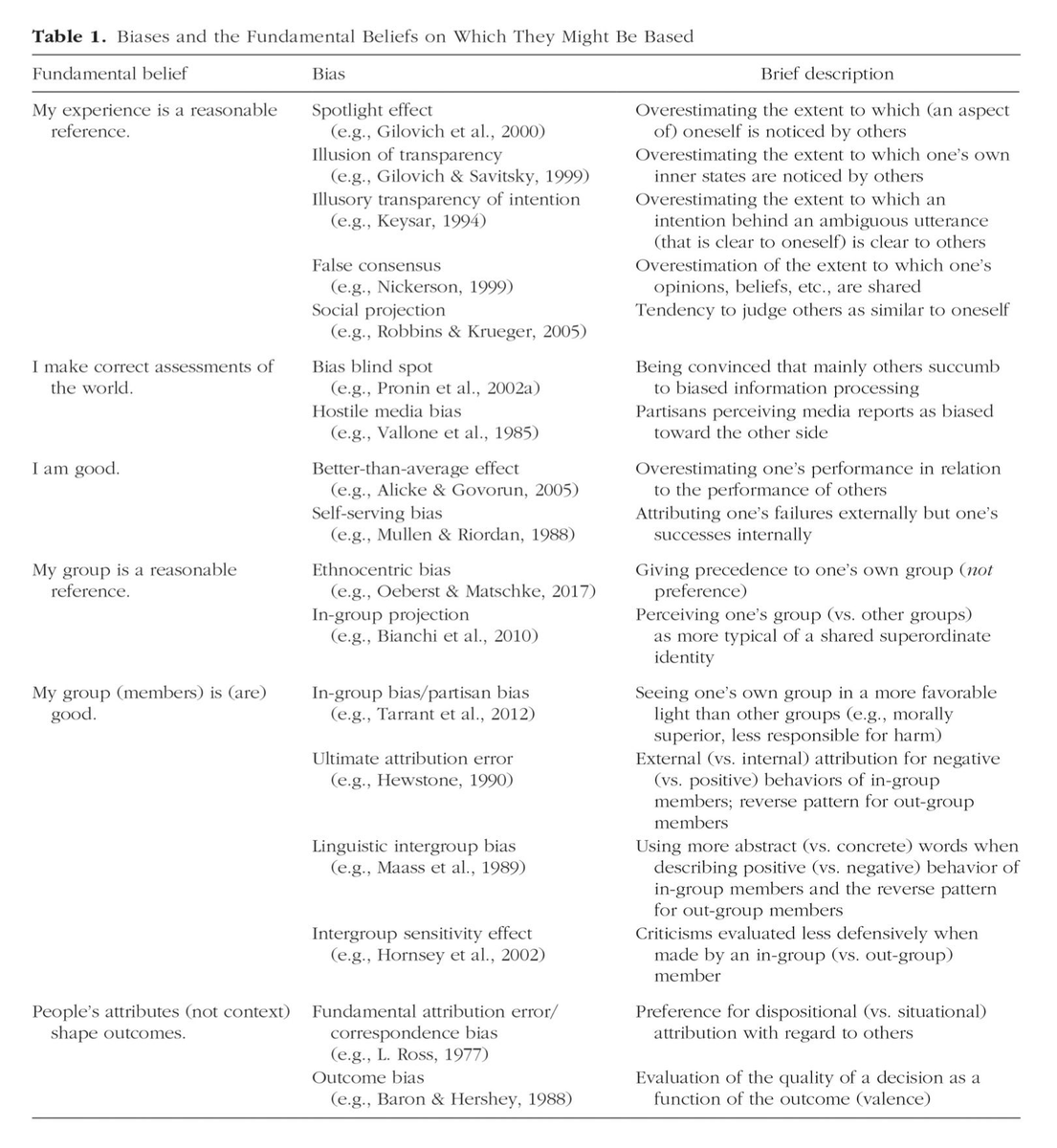
Psychologists have posited hundreds of cognitive biases over the years. A fascinating new paper argues that they all boil down to one of a handful of fundamental beliefs coupled with confirmation bias.
https://t.co/uZTVbGnH3d
Important dataset, but wrong framing leading to misinformation.
They adjust for volume, then claim intensity is superior.
A huge flaw in the study is the determination of high intensity which for the authors is >6METs which is ~21 mL O₂/kg/min…
So the reality is that this high intensity is in the range of Z1-Z3 for many people…😬…That is not high intensity for most. And low intensity in the study is <6METS which for many is not even a brisk walk or just Z1
To produce intensity:
• ↑ ATP turnover
• ↑ glycolysis
• ↑ lactate
To sustain it:
• mitochondrial capacity
• NAD⁺/NADH balance
• lactate clearance
This study doesn’t even mention metabolism or bioenergetics…
However, the main thing is misinformation as we keep falling into the same trap: either intensity or volume. It’s both!
And more importantly, exercise must be individualized, whether for an elite athlete or a patient.
https://t.co/HpZzOaR3bP
Trading is a performance activity, not an intellectual pursuit.
Most traders fail because they over-intellectualize trading. They chase "the formula," obsess over perfect analysis, and try to solve the market like a math equation.
In doing so, they neglect the only things that actually keep you alive: Risk ability, risk skills, and risk process.
> The Fatal Flaw of Analysis Over-reliance
Analysis is vital, but it has a ceiling. It relies on past data to predict a future driven by rapidly shifting dynamics and rigid belief systems. Analysis ignores the "Terrain"—the messy, ground-level reality of the present moment.
When you over-rely on analysis, you under-rely on Assessment and crucially "Adaptive Intelligence" - The ability to adjust thinking and behavior in rapidly changing environments.
> Analysis vs Assessment: The Military Lesson
Think in military terms:
• Analysis: Data compiled by people often far from the frontline, and usually relying on an evidence-based framework.
• Assessment: The "probing and sensing" done by those with boots on the ground (and often behind the frontline - Intelligence)
Nearly every major military disaster—from Pearl Harbor and Vietnam to the 7th of October—occurred because high-level analysis ignored frontline assessment.
This is why relatively small, poorly trained forces can beat powerful, well‑armed superpowers: they understand the terrain, while the giants only understand the data. >> It’s also why the lowly home day trader can thrive in a world dominated by giant, algorithm‑heavy hedge funds—by navigating the “unseen” that machines cannot map.
In trading, Assessment is the real-time sensing of liquidity and sentiment. It isn’t based on hard facts and evidence based-data, instead it relies on observation, feeling, and judgment.
>> The Jim Simons Paradox
Whenever I make the above assertion, somoene throws the legend Jim Simons at me as a "gotcha."
The common narrative is that "Simons beat the market purely with maths."
But this is only partly true, and if anything, I argue that Simons proves my theory:
The genius of Simons wasn’t just the math—it was his Adaptive Intelligence and his respect for the "Terrain" (Liquidity). Here are three ways he prioritized performance over pure intellect:
1. The Liquidity Ceiling
Simons capped the Medallion Fund at $20B.
He knew that if the fund got too large, it would "clog" the system. He understood that liquidity is impossible to measure in real-time—it can evaporate in seconds. He didn't try to "math" his way out of liquidity limits; he respected the terrain and stayed boundaried enough to survive it.
2. The "Gut Feel" Stop
In the 2007 Quant Quake, Simons did the unthinkable for a quant: He overrode the system. While his mathematicians wanted to trust the models, Simons saw the ghost of LTCM. He made a "gut-feel" assessment and stepped in. He knew the ultimate rule: 'You only get margin-called once.'
3. The Anti-Wall Street Culture
Simons didn’t hire from Wall Street. He didn't want people married to "fundamental theses." He wanted creative scientists who could apply adaptive intelligence to the process without the baggage of traditional intellectual ego.
The Bottom Line
Analysis tells you what should happen based on the past. It often has a formulaic component.
Assessment tells you what is happening right now. It is often a gut-feel/pattern-recognition process.
If you cannot bridge the gap between your intellect and your ability to sense the terrain, no model in the world will save you when the liquidity vanishes.
I’ve had the privilege of coaching the "Elite of the Elite," and the difference in their approach is striking. They operate within a multi-layered matrix: a structure that starts with deep analysis and ends with a live, tactical assessment of the market.
Success depends on the ability to work within this matrix in real-time. This is Adaptive Intelligence in action. My work focuses on helping traders elevate this intelligence, transforming how they engage with risk and allowing them to operate at a higher level of performance.
In trying to think of a powerful image for Adaptive Intelligence and navigating a complex environment such as markets, it occurred to me that a chameleon represents the trader who can move from being a "Subject" of the market to an "Architect" of their own survival through sheer adaptability.
"Don't ask for wealth. Don't ask for beauty. Don't ask for health. Don't ask for power. Ask to understand your life from the standpoint of God."
-Bishop Barron.
Interesting report from this Meta-analysis that psychedelic assisted psychotherapy in the treatment of depression is no more effective than open-label antidepressants
https://t.co/k9OLVd3gQR