Whether it’s existing consulting firms, new ones that emerge, FDEs from agent vendors, or new internal agent engineering roles, the amount of work that is going to be created to implement agents in enterprises will exceed anything we imagine today.
The complexity of implementing agents in any existing organizations is very real. When I talk to large enterprises, as you move from a chat paradigm to agents that participate in meaningful workflows, there are a number of things they need to do.
First, you have to get agents to be able to talk to your data securely across your systems. In many cases, enterprises have decades of legacy infrastructure that contain the valuable context for AI agents. That’s going to take a ton of work to go modernize and move to systems that work well with agents.
Then, you need to ensure that you’ve implemented agents with the right access controls and entitlements, the right scopes to be safely used, and have ways of monitoring, logging, and securing the work that they do.
Next, you need to actually document the processes in the organization in a way that agents can utilize for doing the work. You also need to figure out what the new workflow looks like when agents and people are working together on a process, and who steps in where. Just replicating the old workflow will mute the gains. Oh and you likely need to create evals for your top new end-state processes.
Finally, you have to keep up with a rapidly changing set of best practices and architectural shifts happening in the agent space. While it’s fun for people to change their personal productivity tools on a dime, it’s 100X harder to do this in a business process. The speed of change is a blessing and a curse right now for anyone trying to keep a stable system design.
All of this means that individuals and companies that develop expertise on the above set of components (and more) are going to be needed to help organizations actually implement agents at scale. This is also the rationale for vertical AI agents right now that can go in deep on a business domain and help bring automation to it.
This is a huge opportunity right now whether you’re doing this internally or as an external business provider.
Great line from @shellypalmer that I’ll paraphrase - AI shouldn’t be a ghostwriter, it should be a sparring partner.
Best way to keep your job isn’t to dismiss AI. It’s to engage with it and find where it’s wrong.
In order for AI to know it’s wrong, you have to spend a lot of time building context and rules before you use it.
Which is something that 99 pct of people have no clue how to do. And unless you are in a tech company, there is the same probability that the boss(es) above you have no clue what I’m talking about.
And in business, AI never knows the consequences of its actions. It doesn’t have judgement. That’s left to you
If you learn how to get the best out of AI. How to challenge AI , like it was a competitive coworker or consultant, and how to bring judgement and the ability to explain in a manner your peers and bosses understand, you will thrive.
If you just regurgitate what AI gives you, you will be fired.
I’m coming to the conclusion that the biggest challenge for Enterprise AI, and AI in general , as of now, is that it’s still impossible to make sure that everyone gets the same answer to the same question, every time.
Which is a great response to the doomers. AI doesn’t know the consequences of its output.
Judgement and the ability to challenge AI output is becoming increasingly necessary, and valuable.
Which makes domain knowledge more valuable by the second.
Am I wrong ?
New podcast on vibe coding - A Return to Code.
A Return to Coding 00:20
The Personal App Store 03:17
Vibe Coding Is a Video Game with Real-World Rewards 06:22
Pure Software Is Uninvestable 10:33
A Place for Each Model 14:22
AI Is Eager to Please 17:57
Why Math and Coding? 22:10
The Beginning of the End of Apple’s Dominance 24:17
Coding Agents As Customer Service Reps 27:55
Mike Stonebraker is a Turing award winner famous for his fundamental contributions to databases (e.g. Postgres, C-Store and much more). I interviewed him recently about:
• The story behind Postgres & the hardest technical challenge in building it
• Where he disagreed with Google's technical decisions
• Future problems in databases
• Literature recommendations to learn databases
• Why LLMs score 0% on his text-SQL benchmark
• What if you replaced all state in an OS with a DB
Timestamps:
0:00 - Intro
1:03 - How he got into databases
6:43 - Competing with Oracle
9:07 - What made Postgres special
15:55 - One size fits none
21:37 - Why he disagreed with Google
29:14 - Why he chose academia over big tech
30:58 - Replacing state in an OS with a DB
42:02 - Future problems in databases
51:36 - Technical book recommendations to learn databases
52:20 - Advice for younger self
55:52 - Outro
Where to watch:
• YouTube: https://t.co/YCunRSEIUK
• Spotify: https://t.co/7cCzATzN8z
• Apple Podcasts: https://t.co/jOYDGtGVnt
• Transcript: https://t.co/36BL7eGNmq
Steve is right. Companies are stuck at the chat-wrapper phase because they think AI is a typing problem. It’s an orientation problem.
If you don't build a deterministic containment vessel for agentic entropy, AI will accelerate liability.
https://t.co/CVC9PyRBbd
I was chatting with my buddy at Google, who's been a tech director there for about 20 years, about their AI adoption. Craziest convo I've had all year.
The TL;DR is that Google engineering appears to have the same AI adoption footprint as John Deere, the tractor company. Most of the industry has the same internal adoption curve: 20% agentic power users, 20% outright refusers, 60% still using Cursor or equivalent chat tool. It turns out Google has this curve too.
But why is Google so... average? How is it that a handful of companies are taking off like a spaceship, and the rest, including Google, are mired in inaction?
My buddy's observation was key here: There has been an industry-wide hiring freeze for 18+ months, during which time nobody has been moving jobs. So there are no clued-in people coming in from the outside to tell Google how far behind they are, how utterly mediocre they have become as an eng org.
He says the problem is that they can't use Claude Code because it's the enemy, and Gemini has never been good enough to capture people's workflows like Claude has, so basically agentic coding just never really took off inside Google. They're all just plodding along, completely oblivious to what's happening out there right now.
Not only is Google not able to do anything about it, they don't seem to be aware of the problem at all. I'm having major flashbacks to fifty years ago as a kid at the La Brea Tar Pits, asking, "why can't they just climb out?"
My Google friend and I had this conversation over a month ago. I didn't share it because I wanted to look around a bit, and see if it's really as bad as all that. I've been talking to people from dozens of companies since then. And yeah. It's as bad as all that.
Google is about average. Some companies at the bottom have near-zero AI adoption and can't even get budget for AI. They may have moats and high walls, but the horde is coming for them all the same.
And then there are a few companies I've met recently who are *amazingly* leaned in to AI adoption. One category-leader company just cancelled IntelliJ for a thousand engineers. That's an incredibly bold move, one of many they're making towards agentic adoption. In my opinion, that company is setting themselves up for a _huge_ W.
As for the rest, well, it's the Great Siloing. Everyone's flying blind. With nobody moving companies, no company knows where they stand on the AI adoption curve. Nobody knows how they're doing compared to everyone else.
Half of them just check a box: "We enabled {Copilot/Cursor} for everyone!" Cue smug celebrations. They think this is like getting SOC2 compliance, just a thing they turn on and now it's "solved." And they don't realize that they've done effectively nothing at all.
All because of a hiring freeze.
@Steve_Yegge The SOC2 comparison is right - treating AI as a procurement checkbox
The 60% are stuck on Cursor because it's localized and 'safe'. Going agentic I think requires an orientation substrate - boundaries, obligations, legacy seams - that the agent must respect.
Adoption = process
I don't want to make fun of Anthropic on account of how they vibe coded themselves into this situation...
I just want to make a few points:
- AI models still have limited context
- We still have limited tools
- There is no magic
https://t.co/n4y6q13dVb
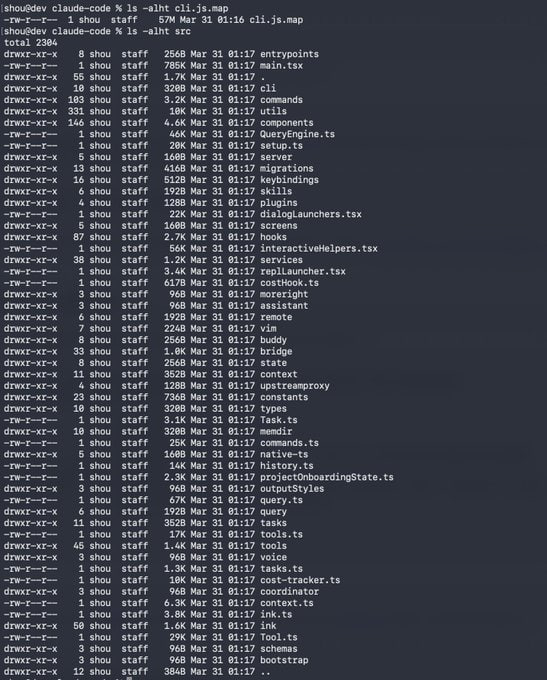
Anthropic accidentally leaked their entire source code yesterday. What happened next is one of the most insane stories in tech history.
> Anthropic pushed a software update for Claude Code at 4AM.
> A debugging file was accidentally bundled inside it.
> That file contained 512,000 lines of their proprietary source code.
> A researcher named Chaofan Shou spotted it within minutes and posted the download link on X.
> 21 million people have seen the thread.
> The entire codebase was downloaded, copied and mirrored across GitHub before Anthropic's team had even woken up.
> Anthropic pulled the package and started firing DMCA takedowns at every repo hosting it.
> That's when a Korean developer named Sigrid Jin woke up at 4AM to his phone blowing up.
> He is the most active Claude Code user in the world with the Wall Street Journal reporting he personally used 25 billion tokens last year.
> His girlfriend was worried he'd get sued just for having the code on his machine.
> So he did what any engineer would do.
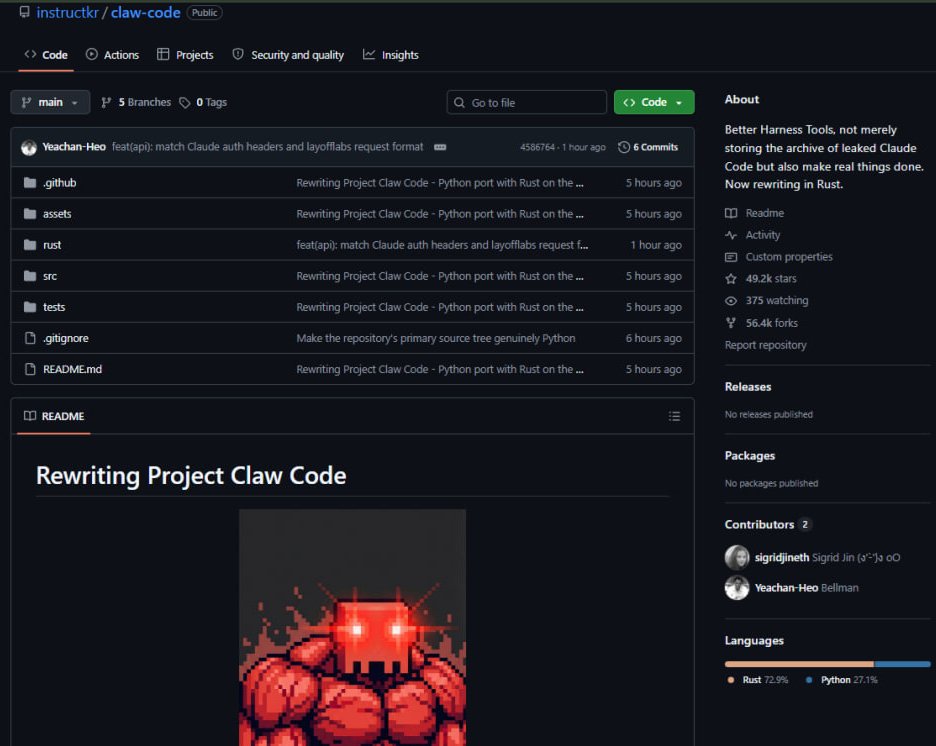
> He rewrote the entire thing in Python from scratch before sunrise.
> Called it claw-code and Pushed it to GitHub.
> A Python rewrite is a new creative work. DMCA can't touch it.
> The repo hit 30,000 stars faster than any repository in GitHub history.
> He wasn't satisfied. He started rewriting it again in Rust.
> It now has 49,000 stars and 56,000 forks.
> Someone mirrored the original to a decentralised platform with one message, "will never be taken down."
> The code is now permanent. Anthropic cannot get it back.
Anthropic built a system called Undercover Mode specifically to stop Claude from leaking internal secrets. Then they leaked their own source code themselves. You cannot make this up.
Which direction should I take this game engine?
https://t.co/W66zvsY9OD
Make an educational games platform for kids with sims for their classes?
Or an arcade games platform to compete with Apple Arcade?
@Dexerto So they want to compete with ME? They don't know what's coming :-)
I even have running demos https://t.co/W66zvsY9OD
They run fine on rpi5 but really shine on a MacBook with EDR display
@ryolu_ Ai solves writing code fast and proves this was never the problem - it was just the bottleneck. The real problem was always systems thinking. good professionals were developing systems thinking during writing code. And some people learned it without writing code
software is still about thinking
software has always been about taking ambiguous human needs and crystallizing them into precise, interlocking systems. the craft is in the breakdown: which abstractions to create, where boundaries should live, how pieces communicate.
coding with ai today creates a new trap: the illusion of speed without structure. you can generate code fast, but without clear system architecture – the real boundaries, the actual invariants, the core abstractions – you end up with a pile that works until it doesn't. it's slop because there's no coherent mental model underneath.
ai doesn't replace systems thinking – it amplifies the cost of not doing it. if you don't know what you want structurally, ai fills gaps with whatever pattern it's seen most. you get generic solutions to specific problems. coupled code where you needed clean boundaries. three different ways of doing the same thing because you never specified the one way.
as Cursor handles longer tasks, the gap between "vaguely right direction" and "precisely understood system" compounds exponentially. when agents execute 100 steps instead of 10, your role becomes more important, not less.
the skill shifts from "writing every line" to "holding the system in your head and communicating its essence":
- define boundaries – what are the core abstractions? what should this component know? where does state live?
- specify invariants – what must always be true? what are the constants and defaults that make the system work?
- guide decomposition – how should this break down? what's the natural structure? what's stable vs likely to change?
- maintain coherence – as ai generates more code, you ensure it fits the mental model, follows patterns, respects boundaries.
this is what great architects and designers do: they don't write every line, but they hold the system design and guide toward coherence. agents are just very fast, very literal team members.
the danger is skipping the thinking because ai makes it feel optional. people prompt their way into codebases they don't understand. can't debug because they never designed it. can't extend because there's no structure, just accumulated features.
people who think deeply about systems can now move 100x faster. you spend time on the hard problem – understanding what you're building and why – and ai handles mechanical translation. you're not bogged down in syntax, so you stay in the architectural layer longer.
the future isn't "ai replaces programmers" or "everyone can code now." it's "people who think clearly about systems build incredibly fast, and people who don't generate slop at scale."
the skill becomes: holding complexity, breaking it down cleanly, communicating structure precisely. less syntax, more systems. less implementation, more architecture. less writing code, more designing coherence.
humans are great at seeing patterns, understanding tradeoffs, making judgment calls about how things should fit together.
ai can't save you from unclear thinking – it just makes unclear thinking run faster.
@ryancarson After a month using claude code on 4 separate projects I was becoming the bottleneck and I was thinking of using @official_taches 's GSD. I will compare your approaches.
I also made use of @Steve_Yegge 's beads and trying to integrate my own https://t.co/4KPbs4h1YG for context.
I’m open-sourcing the core.
I believe technical agencies should own their infrastructure, not rent it.
If you are tired of the WordPress roadblock and want to see what a Serverless CMS / Agency OS looks like, check it out:
https://t.co/SXuElsSdcD hosted on AMODX
WordPress is dead to me.
If it works for you, more power to you. Keep shipping.
But when I started building my own marketing engine from scratch, I found the legacy stack was a roadblock, not an enabler.
I needed speed. I got plugins.
So I decided to build my own way out. 🧵
It is going better than expected.
The friction is gone.
We aren't fighting the tool anymore; the tool is doing the heavy lifting.
The "Context Engine" holds our strategy, and the AI Agents execute the grunt work. We just steer.