Founder of @dataengines. I tweet about invention, science, and democracy. Of biggest interest to me are their origin and archaic stories and how they overlap with randomness and errors.
@farairesearch@ARGleave@soroushjp Your readers may be interested in this work also related to the problems of #AISafety - how do we evaluate noisy algorithms using unlabeled data? And if we did find such algorithms, how would we validate them when we actually use them?
Tune into The AGI Show podcast featuring our CEO, @ARGleave with @soroushjp. Discover Adam's insights on current research directions in AI Safety and promising agendas for trustworthy & beneficial AIs.
https://t.co/xAg7GrNI9H
@TonyTheLion2500 Hard work and pecking on it every day. You are far better off spending 10 minutes a day on a problem than one hour every 6 days. If training the body is like that - every day work - why is the brain so different?
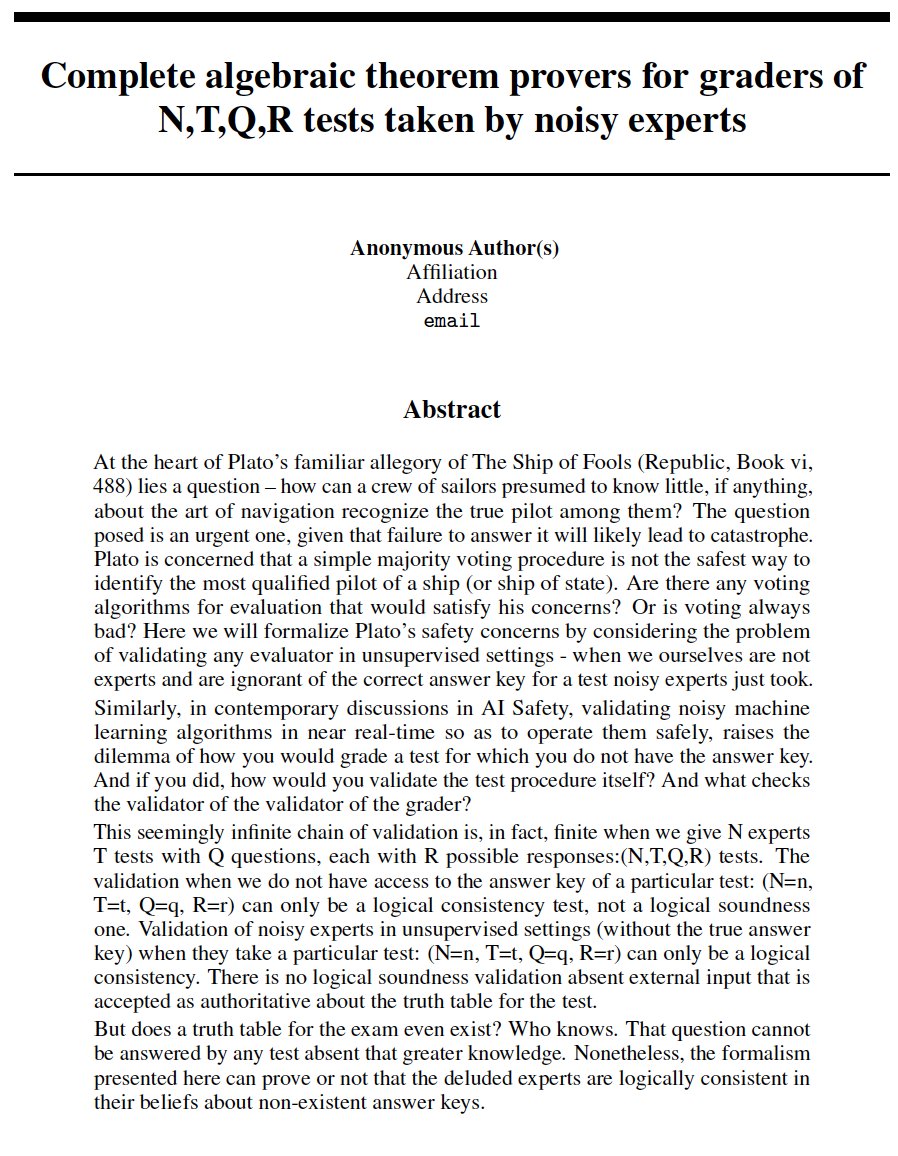
@OpenAI Then you should consider incorporating me in that team. Check out what one can do with just algebra and geometry when it comes to the problem of evaluating noisy binary classifiers on unlabeled data - a bottleneck task for AI safety in near real-time 👇
https://t.co/exMiPpybSr
Emily Wilson performing (in Homeric Greek!) some of her translation of the Iliad followed by a discussion of her translation goals. https://t.co/suxHKO2Z0Q
Update to my paper on avoiding probability and just using algebra to make us safer when evaluating noisy judges. The independent solution to the @eaplatanios and @tommmitchell agreement equations is a theoretical dead-end. https://t.co/exMiPpybSr
Since there is no algebraic way to separate the stream error rate, there is no stream error rates independent solution either. You have to contend with the convolution of your label rates with the unknown prevalences of the stream labels.
The submission to @NeurIPSConf on algebraic evaluation is on the road to rejection. One of the main criticisms - that I do not cite the work of @eaplatanios and @tommmitchell its relation to our formulation - has lead to discovering an error in their independent solution.
@eaplatanios The algebra is easy. The stream error rates for two classifiers can be written as: e1 = pA*e1A+pB*e1B and e2=pA*e2A+pB*e2B. The incorrect assertion in the highlighted line is that (pA*e1A+pB*e1B)*(pA*e2A+pB*e2B) == (pA*e1A*e2A+pB*e1B*e2B). And yet the RHS is the joint rate!
@Jack10644137@bneyshabur@RealChemistry_ Yes, you will be able to find more work if you have a PhD. But it will cost you upfront and still does not prepare you for the toolset you need in industry. Going for a PhD is a tricky decision. A masters is a very good sweet spot that requires less knowledge of your future.
@Jack10644137@bneyshabur@RealChemistry_ Most of the industrial AI work is data quality assurance and governance (storage architecture, database schemes, etc). The data, not the algorithms, are the gold. Fancy algorithms incur a lot of technical debt and may bring only marginally thin improvements over simpler ones.