WE BUILT ONBOARDING AROUND OUR BIGGEST WEAKNESS
nobody wants to photograph their clothes so we killed this step
https://t.co/OjctPloOm7 builds your digital closet from your camera roll in ~2 mins
all on-device, nothing leaves your phone
design inspired by @lihachyov
live! 🚀
WE BUILT ONBOARDING AROUND OUR BIGGEST WEAKNESS
nobody wants to photograph their clothes so we killed this step
https://t.co/OjctPloOm7 builds your digital closet from your camera roll in ~2 mins
all on-device, nothing leaves your phone
design inspired by @lihachyov
live! 🚀
A four month old company is sitting at the top of the ARC-AGI-3 public leaderboard, with a score half again as high as second place.
They came out of stealth today and will not discuss their method while the competition is still running.
meet @mostik_ai!
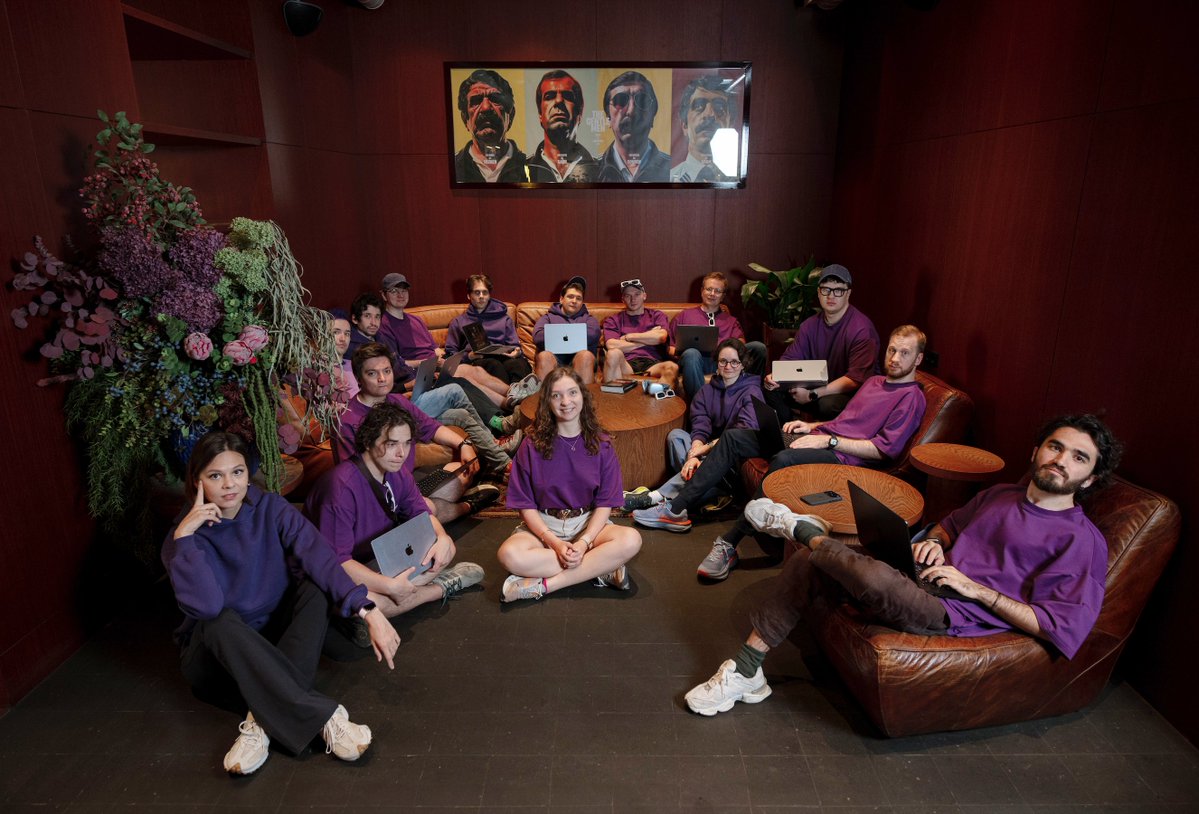
what happens when you put 12 PhDs in one room for four months? first place on the ARC-AGI leaderboard, which I can't say much about while the competition is still running. and this, which I can.
everyone's arguing about whether open models will catch up to frontier models. we think it's the wrong question. here's the one we pose: why does a frontier model have to generate your answer at all, when the only thing you need from it is the reasoning?
we do this by enabling models to communicate in latent space. through our protocol, hidden states pass straight from a frontier model into a small one running on your infrastructure -- no text between them, and neither model is fine-tuned. two models from different families, sharing reasoning, both left untouched.
how do we know it works? we tested it on a setup where a 753B model reads the problem, and a 4B edge-class model writes the answer. with this approach, we get results 80% as accurate as the frontier model, but at 20x faster performance.
we're committed to preventing frontier model lock-in and are already partnering with inference providers to accelerate open-weight adoption. we've done this between 15 of us, in four months, 12 PhDs and a Fields medalist, backed by @generalcatalyst
WIRED has the first external account of the company and the work: https://t.co/tP8nItCsDl
full writeup, the setup, and all the numbers: https://t.co/C9NZ5vtV1V
meet @mostik_ai!
what happens when you put 12 PhDs in one room for four months? first place on the ARC-AGI leaderboard, which I can't say much about while the competition is still running. and this, which I can.
everyone's arguing about whether open models will catch up to frontier models. we think it's the wrong question. here's the one we pose: why does a frontier model have to generate your answer at all, when the only thing you need from it is the reasoning?
we do this by enabling models to communicate in latent space. through our protocol, hidden states pass straight from a frontier model into a small one running on your infrastructure -- no text between them, and neither model is fine-tuned. two models from different families, sharing reasoning, both left untouched.
how do we know it works? we tested it on a setup where a 753B model reads the problem, and a 4B edge-class model writes the answer. with this approach, we get results 80% as accurate as the frontier model, but at 20x faster performance.
we're committed to preventing frontier model lock-in and are already partnering with inference providers to accelerate open-weight adoption. we've done this between 15 of us, in four months, 12 PhDs and a Fields medalist, backed by @generalcatalyst
WIRED has the first external account of the company and the work: https://t.co/tP8nItCsDl
full writeup, the setup, and all the numbers: https://t.co/C9NZ5vtV1V
I've built my own Palantir to track every customer action in my app (https://t.co/V83BvAJtUz).
Built the analytics, designed the UI, and engineered the data pipeline myself.
@carlmonkft@RevenueCat@Superwall I ran into similar problems while building my own product, so I ended up building a founder-first analytics layer instead of relying entirely on third-party dashboards.
Check your dm 🙌
Show the auth page as late as possible.
People don't open your app because they dream of creating an account.
They open it because they expect value. Deliver that value first.
Ask for the account only after the user has already started a cognitive process they don't want to lose.
Authentication shouldn't begin the experience.
It should preserve it.
https://t.co/9gcf0Hjda6 onboarding as an example. 👇
Great onboarding flow 🤫🧏
→ Open the app
→ Answer a few questions about yourself
→ Get your first personalized insight
https://t.co/V83BvAJtUz gives you an initial interpretation of your current state and a small experiment to validate or improve it.
No sign-up required.
🇳🇴 It feels like the internet is mourning Norway's World Cup elimination more than anyone else's. I think I might know why.
Throughout the tournament, Norway developed one of the most recognizable rituals: the collective chant "Ro!" (Norwegian for "row!") accompanied by a synchronized rowing motion.
In the framework I'm currently developing, this is what I'd call a meme: a stable configuration of perceptual patterns that can be reproduced across different people's cognitive systems and reliably trigger roughly the same interpretation.
My guess is that this meme became remarkably stable even among non-Norwegians. It naturally resonated with the cultural image of Vikings, and because it was repeatedly performed by almost everyone throughout the tournament, it gradually became part of the shared experience.
When Norway was eliminated, the team disappeared from the competition. But at the cognitive level, something else disappeared as well: the opportunity to reproduce that ritual.
Maybe that's why so many people felt an unexpected sense of loss. It wasn't just the team that vanished—it was a stable cognitive pattern that had already become part of the collective experience.
One of the functions of rituals may be exactly this. They don't create meaning or behavior from scratch. They repeatedly reactivate an existing semantic core until it becomes stable enough to persist in collective memory.
Curious — did you find yourself missing the "Ro!" ritual as much as the Norwegian team itself?