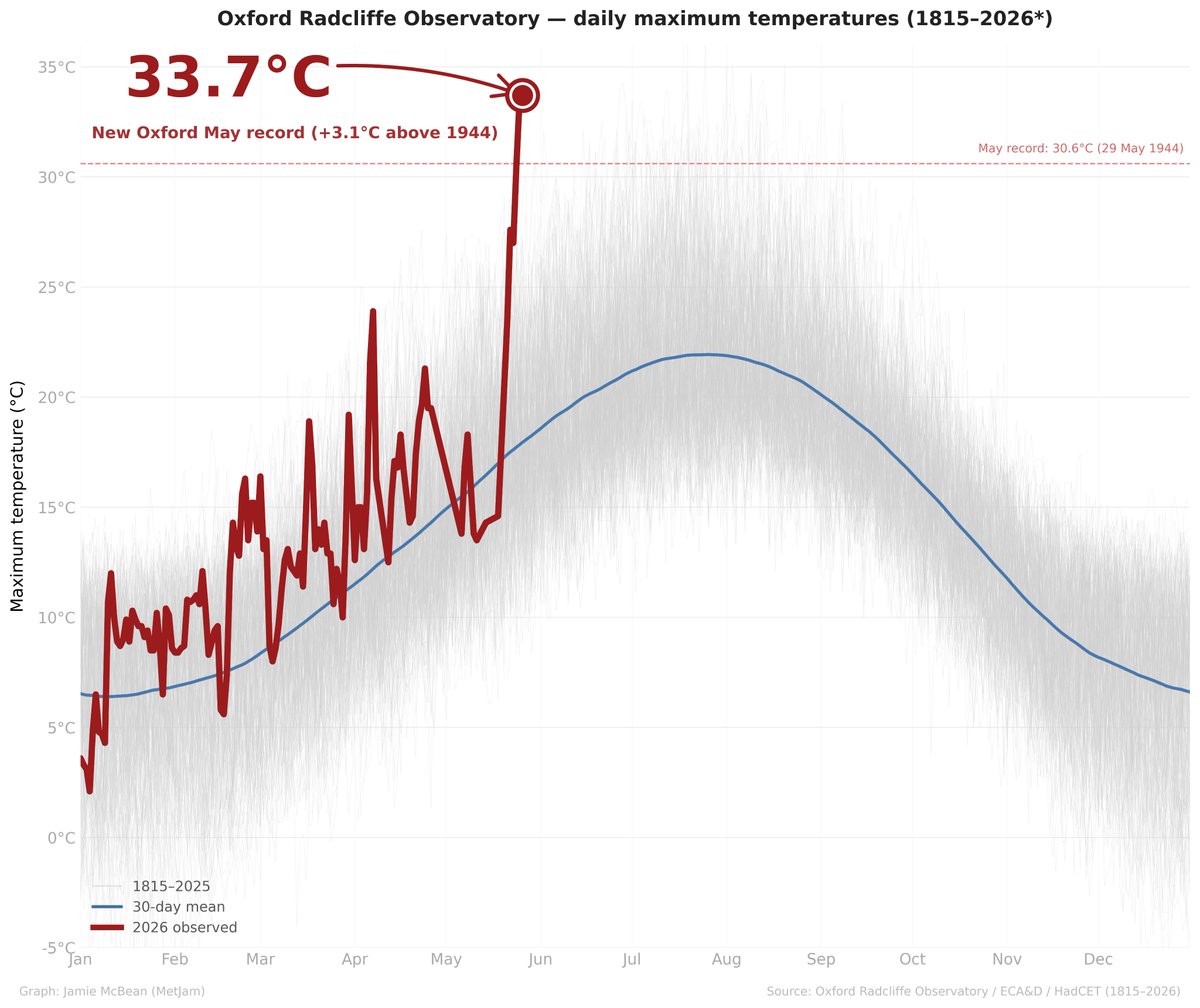
Oxford, the longest running continuous weather station in UK history, with temperature observations stretching back to 1815, has preliminarily broken its maximum temperature record for May yesterday by OVER 3ºC with a temperature of 33.7ºC. Unprecedented in its 211-year history.
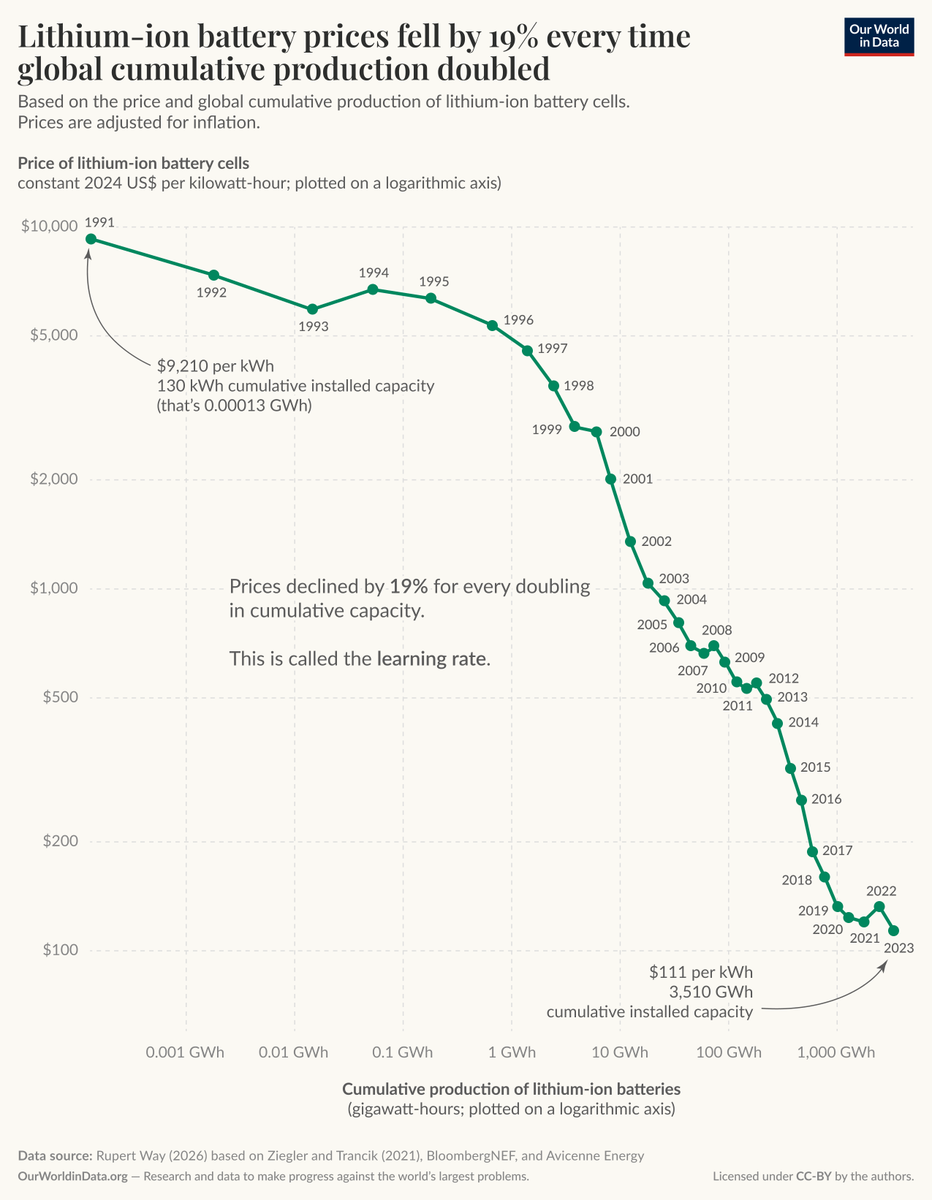
Decades of data says the price of storage drops by 19% every time global production doubles. This isn't some marginal gain. It's an unstoppable force of nature
You can’t out-compete math this aggressive. This "learning rate" is a one-way street to total electrification - because it's cheaper. As battery costs crater, EVs become cheaper than petrol cars, and grid storage makes solar/wind reliable 24/7
This feedback loop can't be stopped, however many fossil fuel wars Big Oil continues to initiate
That's us! 🌍
The Artemis II crew captured beautiful, high-resolution images of our home planet during their journey to the Moon. As @Astro_Christina put it: "You guys look great."
✍️ New article: Battery costs have declined by 99% in the last three decades, making electrified transport a reality—
Over 20 million electric cars were sold globally in 2025 — some for as little as $10,000. Even just two decades ago, that would have been impossible.
The reason it's possible now? Batteries have gotten *much* cheaper.
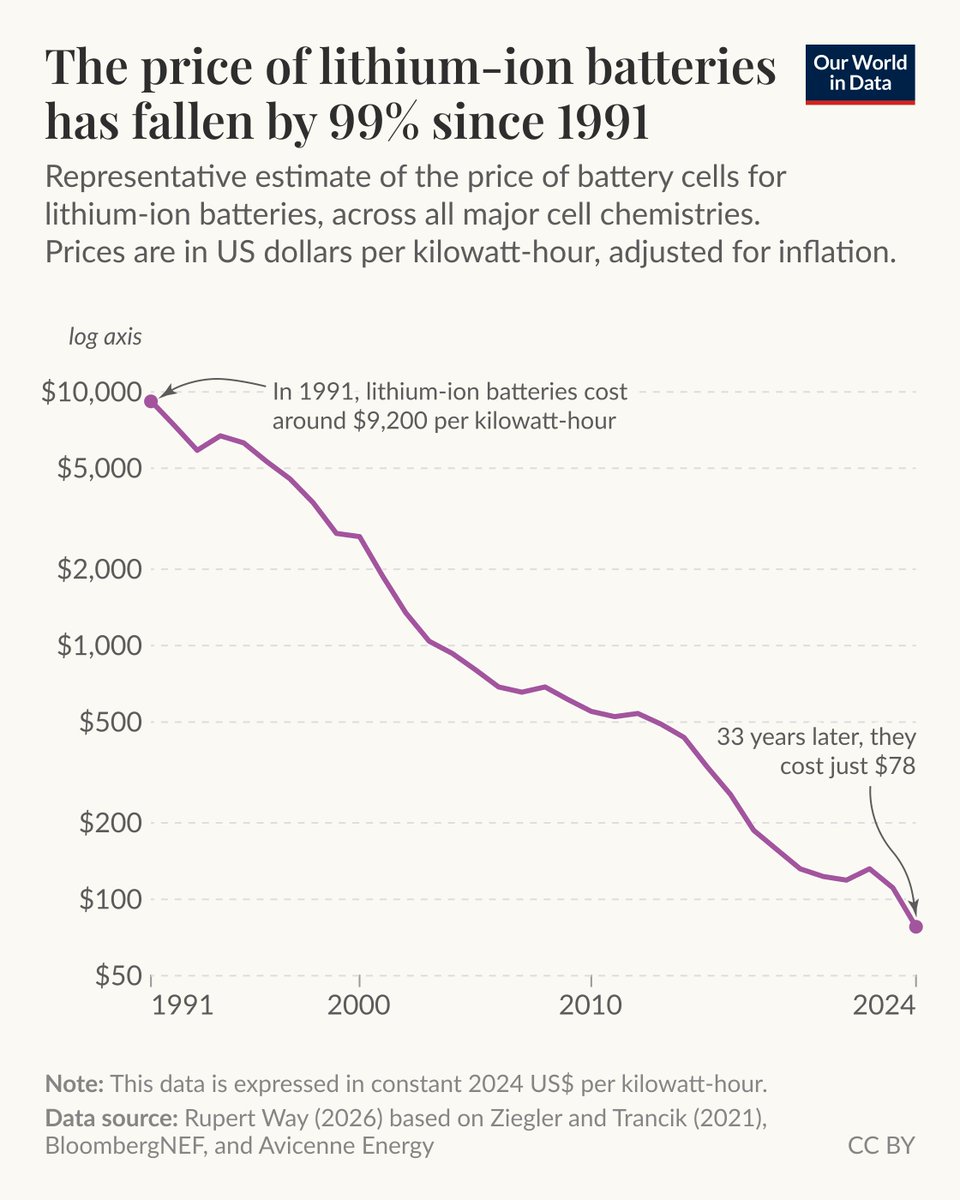
In 1991, lithium-ion battery cells cost around $9,200 per kilowatt-hour. By 2024, that had fallen to just $78 — a decline of more than 99%. You can see this in the chart.
To put that in perspective: the battery cells in a standard electric car today cost around $5,000. In 1991, those same cells would have cost nearly $600,000.
There was no single breakthrough behind this. Batteries follow a “learning curve”: as cumulative production grows, thousands of small improvements in chemistry, manufacturing, and supply chains drive prices down.
Since 1998, every time global cumulative battery production doubled, the price dropped by roughly 19%.
Early progress was driven by consumer electronics — phones and laptops — before the technology became viable for cars, buses, and larger energy storage.
Energy density has also more than tripled since the 1990s, meaning batteries can now store far more energy for their volume.
The half-a-million-dollar battery was never going to transform transport. The $5,000 battery is.
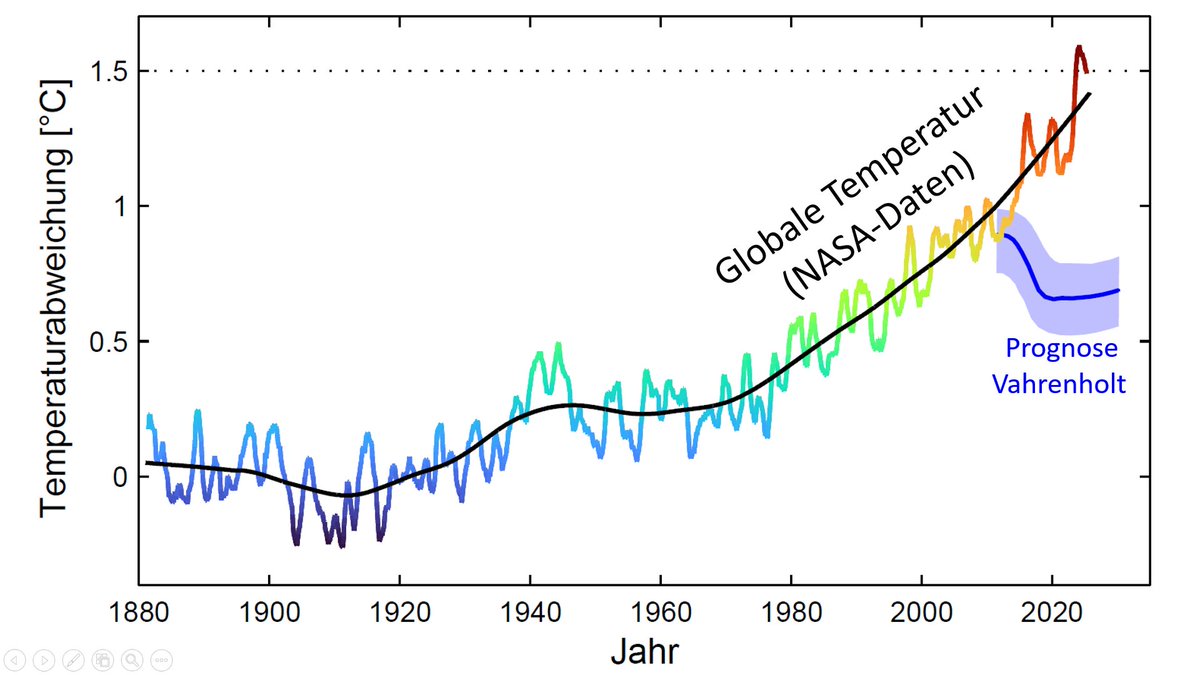
One of our main German climate deceivers, Fritz Vahrenholt, actually has predicted cooling in a 2012 book - see the blue curve. He worked for RWE, the largest CO2 emitter of Europe.
BREAKING: A new paper introduces a fundamentally different way to search for new drugs.
Not a small improvement.
A change in approach.
For decades, virtual screening worked like this:
• Choose one protein
• Test millions of molecules computationally
• Wait days or weeks
• Hope for useful hits
This method does not scale to the genome.
The core idea behind DrugCLIP is surprisingly simple:
Instead of simulating molecular physics,
treat drug discovery as a search problem.
The method uses the same principle behind modern search engines and recommendation systems.
Proteins and molecules are represented in a shared space, allowing rapid matching between the two.
Rather than asking: “Does this molecule bind?”
It asks: “Which molecules belong to this protein pocket?”
The impact is dramatic.
Screening becomes millions of times faster than traditional docking approaches, while maintaining strong accuracy.
A key challenge has been the use of predicted protein structures from AlphaFold.
The authors addressed this by developing a pocket-refinement approach that makes predicted structures usable at scale, opening the door to less-studied targets.
Crucially, this was not only a computational exercise.
The team validated their results experimentally, identifying real binders and confirming structures in the lab.
This is where many AI papers fall short - and this one did not. The scale is what truly stands out:
• ~10,000 human proteins
• 500 million molecules
• Trillions of protein–molecule pairs
• Completed in under 24 hours on modest GPU resources
This is not incremental progress.
It is a step change.
The implication is clear:
Drug discovery is no longer limited primarily by computation.
The new bottlenecks are biology, validation, and creative hypotheses.
DrugCLIP doesn’t just speed up virtual screening.
It reframes drug discovery as a scalable search problem - and that changes what’s possible.
A thread of videos from today’s flight into Hurricane Melissa
In this first one we are entering from the southeast just after sunrise and the bright arc on the far northwest eye wall is the light just beginning to make it over the top from behind us.
Grid scale batteries are changing our electricity system. Excellent new visual story on batteries in FT today shows just how far this technology has evolved.
Fasten your seatbelts, this is just the beginning.
https://t.co/Xf3EE89ANI
Your daily reminder:
Sex is a near universal reality present across almost all multicellular plant and animal species, where two cells called gametes (each with half the number of chromosomes) combine to form a unique individual.
There are only two specialized roles for this process. One role, the male sex, provides the smaller gamete (sperm). The other role, the female sex, provides the larger gamete (the egg). This difference in gamete type is the universal difference between male and female no matter the species, and it has directly influenced the biological differences between the sexes we see today.
In about a month, we will be releasing The Sex Development Handbook, a first of its kind visual guide to human sex development and all major DSDs. No other publication on this topic combines accessible scientific commentary with clear, visual diagrams. A must-read for everyone in the medical field and anyone curious about how we all develop as male or female.
🔗 Sign up at the link for updates and a sample on release day! https://t.co/kwiwaOcWxi
Over the last 60 years, the world population has more than doubled.
This has inevitably reduced the land available per person to live and grow food.
How have we managed to feed a rapidly growing population with ever-shrinking land resources?
Let's look at this for cereals, which make up more than half of total caloric intake in many countries and dominate global arable land use by area.
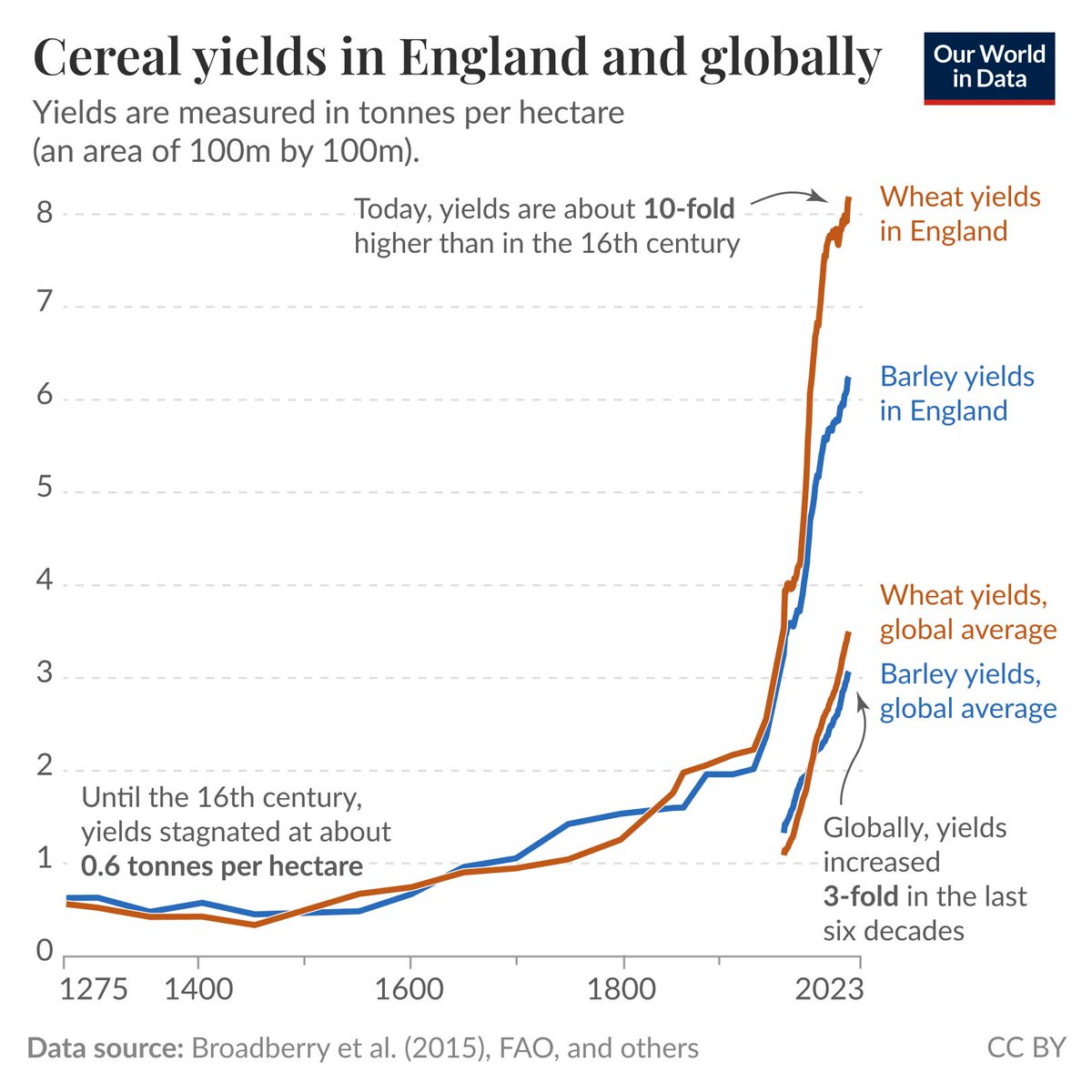
We see in the chart that for cereals, this has been achieved by massively increasing the yield — the world can now produce more than three times as much cereal from a given area of land as it did in 1961 (i.e., an increase in yield of 214%).
In the same period, land used for cereal has only increased by 14%.
This increase in yield output (or "intensification") has typically been achieved through a combination of chemical inputs (such as fertilizer, pesticides, and herbicides); improved water use (e.g., irrigation); mechanization and improved farming practices; and the use of higher-yielding crop strains or seeds.
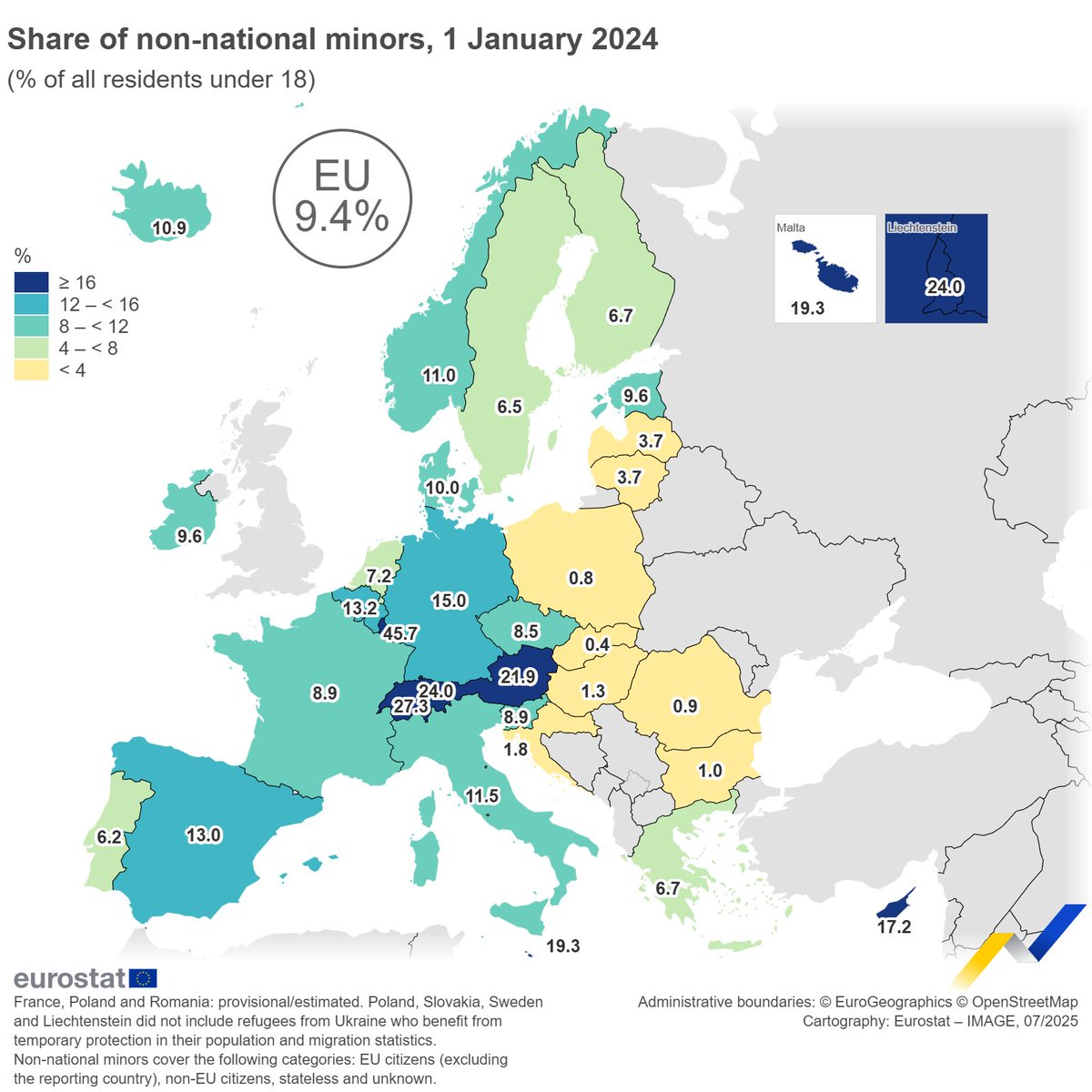
In 2024, 9.4% of minors under 18 in the EU did not have the citizenship of their country of residence. 🛂
Highest shares in:
🇱🇺Luxembourg (45.7%)
🇦🇹Austria (21.9%)
Lowest in:
🇸🇰Slovakia (0.4%)
🇵🇱Poland (0.8%)
Learn more 👉https://t.co/6gYMY6bLUC
Rising yields, falling hunger—
The Agricultural Revolution — the transition from hunting and gathering to farming — didn’t end hunger. That’s because more food didn’t mean more per person: it meant more people.
The English cleric Thomas Malthus predicted this would continue forever: food production would always be outpaced by population growth, making lasting progress against hunger impossible.
But at least since the mid-20th century, England has left mass hunger behind. How was this possible? How did English farmers prove Malthus wrong?
The chart shows one central part of the answer. For centuries, cereal yields in England — for staples like wheat and barley — were stuck at about 0.6 tonnes per hectare. That means farmers needed a plot of 100 meters by 100 meters to grow 600 kilograms of cereals per year. Hunger was widespread.
But this changed from the 17th century onward, accelerating a hundred years ago. In a dramatic transformation known as the Second Agricultural Revolution, farmers found ways to grow much more food on the same land.
Today, after four centuries of rising productivity, English farmers are growing about ten times more food on the same land than in the past. This has made it possible to increase food production faster than population growth, breaking England out of the “Malthusian Trap”.
The chart also shows that the world as a whole is changing in the same direction. Global average yields have tripled in the last six decades. Today, yields are already about five times higher than in England in the past. If yields continue to follow this trajectory, it would bring us much closer to the end of global hunger, while also sparing land for nature.
(This Data Insight was written by @MaxCRoser.)
DeepMind just dropped a 106-page paper unveiling AlphaGenome.
This single model could completely redefine how we discover disease-causing mutations and drug targets.
This is massive. 🧵
Gepatschferner (Kaunertal, Tirol, AT)
2020 | 2024
Demise of the largest glacier in Tirol over the last 5 years! 😱
When the landscape is evolving at a non-geological speed... 🔥
📽️ Martin Mergili (Uni Graz), Stefan Haselberger (Uni Wien/PHUSICOS)
H5N1 bird flu has a mortality rate close to 100% in chicken. When the virus is detected in a chicken farm, all animals are being euthanised to reduce their suffering and limit the risk of spread to other animals and humans.
1/
Europe made a colossal mistake:
They banned genetically modified organisms (GMOs) while the rest of the world embraced them.
Now we rely on imports, pay more for food, and miss out on sustainable agriculture.
Here’s the story of Europe’s GMO debacle 🧵: