Want to know how a feature works in an app, down to the binary level...?
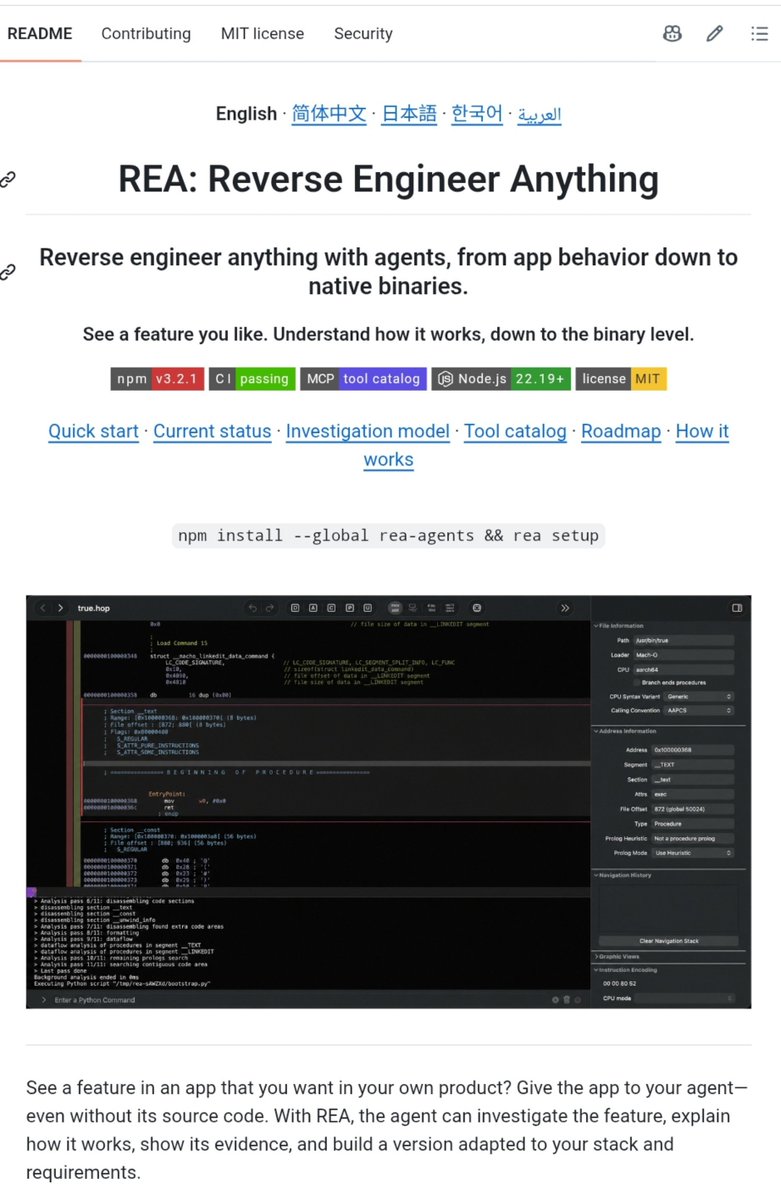
Meet REA (Reverse Engineer Anything) an open-source toolkit that brings reverse-engineering capabilities straight to your AI agent via MCP and CLI
🔹 Decompile apps & native binaries
🔹 Trace execution & inspect evidence
🔹 Recreate features for your own stack
Here's my conversation all about @FFmpeg, the legendary open-source software powering most video on the Internet. In the episode, I talk with Jean-Baptiste Kempf and Kieran Kunhya. JB is lead developer of VLC and Kieran is FFmpeg contributor, codec engineer, and the person behind the now-infamous @FFmpeg account on X.
VLC (@videolan), by the way, is also a legendary piece of open-source software: it's a video player that can open basically anything & has been downloaded over 6 billion times.
I think both FFmpeg and VLC are two of the most important and impactful software systems ever created, both open source, and both created & maintained by volunteers: brilliant engineers from all walks of life.
Thank you to everyone who contributed to FFmpeg and VLC, and in general to all engineers giving their heart & soul to building systems used by millions (or billions) of people, and often doing so not for money, status, or fame, but purely for the love of building great software and doing good for the world.
Thank you to the builders! 🙏❤️
Shoutouts in this chat to @ID_AA_Carmack@karpathy@elonmusk@TimSweeneyEpic and everyone who is a contributor & fan of open source!
It's here on X in full and is up everywhere else (see comment).
Timestamps:
0:00 - Episode highlight
2:17 - Introduction
5:35 - Weirdest things VLC opens
9:59 - How video playback works
19:20 - Video codecs and containers
30:07 - FFmpeg explained
51:07 - Linus Torvalds
55:46 - Turning down millions to keep VLC ad-free
1:10:04 - FFmpeg & Google drama
1:29:18 - FFmpeg developers
1:35:55 - VLC and FFmpeg
1:40:29 - History of FFmpeg
1:43:46 - Reverse engineering codecs
1:57:01 - FFmpeg testing
2:01:08 - Assembly code (handwritten)
2:25:26 - Rust programming language
2:34:42 - FFmpeg and Libav fork
2:43:04 - Open source burnout
2:50:51 - x264 and internet video
3:04:07 - Video compression basics
3:11:04 - CIA and fake VLC
3:21:39 - Ultra low latency streaming
3:39:07 - AV2 codec and video patents
3:48:59 - VLC backdoors
3:59:14 - Video archiving
4:05:51 - Future of FFmpeg and VLC
Pushing it to the limit… literally. Playing GTA 3 on a Nokia N95 connected to a TV with a Bluetooth controller. We enabled the light effects, particles, and more. It looks beautiful. Port by Shinovon, and I’m helping polish the Symbian S60v3 version
#rockstar#gta#nokia#n95
‼️Copy Fail (CVE-2026-31431) is a Linux privilege escalation bug that lets any local user get root using a 732-byte Python script, and itworks on basically every major Linux distro shipped since 2017.
Website: https://t.co/f5G6KnEv35
Write-up: https://t.co/W86Pz2PC6C
GitHub: https://t.co/zAMTC6nTRk
It's a logic flaw in the kernel's crypto code (authencesn via AF_ALG and splice()) that allows a small write into the page cache, which can be used to tamper with a setuid binary like /usr/bin/su.
Think how bad this is going to be for shared environments like Kubernetes, CI runners, and cloud sandboxes, where it enables container escape and tenant-to-host compromise.
Found by Theori's Xint Code scanner, patched in the mainline kernel, and publicly disclosed on April 29, 2026; if you can't patch right away, the recommended workaround is to disable the algif_aead module.
Originally released in 1989 on the Apple II, this is a port of Prince of Persia running natively on Flipper Zero
Check out the source code here: https://t.co/lguS2ac4K7
Download it from Flipper Apps here: https://t.co/P9XjoqFago
It's the full one-hour game, with a remade soundtrack and custom controls just for Flipper
Big thanks to: A Touch of Vintage Electronics and Ashton’s Retro Computer Room for the intro footage
The Press Play On Tape crew for development of the game
apfxtech for the Flipper Zero port
...and to @jmechner for creating the OG game 🐐
Imagine you're John Carmack
you're 22 years old and you just wrote a 3D engine in assembly that runs at 35fps on a 486
Doom drops. Quake drops. Half the planet is playing your code.
you're the reason GPUs exist. you're the reason your friend Jensen has a yacht today.
then in 2009, you sell id Software. people call it betrayal. you call it "they made an offer I couldn't refuse."
VR obsession. Oculus. Meta buys it for $2B. you're CTO.
but Meta thinks you're a liability. your demos are "too intense." your emails are "too long." your focus on frame timing is "slowing us down."
2022. they push you out. not fired officially. just "restructured."
the media writes "end of an era." some crypto bro calls you "washed up."
silicon valley moves on.
but you don't.
you don't write a book. you don't start a podcast. you don't collect speaking fees.
you go completely quiet.
you take the money. you buy a warehouse in Texas. you hire 10 engineers. and you start coding.
not games. not VR.
AGI.
two years. radio silence. no tweets. no conference talks.
while everyone's debating ChatGPT, you're debugging CUDA kernels at 3AM, testing world models.
then in 2025, Keen Technologies pivots hard. you're not "exploring" anymore. you're building it.
here's what people get wrong:
everyone calls it a comeback. a redemption arc. "revenge on Meta."
it's none of that.
you're a 54-year-old engineer who still codes 12 hours a day because you genuinely can't stop.
most CTOs would have bought an island. most legends would have written memoirs.
you just kept typing.
the most dangerous person in any codebase is the one who goes quiet and never stops shipping commits.
karma doesn't need to be real.
but obsession is.
welcome back, Carmack.
Hackers broadcasted a giant Troll Face on Russian military radios and nobody knows who did it still…
Hackers carried out a bizarre cyber prank by hijacking Russian military radio frequencies and transmitting the iconic Troll Face. Routine communications were replaced with warped audio and the infamous meme, briefly turning a secure channel into an episode of digital mockery.
The incident underscored how even protected systems can be exposed to cyber intrusion, serving as a reminder that modern conflict isn’t limited to weapons and territory—it’s also waged through code, signals, and memes.
Chinese scientists have developed,
The best shortest-path algorithm in 41 years!
A team from Tsinghua University has broken Dijkstra's "sorting barrier" - the first improvement since 1984.
Just use for a world-map 🤯
Paper - https://t.co/0AhR5O7vl4
https://t.co/a9KMVRuYGx
The fact that you can just plug sensors into the VGA port of an old laptop and get data out is crazy to me.
It’s always fun finding GPIO in strange places.
FFmpeg makes extensive use of hand-written assembly code for huge (10-50x) speed increases and so we are providing assembly lessons to teach a new generation of assembly language programmers.
Learn more here:
https://t.co/u6MKBb3Xbk