GOOGLE CEO SUNDAR PICHAI: "IF YOU DON'T LEARN HOW TO ORCHESTRATE AGENTS NOW, YOU'LL SPEND 2027 CATCHING UP TO PEOPLE WHO STARTED TODAY."
30 minutes on why the best engineers stopped writing code line by line and started orchestrating agents instead.
Most people think building an agent requires an engineering degree.
It doesn't.
It requires one guide and one afternoon.
Watch the interview. Then save the exact setup below.
One guide. One afternoon. That's all it takes.
The gap between you and the engineers winning in 2027 closes this weekend.
Monica Lam (Stanford Professor):
"AI writes shallow reports for one reason, you ask it ONE question. Our method asks dozens, like a journalist, and the same chatbot starts writing articles 25% better organized than top AI."
paper presented at a leading AI research conference, her Stanford lab (OVAL) unveiled STORM - a method already used by 70,000+ people to generate Wikipedia-grade, fully-cited articles on topics it has never seen.
the secret formula: 6–8 expert perspectives + cited expert interviews + ruthless outline + grounded section-by-section writing + blind-spot red team = a report you can actually trust.
watch the full breakdown to copy all 5 prompts into Claude.
save this post so the formula is ready when you need it.
This is a really fascinating paper that everyone interested in China's industrial policy should read.
It destroys so many myths (see below), and is written by deeply credible people who conducted over three years of fieldwork in China and interviewed 60+ Chinese officials, entrepreneurs, and engineers. When it comes to China studies, it literally doesn't get more rigorous than this.
First myth it destroys: contrary to popular belief, Beijing's industrial policy didn't build the companies that became China's EV champions. They rose largely **despite** it, through its cracks.
For sure, Beijing did favor EVs as an industry and pushed hard for it but their big bet was SOEs (State Owned Enterprises): research grants, pilot programs, licenses, cheap credit - virtually all of it flowed to state firms.
The result? China's actual EV champions - BYD, Geely, NIO, XPeng, Li Auto, etc. - are overwhelmingly private firms that succeeded despite Beijing favoring their SOE competitors.
How so? Because, when favoring SOEs, the central government didn't just pick winning companies, it picked winning cities, each SOE being anchored in a specific city: Shanghai (SAIC), Changchun (FAW), Wuhan-Shiyan (Dongfeng), etc.
Which means that every city not on the list, that wanted a piece of the auto boom, had only one option left: team up with private entrepreneurs who were equally excluded from central government favor.
That's what truly fueled China's EV miracle: an alliance of the excluded, between local private entrepreneurs and local mayors.
This is the biggest misconception this paper destroys: the reality is that the "Chinese state capitalism" that many in the West think powered the EV boom actually tried to block many of these companies from existing. In effect, it was closer to an obstacle course that local actors (mayors and provinces) learned to game.
Geely - now the third largest automaker in China - is a fantastic example of this.
First of all, it started off illegal since, to build passenger cars, you had to have a central government license and they couldn't get one. Zhejiang Province told them to go ahead regardless because the province had hundreds of auto parts suppliers but no carmaker of its own.
It's only a couple of years later, recognizing the fait-accompli that Geely was producing cars and was competitive, that the central government admitted them to the National Sedan Catalog - effectively legalizing them retroactively because there were facts on the ground.
Then there was the Volvo acquisition in 2010, which is fair to say - looking back - proved to be the most strategically valuable acquisition in Chinese automotive history. Despite it being presented at the time (and still described this way today) as "China buying Volvo", all 3 major state-backed banks in China (Export-Import Bank, China Development Bank, Bank of China) refused to finance the deal. The only state-bank money Geely managed to get was a $200 million loan from a provincial branch of China Construction Bank - a tiny fraction of what the deal required.
Geely actually did the deal with Goldman Sachs money via Hong Kong plus loans and equity from four local governments (Chengdu, Zhangjiakou, Daqing, Shanghai's Jiading district), each of which bought in by securing a Volvo plant or headquarters for itself.
In effect, the doors that Beijing controlled were largely closed to Geely, but it made it because the doors subnational actors controlled were opened.
Which all means this paper destroys another very common myth: the big merit of the central government in all this was to be relatively chill about it, to NOT be dictatorial.
I just imagine if that had happened in France and you had - say - the mayor of Lyon or Marseilles open, fund and promote an unlicensed carmaker against Renault: the préfet would shut it down within weeks, and the mayor would be lucky to escape prosecution.
That's the irony: on industrial policy, the supposedly "totalitarian" Chinese state proved more tolerant of local defiance than most Western liberal democracies would be. Beijing's greatest contribution to the EV miracle wasn't the plan - it was looking the other way while the plan was being violated.
To be sure, the paper doesn't hide the costs of this system: ferocious local competition also produced what's known today in China as "involution" (内卷-Neijuan, basically a hypercompetitive price war), as well as some spectacular failures. For instance one county lost 6.6 billion yuan on a carmaker that never really made cars.
But that's precisely the point: this is a high-risk, high-reward model of decentralized experimentation, the very opposite of the careful central planning Westerners imagine.
I've repeated this countless times but it bears repeating again: the single greatest misconception people have about China is - probably because we wrongly associate communism with centralized control - that it is a monolith run from Beijing. Some even say it's run by "one man."
The reality is the exact opposite: China is, in practice, one of the most decentralized countries on earth. Roughly 85% of government spending in China happens at the subnational level - against about 30% in the average OECD country (and even less in France, which is actually one of the most centrally controlled countries on earth). A Chinese mayor commands fiscal resources, land, investment funds and policy latitude that virtually no Western mayor could dream of.
Last but not least, I'd be remiss not to mention what the paper has to say on the positive legacy of Mao and its role in the rise of EVs (given I myself wrote an article titled "Mao's economic record wasn't bad, actually": https://t.co/1NZgHqBHwg).
When it comes to China myths, none is more entrenched than the idea that Mao left behind nothing but ruins.
This paper confirms a key argument of my article: Mao's deliberate dispersal of industry across China (during the Great Leap Forward and Cultural Revolution decentralizations) left dozens of cities with their own small auto works. Inefficient, yes - but these scattered factories survived into the 1990s and became the seed stock of everything that followed: the industrial base, the engineers, and the production licenses that EV startups would use to enter the market.
The paper even says it outright: the fragmentation that industrial policy "sought to eradicate" is "precisely" what "ironically enabled" the EV sector's rapid rise.
This is exactly the mechanism I described in my Mao article: structures built in the Mao era - communes becoming township governments, commune enterprises becoming TVEs, Third Front factories seeding interior industrialization - became load-bearing foundations of the reform miracle.
Fittingly, the spark for China's first municipal carmaker adventure was literally a TVE (Township and Village Enterprise), the institutional descendants of Mao's commune enterprises: Tongbao, a kit-car maker in Wuhu whose success stunned local officials into building what became Chery (one of China's biggest carmakers today). You can't tell the story of China's EV miracle without crediting the legacy of Mao.
What's the biggest lesson in all this for Western policymakers?
The obvious one is that the part of industrial policy that most people assume China does and that they sometimes want to copy - i.e. the state picking winners - is actually the part that failed.
The part that did succeed is the China nobody in the West believes exists: a radically decentralized system with a high degree of tolerance for disobedience and experimentation.
We imagine China as a country where nothing happens without Beijing's approval when the reality is closer to the opposite: China's EV miracle happened precisely because localities asked for forgiveness rather than permission.
All in all, and this is the lesson I often come back to, this is yet another illustration of the importance of understanding China for what it is as opposed to the caricature we've built of it. This matters whichever "camp" you're in. If you see China as a rival, you can't compete with someone you don't understand. If you see them as a source of lessons, you can't emulate what you've misunderstood. Whatever you want from China - to compete with it or learn from it - the entry fee is the same: genuinely understanding it.
The world is applauding the latest Chinese vehicles and sales are surging almost everywhere the cars are available. The one exception: China. https://t.co/Ed4v3jdxBf
BYD Warranty Verdict - GREAT for Taxi's!
So following my Jaecoo warranty review where we found out that some parts on the Jaecoo were actually only covered for 3 years or 40,000 miles despite them plastering 7 years all over their website, I thought I'd have a look at BYD - and you know what I've been pleasantly surprised by the quality of their warranty.
The headline is all BYD's come with a 6 year or 93,750 mile warranty, whichever comes first (Don't ask my why 93,750 miles)?
The really good bits about the BYD warranty are:
➕ There is no reduction in warranty cover for Taxi's, Hire or Reward or Commercial use of their vehicles! (This is frankly amazing for Uber drivers).
➕ Their body anti corrosion warranty is 12 years with no reduced limit for paint issues (Which i presume is covered under their 6 year warranty - 3 years better than Jaecoo!)
➕The EV batteries are covered for 8 years of 125,000 miles (also better than Jaecoo's 100k limit).
➕BYD specifically list their Drive Unit as covered for 8 years or 93,750 miles (this is something I've not seen from the other manufacturers) and can only be seen as a positive for buyers.
➕ BYD gives 48 months / 75,000 miles for a list of “separately mentioned parts”, including lamps excluding bulbs, tyre-pressure monitoring module, suspension, ball joint, multimedia system, shock absorber, engine belt, dust cover/sleeve, bushing/pad, release bearing, wheel bearing, PM2.5 tacheometer, AC/DC charging port assembly, USB charging port connector, carbon canister dust filter and fuel heater assembly.
This last list is much more acceptable and easy to live with than the Jaecoo list of exception items that included some big ticket items like the Alternators and Multi Media etc.
All in all the BYD has an impressive warranty and is definitely one of the best i've read when comparing against its Chinese rivals. Well done @BYDCompany
Pourquoi les voitures 100% autonomes sont une illusion 🚘
Grande utopie automobile, la voiture autonome débarque progressivement sur nos routes. Mais croire que des véhicules 100% autonomes, sans supervision, circuleront librement sans supervision est une illusion.
💬 Benjamin Gaignault, cofondateur d'Ornikar
BYD May 2026 Sales Update 🚗📈
Total sales: 376,990 vehicles (slightly above May 2025)
🇨🇳 China: ~216k
🌍 Outside China: ~160k
A remarkable 42.6% of BYD's sales in May came from outside China.
Thread 🧵
$TSLA - TESLA REGISTRATIONS SURGE ACROSS EUROPE
Tesla registrations jumped sharply in May across Europe, according to industry data.
Sweden rose 71%, Denmark 136%, Spain 113%, and France surged 655% year-on-year.
The broader EV market also grew, with electrified vehicles up about 21% in April and now accounting for over two-thirds of new registrations in Europe (ACEA).
Growth is supported by subsidies and high fuel costs, while UK and Germany data is due later this week. Despite the rebound, Tesla’s European share fell in 2025 amid stronger Chinese competition and fewer new models.
A British biologist looked at 200,000 years of human history and found that the entire reason humans broke out of poverty was not intelligence, not language, not even agriculture, but one mechanism so simple a 6-year-old could explain it.
His name is Matt Ridley.
He is a zoologist by training, an evolutionary biologist by career, and in 2010 he wrote a book called The Rational Optimist that quietly argued the most important fact about human progress had been hiding in plain sight for the entire history of economics.
Naval Ravikant has been telling people to read everything Ridley has ever written for the last 15 years. The reason is the argument inside this one book.
For 200,000 years, anatomically modern humans walked around with the same brain you have right now. Same skull size. Same neural architecture. Same raw capacity for language, planning, and abstract thought.
For roughly 190,000 of those years, almost nothing happened. Generation after generation lived and died inside the same Stone Age toolkit their great-great-grandparents had used. Then somewhere around 50,000 years ago, the line on the chart of human progress started to tick upward. Then it bent. Then it exploded.
The question Ridley spent years on was the only question that mattered. What changed.
It was not the brain. The brain had been the same for 190,000 years. It was not language, which had existed long before the takeoff. It was not even agriculture, which arrived only 10,000 years ago and was actually preceded by the upward bend, not the cause of it.
What changed was that humans started trading with strangers.
This sounds too small to be the answer. Ridley argues that it is the answer to almost everything. The moment one human exchanged a useful object with another human from a different group, something happened that no other species on earth had ever done.
Two ideas that had developed in isolation came into contact. The flint knapper learned what the spear maker had figured out. The fisherman from the coast learned what the hunter from the forest had figured out. The two pieces of knowledge fused into something neither side could have produced alone.
Ridley calls this ideas having sex. The phrase sounds frivolous and it is meant to. The point is that ideas, like genes, get better when they combine with other ideas from different lineages.
An idea sitting inside one head, no matter how brilliant the head, eventually hits a ceiling. The same idea exposed to ten thousand other ideas does something genes do under sexual reproduction. It mixes. It recombines. It produces offspring nobody planned.
The cleanest proof of this argument is the most uncomfortable case study in the book. Tasmania.
Around 10,000 years ago, rising sea levels cut Tasmania off from mainland Australia. A population of roughly 4,000 humans was now isolated on an island, with no possibility of contact with the rest of humanity. They had the same brains. The same language. The same starting toolkit as their cousins 150 kilometers north. The natural experiment was now running.
What happened next is something no economist or geneticist had ever predicted.
The mainland Australians kept inventing. Boomerangs. Spear-throwers. Fishing nets. Bone needles for sewing fitted clothes. Watercraft with paddles. Their technology compounded slowly across the centuries.
The Tasmanians went the other way. They did not just fail to invent the new tools their cousins were developing. They started losing the tools they already had. Fishing was abandoned within a few thousand years. Bone tools disappeared. Fitted clothing disappeared. They forgot how to make fire from scratch and started carrying lit firebrands from camp to camp instead, relighting their fires from a neighbor's whenever their own went out.
By the time European explorers arrived in the 17th century, the Tasmanians had the simplest toolkit of any human society ever recorded. Their material culture had gone backward for 8,000 years.
The archaeologist Rhys Jones called it a slow strangulation of the mind.
Joseph Henrich at Harvard later proved with formal mathematical models that there was nothing wrong with Tasmanian brains. There was something wrong with their network. A toolkit requires a critical mass of people exchanging skills to maintain itself.
The act of teaching a skill is imperfect. Every generation loses a small percentage of what the last generation knew. If your population is large enough and trading widely enough, those losses get caught and corrected by someone else who still remembers.
If your population shrinks below a certain threshold and stops mixing with outsiders, the small losses compound until entire technologies disappear.
This is the part that should haunt anyone reading this in 2026.
Intelligence is not a property of the individual brain. Intelligence is a property of the network the brain is connected to. A genius in isolation will produce less than a mediocre thinker inside a dense exchange of other mediocre thinkers.
The thing your ancestors needed in order to break out of 190,000 years of stagnation was not better brains. It was better connections between brains they already had.
The implication for any individual is direct and uncomfortable. If you are smart and isolated, you will be outproduced by people half as smart who are connected.
The most successful people in any field are almost never the smartest people in it. They are the ones positioned at the intersection of the most idea flows. They are reading more authors than their competitors. They are talking to more people from more disciplines. They are in the rooms where ideas from different lineages bump into each other.
Ridley ends the book on the line that sounds optimistic but is actually a warning its this "The future will be invented by people who connect ideas, not by people who guard them."
This chart is hard to look at.
Last month, I wrote an article titled: "Tesla ‘Robotaxi’ unsupervised fleet finally shows some signs of ramping up".
Emphasis on "unsupervised".
Turns out, it was only a blimp. The active unsupervised fleet has since dwindled, and the total fleet has completely crashed.
I was again too optimistic about Tesla Robotaxi 😅. My bad.
Tesla says its Full Self-Driving software is up to 10 times safer than human drivers. But the figures don't withstand scrutiny – and staffers who trained the technology say it isn't close to safely delivering autonomous vehicles at scale https://t.co/b8veDT8mv4
Após um ano com um carro elétrico BYD Dolphin Plus, volto aqui pra contar e mostrar as contas, conforme o prometido.
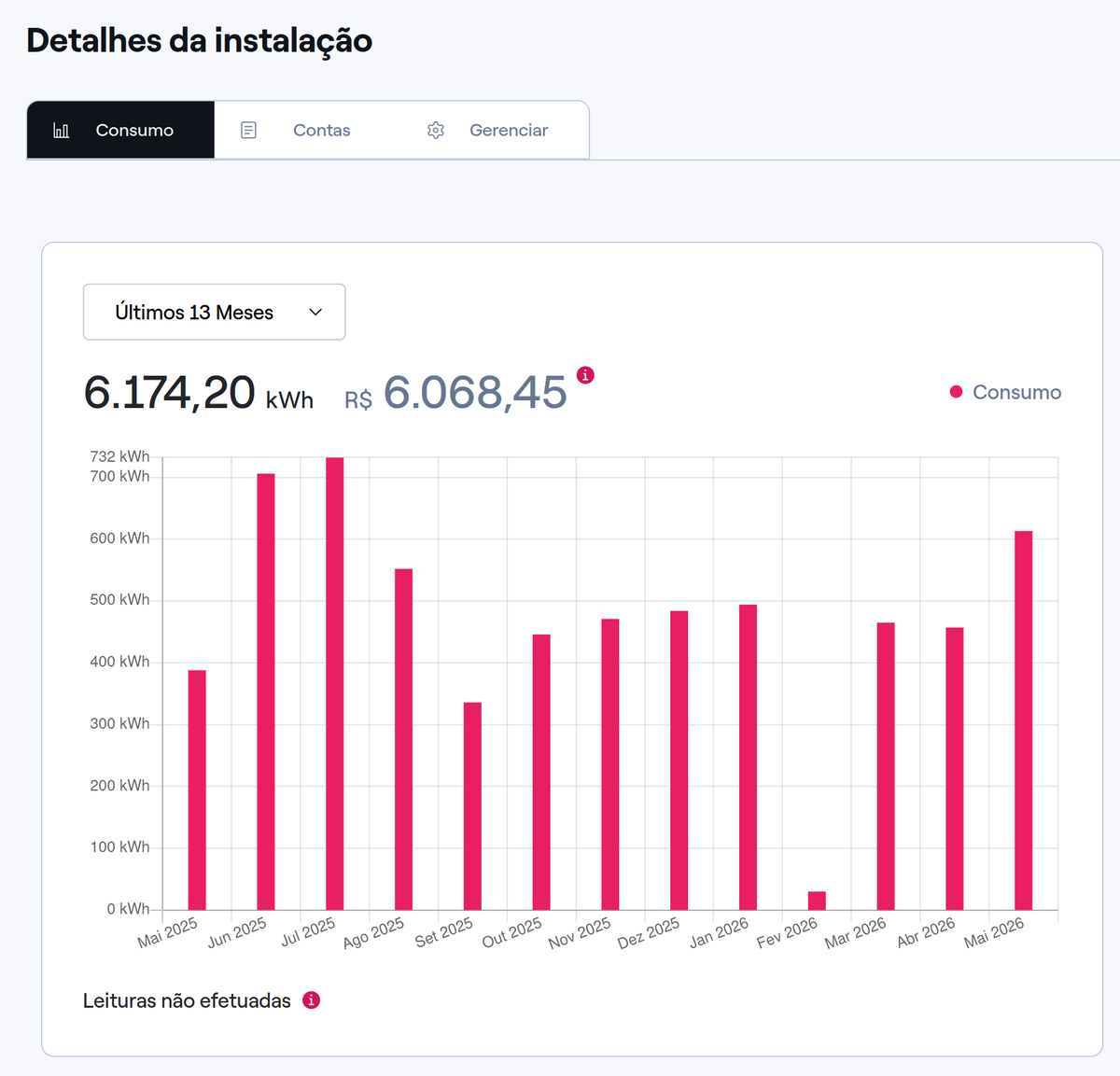
As contas de luz de Junho/25 até Maio/26 são com o carro elétrico, ou seja, exatamente 12 meses. A de Maio/25 refere-se ao mês de Abril e foi de 388kW/h. Descontando Set/25 (que estávamos viajando), a média de consumo foi de 495 kWh, apenas 84 kWh a mais que a média dos seis meses anteriores que foi de 411 (veja o post que estou retuitando).
(sobre o valor baixo de Fev/26, a Enel não fez a leitura e cobrou a taxa mínima, mas isso se acertou nos meses seguintes, o valor já está na conta)
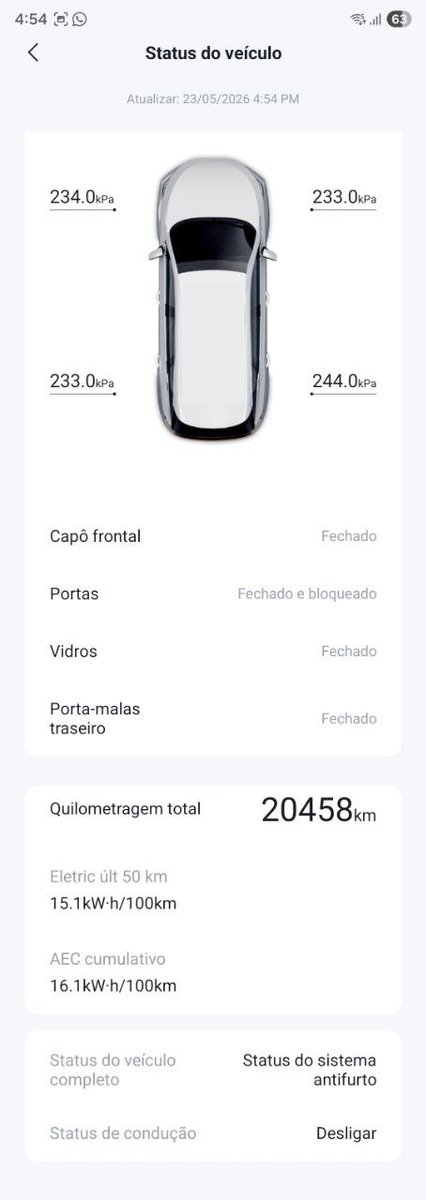
Nesse período rodamos cerca de 20 mil kms. Você pode ver na imagem que o desempenho médio nesse período (consultado hoje) foi 16,1 kwh/100kms. Considerando o custo de R$ 1 por kwh (em SP está um pouco abaixo disso), estamos falando de 6,2 kms para cada 1 kwh, ou 6,2 kms/R$. O meu carro anterior (um Mini Cooper) fazia 9 kms/litro, considerando o custo de R$6,30 no litro da gasolina, o seu custo era de 1,4 kms/R$.
Isso significa que agora eu rodo com o custo 4,3x menor. É como se a gasolina de R$ 6,30 estivesse, para quem tem um BYD Dolphin Plus, por R$ 1,45. Tudo isso enquanto eu ando mais, já que o Dolphin Plus entrega 210 cavalos (o tempo todo), enquanto meu Mini Cooper turbo tinha somente 170 cavalos (e somente em algumas RPMs mais altas e só depois que o turbo começa a atuar - maldito turbo lag).
Considerando os 20 mil kms que foram rodados nesse primeiro ano, o custo do BYD foi de 3,2 mil reais de eletricidade. Com o Mini Cooper seria de 14 mil reais. Poupamos 11 mil reais nesse primeiro ano, só no deslocamento (sem considerar desconto de IPVA etc).
E agora, somente com 20 mil kms, virá a primeira revisão. Ou seja, economizamos nas primeiras revisões de um carro a combustão, também, que não foram necessárias.
Não tivemos nenhum acidente ou nada de custos extras, então não tenho muito a comentar sobre isso. Depois que fizer a primeira revisão eu conto como foram os custos.
E notem que as contas não batem, se gastei 3200 reais, ou 3200 kwh, por mês deveria ter visto um aumento de 268 kwh na conta de energia (ou quase 268 reais). Não vi. Uma parte foi porque foram feitas duas viagens longas nesse período, então mais de 3 mil kms foram recarregados na rua, onde o custo costuma ser 2 a 3x maior do que em casa (e ainda assim mais barato que a gasolina).
Nesse meio tempo o carro desvalorizou dos 170 mil reais que paguei por ele para 150 mil reais, ou 12%. Em comparação um Toyota Corolla Cross XRV, um carro híbrido, caiu de 211 mil para 176 mil reais, ou 17%.
Nesse período a BYD saiu da oitava maior montadora no acumulado até Maio de 2025 para a quinta maior, superando Honda, Jeep e Toyota, sendo maior ainda que Renault, Nissan e Peugeot. Só perde para a lider, VW, seguida por Fiat, GM e Hyundai (sendo essa por apenas 0,5%). As 4 primeiras perderam vendas nesses 12 meses, enquanto BYD cresceu de 39 mil para 55 mil veículos emplacados no acumulado do ano até Maio (40%).
Meu carro segue funcionando perfeitamente, e segue sendo uma excelente experiência de direção. As previsões catastróficas feitas por muitos no primeiro post que fiz a respeito não se confirmaram. Eu não perdi dinheiro, minha conta de luz não estourou, o carro não quebrou ou deu qualquer problema, e, se eu resolvesse vendê-lo agora, receberia mais dinheiro do que se tivesse comprado um carro europeu, dos EUA, coreano ou japonês.
O futuro é elétrico e é chinês.