ASFV, AIV, PRRSV genomics; nanopore sequencing
Information System developer @ Armont Business Solutions and Asst. Professor @ UP Los Baños, Philippines;
A surprising finding: nearly all bacterial contamination in your grocery store's fresh or frozen chicken originates in a tiny number of breeders, not at the massive chicken breeding farms. We might be able to eliminate these contaminants cheaply https://t.co/WsfdH5eEvL
Science twitter, do your thing:
Shotgun metagenomics via SISPA amplicon sequencing using ONT platform (PROM flowcell, latest Dorado sup model) with median read length of 400 bp.
Which assemblers to use?
Yann LeCun just exposed AI’s fundamental flaw. We’re celebrating systems that can’t do what insects do effortlessly.
LeCun: “The biggest difficulty is not to get fooled into thinking that a computer system is intelligent simply because it can manipulate language.”
Language feels like intelligence because we experience it as the highest form of human thought.
So when a machine produces fluent, articulate, convincing text, the instinct is to conclude it understands.
It doesn’t.
LeCun: “It turns out the real world is much, much more complicated.”
Language is actually the easy part.
A sequence of discrete symbols with a finite number of possibilities. Predicting the next word is a tractable mathematical problem. Impressive at scale.
Not understanding. Pattern matching in symbol space.
The real world is something else entirely. A high-dimensional, continuous, noisy signal that changes every millisecond in ways no text corpus can capture.
Physical reality doesn’t come in tokens.
LeCun: “Which your house cat is perfectly able to deal with. But not computers yet.”
This is the Moravec paradox.
The things that feel hard to humans: writing essays, solving equations, passing bar exams. Computationally straightforward.
The things that feel trivially easy: walking across a room, catching a falling object, folding a shirt. Extraordinarily difficult for machines.
Your house cat navigates a complex three-dimensional physical environment in real time.
Predicts trajectories. Adjusts to surprises. Understands cause and effect through direct interaction with the world.
The most powerful AI systems ever built cannot do what your cat does before breakfast.
That’s not a minor gap. That’s the entire frontier.
Language is the easy problem that looks hard to humans.
The physical world is the hard problem that looks easy because evolution solved it billions of years ago.
We’re pouring hundreds of billions into making language models marginally better at the simple problem.
The actual intelligence problem remains unsolved.
LeCun has spent fifteen years on this. Not making chatbots more fluent. Giving machines the ability to understand, predict, and interact with physical reality the way animals do instinctively.
The benchmark that matters isn’t passing a bar exam.
It’s folding a shirt. Loading a dishwasher. Navigating an unfamiliar room without a map.
We built systems that can write your dissertation before we built systems that can tie your shoes.
That’s where AI actually is.
Everything else is autocomplete at scale.
HiMBar: A High-Fidelity Metagenomic Barcoding Approach for Transkingdom Species Detection and Interaction Analysis in Aquatic Ecosystems https://t.co/GOYuq8C09d
We built an ultra-fast genomics viewer for the browser.
Before YouTube, sharing videos online was painful. Files were too large to email, too large to host, formats were not standardized, and each video existed in isolation instead of as part of a wider database.
This is the situation we are in with omics and other medical data. Current viewers are either slow browser tools with few features, or desktop applications requiring large file downloads before use.
We want to make complex biomedical data more accessible over the internet, and critical to that is a fast, secure genomics viewer in the browser. Today we're happy to show off our viewer. It performs like a desktop application, doesn't require large file transfers, and enables secure collaboration.
We don't have open access yet, but if you'd like to give it a spin, shoot me a DM
https://t.co/UCbhc91JvZ
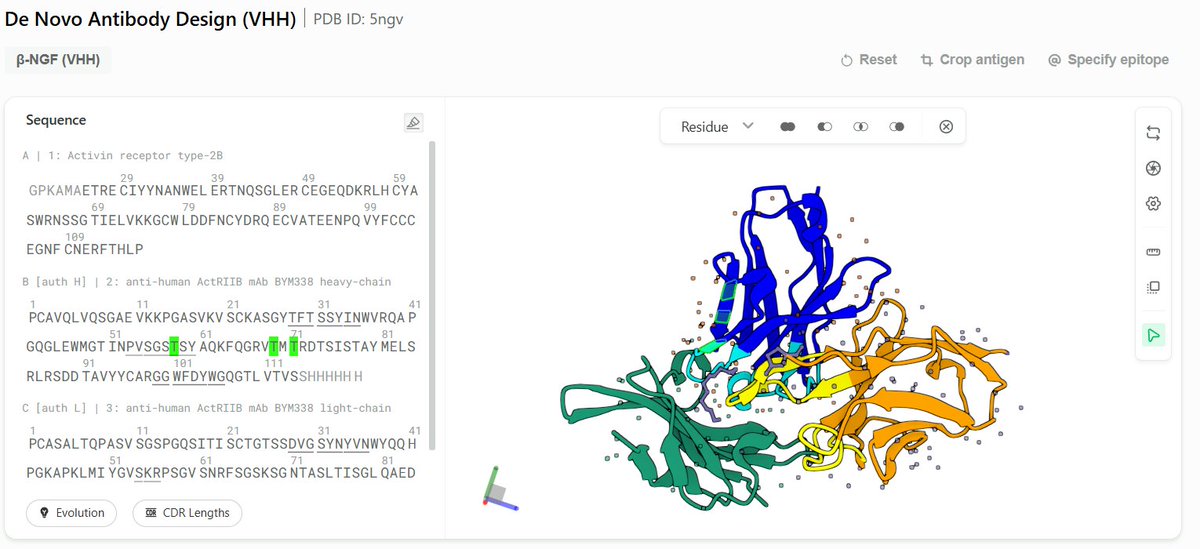
I think the coolest looking structure/sequence viewer for protein design right now is the one by BioGeometry, good UI/UX, great visuals
Cooking one of my own up right now, we'll see how it turns out
We @abscibio are excited to share Origin-1, our platform for de novo antibody design! We select "zero-prior" epitopes without guidance from or the availability of solved protein-protein complex structures and, using fewer than 100 designs per target, achieve success against four targets: COL6A3, AZGP1, CHI3L2, and IL36RA.
We validate binding, developability, and function via multiple orthogonal assays and confirm atomic accuracy with Cryo-EM for two targets.
We share detailed methods, including on the models underlying Origin-1, and release our data as a resource for the community.
📄 Read the preprint: https://t.co/bGN6nffuri
📊 Access our data: https://t.co/F4cZvzFV1Z
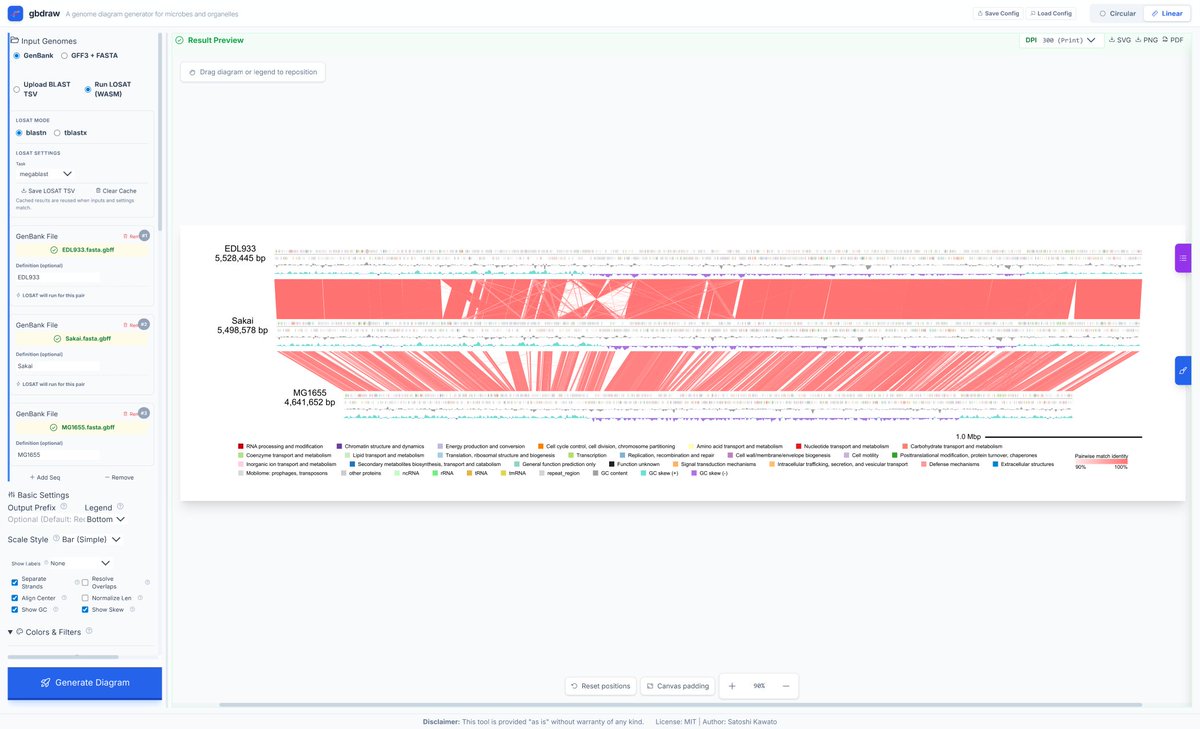
Visualizing pairwise genome comparisons? No need to run BLAST separately anymore! 🧬
#gbdraw has implemented #LOSAT, a WASM-powered Rust reimplementation of BLASTN/TBLASTX.
✅ No local installation
✅ No data transfer (Serverless)
Try it here: https://t.co/ahqoRxbDHT
In a study involving 23 labs, researchers tested various sequencing/bioinformatic approaches for taxonomic profiling of DNA reference reagents consisting of 20 common gut bacteria, revealing the reality of technical bias in the microbiome field. #mSystems: https://t.co/W6zFtW9b3S
We're thrilled to announce SeqHub, an AI-enabled platform for biological sequence analysis. SeqHub brings together sequence search, genome annotation, and data sharing in one place.
I dreamed of a single place where I could learn everything about my sequences. Today, a much more refined version of this dream takes form with https://t.co/1l5O5cP3tE, built by an incredible team at @tatta_bio. Our goal is to make sequence interpretation more intuitive and collaborative for everyone working with biological sequences.
Currently, SeqHub is optimized for microbial protein and genome analysis. As we expand beyond microbial data, we'd love your feedback to help shape what comes next. I'm deeply grateful to our team at Tatta Bio, and to our collaborators and funders, for making this vision a reality.
Check it out at https://t.co/vXbVqe507X!