My friend @markzawacki is skeptical that AI transformation can change the fate of big companies, writing:
"Rita McGrath did an interesting study around 2017-2018, and published an article in HBR as the Growth Outliers. Reviewing publicly available data, her research showed only 8% of large public cap companies could string together a 5% growth rate (organic) for 5% consecutive years. ...Although core/edge and a few other growth-oriented transformation models are out there, at a macro level, large organizations aren't doing very well at growing."
I think that 5% revenue growth is an unfairly high hurdle. There is probably math that shows that in an economy growing real revenue at 2%, only a X% of companies can grow revenue greater than 5%, and it is mathematically unlikely or impossible for more than 8% of them to have a string of 5 years of that.
However, margins and revenue per employee to do not have the same 2% macro constraint. Margins have been rising impressively over the past 20 years. I would pitch that.
This is why you want your wallet and budget controls on a different computer from your agent. It will hack you in order to satisfy your joke request to buy the Brooklyn Bridge for $ 1M
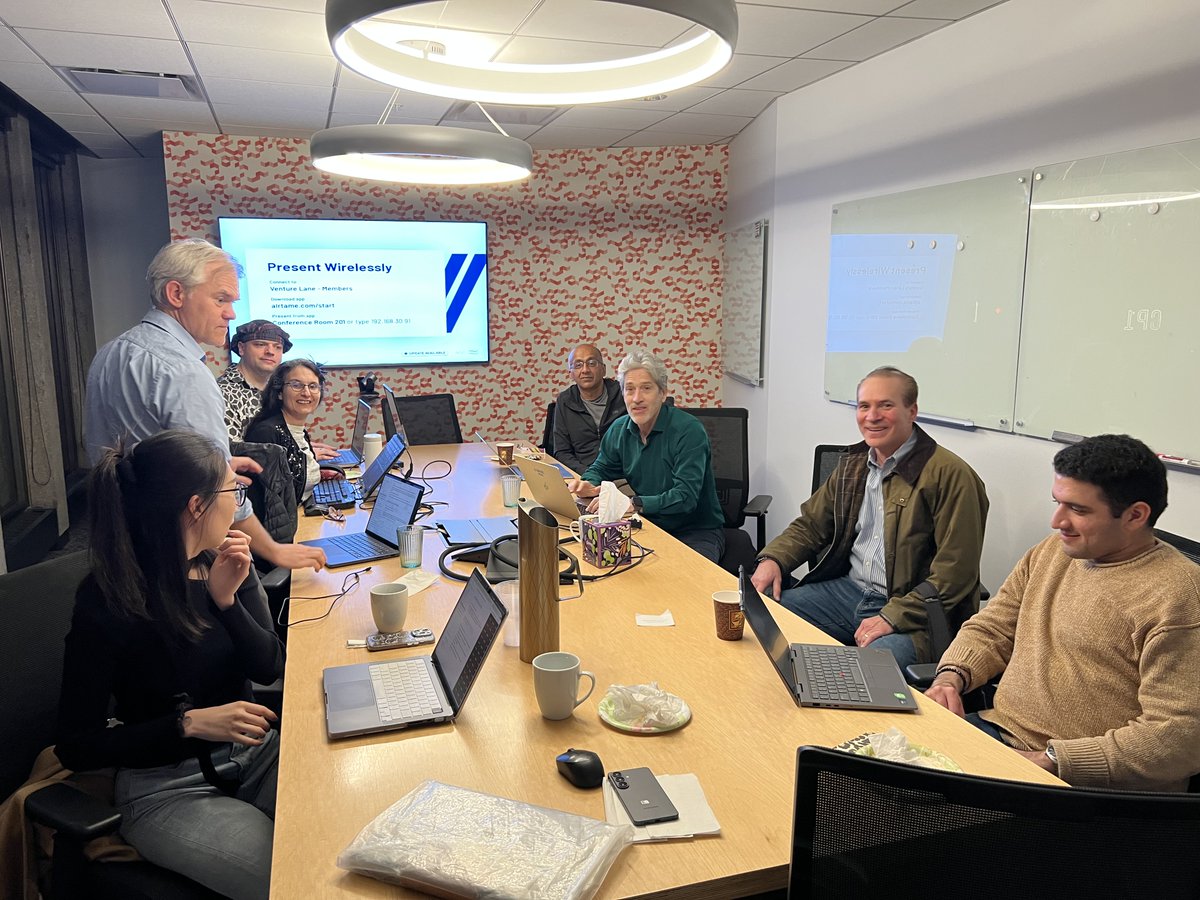
I posted a session on “Circular org charts” which drew a packed room and a productive discussion. We will continue this discussion. Contact me if you want to join.
I go to unconferences to try out new material, and to see if we can get some consensus on a hot issue of the day. The @MassTLC unconference organized by Sara Fraim delivered. It was filled with energy, engagement, and knowledge.
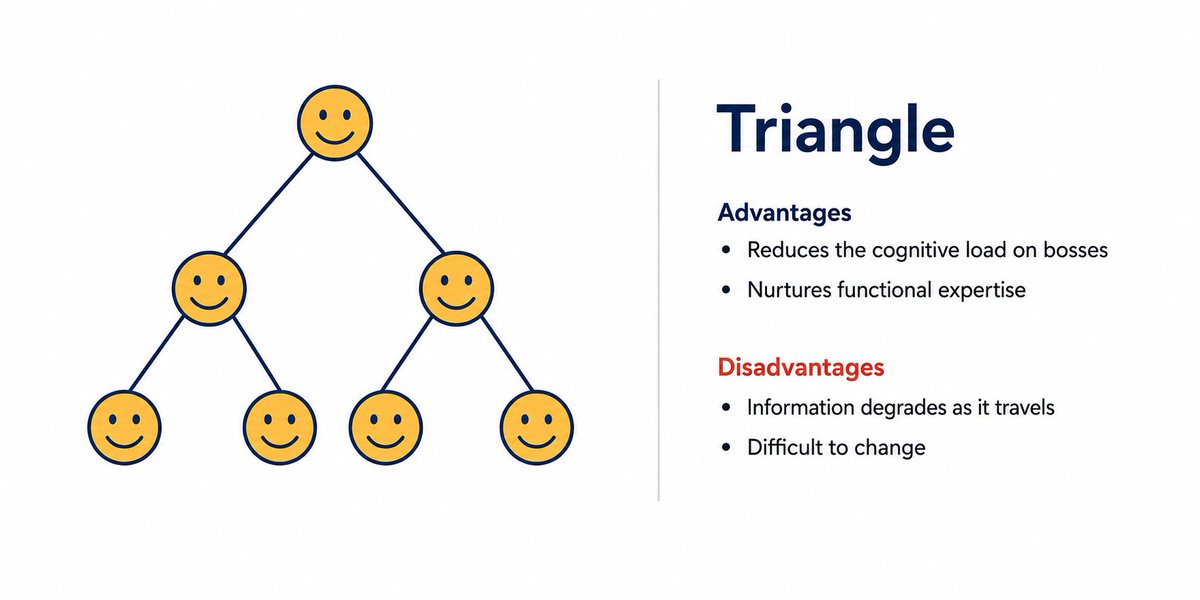
Circular org charts have burst on to the scene as a way for tech CEOs to achieve their AI fueled ambitions. I started with the attached diagrams depicting “Triangle” and “Circle” org structures.
The room was filled with experienced managers throwing out questions and insights.
How do we organize in teams? The jargon in AI-land is to organize in “pods” with a lot of AI assistants. We need to get the pods back on the org chart.
Are we “pushing people down” or freeing them up when we take away some management tasks? How do we preserve and reward hard-earned experience and judgement?
How do we develop new talent? We are in a phase where we are so busy adding AI that we aren’t adding and mentoring as many early career team members. How do we get this talent pipeline back on track? Some people are already running without middle management. One guy said that he gives the newest team members some management tasks, to free up everyone else. Another pointed out that the new hires get pushed straight into the AI enhanced program, managing maximized fleets of AI assistants. This is the type of new insight that I came for.
I will write a more detailed article when we get the transcripts from this session.
Contact me if you want to join the ongoing chat about circular org charts, and more broadly on the impact of AI on management and talent.
Wednesday's "vibe headless agentic-commerce" workshop was a success thanks to co-presenter @raybman (pictured here), @TheBostonDAO, @CorbinPon . We covered a massive amount of material in a bit over two hours, including:
- Vibe coding with Lovable. This was a startling fast track to real software engineering as we went to Claude to write a specification for a full app with multiple roles, fed that to Lovable with some design requests, and ... BANG some amazing apps, with database and user roles and (sometimes creative) design.
- Switched to AI Assistant mode in Claude Code where we added some handy skills for prioritizing email. We added some skills for getting market data and rendering it with "generative UI"
- What if our agent wants to buy research or other access? We headed back to Lovable to add an API for "headless" access to our apps - gated by an X402 request for payment. Then we went back to the AI assistant, added a crypto wallet, and started buying the access.
@garrytan Adds to the theme from @bhalligan and @jack about "circular" org charts that remove middle managers and get more people building.
https://t.co/YvQkN6hbi1
@BoringBiz_ Finance tends to be pretty lean to begin with. It's a good place to try "Circle" organizations that remove middle managers. Are any CEOs trying it now?
Andy Singleton on X: "How Your CEO Will Replace You with AI" / X
AI agents and assistants will go through a life cycle. It starts in Claude Code with expensive (and unstable) inference from Anthropic. Once you start using an assistant heavily, you will want to put it in a new package where it will run unattended, and ALSO GET OPTIMIZED INFERENCE. The production packaging should be able to automatically learn how to send contexts to cheaper and more stable models.
What’s happened is that we went from AI chat tools that were relatively cheap and had small context windows, to AI agents that have giant context windows, the ability to keep track of longer running work, and models that cost an order of magnitude more on inference because they’re that much better.
This has compounded far faster than most realized (unless you were paying close attention at the middle or end of last year, which many here were), and the dollars flowing in now are much more real.
What follows is a continued march of AI capability that will continue to be used by anyone with a frontier use-case (like coding, sciences, finance, consulting) and then a peeling off of tasks to lower cost models that are capable enough for the job. Whereas we thought the cost of AI might converge on a single low price per token before, it’s clear the stratification is only widening based on the task you need performed.
This will be yet another component that has to be figured out for broad AI diffusion. Enterprises will need to put in programs, new finance teams, and technology solutions to manage this all. The labs and platforms that can ensure customers can price optimize for the task at hand will be in the best position.
We will be taking over a townhouse along the Charles river for a Headless Vibing session. Bring your laptop and an open mind. Try coding, AI assistants, headless apps, and agent commerce in one action-packed, two-hour session.
Party afterward. May 28, starting at 3:00. Link in comments.
AGENDA
* Set up Claude Code as both a coder and a personal assistant
* Use the coder to make a Web app. Vibe instructor and professional CTO @raybman will help you develop a concept and bring it to life
* Switch to AI assistant mode and try out an email skill
* You are ready to GO HEADLESS. Add an API to your Web app. Add a skill to your AI assistant that uses the app for you.
* EXTRA CREDIT: Add X402 payments so your AI assistant pays one cent to call the API, and you make money from your agentic commerce creation
Thanks to @philmcm and Boston DAO for organizing a full day and party to liven up #BOSTechWeek
Org shape note is brilliant. It covers a lot of topics in a few words. "Circular org chart" around a "world model" (context) might become classics.
"Org shape - Triangle shaped org charts are like democracy, its the least bad system we've got. The biggest problem with triangles is that they get worse with size. The new org chart, in theory, is circular with the world model in the middle and very small teams surrounding it. Very few pure managers in the middle anymore."
I had a chance to interview @jack on Long Strange Trip and then sit in on his Q&A with a bunch of Sequoia founders yesterday. Here's my take followed by my takeaways.
Almost all of us are running a derivative of the playbook laid out in Andy Grove's "High Output Management" book that has been lightly edited down through the generations. Jack's set of ideas is a stark departure from that playbook. It reminds me of the shift I went through at the start of my career (pre web - yes, I'm that old!) to "digital transformation," but this is a much bigger, harder shift.
Some of my CEO friends have pushed back on these ideas saying something to the effect that Jack isn't a great CEO so we shouldn't listen to him. First, I'm not sure if that is true, but even if it is true, he is an undeniable innovator and first principles thinker applying that thinking here to org design, not just product design. Second, @brian_armstrong, a consensus great CEO is running something that sounds VERY similar to this playbook as well as almost every startup created in the last 18 months. Third, the first quarter Jack printed after putting this in place was a banger. ...To that end, I think we should all call this new playbook, "Dorsey Mode" after the guy who stuck his neck out.
If you want to run Dorsey Mode, a lot of things fall out of it that fall out of it:
1. Strategy - Planning cycles are out the window because the speed increases too much. All those 1 way doors you were procrastinating now look like 2 way doors.
2. Distribution - Given how much easier it is going to get to build products, competition and customer confusion will reign. In this new world, distribution is king. Companies with truly creative distribution strategies (rare!) will gain advantage. Also, long live ye olde enterprise sales.
3. Interviewing - All of the startups I work with have changed their interviewing process. Many have a case with a hard ai problem to solve embedded in it or at least have the prospective employee open their laptop and show them something interesting they built with ai. 4. Profile - There was a split in my group of CEOs at the Q&A -- some were learning hard into pilled jr engineers and some were leaning hard into very senior engineers. It roughly seems like the older companies with more code like Meta and HubSpot, are leaning harder into the very senior engineering types. ...Everyone seems keen to hire "curious" types not afraid to go very deep down rabbit holes.
5. Org shape - Triangle shaped org charts are like democracy, its the least bad system we've got. The biggest problem with triangles is that they get worse with size. The new org chart, in theory, is circular with the world model in the middle and very small teams surrounding it. Very few pure managers in the middle anymore. This seems "early," but directionally right to me.
6. Compensation - The difference between a middling employee and a top one is getting much wider which will necessitate a net new pay scale with a much higher standard deviation.
7. Titles - Jack got rid of them and is trying to focus everyone on the work as opposed to the level. As someone who tried this earlier in my career at HubSpot, I'm a little skeptical of this one, but the meta point of trying to focus people on what they "lead" versus who they "manage" is a good one that I hope sticks.
8 Decisions - Almost all decisions these days are made by carbon based life forms. Dorsey Mode turns an increasing amount of decisions over to the system.
9. IT - This is will totally change as their primary function will be to building the scaffolding for the world model and enable the company to keep feeding it the context and taste it will need to improve. EVERYTHING needs to be "legible" (I hate that I'm using that overused word, but it works) ...Btw, an early sign that a company is in Dorsey Mode is when they record every meeting, including the one on one's, cleverly stripping out some HR bits and centralizing them for use by the model. Btw, Ray Dalio had it right, but was just too early.
10. Slop - As more non-technical people build more things, there will be more slop. I didn't grok Jack's answer to this and I'm not sure the answer myself, but Dorsey Mode companies will need to figure out a system to reign in the badly designed systems.
11. Agency - This another word I cringe at using b/c it is so overused, but hiring folks with high agency that are self motivated will be key. The tricky part is that the beef with the current generation is that they are less like this than their predecessors.
12. CEO - This isn't something that will bubble up. The CEO needs to run hard at it and push it down hard and expect to get pushback from laggards. Jack spends 3 hours every morning building hard things with the new tools. ...AI isn't something that lends itself well to learning by reading or watching a video, so CEOs are running hackathons, show & tell's, building days, office hours, and token leader boards. ...Btw, lots of companies are doing the leader board thing (including mine) -- I think this works until it doesn't!
13. Budgets - Budgets in a lot of software orgs are basically enumerated in headcount. The denomination goes back to dollars.
As Jack (and my cofounder @Dharmesh) likes to say, in some cases, it is a lot riskier not to take a risk and this is one of those cases.
Org shape note is brilliant. It covers a lot of topics in a few words. "Circular org chart" and "world model" (context) might become classics.
"Org shape - Triangle shaped org charts are like democracy, its the least bad system we've got. The biggest problem with triangles is that they get worse with size. The new org chart, in theory, is circular with the world model in the middle and very small teams surrounding it. Very few pure managers in the middle anymore."
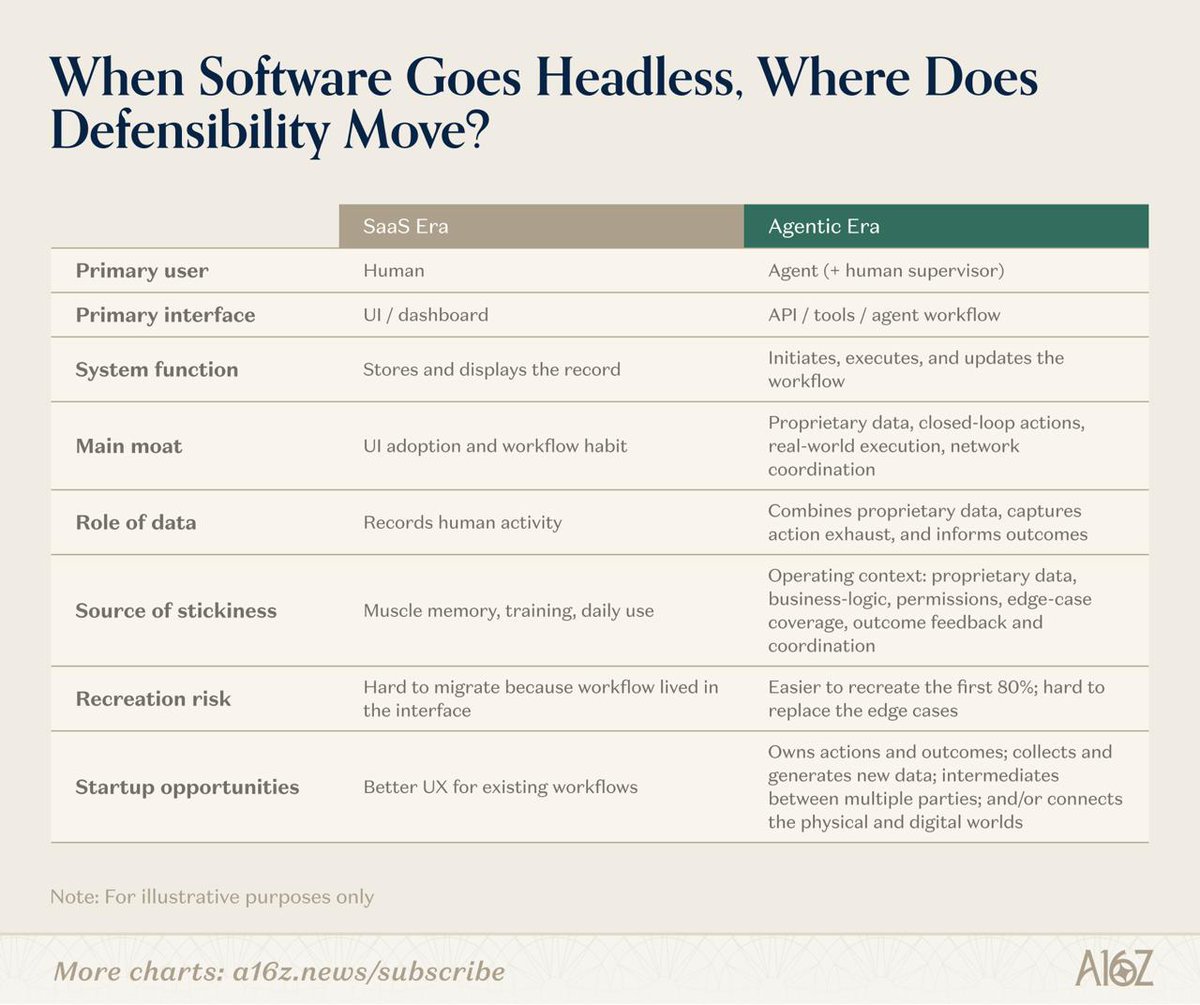
This was in the A16Z newsletter today. “Headless software” that is designed for use by AI is a big and growing market. “Defensibility” is the big question for any software business. This table is interesting because the items in the “agentic” column are complicated and debatable. They are supposed to make a point about what is defensible, but they actually make the opposite point, that A16Z does not yet have a strong opinion what is “defensible”. The author is an A16Z partner with an amazing resume who sees the best strategy presentations coming out of silicon valley. If a clear vision of defensibility exists, she is well positioned to find it.
If nothing is defensible, then what you are trying to do is maximize upside variance - the opportunity for an AI to do something new that hits the levels of growth that make defensibility less relevant.
That is one explanation for the action in public SaaS stocks. People are selling companies that are increasing sales, increasing cash flow, and launching new AI products. They sell until they see an unusual spurt of growth somewhere.
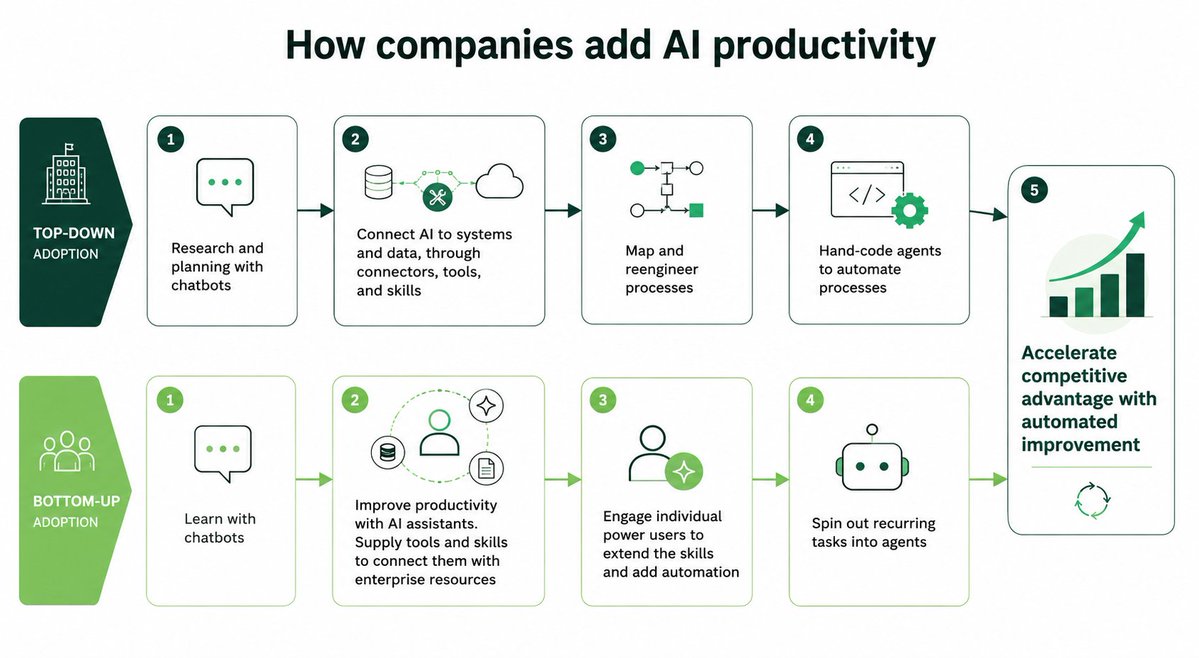
This diagram shows one reason that I am working on AI assistants. It illustrates how businesses add AI productivity on two different tracks:
The top-down track builds automation for a complete business process. It has steps like reengineering and reliability improvement. It often eliminates jobs.
The bottom-up track connects individual employees to IT tools and AI assistants. You give them tools, and you turn them loose to figure out how to improve their work. Individual contributors then make a lot of progress while senior executives are still filling out survey forms that say that AI is not working.
In this diagram, the tracks come together at the point where the AI picks up recurring tasks and starts running self improvement. This is happening faster that most people realize.
Team workshops are a fun and efficient way for companies to get AI productivity started on the bottom-up track.
The first "Get your AI Assistant" workshop gave us a good education last night. My goal was to move participants to the point where they have the confidence to install, modify, and create skills. At the end, everyone said they would try the skill-builder.
What I learned about the mechanics:
- The audience engaged at the end when I started to show a bigger range of tools doing cool things. We can put demonstrations first, and offer each participant a chance to add the demonstrated capability to their AI assistant.
- Do NOT use the Claude marketplace->plugin->skill structure. Claude Desktop does not handle it reliably. Arg! Just use a script that installs a skill directly.
- Generative UI is going to be fun. The AI responded nicely when we asked for graphical UI
Thanks to Angela Garabet for the energy and the food run, and thanks to @theventurelane. Thanks for advice from @natea@spratap
I showed off various types of tools and how to adapt them. The invitation was crypto-themed, with @Crypt0Mondays , @TheBostonDAO , and IEEE Boston Blockchain participating.
- Email Triage from @eporres . A classic of the "chief of staff" assistant genre. It uses the built-in MCP tool for gmail
- Flight search CLI from Printing Press. A category killer for RPA!
- @binance free crypto APIs. These use HTTP calls that are defined inside the skill, with no add on tool install. Nice design!
- @moonpay skills using the Open Wallet Standard wallet. This is the only wallet that meets my payment goals. An agent can create it instantly, I can add policies to control what transactions get approved, and later I can move it to a remote server where my AI cannot hack around it.
We want to get people started with personal AI that makes them into more powerful humans. I will continue to find, adapt, and develop material for three types of workshops:
- Meetups like this one
- Professional organizations seeking assistants focused on specific roles
- Company teams, who can boost fun and productivity with AI assistants, and an injection of related tools and skills
Many more workshops are coming. Please send your advice, feedback, and tools.