How do job seekers react when orgs quantify their diversity commitments? In a 🚨new paper🚨 with @IkeMDSilver1 & @edwardhchang, we explore competing predictions about how women and racial minorities react to measurable goals vs. vague, values-focused commitments
Our Research Doodles series, feat. illustrations by @MarissaShandell, is back for the summer!
First up: To get more done, make your goals smaller.
This can curb procrastination & boost commitment, found @AngelaDuckw, @Katy_Milkman, @Marissa_Sharif, @AneeshRai17 & Edward Chang.
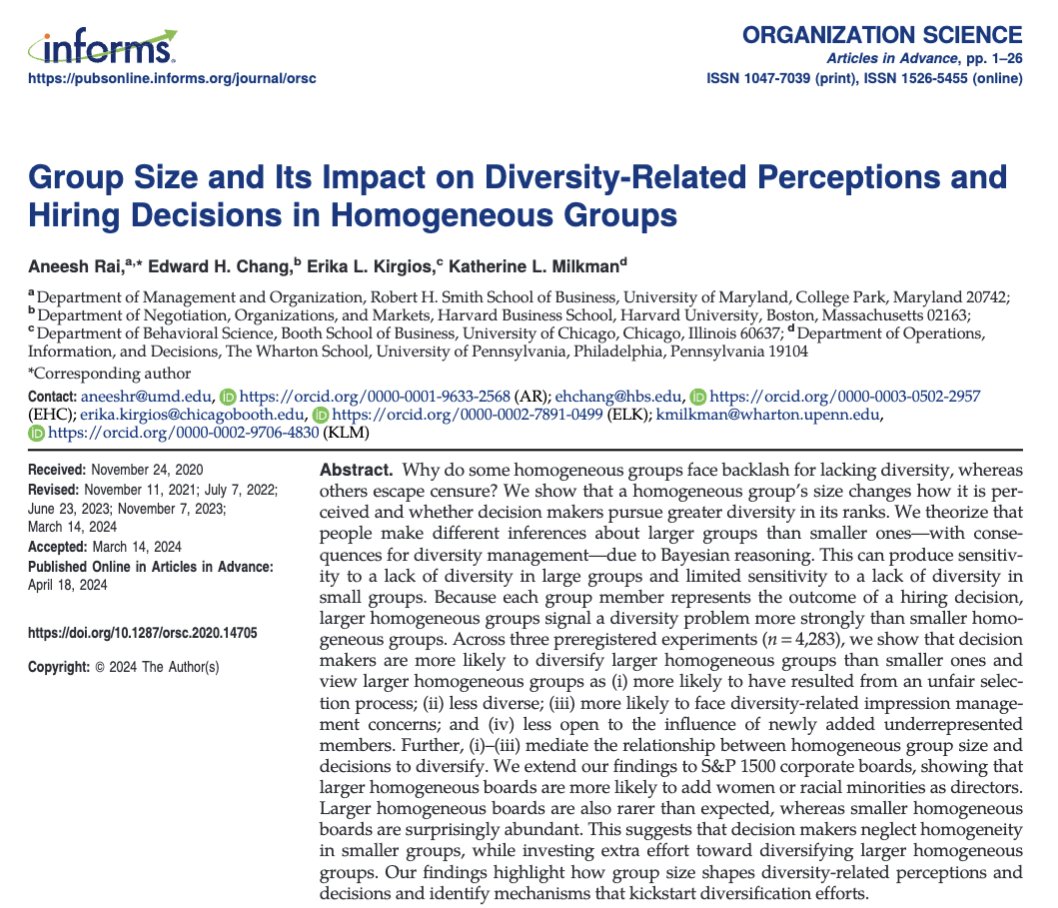
Does a homogeneous group's size matter for how it’s seen and if it’s diversified? Yes! Our new @OrganizationSci paper suggests decision-makers neglect gender and racial homogeneity in smaller groups while investing extra effort to diversify larger homogeneous groups
One experiment suggests it could be due to larger homogeneous groups sparking increased concerns about lack of diversity, fairness, and potential social sanctions. Orgs seeking to increase diversity could try to leverage these without waiting on homogeneous groups to grow in size
🚨New Paper🚨
Economics says: pay people directly for goal achievement.
A new field experiment led by @BerkeleyHaas Prof. Rachel Gershon shows higher achievement if you pay people only if they and a friend both achieve their goal (here, gym attendance).👉https://t.co/OSY4qe6Jnf
Did you set a big, hairy, audacious goal for 2024?
Our recent field experiment suggests you break that BHAG into flexible, bite-sized chunks @sciam@aneeshrai17
https://t.co/pQQsFWA8Kr
Check out our @sciam op-ed highlighting the benefits of breaking big goals into smaller subgoals for increasing productivity over time! Grateful to have worked with a dream team of authors on this paper. 😊 @katy_milkman@angeladuckw@marissa_sharif@edwardhchang
What happens if you break a 200 hr yearly commitment down for people, reminding them it's just 4 hours of effort per week? Our new field experiment shows people make 8% more progress. Breaking big goals down can help you achieve more. @sciam@aneeshrai17 https://t.co/jdz5lrOjfe
Attending #AOM2023? Don't miss my students' terrific symposium on boosting DEI in orgs. It's a finalist for the best symposium award in 2 different divisions of AOM. The superb co-organizer @iamlindachang (https://t.co/iEKS6KKhMi) is on the job market & will preview her fab JMP👇
To improve equity at work, make sure you’re accurately evaluating what works.
In a new https://t.co/VIvZXt1Riw article, @edwardhchang, @JamesElfer, Katryn Wright, Guusje Lindemann and I discuss the importance of an evidence-based approach to DEI. https://t.co/DI8xU9ADKu
🚨 New publication in Current Opinion in Psychology! 🚨
When faced with situations where we could help others, people often shy away from providing "prosocial input" (like giving compliments, or delivering helpful feedback). Why do we do this?
https://t.co/rJnkgodjrH
We just published a >9,000-person, pre-registered field experiment with an important lesson about goal setting. We partnered with a big non-profit (@CrisisTextLine) to test messages encouraging people to meet their commitment to 200 hours of yearly volunteering.
🚨My first paper (w/ @jpsimmon) is out in JEP:General!
People are overconfident. Can constructing a belief distribution – that is, indicating how likely all possible outcomes are – reduce this tendency?
Past work: Yes!
Our paper: No, it’s the opposite…
https://t.co/5Yf2Q9o6Qx
Q: How can we better nudge people towards honesty?
I wrote an article with a possible solution: focus interventions on the core justifications people use to justify dishonesty.
We also find that increasing subgoal flexibility (by breaking the 200-hr volunteering goal into a subgoal of volunteering 8 hrs every 2 weeks, rather than 4 hrs every week) led to longer-lasting benefits from creating subgoals.