If I had to name one project that keeps quietly building regardless of market conditions, @virtuals_io would definitely be one of them.
I’ve talked about Virtuals’ overall numbers before, so today I want to focus on what they’re doing beyond that.
[1] Virtuals × Robinhood Chain
This is one of the parts I’m watching most closely rn.
Virtuals has already brought thousands of AI agents onto Robinhood Chain, generating hundreds of millions in trading volume and millions in capital raised for builders.
The combo makes sense:
Robinhood brings users + financial assets.
Virtuals brings the infra for agents to trade and operate onchain.
That gives AI agents a much bigger use case than simply launching tokens.
[2] Virtuals is expanding beyond Base
Virtuals has expanded into Robinhood Chain, Solana and now Arc.
On Arc, builders can tokenize and co-own AI agents directly onchain.
IMO, this is slowly turning Virtuals from a Base-native project into cross-chain infra for the agent economy.
[3] Occupy is another experiment worth watching
Occupy connects token launches with tokenized stocks.
Part of the fees goes into a stock treasury, while AI agents can participate in managing those assets.
Still early, but the direction is interesting:
AI agents → capital → RWA → governance.
All of this keeps strengthening my conviction in $VIRTUAL.
Not every experiment will work, but the team keeps shipping, expanding and finding new ways for agents to create and own value.
The thesis is moving from:
AI agent launchpad to financial infra for the agent economy.
That’s why $VIRTUAL is still one of my main bags to watch.
$VEX | @ProjectVEXai dumped tokens and extracted nearly $1.5M from users 👇👇
I’m pretty busy and tbh I didn’t really want to get involved in this drama, but the $VEX founder has asked me many times for proof that tokens were being sold.
So I went back onchain and checked how these transactions actually work.
[1] Why you can’t find the sell txs from the From wallet
With a normal wallet, the flow is simple: EOA wallet → DEX → sell, so checking the From address usually shows the trading history directly.
But some of the $VEX wallets I checked use a different setup, where the address shown in From is only a Bundler.
The actual transaction can be executed through a Smart Account behind it, which means the visible From wallet may show almost no $VEX buy/sell history.
Think of it like this: Bundler = delivery driver, Smart Account = the person deciding where the package goes.
[2] How Smart Accounts work
A normal EOA wallet works like:
Private key → Wallet → DEX
A Smart Account setup can look more like:
Owner key / passkey / multisig → Smart Contract Wallet → Execution contract → DEX / bridge / app
So if you only check the visible From wallet, you are only seeing the outer layer of the transaction.
The real token movement can happen behind it through Smart Accounts, execution contracts and liquidity pools.
[3] This is what I found when tracing $VEX
Instead of stopping at the From address, I checked ERC-20 Transfer logs, Approval logs, Smart Accounts, Bundlers, execution contracts and liquidity pools.
Once you follow the full path, the $VEX sell activity is there: token leaves the Smart Account, part goes to fees, and the rest gets routed into liquidity pools and swapped into other assets.
So when someone says “show me the wallet selling $VEX,” checking only the Bundler wallet is basically useless.
You need to trace the entire execution path.
[4] Then I checked the top PnL wallets
I quick checked around 100 of the highest PnL wallets around $VEX, and many of them show similar behavior.
They were active around $VEX from very early on, traded continuously, used Bundler/Smart Account execution and ended up with very high PnL.
From my quick calculation, the combined PnL of the wallets I checked is already close to $1.5M.
That is a lot of money extracted from the market while users were still buying and holding $VEX.
I’m still tracing these wallets one by one, so I’m not saying every address is already confirmed to belong to the team/MM.
But the sell activity itself is onchain.
[5] And don’t forget the 1% transaction fee
$VEX also charges around 1% transaction fee, and with the volume the token generated, the fee side alone could be worth around $2M based on my estimate.
So potentially we are looking at around $1.5M PnL from these wallets + around $2M from transaction fees.
If the team thinks my wallet analysis is wrong, the answer is simple: public the team wallets, MM wallets, treasury wallets and fee wallets.
Then everyone can compare them directly onchain.
Send this sh*t to 0.
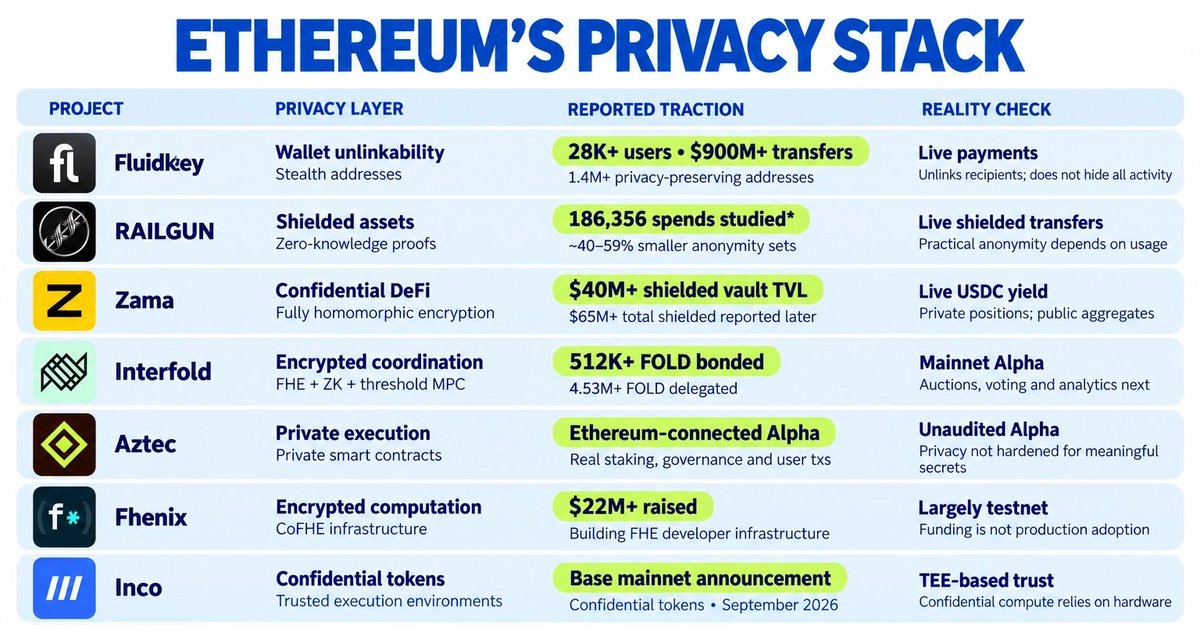
Privacy narrative is everywhere right now with $ZEC and $VVV leading.
Ethereum itself is also pushing the privacy lane, but it probably never becomes a privacy chain in the Zcash/Monero sense.
The chain stays public underneath while an entire privacy layer gets built above it.
Wallet privacy, private orderflow, shielded transfers, encrypted balances, private execution, private DeFi, selective disclosure… are some of the privacy tech I can name.
Somehow almost every piece of that stack went from research to something usable in 2026.
@fluidkey has 28K+ users, generated 1.4M+ privacy-preserving addresses and processed $900M+ transfers using stealth addresses.
Meaning you can receive money without permanently doxxing one reusable wallet to everyone paying you.
@RAILGUN_Project gives Ethereum an actual shielded asset layer too.
A 2026 study looked at 186,356 unshielding spends across RAILGUN/Hinkal and found real-world constraints reduced average anonymity sets by ~40-59%.
3,679 txs ended up with 10 possible senders or less. 1,228 had an anonymity set of one.
FHE finally started looking less like cryptography twitter fanfic.
@zama | ethereum:0xa12cc123ba206d4031d1c7f6223d1c2ec249f4f3 launched confidential USDC yield through a Steakhouse/Morpho vault where individual positions stay hidden while aggregate information can remain public.
– $40M+ shielded TVL in ~7 weeks
– $65M+ total shielded two days later
They’ve also shown confidential OTC settlement with GSR, confidential payroll/payments and encrypted tokens.
@theInterfold is building encrypted coordination where multiple parties can compute on private inputs using FHE + ZK + threshold MPC, without trusting a single operator or TEE.
Mainnet Alpha is live with 512K+ $FOLD bonded to ciphernodes and 4.53M+ delegated, with auctions, private voting and shared analytics coming next.
@aztecnetwork is attacking general private execution.
Its Alpha is already connected to Ethereum with real staking, governance and user txs, but the network is unaudited, privacy isn’t fully hardened and meaningful secrets shouldn’t live there yet.
@fhenix raised $22M+ for CoFHE infrastructure, but current deployments are still largely on testnet.
@inconetwork went another direction and leaned more on TEEs for encrypted computation, announcing confidential tokens on Base mainnet in September.
@ethereumfndn’s Kohaku is trying to build privacy-first wallet tooling, but the repo still says major parts are WIP, unaudited and not production ready.
The thing with privacy is companies don’t necessarily need anonymous money.
They need payroll, treasury balances, trade size, inventory, collateral and counterparties to NOT be broadcast to the entire internet while still keeping settlement auditable.
Ethereum privacy rn is basically at the point where the edge pieces are becoming real, but the center is still unfinished.
And there probably won’t be one winning privacy primitive.
> ZK for proving private state transitions.
> FHE for computing over encrypted balances/state.
> MPC/threshold crypto for distributed key authority.
> TEEs when latency matters more than pure cryptographic trustlessness.
> private mempools for hiding intent before execution.
> stealth addresses for unlinkability.
Ethereum underneath all of it for public settlement. That’s also where Ethereum has a pretty unique edge.
. @Zcash as the first privacy ETF is doing what people said only BTC and ETH ETFs could do
$ZEC traded above $1,200, gained roughly 45% in a week, and pushed its market cap toward $20B.
Grayscale’s $ZCSH began trading on August 25 and already holds around $463M in assets.
Price appreciation contributed to that growth, but the ETF also recorded real net inflows.
Then leverage amplified the move.
ZEC open interest crossed $2B, while more than $34M in shorts were liquidated as price broke higher.
Spot demand → breakout → forced short covering → more momentum.
Th most interesting thing is why privacy is working now.
AI is making wallet profiling, address clustering, and identity linking cheaper.
On transparent chains, every transaction can become part of a permanent financial profile.
I increasingly view privacy as a hedge against onchain identity exposure.
That gives Zcash something most alt narratives currently lack:
→ price confirmation.
→ institutional access through a new wrapper.
→ a cultural reason to own it now.
I also spent time looking for the next ZEC beta play.
One thing became clear: Zcash still doesn’t have a mature native token economy, so I’m separating real ZEC exposure from tokens that only borrow the narrative.
My current map:
[1] Clean exposure: $ZEC and $ZCSH
This remains the most direct trade. ETF demand, shielded adoption, and derivatives positioning all flow back to the same asset.
[2] Capital-efficient ZEC exposure
@kamino has opened a ZEC-backed lending market on Solana, allowing users to borrow USDC against ZEC and loop the position up to 1.7x.
That creates another demand path for ZEC, but it also adds liquidation and bridge risk.
[3] Meme beta: $ZCAT
$ZCAT uses a 3% transaction tax to buy and distribute ZEC to holders.
More than 2,320 ZEC, worth roughly $2.8M, has already been distributed.
This is not native Zcash activity, but it is one of the first meme structures where speculation creates direct ZEC buying.
[4] Native Zcash optionality
@zec_bit is testing private NFT ownership directly on Zcash, with its Genesis collection traded in ZEC.
Further out, Zcash Shielded Assets and projects such as ZPrivDEX could create private stablecoins, tokenized assets, and native shielded trading.
The privacy-first wallet @noir_wallet is probably where you start.
Those products are still early. I see them as a watchlist, not liquid beta yet.
This is where the bigger opportunity may form:
ZEC as the monetary asset
→ memecoins creating speculative demand.
→ private tokenized stocks and stablecoins.
→ native shielded markets.
for now, i’m watching where real ZEC is bought, locked, used as collateral, or required for settlement.
that is a much stronger signal than buying every token with "Zcash" in its name.
DYOR.
Parking in stables doesn’t mean I want another farm token.
@Elara_HQ’s yield comes from stablecoin trading fees and spread capture, accruing to sELUSD stakers.
The breakdown here:
If you only look at the RWA perp chart, the obvious take is just numbers go up bc ppl wanna trade stocks, indices, metals, FX etc on crypto rails.
But not many ppl know onchain RWA trading just hit its second real phase.
First we tokenized the asset. Then crypto did what crypto does and wrapped the price into perps.
Now venues are realizing neither is enough if you actually want TradFi-sized flow to live onchain.
– $0.8B monthly volume in Oct 2025 to $147B at the July peak
– share of all onchain perp volume went from 0.06% to 12–15% now
– $4.9B of RWA perp OI
– TradeXYZ + Variational controlling almost 90%
Most of that growth is still what I’d call phase 1: take the crypto perp machine and point it at stocks, gold, oil, indices, FX and pre-IPO names.
24/7 CLOB + oracle + leverage + premium-based funding, with crypto MMs carrying inventory and hedging somewhere else.
Works insanely well for bootstrapping markets, but problem is the underlying assets aren’t BTC lol.
Stocks sleep, exchanges close on weekends, dividends exist, financing has a real cost and a $5M gold position probably shouldn’t depend on whether CT apes are overcrowded long that hour.
So how does onchain RWA perp trading evolve?
– @trade_xyz / HIP-3 proved that permissionless markets + a fast CLOB + unified margin can create new markets faster than TradFi ever will.
HIP-3 became the RWA liquidity gravity well onchain and today TradeXYZ still sits at $3.9B OI, $1.7B daily RWA volume, ~73% of tracked DEX RWA OI.
– @variational_io’s new swaps are designed to bring a TradFi-style financing relationship into an onchain wrapper.
OLP becomes the counterparty through RFQ, prices the trade, then hedges the risk through CEXs, DEXs, OTC and TradFi liquidity.
The first 5 swap markets were US100, US500, XAU, XAG and USOIL and they already did ~$3.8B volume with a $245M OI peak.
– @qfex takes the CLOB route but simply turns funding off when the underlying cash market isn’t giving it a reliable reference.
It still offers 24/7 trading, but doesn’t pretend a Saturday equity position needs to play the same crypto-style financing game all weekend. Already has $212M RWA OI across 171 markets.
– @Lighter_xyz’s main RWA book is $101M OI across 76 markets, but its Robinhood instance did ~$5B volume in August, crossed $200M OI with 21k+ accounts and >70% of that OI was RWAs.
Tells me brokerage distribution can bootstrap an RWA venue in a way a standalone DEX probably can’t.
– @OndoPerps is trying to turn the RWA itself into the balance sheet by letting tokenized stocks be posted as collateral for equity/commodity perps.
Still small at $78M OI / 45 RWA markets, so the numbers haven’t caught the thesis yet.
Phase 1 was about proving ppl want the exposure. Phase 2 is about fixing everything underneath it like liquidity, funding, collateral, market hours, hedging and distribution.
Making the whole market around it work onchain is the actual game now.
.@Uniswap v4 already flipped v3 in 30d volume and somehow the conversation is still mostly about hooks.
The bigger story imo is what happens when v4 becomes the liquidity backend and UniswapX becomes the router sitting above everything.
What I find more interesting is the capital efficiency.
– v4 did ~$39B volume over the last 30d against $1.05B TVL = ~37.1x monthly turnover.
– v3 did ~$33.8B over the same 30d against $1.5B TVL = ~22.5x.
– v4 takes ~54% of Uniswap volume on Ethereum.
→ v4 is moving ~1.65x the volume per dollar sitting inside the system.
Which makes more sense when you look at what is actually getting used.
8 of the 10 largest v4 pairs by 30d volume are stable pairs.
Uniswap itself did ~$43.4B stable-to-stable volume in Q2, and now v4 is getting purpose-built infra for exactly this flow.
@sparkfinance already moved $150M of stable liquidity onto v4.
Capital doesn’t necessarily need to sit dead inside an AMM 24/7 anymore just so it can be available when someone wants to trade.
Which also explains why TVL becomes a worse metric for judging v4.
UniswapX is the other tech I’m bullish on. Its fillers can use v4 liquidity, v3 liquidity, other DEXs or their own inventory.
What matters is v4 is making liquidity more programmable and potentially more fragmented. UniswapX is supposed to make that fragmentation invisible.
We can already see how useful that architecture could become on RH.
v2 + v3 + v4 + UniswapX all went live there from day one, and RH is now Uniswap’s largest 30d chain with ~$29B volume.
– v4 is doing ~$15.9B there, or ~42% of all v4 30d volume.
– ETH adds another ~$12.6B, BSC ~$4.4B, Base ~$2.2B.
We also got many projects building on top of v4 hooks, but it’s still early.
90k+ hooks have been initialized, but hooked volume was only around ~1% of v4 volume in most months.
But I really love some of the tech being built:
– @token_works: one of the few teams that actually proved v4 hooks can print, using decaying 95–99% launch taxes + automated fee routing to generate ~$51M cumulative strategy fees.
– @standard_rsv: an onchain central bank where a v4 hook on ETH/$STANDARD runs monetary policy itself, while fees rotate between gold/POL accumulation and $STANDARD buyback + burn.
– $IMD: @surfcoderepeat is building protocol-owned markets on v4 where the hook itself manages liquidity, burns excess inventory and routes value to stakers + future onchain compute.
v4 is winning because the same dollar of liquidity can do more work, while UniswapX can sit on top and hide the mess.
And maybe Uniswap’s moat now is owning the order flow and making every source of liquidity fight for it.
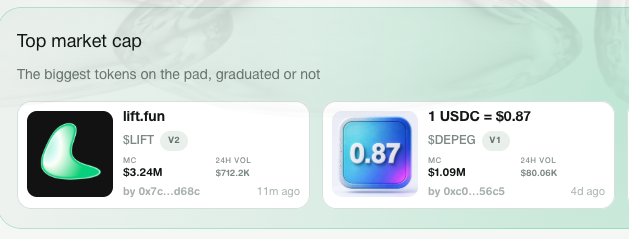
$Depeg 5x from 200k to $1M+ rn on day-1 Arc mainnet.
@liftdotfun has also just launched its token $LIFT with $3M mcap rn
I think not many launchpads that have $1M mcap on their runner, so Lift might be a good one to keep an eye on.
now following the launchpad and its runner. Pad = 2-3X runner valuation, imo.


![Okada_DeFi0x's tweet photo. $VEX | @ProjectVEXai dumped tokens and extracted nearly $1.5M from users 👇👇
I’m pretty busy and tbh I didn’t really want to get involved in this drama, but the $VEX founder has asked me many times for proof that tokens were being sold.
So I went back onchain and checked how these transactions actually work.
[1] Why you can’t find the sell txs from the From wallet
With a normal wallet, the flow is simple: EOA wallet → DEX → sell, so checking the From address usually shows the trading history directly.
But some of the $VEX wallets I checked use a different setup, where the address shown in From is only a Bundler.
The actual transaction can be executed through a Smart Account behind it, which means the visible From wallet may show almost no $VEX buy/sell history.
Think of it like this: Bundler = delivery driver, Smart Account = the person deciding where the package goes.
[2] How Smart Accounts work
A normal EOA wallet works like:
Private key → Wallet → DEX
A Smart Account setup can look more like:
Owner key / passkey / multisig → Smart Contract Wallet → Execution contract → DEX / bridge / app
So if you only check the visible From wallet, you are only seeing the outer layer of the transaction.
The real token movement can happen behind it through Smart Accounts, execution contracts and liquidity pools.
[3] This is what I found when tracing $VEX
Instead of stopping at the From address, I checked ERC-20 Transfer logs, Approval logs, Smart Accounts, Bundlers, execution contracts and liquidity pools.
Once you follow the full path, the $VEX sell activity is there: token leaves the Smart Account, part goes to fees, and the rest gets routed into liquidity pools and swapped into other assets.
So when someone says “show me the wallet selling $VEX,” checking only the Bundler wallet is basically useless.
You need to trace the entire execution path.
[4] Then I checked the top PnL wallets
I quick checked around 100 of the highest PnL wallets around $VEX, and many of them show similar behavior.
They were active around $VEX from very early on, traded continuously, used Bundler/Smart Account execution and ended up with very high PnL.
From my quick calculation, the combined PnL of the wallets I checked is already close to $1.5M.
That is a lot of money extracted from the market while users were still buying and holding $VEX.
I’m still tracing these wallets one by one, so I’m not saying every address is already confirmed to belong to the team/MM.
But the sell activity itself is onchain.
[5] And don’t forget the 1% transaction fee
$VEX also charges around 1% transaction fee, and with the volume the token generated, the fee side alone could be worth around $2M based on my estimate.
So potentially we are looking at around $1.5M PnL from these wallets + around $2M from transaction fees.
If the team thinks my wallet analysis is wrong, the answer is simple: public the team wallets, MM wallets, treasury wallets and fee wallets.
Then everyone can compare them directly onchain.
Send this sh*t to 0.](https://pbs.twimg.com/media/HS_RujYacAAj0x0.jpg)
![Okada_DeFi0x's tweet photo. $VEX | @ProjectVEXai dumped tokens and extracted nearly $1.5M from users 👇👇
I’m pretty busy and tbh I didn’t really want to get involved in this drama, but the $VEX founder has asked me many times for proof that tokens were being sold.
So I went back onchain and checked how these transactions actually work.
[1] Why you can’t find the sell txs from the From wallet
With a normal wallet, the flow is simple: EOA wallet → DEX → sell, so checking the From address usually shows the trading history directly.
But some of the $VEX wallets I checked use a different setup, where the address shown in From is only a Bundler.
The actual transaction can be executed through a Smart Account behind it, which means the visible From wallet may show almost no $VEX buy/sell history.
Think of it like this: Bundler = delivery driver, Smart Account = the person deciding where the package goes.
[2] How Smart Accounts work
A normal EOA wallet works like:
Private key → Wallet → DEX
A Smart Account setup can look more like:
Owner key / passkey / multisig → Smart Contract Wallet → Execution contract → DEX / bridge / app
So if you only check the visible From wallet, you are only seeing the outer layer of the transaction.
The real token movement can happen behind it through Smart Accounts, execution contracts and liquidity pools.
[3] This is what I found when tracing $VEX
Instead of stopping at the From address, I checked ERC-20 Transfer logs, Approval logs, Smart Accounts, Bundlers, execution contracts and liquidity pools.
Once you follow the full path, the $VEX sell activity is there: token leaves the Smart Account, part goes to fees, and the rest gets routed into liquidity pools and swapped into other assets.
So when someone says “show me the wallet selling $VEX,” checking only the Bundler wallet is basically useless.
You need to trace the entire execution path.
[4] Then I checked the top PnL wallets
I quick checked around 100 of the highest PnL wallets around $VEX, and many of them show similar behavior.
They were active around $VEX from very early on, traded continuously, used Bundler/Smart Account execution and ended up with very high PnL.
From my quick calculation, the combined PnL of the wallets I checked is already close to $1.5M.
That is a lot of money extracted from the market while users were still buying and holding $VEX.
I’m still tracing these wallets one by one, so I’m not saying every address is already confirmed to belong to the team/MM.
But the sell activity itself is onchain.
[5] And don’t forget the 1% transaction fee
$VEX also charges around 1% transaction fee, and with the volume the token generated, the fee side alone could be worth around $2M based on my estimate.
So potentially we are looking at around $1.5M PnL from these wallets + around $2M from transaction fees.
If the team thinks my wallet analysis is wrong, the answer is simple: public the team wallets, MM wallets, treasury wallets and fee wallets.
Then everyone can compare them directly onchain.
Send this sh*t to 0.](https://pbs.twimg.com/media/HS_Q17XaMAAV8LM.jpg)


![Defi_Rocketeer's tweet photo. . @Zcash as the first privacy ETF is doing what people said only BTC and ETH ETFs could do
$ZEC traded above $1,200, gained roughly 45% in a week, and pushed its market cap toward $20B.
Grayscale’s $ZCSH began trading on August 25 and already holds around $463M in assets.
Price appreciation contributed to that growth, but the ETF also recorded real net inflows.
Then leverage amplified the move.
ZEC open interest crossed $2B, while more than $34M in shorts were liquidated as price broke higher.
Spot demand → breakout → forced short covering → more momentum.
Th most interesting thing is why privacy is working now.
AI is making wallet profiling, address clustering, and identity linking cheaper.
On transparent chains, every transaction can become part of a permanent financial profile.
I increasingly view privacy as a hedge against onchain identity exposure.
That gives Zcash something most alt narratives currently lack:
→ price confirmation.
→ institutional access through a new wrapper.
→ a cultural reason to own it now.
I also spent time looking for the next ZEC beta play.
One thing became clear: Zcash still doesn’t have a mature native token economy, so I’m separating real ZEC exposure from tokens that only borrow the narrative.
My current map:
[1] Clean exposure: $ZEC and $ZCSH
This remains the most direct trade. ETF demand, shielded adoption, and derivatives positioning all flow back to the same asset.
[2] Capital-efficient ZEC exposure
@kamino has opened a ZEC-backed lending market on Solana, allowing users to borrow USDC against ZEC and loop the position up to 1.7x.
That creates another demand path for ZEC, but it also adds liquidation and bridge risk.
[3] Meme beta: $ZCAT
$ZCAT uses a 3% transaction tax to buy and distribute ZEC to holders.
More than 2,320 ZEC, worth roughly $2.8M, has already been distributed.
This is not native Zcash activity, but it is one of the first meme structures where speculation creates direct ZEC buying.
[4] Native Zcash optionality
@zec_bit is testing private NFT ownership directly on Zcash, with its Genesis collection traded in ZEC.
Further out, Zcash Shielded Assets and projects such as ZPrivDEX could create private stablecoins, tokenized assets, and native shielded trading.
The privacy-first wallet @noir_wallet is probably where you start.
Those products are still early. I see them as a watchlist, not liquid beta yet.
This is where the bigger opportunity may form:
ZEC as the monetary asset
→ memecoins creating speculative demand.
→ private tokenized stocks and stablecoins.
→ native shielded markets.
for now, i’m watching where real ZEC is bought, locked, used as collateral, or required for settlement.
that is a much stronger signal than buying every token with "Zcash" in its name.
DYOR.](https://pbs.twimg.com/media/HS0dxxQbkAAxw9c.jpg)