Arda Güler’in Belçika maçı performans editi gelmiş. Dünya’nın aktif en iyi 10 numarasıdır. elimizde nasıl bir değer olduğunun farkında değiliz. Şu çocuk ispanyollarda olsa ülkeyi üstüne yaparlardı
@Grand_DM I play mainly to be able to make or design things, be it rules or worlds or characters or stories or drawings. Not doing that would mean a different hobby from me, like buying the finished model aircraft instead of assembling it.
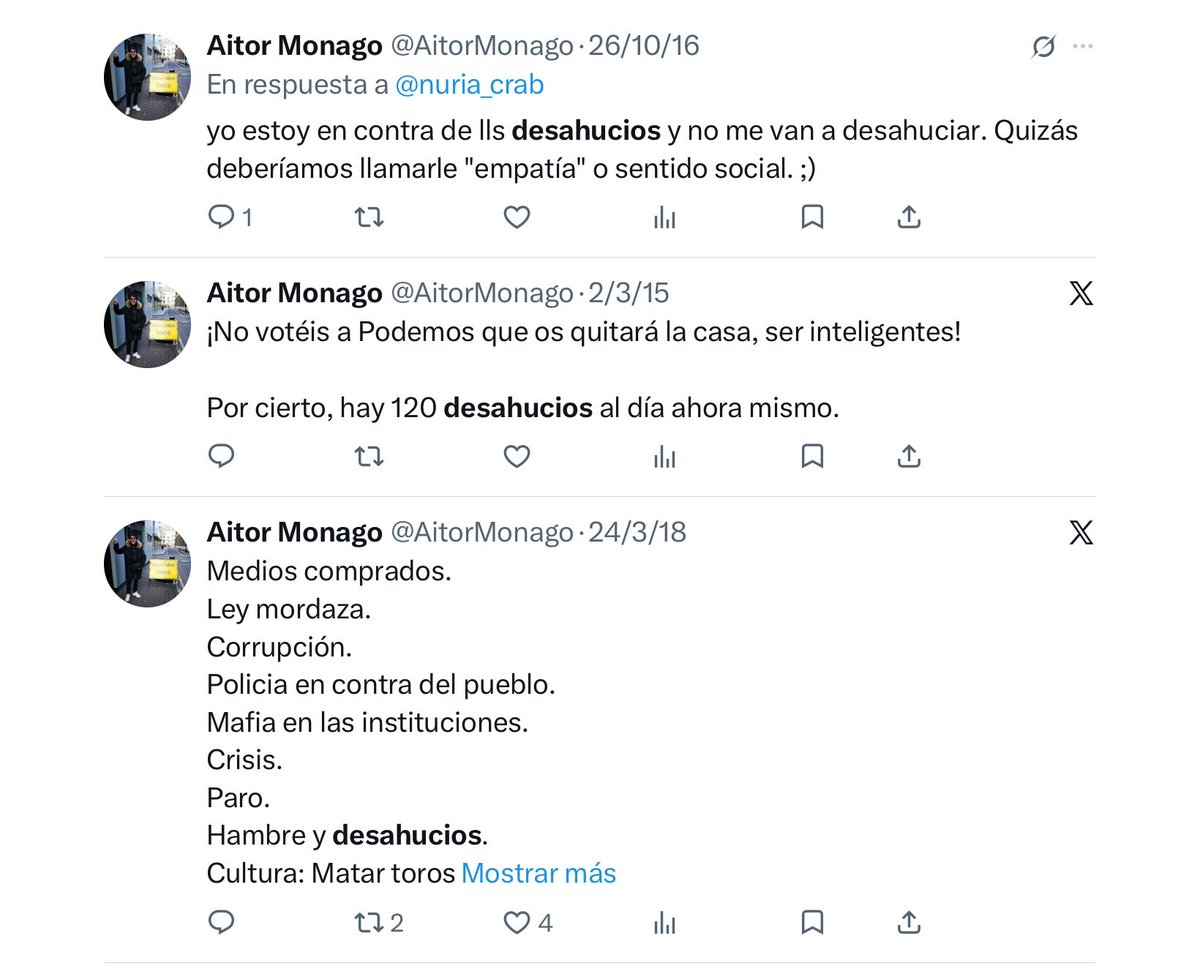
@TheGoodKnowmad@juanmacias Exacto. Igual podría poner 1+1+13 con rotulador, porque en ningún sitio dice que tenga que usar esos números proporcionados.
Los perroflautas y sindicalistas tratan de cortar la ronda litoral de Barcelona para impedir que los currantes acuden a sus puestos y los trabajadores les plantan cara a base de tortas.
Otro de esos emocionantes momentos en los que un niño mongólico abre los regalos de Navidad: Podemita obligado a soportar puerta con puerta durante cuatro años a unos okupas moros.
“El ejemplo de que se han estado haciendo las cosas mal”.
@BonaStrategy Hay algún ETF que replica una estrategia parecida, pero con diferencias (bonos a 1 año, límites de ganancias y de pérdidas cubiertas...). Para pequeños importes y momentos específicos (ej. posibilidad de recesión) creo que reducen volatilidad https://t.co/ODbBgtR04h
@BonaStrategy Pues, ahora mismo, tengo casi toda la cartera en bonos a largo plazo (eur/usd/gbp), con un tir de un 5% aproximadamente. Pero uso los cupones para comprar opciones a 1 año de índices de renta variable. No me importa esperar a vencimiento, si es necesario. ->
Quando un cinese capisce la situazione russa meglio di tutti i cosiddetti esperti dei talk show:
«Guardando la situazione attuale, questa operazione della Russia è come avere in mano una mano di partenza perfetta e riuscire a giocarsela fino a mandare tutto a puttane.
Se non avesse invaso l’Ucraina, oggi, nel grande poker globale dell’intelligenza artificiale, oltre agli Stati Uniti e alla Cina, con ogni probabilità ci sarebbe stata anche la Russia.
Per sviluppare l’IA e addestrare modelli di grandi dimensioni, la logica di fondo è: consumare una quantità enorme di elettricità, raffreddare tutto e mettere insieme tonnellate di hardware. Negli ultimi due anni, i responsabili dei data center di tutto il mondo si lamentano delle bollette della luce e dei costi dei sistemi di raffreddamento. E la Russia? È come se Dio stesso le avesse servito tutto su un piatto d’argento: in Siberia basta aprire la finestra per avere un condizionatore naturale di prima classe. Nel Paese ci sono acqua, energia nucleare e gas a basso costo. Non a caso, quando si faceva mining di criptovalute, tutti sceglievano la Siberia.
Inoltre, i russi sono forti in matematica e negli algoritmi. Nelle competizioni internazionali di programmazione e su Kaggle, nel campo del machine learning, i russi fanno regolarmente a pezzi la concorrenza. E, al di fuori degli Stati Uniti e della Cina, la Russia è uno dei pochi Paesi ad aver sviluppato un proprio ecosistema digitale completo: per le ricerche c’è Yandex, per i social network VK, oltre a Telegram. E adesso c’è Nebius, la nuova stella emergente nel settore della potenza di calcolo, le cui azioni sono schizzate alle stelle sulla borsa americana. Il suo nucleo è costituito proprio dagli stessi russi che lavoravano in Yandex.
Se, dopo la pandemia, la Russia avesse messo a disposizione terreni, aria fredda ed elettricità a basso costo, per poi invitare la Cina — quella macchina da guerra delle infrastrutture — a contribuire alla costruzione di linee ad alta tensione, stabilimenti e reti in fibra ottica, attirando anche capitali europei per costruire fabbriche di server, i russi avrebbero potuto trasformarsi nella più grande «fabbrica di supercalcolo» dell’Eurasia. Mentre Stati Uniti e Cina si affrontavano come divinità, la Russia avrebbe potuto stare in mezzo e riscuotere pedaggi da entrambe le parti.
E invece com’è andata a finire? Putin si è dato una pacca sulla coscia e ha deciso: no, io devo conquistare quei due pezzetti di terra.
La mente di Putin è rimasta definitivamente intrappolata nel vecchio sogno zarista ottocentesco dell’«espansione dei confini». Che importanza ha avere uno sbocco sul mare o una zona cuscinetto militare? Anche se fossero davvero necessari, esistono mille modi per ottenerli. Ma siamo nel XXI secolo! La lotta per il dominio mondiale oggi si gioca sulle catene di approvvigionamento dei semiconduttori, sugli algoritmi più avanzati e sulla conquista dei migliori talenti nel settore high-tech. E tu vai a impantanarti nel Donbass per un paio di pezzi di terra fangosa e qualche acciaieria abbandonata, ipotecando in cambio il futuro dell’intero Paese.
Non appena sono risuonati i primi spari, tutto è crollato. I programmatori e gli ingegneri più brillanti sono scappati in una sola notte. Il nucleo tecnologico di Yandex ha dovuto sottoporsi a una brutale amputazione per non affondare: ha reciso i legami con la madrepatria per potersi ricostruire in Europa sotto il nome di Nebius. Putin ha terrorizzato le persone più lungimiranti del Paese, trasformandole in rifugiati e fondatori di startup all’estero.
Alla vigilia dell’esplosione dell’intelligenza artificiale, il mondo intero corre freneticamente per aumentare la propria capacità di calcolo e cerca disperatamente un biglietto per la nuova rivoluzione industriale. E il capo della Russia trascina decine di migliaia di persone a sprofondare nel fango, combattendo una guerra di posizione nello stile della Prima guerra mondiale, cento anni dopo».
I can guarantee that the founders of D&D and the first commercial RPG, TSR, that we worked harder, longer and with more elan to establish, against strong headwinds then, a before unheard of industry, first on the block, than the idiot ideologues at WotC have done in destroying and purposefully mutilating all of what we accomplished. It's a joyous chore to create something born of vision and nurtured and sculpted by unselfishness and hard work, but it takes little energy to deface and suck the life out of same.
Postmodern robber barons suck don't they? They have infiltrated the entertainment and arts industries right down to their various fandoms, the latter whom cheer on the takeover of once highly regarded franchises with the same hope of being something along side their new leaders that none from each group are: creators, nurturers and honorable custodians.
The recent BioWare debacle is on-point comparable to what has happened with Wizards of the Coast/Hasbro regarding their custodianship of D&D. The timelines, trajectories, their separate rises, their mystifying and beleaguered course changes which defied their once successful and merged creative<>business models, and their ultimate falls. EA wasn't swallowing it for BioWare as Hasbro continues to do for the D&D brand, the latter company which has a 3.4-1 debt to equity ratio and should be in shareholder revolt mode.
And this is but one such example, from beginning to end. There are myriad other examples out there; and they are not nonsense. Far from being that, they are the battle lines formed on one side by the uncreative, uncaring, and manipulative robber barons versus the creative, reasonable, vision-workers on the other.
My post about Hitler and the far right got millions of views. Clearly, it hit a nerve. So today I'm going to show you, step by step, why the notion of "far right" as it's used in France makes almost no sense. And why the people who wield it are usually the last ones who should be lecturing anyone.
Let's start with the only question that matters: what makes a political system work or fail? To a very large extent, it's the economy. A country that produces wealth, that lets its citizens create, trade and build, stays standing. A country that destroys that collapses, no matter how beautiful its slogans are.
And in economics, there are really only two worldviews.
The first is collectivism. The idea that the State knows better than you. That it must plan production, set prices, run companies, decide what you earn, what you buy, and eventually what you think. The individual is just a cog serving a grand collective project: the class, the nation, the race, the people.
The second is freedom. Capitalism, property, individual liberty, individual responsibility. The idea that millions of people creating value for one another produce infinitely more prosperity than an office of planners, however brilliant they may be.
Now look at the list of the great totalitarian regimes of the 20th century. Stalin: total planning, forced collectivization, millions dead. Mao: the Great Leap Forward and the deadliest famine in human history. Pol Pot: money abolished, cities emptied, nearly a quarter of Cambodia's population exterminated. Mussolini, the man who coined the word fascism: "Everything within the State, nothing outside the State, nothing against the State." And Hitler, leader of the National Socialist German Workers' Party, whose program proclaimed "the common good before individual good." He subjected the entire German economy to State plans: the Four-Year Plan, frozen prices and wages, unions dissolved into a single state labor front, industrialists producing whatever the regime decided.
Their flags were different. Their designated enemies were different. But the machinery was the same: the individual doesn't exist, only the collective matters, and the State decides everything.
Why does it always end in totalitarianism? Because collectivism doesn't work. And when a system doesn't work, it has only two options: admit failure or force people. They always choose force.
Ludwig von Mises proved it as early as 1920: without free prices, without a market, a planner simply cannot know what to produce, how much, or at what cost. He is flying blind. A planned economy isn't a less efficient version of the market. It's an impossibility.
Friedrich Hayek drew the political conclusion in 1944 in The Road to Serfdom, a book he dedicated "to the socialists of all parties." One chapter is titled "The Socialist Roots of Naziism." Another, "Why the Worst Get on Top." For Hayek, controlling the economy isn't controlling one sector among others. It is "the control of the means for all our ends." Whoever controls your bread controls your life. Then your speech. Then your thoughts.
Milton Friedman put it his own way: a society that puts equality before freedom ends up with neither.
So we know exactly what works. It's not an opinion. It's a century of real-world experiments. Listen to the Austrian school, Mises and Hayek, with Friedman from Chicago alongside them: economic freedom, limited government, individual responsibility.
And this is where we get to the great accusatory inversion. Part of the left-wing press spends its time screaming fascism. Why? Because the fascism fantasy is the best way to never talk about the track record of their own ideas. Deep down, they know: if their collectivist program were applied all the way, it wouldn't work, because a collective economy cannot work. And an economy that doesn't work always ends up having to coerce, surveil and ban. In other words, it becomes exactly what they claim to be fighting. The real heirs of totalitarian logic are not the ones being pointed at.
So who gets called "far right" in 2026? People who want safe cities. People who want to keep their culture. People who just want to live a peaceful life, raise their kids, and not have to board up their shop every weekend. People who want the law to apply to everyone.
If that's the far right, then the word no longer means anything. And maybe that was the point.
Aunque fuera cierta la premisa (que no lo es, porque el TC es hoy una institución degradada) una afirmación así solo demuestra una ignorancia irrecuperable, porque ni siquiera los tribunales que ven corregidas sus resoluciones por otros superiores YERRAN (1)
La FNAC de Marseille, immense, a été entièrement pillée. Il ne reste que les livres. C’est cocasse pour des jeunes qui voulaient des moyens d’étudier 😏
A los que piden que ardan las calles me gustaría preguntarles de qué calles estamos hablando, exactamente. Mas que nada por ir concretando, que lo mismo estamos todos de acuerdo hasta que ponemos una dirección.
Porque uno dice "que arda todo" y queda super rebelde. Luego resulta que ese "todo" incluye el coche de una enfermera, la tienda de un señor que todavía está pagando el préstamo o un restaurante de una familia china que invirtio todos sus ahorros. La revolución tiene estos detallitos tontos cuando se acerca uno a mirar, porque te empiezan a salir personas por todas partes y te joden la panorámica.
El señor de la tienda, por ejemplo, qué hace ahí? Por qué no comprende que le están construyendo un mundo mejor? Lleva veinte años trabajando como un mulo, paga impuestos, tiene dos empleados y una úlcera, pero se ve que le falta conciencia social.
Ahí hay algo que a mí se me escapa. Todo esto se hace por el pueblo, pero para ser pueblo te piden más pedigrí que a un caniche de exposición. Porque al que pide que no le quemen el negocio le retiran el carnet en el acto. Alguien le ha preguntado qué quiere o sólo cuenta como pueblo mientras acepta sin rechistar que le jodan la vida?
Todo para el pueblo, pero sin el pueblo. Espera, esto me suena.
Entonces, quién es el pueblo?
El que revienta el escaparate, sí.
El que huye con los perfumes robados, también.
El dueño, viendo cómo se llevan entre risas su trabajo, no, ese es un capitalista, que se joda.
Yo le aconsejaría entrar y robarse algo, igual si es un poco ladrón lo reconocen como pueblo.
Qué estamos justificando exactamente? A veces hay que utilizar la violencia para defenderse. Pero a quién estás defendiendo cuando le quemas el coche a un desconocido. Qué peligro has evitado reventando un local? Hasta dónde puedes llegar y quién te ha dado permiso? Porque como valga con estar convencido de que eres de los buenos, estamos jodidos. Pocos cabrones he conocido que no tuvieran una explicación preciosa para lo suyo.
Imagina que la tienda es de tu hija y que, al intentar defenderla, le dan con una barra de hierro en la cabeza. Le explicas que hay que comprender esa rabia, que no se lo tome como algo personal y que están haciendo la revolución por su bien.
Es solo por saber si el contexto te sigue pareciendo tan convincente cuando la que recibe es tu hija.
O tu madre.
Y me interesa también el tío que reparte el entusiasmo, ese que lleva días calentando el ambiente y después aparece muy preocupado porque alguien se ha calentado. No se lo explica. Dijo que había que hacer arder las calles, pero como florecen los almendros, una cosa poética. Cómo iba a saber que entre tanto cenutrio habría algunos poco familiarizados con la metáfora.
Si a un idiota con la testosterona disparada le cuentas que su violencia es noble y le señalas a un enemigo, qué le estás dando? Una opinión o permiso? El que rompe paga, pero tú no eres, quizás, el responsable de todo?
Qué barata sale la revolución cuando la casa y el cuerpo los ponen otros, amigo.
Antes de pedir que arda todo, dime qué vas a poner tú, revolucionario de medio pelo, qué parte de tu vida estás dispuesto a ver hecha trizas.
Y después quédate a explicarle al de la tienda para qué ha servido arruinarle la vida, igual tiene ganas de partirte la cara. Será un buen momento para explicarle que la violencia no lleva a ninguna parte.
A ver si tienes cojones de darle esa lección delante de su negocio quemado.
¿No "acerto" el 23J?
En realidad no. Se desvió en sentido contrario, pero no menos que el promedio. Sobreestimó a la izquierda en +3 puntos, cuando el conjunto la subestimó.
PSOE y Sumar tuvieron 152 escaños, cuando el promedio les daba 142. ¡Pero el CIS decía 171! SI hubiesen sido 171 no se hubiesen necesitado a PNV, Bildu, ni Junts.
Puedes decir que "acertó" viendo un electorado a la izquierda de los otros sondeos. Pero, si siempre predices más votos de izquierda (44 de 45 veces), ¿es realmente un acierto o un efecto "reloj parado"?