John Templeton:
Keep in mind the wise words of Lucien Hooper, a Wall Street legend: “What always impresses me,” he wrote, “is how much better the relaxed, long-term owners of stock do with their portfolios than the traders do with their switching of inventory. The relaxed investor is usually better informed and more understanding of essential values; he is more patient and less emotional; he pays smaller capital gains taxes; he does not incur unnecessary brokerage commissions; and he avoids behaving like Cassius by ‘thinking too much.’”
Plenty of people sitting on a $2,000,000 portfolio still spiral over a $15,000 trip with the family.
It’s not that the money isn’t there.
It’s that the account balance never got translated into a green light.
Their net worth climbed. Their personal “allowed to spend” settings stayed frozen.
So the person who had to pass on a $15,000 vacation at 35 is still running the exact same mental spreadsheet at 48. Despite the numbers living in a different universe now.
Getting rich is challenge one. Letting yourself enjoy it without self-punishment is challenge two.
Most people stop after the first.
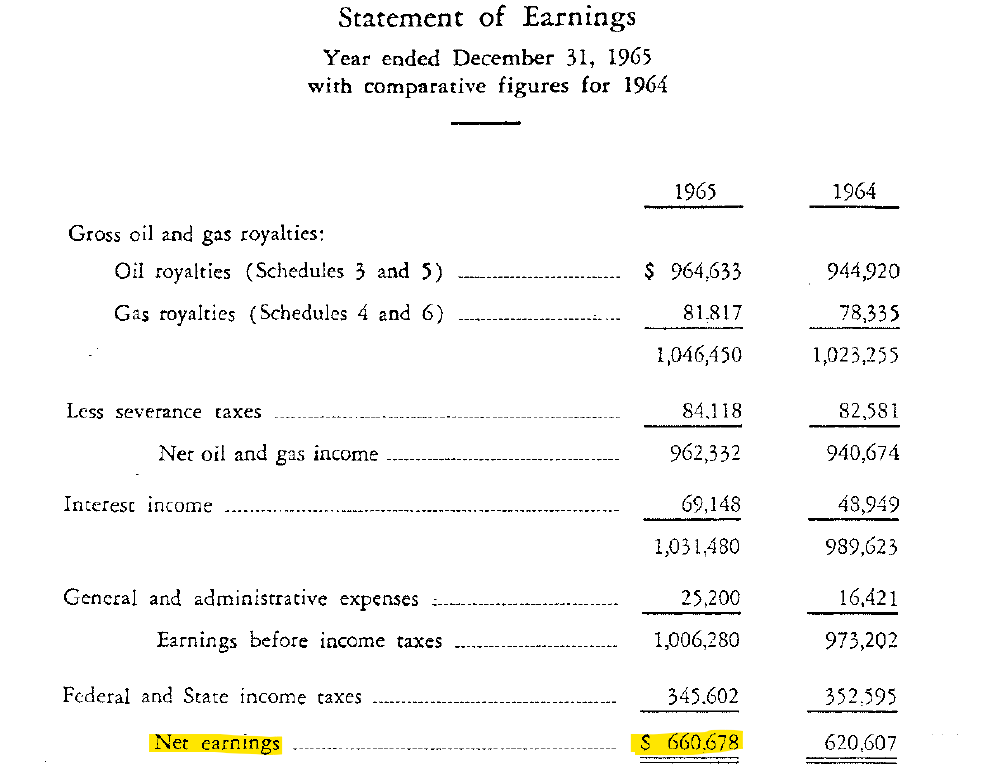
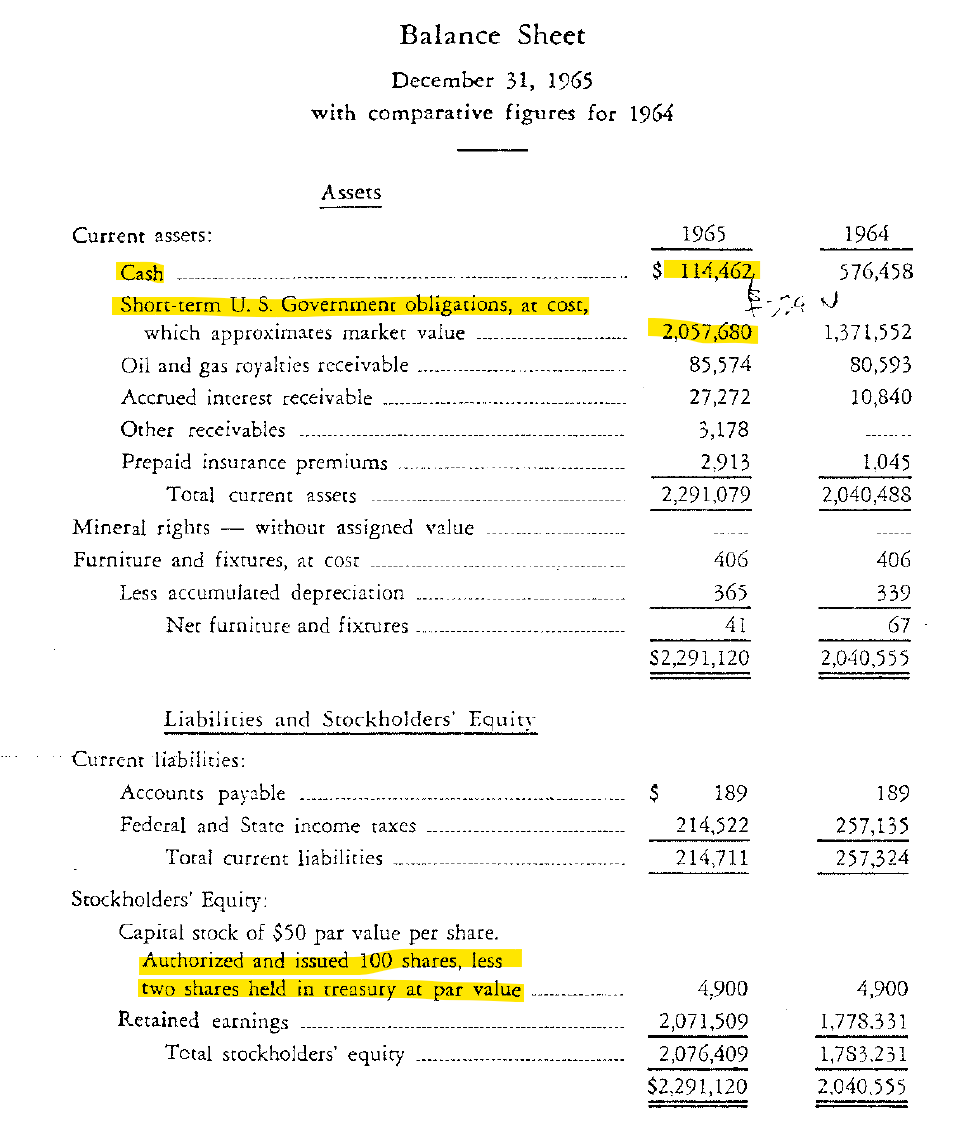
My favorite Buffett investment: Delta Duck Club.
- $2.8 million market cap (4x earnings).
- 13% dividend yield.
- Oilfield remained active for 50+ years.
Here's a letter Buffett sent to the Chairman of Interpublic in Feb 1974.
EPS 1973: $2.74
Avg stock price 1974: $10.38
EPS 1983: $8.75
Avg stock price 1984: $108.68
Warren Buffett once turned $10,000 into $15 million just by buying and holding
Today his personal fortune sits at $140 billion, and he still lives in the same house he bought in 1958 for $32,000.
He still does his own tax return.
"I've got an untapped potential for that type of life. It's made life a lot easier the last couple of years" - on deliberately driving the cheapest car he could find, despite being one of the richest men alive.
His investing rule stripped to one sentence: "if you're in a poker game for 30 minutes and you don't know who the patsy is, you're the patsy."
He applies it to his own portfolio, if a stock drops and it upsets him more than it excites him to buy more, he's the patsy.
His most controversial stance isn't about markets at all, it's about his own kids. He refuses to hand them fortunes: "if I'm going to be a sprinter, I don't want to be a bet against everybody else leaving the starting box before me"
His final word on where nearly all $140 billion eventually goes: "99% plus of it is going to go to society. It should"
bookmark & watch the full conversation ↓
ASML is the only company capable of manufacturing the machine that creates every advanced AI chip in the world. Yet over the last five years, ASML is up ~120%, while Nvidia is up ~1,300%.
This means that even though ASML is the most unavoidable bottleneck in the AI stack, Nvidia still outperformed it by ~10x.
To understand where value actually accrues in the AI stack, our team at Social Capital set out to map it:
The stack we drew has six layers:
-Infrastructure
-Chips
-Data
-Models
-Execution
-Application
Each layer has its own “fulcrum assets,” which are single points in the stack that every unit of value has to cross. The companies that sit on the less obvious ones will likely shape the next 40 years of computing.
Infrastructure is the most concentrated layer in the stack. In fact, four companies in Japan supply the film that every chip needs, and a single mine in North Carolina sits underneath most wafers in production. In 1880, Rockefeller owned 90% of refining. This same pattern is forming now.
After infrastructure is where the stack forks into Digital and Physical AI. Digital AI runs in the cloud, trains on text, and executes through APIs. Physical AI runs on local chips, trains on real-world data, and executes through motors and batteries.
These two forks compound on very different curves, and a handful of names already sit on the boundaries that matter.
Every era of computing has been won by the people who got the stack right. This is the clearest view we have of where AI is going.
Homage to you, Charlie Munger
Top 10 quotes:
1. "Spend each day trying to be a little wiser than you were when you woke up."
2. "The best thing a human being can do is to help another human being know more."
3. "It is remarkable how much long-term advantage people like us have gotten by trying to be consistently not stupid, instead of trying to be very intelligent."
4. "In my whole life, I have known no wise people who didn't read all the time. None. Zero."
5. "I never allow myself to have an opinion on anything that I don't know the other side's argument better than they do."
6. "The big money is not in the buying and the selling, but in the waiting."
7. "You don't have to be brilliant, only a little bit wiser than the other guys, on average, for a long, long time."
8. "The first rule is that you can't really know anything if you just remember isolated facts and try to bang them back."
9. "There are worse situations than drowning in cash and sitting, sitting, sitting."
10. "The game of life is the game of everlasting learning. At least it is if you want to win."
These quotes reflect Munger's lifelong emphasis on continuous learning, rational decision-making and a long-term perspective, in investing and in life.
R.I.P. Charlie Munger
"How did Buffett and Malone get so rich"
they basically figured out that if u have an enormous tax bill, all u have to do is go out and buy a fuck ton of capex, like railroads or cable companies, and then the taxes go away
"How does that work"
honestly thats just how the tax code was written here I guess. like...u dont wanna pay taxes, no worries, just go buy some businesses instead lol
thats how we roll
make sure u buy the heavy ones though, with lots of fixed assets. we have it all set up so that u can defer taxes forever and pay 15% on cap gains. meanwhile the proles stand all day at a Dollar General cashier, make $12/hour, and then pay 50% taxes.
anyway just keep ur eyes open next time u have a tax obligation... u can buy a department store, a textile mill, a map company, we dont fuckin care, long as u buy clunky ass shit u dont gotta pay us
(somehow, all of this is somewhere between 100% and 99.9% accurate...and thats before "go buy an insurance co, theres a thing called float.")
Dad buys land for $100K. Today it's worth $5M. Dad doesn't sell because selling triggers huge tax bill. Dad borrows against it instead. A loan isn't income. So no tax. Dad lives off the loans for decades. Dad dies still owning the land. Kids inhert at $5M basis.
Kids sell & owe nothing to the lRS. The $4.9M gain? Gone This is exactly what wealthy
families do to avoid taxes and build generational wealth.
Warren Buffett on the number one rule for life:
Asked about the most important advice he gives, Buffett doesn't reach for anything about investing, business, or money. He reaches for something 2,000 years old.
"The number one rule I give him is just the golden rule. I'm not a religious guy, but nobody said it any better in a couple thousand years than that. Which may be why it's lasted to a certain degree, too. More people are reading a 2,000-year-old book about how to behave than anything that anybody's coming up with lately."
The rule itself is simple: "Do unto others as you'd have them do unto you."
What's striking is how universally Buffett applies it:
"That's true for everything from parenthood to being a boss. Just everything in life."
And then he makes an unexpected argument for it. The golden rule isn't just morally right. It's practically smart:
"It doesn't cost you anything. In fact, it's reflected in better behavior toward you. So it's a very selfish sort of thing in one sense."
But the line that lands hardest is his closing observation, drawn from decades of watching people across every kind of situation:
"I've never seen anybody that's unhappy that behaves that way. And I've seen a lot of people in a lot of different kinds of situations."
“In a business which is successful, you should never be satisfied. You should always be frightened. In a way, the state of mind is to be positive paranoid.”
~ Bernard Arnault