In 1998, Warren Buffett gave a 1-hour masterclass on how to never lose money investing.
Here are the 22 most valuable lessons from his lecture:
1. You only have to get rich once. If you have $100 million and can make 10% unleveraged or 20% leveraged, the difference between $110 million and $120 million at year-end means nothing to your life, your family, or anything. But the downside, especially with other people's money, is disgrace, humiliation, and facing the friends whose money you lost. The equation never makes sense.
2. To make money they did not need, they risked money they did have and needed. That is just plain foolish, Buffett says, regardless of your IQ. If you hand him a gun with a million chambers and one bullet and offer him any sum to put it to his temple and pull once, he will not do it. There is nothing on the upside that justifies the downside. People do this financially all the time without thinking.
3. The smartest people in finance went broke, and that is the most fascinating story Buffett knows. Long-term Capital Management had 16 people with possibly the highest average IQ of any business in the country, 350 to 400 combined years of experience, and most of their own net worth in the firm. They still went bankrupt. Buffett says if he ever wrote a book, it would be called why smart people do dumb things.
4. Beta and sigmas tell you nothing about the real risk of going broke. The LTCM team relied heavily on mathematics and believed a six- or seven-sigma event could not touch them. They were wrong. History does not tell you the probabilities of future financial events. The real risk is not volatility. It is a permanent, irreversible blind spot in something crucial, often caused by knowing a great deal about something else.
5. Invest only in businesses you can understand. That one rule narrows the field by about 90%, and that is fine. Buffett can understand Coca-Cola. he cannot value an internet company, and he says if a student handed him a valuation of one on a final exam, he would flunk them. People thought Enron was incredible because it had a good track record, but almost nobody understood how it made money. That was the signal to avoid it.
6. You want a business that is a castle with a wide moat around it. Inside the castle, you want an honest, able, hard-working duke. The moat can be low cost, like Geico in auto insurance, or brand, or patents, or location. But a wonderful castle will always be attacked, so the job of every manager Buffett owns is one thing: widen the moat. Throw crocodiles and sharks into it to keep competitors out.
7. Moats change slowly and invisibly, but they change. Thirty years ago, Kodak's moat was as wide as Coca-Cola's. They had share of mind; the little yellow box meant best in everyone's head. Then they let Fuji into the Olympics and narrowed their own moat. Coca-Cola's moat, by contrast, is wider now than 30 years ago. Every time infrastructure gets built in a country that is not yet profitable, the moat widens a little. You cannot see it day by day, but in 10 years, the difference is enormous.
8. Share of mind beats share of market. When you say Disney, every person in the room has something in their head. Say Universal Pictures or 20th Century Fox, and you have nothing. A mother with two kids will pick the $17.95 Disney video over the $16.95 alternative because she knows it will be fine and does not want to preview ten videos to decide. That little bit of certainty in the customer's mind is worth a fortune.
9. The best businesses have pricing power and require little capital. see's candy sold 16 million pounds at $1.95 when Buffett bought it for $25 million. The entire thesis was whether the price could go to $2.25 without hurting sales. It could, because nobody wants to hand their valentine a box of candy and say, "This year I took the low bid." Today, See's makes $60 million on the same formulas and still takes almost no capital. Compare that to GM, which had to reinvest every dollar into better factories and whose stock barely moved over 50 years.
10. The best businesses earn a royalty on other people's capital. Coca-Cola sells a formula and collects a royalty on every drink. American Express takes a few percent of every dollar you spend. You put up the capital, they take a cut. Low capital intensity is one of the most underrated qualities in a business and one of the surest paths to durable wealth.
11. Define your circle of competence and stay inside it. The size of the circle does not matter. Staying inside, it does. If you know which 30 companies out of thousands you actually understand, you are fine. Buffett understood H.H. brown shoes and Frank Rooney, so he closed that deal in five minutes. If you do not know enough to understand a business instantly, you will not understand it in a month either.
12. Ignore the macro entirely. Buffett has never bought or skipped a business because of a feeling about interest rates, the economy, or any macro forecast. If Alan Greenspan and Bob Rubin both whispered exactly what they would do for the next 12 months, it would not change what he pays for anything. You want to focus on what is important and knowable. The macro is important but not knowable, so you ignore it.
13. Inactivity is the strategy, not a flaw. Wall Street makes money on activity. You make money on inactivity. A broker is like a doctor paid by how often he changes your pills. If everyone in a room trades their portfolio with everyone else every day, they all end up broke, and the intermediary keeps the money. Buffett looks for one good idea a year and rides it to its full potential. He measures Berkshire by how little turnover there is, like a church where the same people fill the seats every Sunday.
14. If you understand businesses, diversification is a mistake. For the 99% who will not evaluate businesses, Buffett recommends a low-cost index fund and extreme diversification. But if you bring real intensity to evaluating companies, owning more than six is a terrible idea. Very few people got rich on their seventh best idea. A lot of people got rich on their best one. Buffett keeps about half his money in what he likes best.
15. Buffett's biggest mistakes are mistakes of omission, not commission. The times he understood a business well enough to act and instead sat there sucking his thumb. He passed on healthcare stocks during the Clinton plan and on Fannie Mae in the mid-eighties, each a multi-billion-dollar miss. Accounting never captures these. The $2,000 he put into a Sinclair service station as a young man, money he lost, has an opportunity cost of about $6 billion today.
16. Focus on what will happen, not when. Coca-Cola went public in 1919 at $40 a share and dropped to $19 within a year. There was always a reason not to buy: the great depression, world war, sugar rationing, thermonuclear weapons. But one share bought then and reinvested would be worth about $5 million. If you are right about the business, you will make a lot of money. The timing is the tricky part, so do not focus on it.
17. When hiring, look for integrity, intelligence, and energy. But if the person lacks the first one, you actually want them dumb and lazy. Because a person with intelligence and energy but no integrity will destroy you. Buffett borrowed this from Pete Kiewit. The trait everyone screens for last is the one that matters most.
18. Here is a thought experiment Buffett gives students. Imagine you could own 10% of one classmate for the rest of their life. You would not pick the highest IQ or the best grades. You would pick the person you respond to best, the one who is generous, honest, gives credit to others, and has leadership qualities. Now imagine you also had to short one classmate. You would pick the egotistical, greedy, slightly dishonest one. The qualities that decide both are not talent. They are character.
19. Every quality on the admirable side is achievable, and every quality on the repellent side is removable. The things that make you want to own 10% of someone are not the ability to throw a football or run fast; they are behavior, temperament, and character, all of which anyone can choose. Buffett's point: you already own 100% of yourself, so you might as well become the person worth betting on.
20. The chains of habit are too light to be felt until they are too heavy to be broken. Buffett sees people in their forties and fifties trapped by self-destructive patterns they can no longer change. At a young age, you can choose any habits you want. Ben Franklin and Ben Graham both did exactly this, looking at people they admired and simply deciding to behave like them. There was nothing impossible about it.
21. Take a job you would take if you were already independently wealthy. Buffett told a 28-year-old at Harvard who wanted a consulting job "to look good on his resume" that it was like saving up sex for your old age. There comes a time to just start doing what you love. Buffett offered to work for Ben Graham for free, was told he was overpriced, and kept pestering him for years. Take the job you would jump out of bed for. You cannot miss.
22. You won the ovarian lottery, and that should shape how you think. Buffett imagines a genie 24 hours before your birth letting you design the world's rules, with one catch: you do not know which of 5.8 billion balls you will draw. Born here or in Afghanistan, with an IQ of 130 or 70, male or female, able-bodied or not. If you could put your ball back and draw one of 100 random others, most people would not, because they are already in the luckiest 1%. Buffett knows he is perfectly wired for a market economy that pays him like crazy, while an equally good citizen leading scout troops and teaching Sunday school is not, purely by luck.
Bapak nyangkut di Tanah
Emak nyangkut di Emas
Anak 1 nyangkut di Ihsg
Anak 2 nyangkut di Nasdaq (dia benci sama IHSG)
Anak 3 nyangkut di BTC (dia benci sama saham)
Lo ngerasa bosen mulu? itu karena jarang ngerjain side quest. Hidup itu nggak cuma kerja pulang kerja pulang plus rotting di tempat tidur doang.
Nih, 20 side quests yang bisa lo kerjain dikala bosen melanda.
“A lot of smart people think they’re smarter than they are and they actually do worse than dumb people.” 😂
“It’s common to be utterly brilliant and think you’re more smarter. Warren and I have been good at avoiding this mistake.”
- Charlie Munger. 2020.
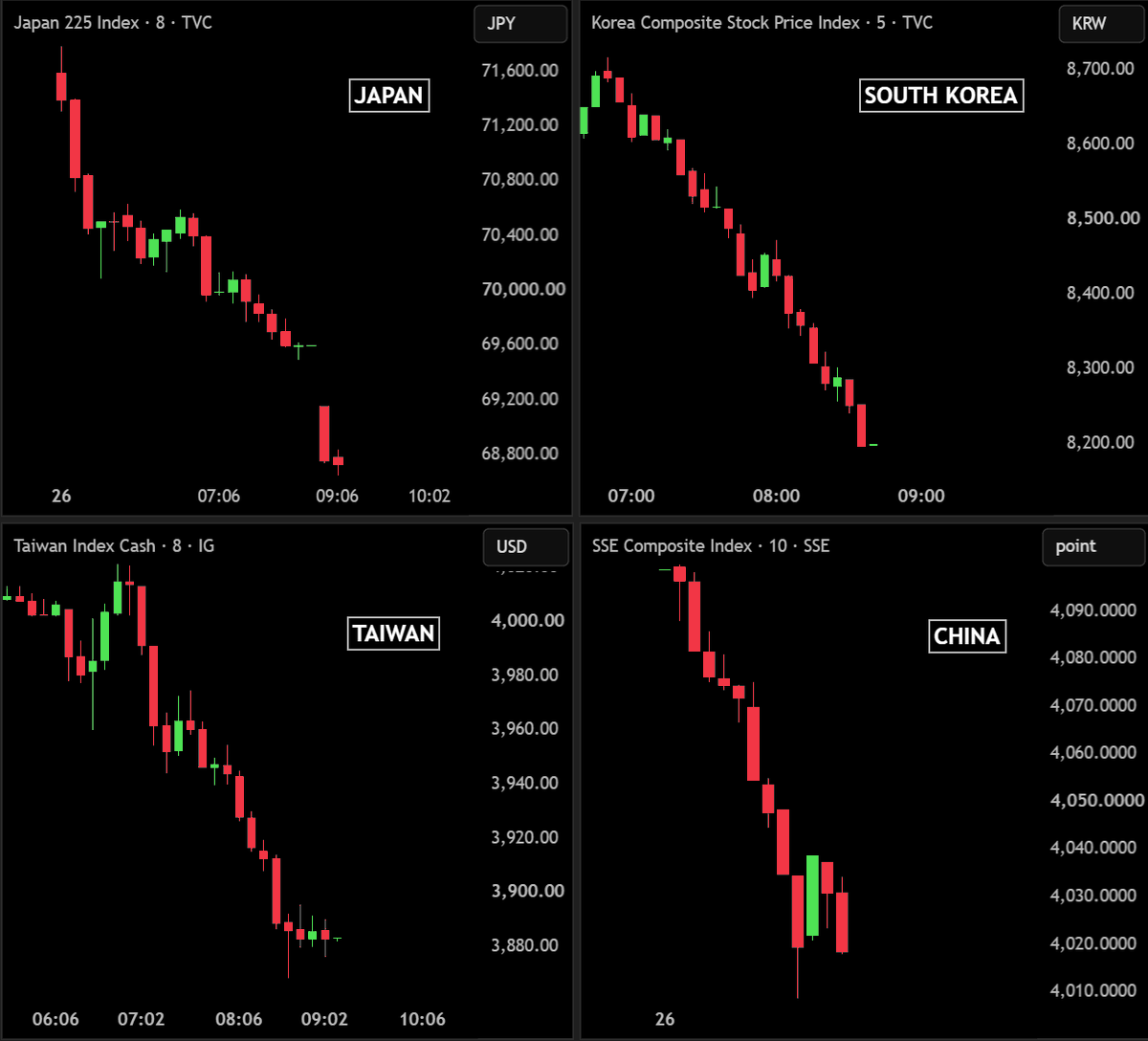
🚨 BLOODBATH in Asian Markets
Over $1 TRILLION wiped out from Asian stocks in just a few hours.
Asian stocks crashing after Apple's price hikes to offset surging chip costs reignited concerns over elevated AI and Tech valuations.
South Korea's KOSPI down -8.2%, wiping out over ₩500,200,000,000,000 ($340 billion).
Japan's NIKKEI down -4.5%, wiping out over ¥52,500,000,000,000 ($355 BILLION).
China's SSE down -2.15%, wiping out over ¥1,645,000,000,000 ($229 BILLION).
Taiwan's stock market down -3%, erasing NT$132,000,000,000,000 ($127 BILLION).
This is genuinely shocking, and says so much about our approach to China.
I decided to check for independent reviews of the English version Xi Jinping's latest book, published a year ago, to see what people had to say about it since I hadn't read it myself.
To my surprise, I couldn't find any: not a single thoughtful review about the book out there! Even on Amazon, check it for yourself (https://t.co/1LVlhACA53): the book has only 3 ratings, that's it.
No matter where you stand on China, you’ve got to admit that’s pretty crazy: the sitting president of the world's rising superpower publishes a 700-page book explaining exactly what he's doing and why, and we don’t even care to look.
If there ever was a fact that illustrates just how willfully ignorant we are about China, this is it.
All the more because we then go spew the usual clichés around how secretive and impenetrable the Chinese system is: the book is on Amazon for $21 for crying out loud!
Anyhow, this felt so wrong that I figured I'd fix it. I bought the book, read it attentively and wrote what I hope you'll agree is a thoughtful review of it.
The book contains genuinely surprising passages, such as Xi writing that oversight of the Communist Party by "the judiciary, the public, and the media" was not just something the Party must “readily accept,” but something that he framed as historically decisive - an essential component to "escaping the historical cycle of rise and fall" that has doomed every dynasty in China's history.
Other passage that I'm sure would surprise many: a common narrative out there is that China blames the West for the century of humiliation and is driven by revenge. Well, Xi explains that's not true at all: the century of humiliation was China's own mistake, originated in the Ming Dynasty's disastrous "policy of national seclusion" that "resulted in China missing out on the opportunities presented by the Industrial Revolution" and "led to China’s decline."
All in all, the book is remarkably self-reflective and thoughtful. For instance Xi recognizes that his drive for “full and rigorous internal governance” - including to rid the Party of corruption - risked "instill[ing] fear and apprehension, or intimidate members into inaction.” He emphasizes the need for pragmatism in this regard, codified in a framework called the “Three Distinctions” that separates honest mistakes - made while experimenting, reforming, or operating without precedent - from deliberate violations committed for personal gain.
And many other surprises still. I found it a genuinely fascinating read for anyone interested in how the Chinese system works and how Xi thinks - or anyone interested in governance, period, as so much of what he writes is pretty universally applicable.
This is the link to my review of the book, an article I titled "The Book the West Refuses to Read": https://t.co/DYowWEESOd
MSCI again decided to postpone its review on Indonesian equities, saying it needs more time to see whether recently announced transparency reforms are effective https://t.co/FL1yfTIAe5
BREAKING: Iran's chief negotiator Ghalibaf has finalized the immediate release of $12 billion in frozen Iranian assets during the Switzerland talks, with Deputy FM Gharibabadi saying implementation is now urgently underway, per Tasnim. This directly contradicts VP Vance's new claim that "no money is being released to Iran."
Iran also refused to use the unfrozen funds to buy US agricultural products, saying Iran has "no obligation to buy agricultural products from the United States" under the existing agreement, rejecting Vance and Jared Kushner's framework requiring Iran to do so.
⚡️BREAKING: An Armada of oil Tankers loaded with Iranian oil is heading for East Asia
China, South Korea, and Japan have purchased all of the Iranian oil currently available
Chinese AI stocks are skyrocketing:
Shares of Zhipu, a Chinese AI model developer, have surged +2,000% year-to-date in Hong Kong.
MiniMax, another Chinese AI model developer, has gained +260% over the same period.
Both companies build LLMs similar to ChatGPT and Claude, and have become key beneficiaries of China’s domestic AI investment boom.
The rally was further fueled this week after China introduced new measures to expand AI adoption across consumer markets, e-commerce, logistics, and retail, while the securities regulator pledged to ease listing requirements for AI companies.
China’s AI boom is accelerating.
BREAKING: The US has issued Iran a general oil-related license allowing the production, delivery, and sale of Iranian-origin oil, petrochemical, and petroleum products through August 21st.
Iranian oil is officially returning to global markets for the first time since 2018.
One reason Germany 🇩🇪 became an industrial powerhouse:
Not everyone goes to university.
Nearly half of young people enter vocational training or apprenticeships.
Germany treats skills and degrees with almost equal respect.
According to Kevin O'Leary, the only number that actually buys you freedom is $5 million.
Specifically, $5 million in Treasury Bills (T-bills).
Here's his logic:
T-bills are the safest asset on earth. They yield somewhere between 4 and 5%. On $5 million, that's $200,000 to $250,000 a year in interest.
His rule: get there, put it in T-bills, roll them, and never touch the principal. Not for a business opportunity. Not for a real estate deal. Not for anything. It just sits.
"If the poopoo hits the fan, you're still good."
Because the real value of that account isn't the yield. It's what it does to your decision-making. When you know that pile exists and nothing can touch it, every deal you do from that point forward is made from a position of strength. You can walk away. You can wait. You can say no.
Most entrepreneurs blow past this number and immediately put it back to work. That's the mistake. The discipline is to stop, lock it away, and let the rest of your portfolio take the risk.
Gold is an alternative. But gold doesn't yield anything. T-bills pay you to be safe.
Tiap tahun, JETRO (Japan External Trade Org) bikin survey kondisi bisnis ke perusahaan2 jepang di LN termasuk Indonesia
Salah satu surveynya adalah risk berbisnis di suatu negara
3 dari top 5 risk di sini itu berkaitan dgn policy, prosedur pajak dan legal system (2025)
I love people who are intellectually omnivorous.
The kind who can discuss folklore, black holes, bird migration, poetry, and grocery store pricing in a single conversation without getting lost.


![RnaudBertrand's tweet photo. This is genuinely shocking, and says so much about our approach to China.
I decided to check for independent reviews of the English version Xi Jinping's latest book, published a year ago, to see what people had to say about it since I hadn't read it myself.
To my surprise, I couldn't find any: not a single thoughtful review about the book out there! Even on Amazon, check it for yourself (https://t.co/1LVlhACA53): the book has only 3 ratings, that's it.
No matter where you stand on China, you’ve got to admit that’s pretty crazy: the sitting president of the world's rising superpower publishes a 700-page book explaining exactly what he's doing and why, and we don’t even care to look.
If there ever was a fact that illustrates just how willfully ignorant we are about China, this is it.
All the more because we then go spew the usual clichés around how secretive and impenetrable the Chinese system is: the book is on Amazon for $21 for crying out loud!
Anyhow, this felt so wrong that I figured I'd fix it. I bought the book, read it attentively and wrote what I hope you'll agree is a thoughtful review of it.
The book contains genuinely surprising passages, such as Xi writing that oversight of the Communist Party by "the judiciary, the public, and the media" was not just something the Party must “readily accept,” but something that he framed as historically decisive - an essential component to "escaping the historical cycle of rise and fall" that has doomed every dynasty in China's history.
Other passage that I'm sure would surprise many: a common narrative out there is that China blames the West for the century of humiliation and is driven by revenge. Well, Xi explains that's not true at all: the century of humiliation was China's own mistake, originated in the Ming Dynasty's disastrous "policy of national seclusion" that "resulted in China missing out on the opportunities presented by the Industrial Revolution" and "led to China’s decline."
All in all, the book is remarkably self-reflective and thoughtful. For instance Xi recognizes that his drive for “full and rigorous internal governance” - including to rid the Party of corruption - risked "instill[ing] fear and apprehension, or intimidate members into inaction.” He emphasizes the need for pragmatism in this regard, codified in a framework called the “Three Distinctions” that separates honest mistakes - made while experimenting, reforming, or operating without precedent - from deliberate violations committed for personal gain.
And many other surprises still. I found it a genuinely fascinating read for anyone interested in how the Chinese system works and how Xi thinks - or anyone interested in governance, period, as so much of what he writes is pretty universally applicable.
This is the link to my review of the book, an article I titled "The Book the West Refuses to Read": https://t.co/DYowWEESOd](https://pbs.twimg.com/media/HLoLNd2agAAsWoq.jpg)