The incentives in healthcare are so fucked that some of the solutions we’ve come up with would scandalize people if they actually understood how they worked.
Take someone on Skyrizi, which can cost upwards of $100K/year.
Their employer is self-insured and buys stop-loss insurance to protect against expensive patients, but the stop-loss insurer can laser someone with predictable six-figure drug costs, leaving the employer on the hook.
So employers come with a workaround. They remove Skyrizi from their pharmacy benefit, hire an “alternative funding” vendor, and have the vendor try to get the patient free medication through AbbVie’s patient assistance program.
The employer potentially saves $100K a year, and the patient might still get their medication for free. Great!
Except AbbVie catches on. Why should its patient assistance program subsidize employers that have deliberately stopped covering its drugs? So in 2023, AbbVie changes its eligibility rules and starts excluding patients whose employers use these arrangements.
Now the alternative funding vendor has to find another source for the drug, the employer has to decide whether to cover it after all, and the patient is stuck navigating the whole mess.
The crazy part is that everyone is behaving pretty rationally. The stop-loss insurer doesn’t want a predictable loss. The employer doesn’t want a $100K pharmacy bill. AbbVie doesn’t want its assistance program being used to subsidize commercial insurance plans.
And the person with Crohn’s disease or psoriasis is getting ping-ponged between all of them, with the risk of losing access to a medication they depend on.
We’ve made incredible pharmaceutical advances that can transform the lives of people with chronic diseases, but the last mile of actually getting those drugs to patients is still a game of hot potato and fucked incentives.
The patient is the only one who can’t just walk away from the problem.
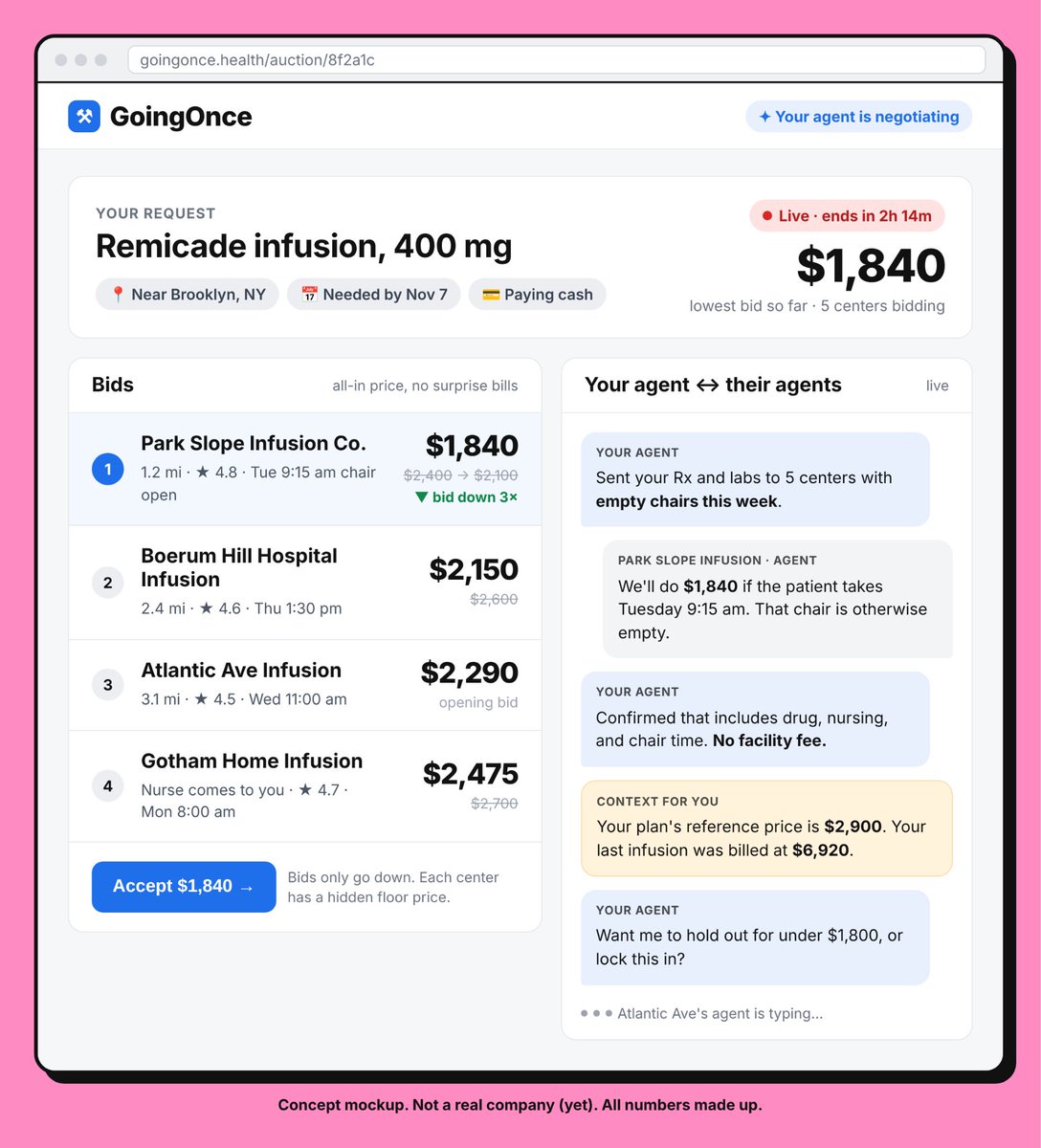
I think the concept of a reverse auction in healthcare is interesting.
Patient says “I want a drug infusion” and then a network of companies offering drug infusions basically bid for you to come there.
There have been companies that have tried this in the past (e.g. medibid), but it’s a very tough problem:
> You have to get customers to actually come to your site when they’re thinking about the transaction.
> There has to be enough available entities on the supply side (e.g. infusion centers with open slots)
> Both sides need a lot of context (what’re you coming in for? Can this facility do that? How do you think about quality?)
> This is not how payers do their contracting/set prices - so it’s mostly relegated to cash.
But I do think AI tools might make this more feasible today. They can gather the context, and two agents can do the bidding to figure out if it’s a good fit. They can also brute force a lot of the logistics part that made this complicated before (e.g. scheduling integration).
And if people start actually using AI tools to figure out where to go for care, then you don’t need them to go to your interface.
Places can put their excess capacity on a marketplace and create a floor price that they would bid down to if a patient was looking for care. This would probably have to be for cash but would be interesting to see these new level-funded plans or reference-based pricing plans lean into something like this.
Texting a bot is not primary care. It's just not.
I know tech is commandeering everything in healthcare and thus diluting it's meaning, but it's not.
You cannot receive adequate primary care via asynchronous communication.
It's impossible. No amount of VC funding makes this possible.
This is a hill I'm willing to die on.
@ItsDanyele I’ve been there! Lived in Long Beach 2014–2020, when LA felt like it was at its peak. Recent visits have made me sad, so much has changed. I grew up in the Bay and saw similar decline, but I’m more optimistic about its comeback. Maybe biased, but the Bay’s best is ahead 🤙🏼