A guy who sold $1.2 million worth of products on Amazon last year told me where every single item comes from.
Alibaba.
The $35 wireless earbuds he sells on Amazon cost him $3.80 from a factory in Shenzhen. The $28 phone case that gets 4.7 stars cost him $1.40. The $45 LED desk lamp cost him $6.20. The $22 resistance bands cost him $0.90.
He doesn't design the products. He doesn't manufacture them. He doesn't invent anything. He finds factories on Alibaba that already make the product, orders 500 units with his logo printed on them, ships them to an Amazon warehouse, and lists them with professional photos and optimized copy.
His average markup: 440%.
He told me something most American consumers have never considered:
"Every product you buy on Amazon with a brand name you've never heard of — and most of the ones you have — is available on Alibaba at the factory price. You're paying a middleman to put it in an Amazon box. The factory doesn't care who buys. They'll sell to you directly for the same price they sell to me. You just don't know how to find them."
He said the entire private-label economy — the thousands of brands you see on Amazon that didn't exist 3 years ago — is built on a single supply chain that anyone can access.
"There's no gatekeeping. There's no wholesale license. There's no minimum purchase in a lot of cases. Alibaba is a platform where factories list their products, their prices, and their minimum order quantities — and anyone with an internet connection can contact them. The factories that make products for companies selling on Amazon, Target, and Walmart will talk to you the same day. Most consumers don't know this world exists."
He showed me 9 things most people get wrong about buying from Alibaba — and the system that lets anyone buy from the same factories supplying the biggest retailers on earth.
Here's the full playbook:
🧵
Mark Cuban is right: Software is dead
145 million homeowners in the US.
99% of them have zero clue how to use AI.
They don't need a "SaaS" subscription.
They need someone to solve their problems with it.
the next decade belongs to the architects, not the coders.
and the most underserved market of all isn't enterprise.
it isn't startups.
it's homeowners.
physical problems. real money. zero AI competition yet.
Many of the richest and most famous investors in the world including Brad Gerstner, Leopold Aschenbrenner and a bunch more just updated their portfolios
This is what their portfolios look like as of the end of Q2
A thread🧵⬇️
Berkshire Hathaway $BRK.B
@thekookreport@Space_EngGG@GewoonLukas_@Defiantclient2@grok Are they really through production hell though? When they talk about 6 satellites per month, they are actually talking about the microns and not the whole satellite. I wish they would give the number of actual satellites completely done per month
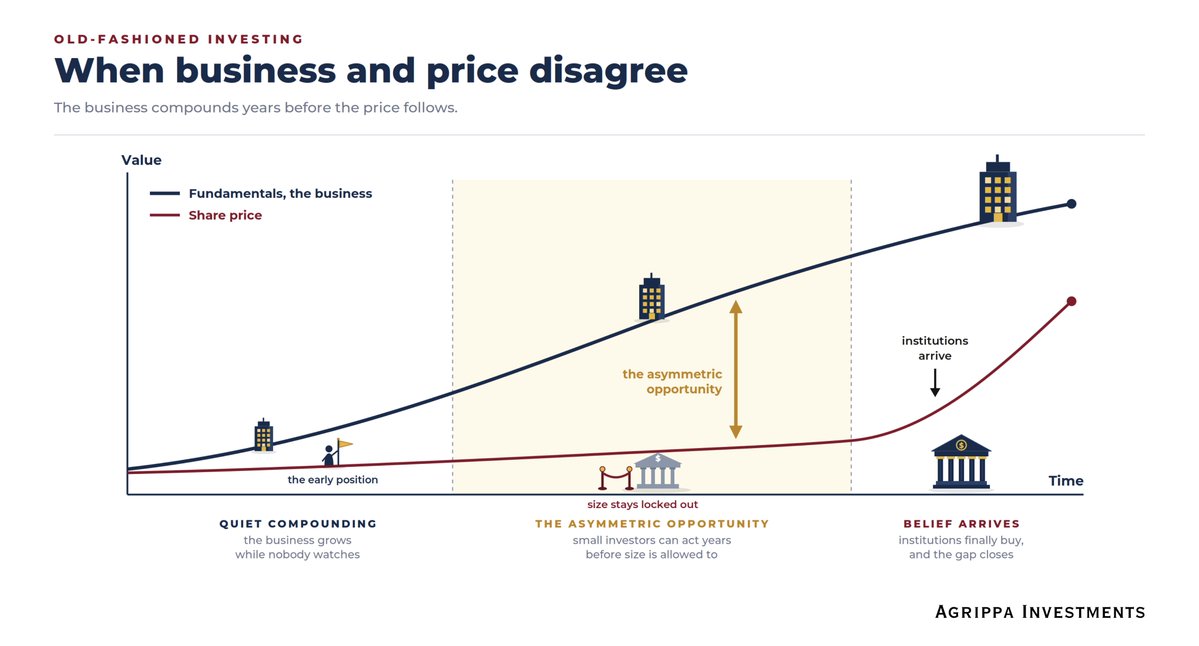
$IREN: When Business and Price Disagree
These days, everybody in this market is trying to ride a wave. When photonics stocks pump, the crowd is suddenly deep into photonics, and when the wave moves on to memory, the crowd moves with it, often at the worst time.
There's a constant scramble to chase whatever is hot at the moment. Almost nobody can call themselves an old-fashioned investor anymore, and I mean something specific by that. Finding a business before the market cares, taking a position, and sitting on it while nothing happens. That is what investing was supposed to be, and what it still is once you strip away the noise.
$IREN is exactly that kind of case. I fully relate to investors who entered in the $40-$70 range that has defined the stock over the past ~8 months. Many of them assume that people who entered in the single digits can cope better with the frustrating price action since they're still up big on their positions.
And while I agree to some extent, holders of that vintage have also been through this exact distress before and learned to stay patient the hard way. $IREN's price action has always been extremely volatile and exhausting. Shortly after I entered in 2024, the stock had wild swings yet mostly stayed range-bound for nearly an entire year, until it finally broke out last year. Today it sits in a similar spot, consolidating again.
Underneath, the fundamentals are steadily improving, which is all investors should care about in the first place.
$IREN's secured power portfolio grew by nearly 3 GW in a span of ~6 months, during a structural power shortage. And unlike competitors, secured grid-connected power is a far greater asset than merely "contracted power", which hinges on many factors and often comes with the asterisk of having to pay colocation leases.
Cloud contract terms are clearly improving, while customer selection has been stellar, with two Mag 7 companies in $MSFT and $NVDA, alongside shining AI-native startups like Fireworks, Fluidstack, Perplexity, and Figure. All while the first of several purpose-built AI data centers was delivered at Horizon 1 yesterday, de-risking the thesis even further.
This is where the old-fashioned investor mindset matters most.
The right time to position is when the opportunity is still asymmetric and largely not priced in yet, which often means the price action stays frustrating for a while until the rest of the crowd catches up.
It also means you have to wait and let your investment thesis play out, which can take several years. Sometimes, as was the case with the likes of $PLTR, price action can front-run a company's fundamentals, with fundamentals eventually catching up.
You could make the argument that this was also the case with $IREN's re-rate last year. However, I would more so credit that re-rate to the market starting to appreciate the company's vast secured power portfolio, as it previously traded for pennies on the dollar on an asset valuation basis.
But more often than not, price action finally catches up to reality once the actual earnings come in, which $IREN is right in front of at this point.
Institutions, which drive much of the buying pressure behind stocks that make it big long term, are typically late to arrive. They are structurally incentivized to pull the trigger only once a successful track record is established.
For $IREN, early signs are there that we are heading into this next phase, which often defines a structural change in the way the stock trades. Institutional ownership is increasing rapidly while retail, always chasing the next wave and often piling in near the end of a momentum fad, has given up on the story.
Stay focused on fundamentals, and only enter a position with a long-term mindset. Price action can be a very deceiving gauge of how well a company is doing over the short run.
Long $IREN
It was on this day in 1950 that Paramahansa Yogananda held the first Self-Realization Fellowship Convocation at the SRF International Headquarters in Los Angeles.
The Convocation tradition continues today in an expanded way. Seekers from around the globe join in person or online to dive deeply into the yoga techniques and the universal teachings that Yogananda brought to the world.
Talks, meditations, and kirtans from the 2026 Convocation are still available for viewing on our YouTube channel: https://t.co/YBQoYfZ6Xa
#Yogananda #SelfRealizationFellowship #SRFConvocation #KriyaYoga #meditation
Egg shell opener with a secure egg-shaped groove that keeps eggs steady while cracking.
Enjoy a more precise way to prepare eggs with less effort in your kitchen.
I'm a former Citadel quant who covered power & gas.
There's constant talk about chips & memory, but power is the central bottleneck for AI.
Very few people understand it, so I'm posting a canonical primer on power pricing & data centers: https://t.co/LO5ovj2imA
“Both sides of the aisle — as well as the House and the Senate — are working through the math about how you do this in ‘27. If they don’t figure it out, there is no Golden Dome because there is no funding,” Gen. Michael Guetlein, the project’s director, said Tuesday during the Space and Missile Defense Symposium in Huntsville, Alabama. https://t.co/1SxISv01qu
Golden Dome is in jeopardy largely because of how the Pentagon has funded the program thus far, Guetlein explained. Since the effort was initiated by President Donald Trump in 2025, the White House has relied on funding provided through reconciliation instead of the standard budget appropriations.
Read more by @MikaylaEasley: https://t.co/THdQ6VEL3r
$CBRS
I’ll just say it again, in case you missed it in the lede:
Before we get to the story, we need to clear up the headline mess.
From what we saw, much of the quick hit coverage on X was not merely harsh. It was wrong.
CBRS guided and analysts modeled the quarter on core revenue, core gross margin and core operating margin.
The company defines those core metrics because GAAP is heavily distorted right now by pass through data center revenues and costs, customer warrant amortization, IPO related compensation, and other items that do not describe the core business run rate.
That does not mean GAAP is irrelevant. It means the wrong comparison produces the wrong conclusion.
On the actual comparison set, CBRS beat across the board.
Core revenue was $209.9 million versus an estimate of $190.6 million. Core revenue grew 103% year over year versus an estimated 84.5%. Core gross margin was 40.6% versus 37.3%.
Core operating margin was negative 16% versus an estimate of negative 32.4%.
Headlines show misses across the board.
The company also guided Q3 above estimates across revenue, revenue growth, gross margin and operating margin, then raised full year guidance across the same metrics.
The analysts on the call understood this.
Much of the non professional finance commentary after hours did not.
Now to the real story.
CBRS is becoming less of a hardware company and more of an inference cloud at exactly the moment the market appears desperate for fast inference.
GAAP cloud and other services revenue grew 281% year over year. Core cloud and other services revenue grew 287% year over year to $127.7 million. Core cloud is now more than 60% of core revenue.
That is the transition we wanted to see.
In the establishing dossier we framed the core question as whether CBRS was merely another chip company entering a crowded market, or whether it could use its technology to become one of the infrastructure owners that monetizes each megawatt better than everyone else.
Q2 moved the company further toward the second answer.
CBRS is still selling hardware, but the better version of the story is not “sell the machine once.” The better version is “operate the machine and repeatedly sell its output.”
This is why the quarter matters more than the revenue beat and why we, irrespective of the stock move after hours, were blown away with the call (in the good way).
A lot of it is aspirational so, ya know, what are you gonna do?
But, their aspirations are sort of “one-of-one” company that can do this.
The result is that CBRS is building capacity, signing customers, expanding manufacturing, securing supply and moving the company deeper into the recurring usage layer of AI infrastructure.
The company now has more than 600 megawatts of data center capacity either live or under contract for delivery by the end of 2027, with a pipeline measured in gigawatts.
Manufacturing capacity is expected to increase more than 10x in 2026.
TSMC wafer supply is secured for continued growth (because of their very clever decision to go with larger wafers). Management again emphasized that CBRS does not use HBM, does not use CoWoS and does not need three nanometer capacity. Just super clever.
That is not a small point. AI infrastructure right now is a supply chain knife fight.
HBM is tight.
CoWoS is tight.
Leading edge fab capacity is tight.
Power is tight.
Data center space is tight.
CBRS is not free from constraints, but its constraint stack is different from Nvidia class GPU infrastructure.
The most important constraint remains data centers.
But even there, CBRS has a structural distinction that matters.
Because it is primarily an inference cloud, not a massive training cluster provider, it does not need every site to be a gigawatt monster. (this is also why DOCN is in such a great position).
CBRS can scale across smaller, more distributed locations.
Management said the company has data centers live or under contract across several US and international markets, and that this flexibility lets it chase capacity in places where training clusters may not fit.
That is a big deal.
The AI world is not merely asking for more compute. It is asking for usable compute inside the power envelope available today.
This brings us to what may be the clearest one sentence framing of CBRS after this call:
CBRS may be selling the thing the AI world is desperate to buy: more useful life from existing GPUs, more revenue from each megawatt and faster answers for every user and agent, and maybe, just maybe, for every GPU.
We see it as the secret weapon for extending the life of deployed GPU fleets.
We see that it can drive more dollars per megawatt of energy.
We see that it can deliver faster responses to users and agents.
We see that it can help neoclouds, hyperscalers, frontier labs and enterprises squeeze more value out of power they already have or power they are racing to secure.
The world really wants that.
Really… A lot.
And that is why the AMD and AWS disaggregated inference relationships are so important.
The old simplistic question was whether CBRS could replace GPUs.
Here’s the secret – nobody cares.
The better question is whether CBRS can make GPUs more valuable.
And EVERYBODY cares about that.
That is a much larger and cleaner opportunity.
It's also really risky becasue, for now, it is an aspiration.
For more like this, but ya kmnow, like, complete, try CMl Pro for $10. Link below.
Finally had a chance to go through the $ASTS Q2 transcript line by line. Pulled out the ones that stood out. Each is a pretty big deal on its own, let alone taken in totality...
Direct transcript quotes:
-From the beginning, we designed our network architecture alongside existing mobile network operators, not as a replacement of them.
-We're building the direct-to-device network of the future today in partnership with, not in competition with mobile network operators.
-our total addressable market is rapidly expanding. We see several growth opportunities across government communications and non-communications opportunities, including radar, emergency response, Internet of Things, AI edge compute, and other advanced connectivity solutions.
-In the United States, we have deployed over 3,000 low-band cellular cells. We expect to deploy the remaining cells this year to light up the roughly 5,600 cellular cells that cover the United States.
-Our ASIC chip is now in full production
-As a reminder, our ASIC is designed to support up to 10 GHz of processing bandwidth per satellite, which is nearly 10 times improvement from our in-orbit Block 1 BlueBird satellites. Over time, we expect further gains of up to additional 10 times improvement in user experience through AI-enabled spectrum management.
-We recently unveiled plans for an additional 400,000 sq ft of manufacturing and production space in Midland, Texas, as we prepare to further scale production for United States government and our extended TAM of commercial applications.
-We expect our global manufacturing and operations footprint will exceed 1 million sq ft of manufacturing capability, with over 900,000 sq ft residing in the United States once completed.
-the regulatory backdrop also continues to support our commercialization efforts and provide a window into how we expect the business to develop.
-We plan to talk more about these [three government] awards publicly soon, but they represent near-term capabilities that have been in development with the U.S. Department of War for years and leverage our unique in-orbit technology to solve large strategic needs. In general, the backdrop and size of the Golden Dome opportunity, coupled with the Arsenal of Democracy initiative, remains very strong...
-I want to take a moment to discuss the large addressable markets for the company beyond direct-to-device. We see the opportunity to leverage our unique platform that we have created to dramatically expand the company's total addressable market... We believe each of these new additional end markets could ultimately become multibillion-dollar annual plus revenue opportunities for AST SpaceMobile.
-In the government and defense market, firstly, we've seen early traction around non-communications, including radar.
-Secondly, and this will sound familiar, we have the ability to provide secure communications directly to low-profile, low-power devices. This means regular 3GPP devices, but also custom-designed handsets, existing radios, headsets, wearables, and drones… These applications will be new to the war fighter and greatly simplify and improve communications for them in the years to come.
-Apart from defense, we also see a few more funded comms opportunities. First, we are seeing a trend with large countries or regional bodies looking to replicate owned, in-orbit, resilient communications… With the Japan J-LEO preliminary award falling into this category.
-Second, federal emergency and backup is another market taking shape...
-Thirdly, IoT, or Internet of Things, is an attractive market for cellular and satellite operators… With our controlled MSS frequencies combined with extremely low-cost devices, this is another attractive use of our existing in-orbit network.
-One final network I wanted to highlight today is space-based AI edge compute. As companies are starting to think about how to service this market in a big way, one of the key elements is the ability to deploy and control large structures in space, which is what we do. This is significant power to orbit at meaningful scale and with competitive cost. This provides clear cost and scale advantages for supplying power and compute in space.
-In total, all of these markets represent an expansion of our incredibly strong core direct-to-device total addressable market into new large markets, primarily on a funded basis, leveraging the incredible platform we have built.
-Our commercial and government efforts to date serve as important milestones in our roadmap to much larger opportunities, each with potentially billions of dollars in revenue per year as we scale our business.
-What we are seeing is that this [government] opportunity is going to start scaling up into a recurring multi-billion dollar a year opportunity starting in 2027.
-this [broad spectrum portfolio and efficiency] is allowing us to actually scale up into a multitude of new applications that create a multiplication of our TAM, our current TAM, from D2D to seven more new applications that really multiply the addressable TAM that we have today.
-We want to continue expanding our capability of producing [satellites] to even larger satellites that allow us to support communications, radar, GPS, AI, cloud computing, IoT, and other very strategic applications that we have.
-We see the J-LEO project as a real proof point for how large countries are thinking about their own infrastructure… This is a trend that's going to play out, we think, multiple times in the coming years.
-I would say that we expect [government contracts] to scale in the near term most significantly.
-Frankly, as we said when this was announced, the [US MNO] joint venture frankly frees up a third and fourth customer for us in the U.S., so we were happy and supportive of it.
-Going forward with the joint venture, we look forward to partnering with them [T-Mobile] as well.
---
Michael Funk
Yeah, good evening. Thank you for the questions, guys. So first, ex Blue Origin, how many launches do you have contracted for the remainder of 2026 and 2027, and what is the stack ability on those vehicles?
Scott Wisniewski
We have 10 launches booked with two different providers, and we're targeting a cadence of every month or two on average… I think with Blue Origin, I think we're all watching that. We were sad to see what happened in May, but they've made tremendous progress to date both turning around the pad and getting resolution recently on the root cause for the anomaly. They're targeting this year. We're not betting on that necessarily. We'll be happy if they do it, but we're not betting on that in our numbers. With a mix of launches, we think we can get to early 2027 for our initial 45 satellites.
---
-We've been consistent now for several quarters that we are falling between $21 million and $23 million [cost] per satellite. That includes launch, that includes our direct labor and so forth… I think that that is over the life of a constellation. So some of the initial satellites may exceed, but over time in our planning and so forth, that range holds up for the first constellation. Then we continue to look at ways to take cost out. As we continue to engage with launch providers and acquire more launches, the economics scale better in that way. So over time, we'd hope to bring that cost down, but that's been consistent in that $21 million- $23 million range currently.
---
Chris Schoell
Great. Thank you. You mentioned the expanding TAM, and you cited AI edge computing, federal emergency, and IoT. Can you just help us better understand what needs to be done operationally to tap into some of these markets, and any rough sense on the timeline there? And as you think about targeting these areas, how should we think about funding needs? Will you continue to be opportunistic, or do you have much of what you need for the foreseeable future? Thank you.
Abel Avellan
Yeah. Chris, all these opportunities are basically on the back of the architecture we have, which is basically fundamentally the largest capacity to generate power in space, and the largest gain, antenna gain, for a spacecraft. So basically, we are piggybacking in the space architecture we have, and also on the gateway architecture we have. In AI compute, we are starting to add that capability into our satellites. We mentioned that we're on satellite 46. In production now, we're starting to add the compute capability on satellite 47, 48, so later in the year, we integrate it to our system. IoT, radar, emergency, and dedicated constellations, or specialized constellations like the one in Japan, they're already part of the architecture as we have it. So these are incremental opportunities, basically, taking advantage of what we have built on our intellectual property.
---
-As you know, we had a joint venture in Europe with Vodafone. 21 of the top 25 operators in Europe have indicated they want to partner with us in accessing that [spectrum] capacity.
---
Louie DiPalma
Good evening, Abel, Scott, and Andy. On prior calls, you discussed the target for 2027 revenue to approach $1 billion. Given the different puts and takes and the backlog of $1.3 billion now, how should we think of modeling next year's revenue and beyond? Thanks.
Scott Wisniewski
Hey, Louie. The principles there were based on a first full-year of commercial service. Nothing's changed on our expectation and our goal of approaching $1 billion of revenue in our first year of commercial service. Next year, the way to think about it is still a really strong opportunity in government that could contribute to probably as much as half of that. Still good infrastructure revenue like we have this year. Then as commercial service comes online, ramping into the balance of that. We still feel really good about that number. It's just a question of when we kick it off and when we hit to run rate.
---
Louie DiPalma
Great. Thanks, Scott. You discussed the beta trials. What is the timing in terms of when consumers will be able to trial your network? I know that you don't want to speak on behalf of your carrier partners, but have they given any sense on when the generic AT&T and Verizon customers will be able to test out the service? Related to that, if there are 25 satellites in orbit, from a general location in the U.S., what percentage of the day will a satellite be overhead such that consumers will be able to connect to your network?
Scott Wisniewski
Thanks, Louie. Getting the capability ready for consumers is something that we're targeting for later in 2026. How we go to market with that, how we use that, of course, like you said, we're going to defer to our partners, and there'll be announcements on that in the right way. But we're very focused on enabling that. There's a lot that you can do separate and apart from the space. So those two are kind of separate. While we've historically said 25 satellites is the right way to think about it, we have great flexibility there on how we do beta. For us, it's all about racing towards putting satellites in the air and then racing towards getting a scaled beta available. Because of course, the steps from a scaled beta to commercial service is pretty quick. It's just a function of satellites in orbit.
In terms of our about 25 satellites, like you said, there's a lot of variance there, but think about it as about half the day coverage.
---
-we expect to be working with all operators in United States and all major operators in Europe. We did announce 60 mobile operators around the globe with access to around 3 billion devices on a global basis. As it relates specifically to the United States, as Scott explained it, we plan to keep the contracts that we have with our current partners the way they are, and expanding the relationship into all of them, both through the JV and directly with each one of them.
---
Scott Searle
Great. Are there any other opportunities that are percolating that you can address in terms of number opportunities or potential timeline for other similar types of dedicated sovereign constellations? Thanks.
Scott Wisniewski
Hey, Scott. We do not want to comment on that, but there are other discussions with other parties. Frankly, if you think about it, having communications capabilities that are resilient and in your control, I do not know why a G20 country would not want this kind of capability, given the price.
---
Huge things I didn’t specifically quote which are in addition to the above:
-Announcement of the $1B J-LEO grant with Japan itself
-Captured nearly all of US market
-Captured nearly all of European market
-Largest global portfolio of spectrum ever assembled plus “More spectrum lanes of traffic for our network means more subscribers and better services when paired with our unique technology.”
-Working on adding 20 more MNO’s across 50 other countries.
-Total government contracts is now sixteen