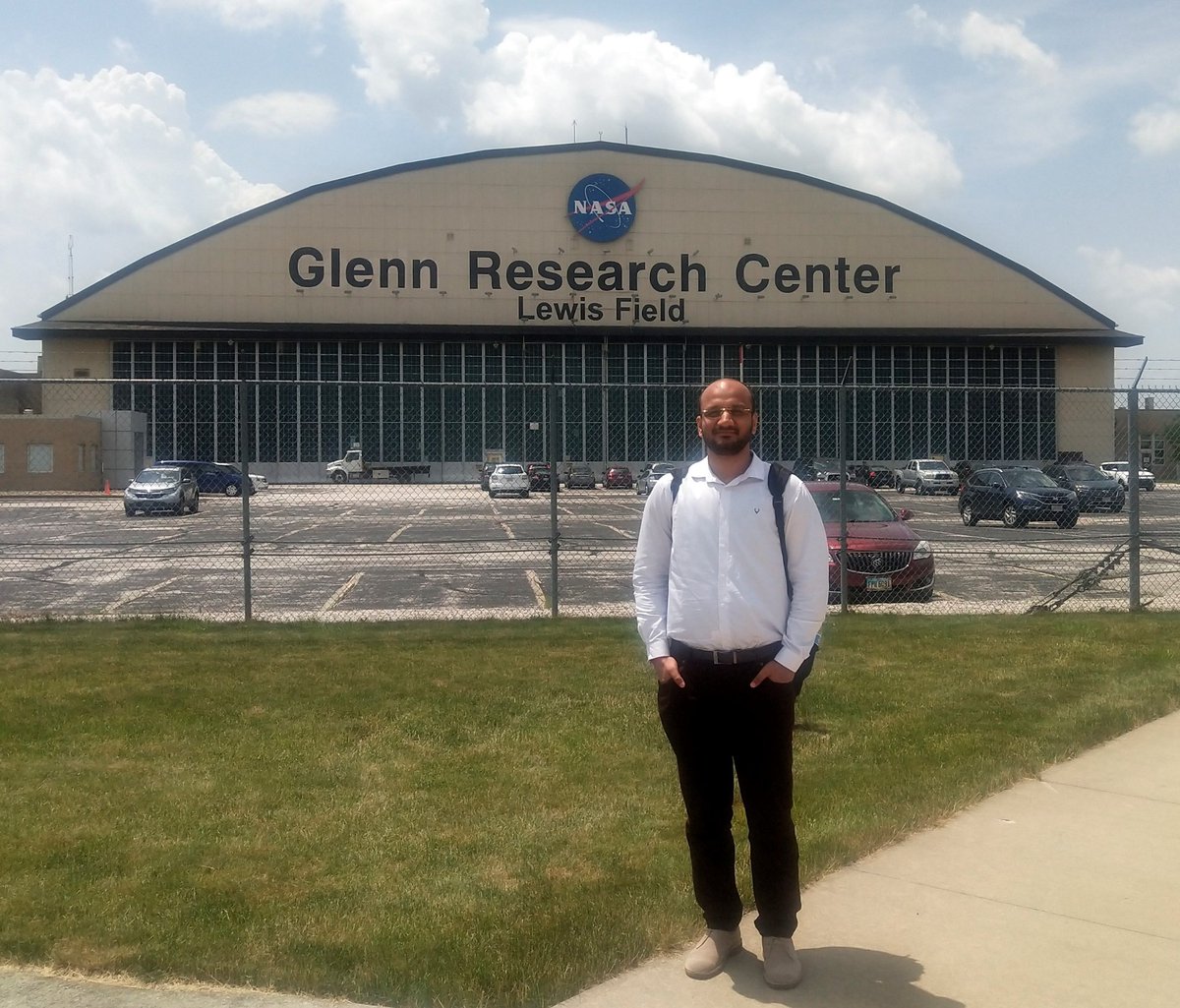
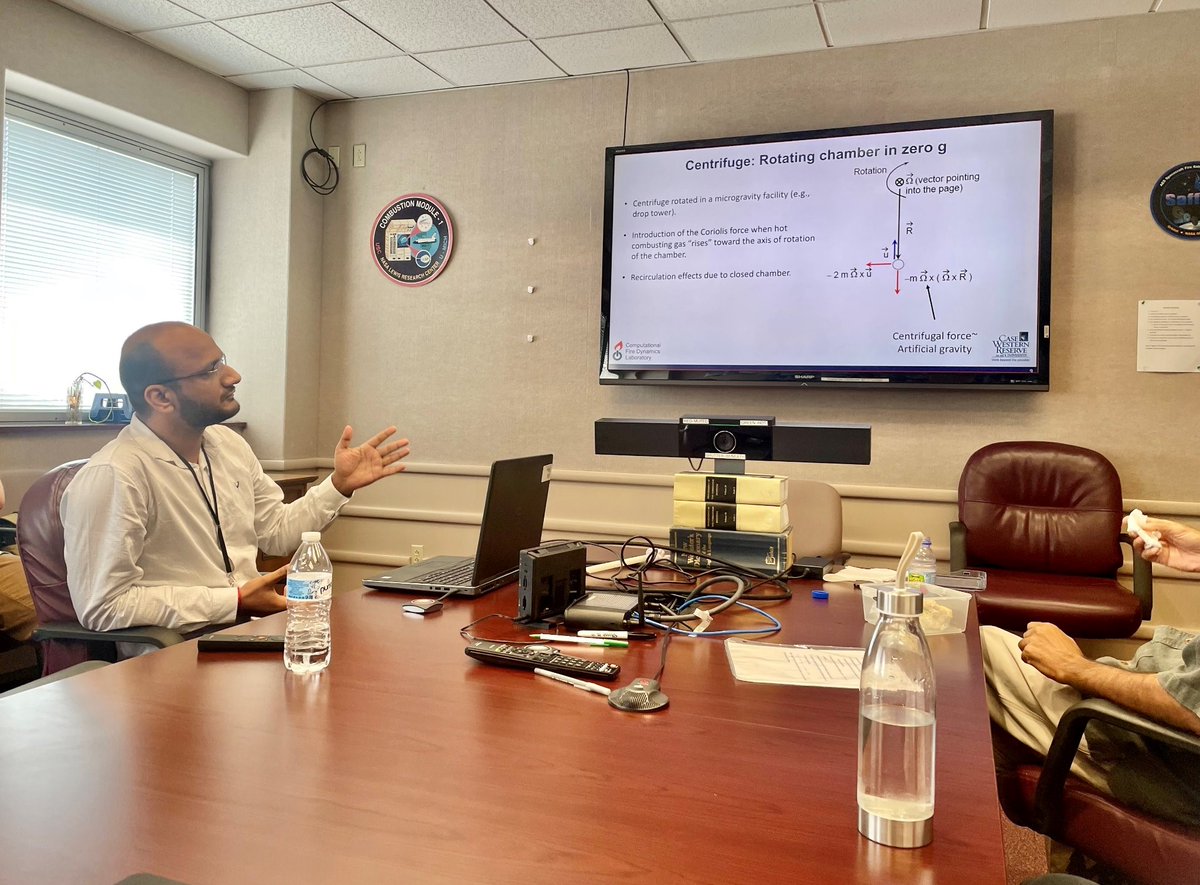
Such an honor and grateful moment to visit @nasa Glenn Research Center and deliver a technical talk on our work for understanding the material flammability in Lunar gravity. Talk was well received with insightful questions and discussions.
True, when we were stuck in traffic on the way back to NYC, Adeo asked me what I was going to do after PayPal/X and I said I always wanted to do something to advance space, but didn’t think there was anything private individuals could do.
The origin of SpaceX was doing a philanthropic mission to get the public excited about life on Mars, so that NASA’s budget could be increased to achieve that goal. There was no commercial ambition at the time.
The $50M was from the proceeds of the sale of PayPal to eBay.
After learning more about the limiting factors for humanity in space, it became obvious that the issue was a lack of advancement in rocket technology, in particular the failure to develop a fully reusable rocket, without which expanding consciousness beyond Earth is impossible.
Intelligence is a network property, not an individual trait, so connected mediocre thinkers outperform isolated geniuses, and future inventions will come from those facilitating idea flows rather than hoarding them.
A British biologist looked at 200,000 years of human history and found that the entire reason humans broke out of poverty was not intelligence, not language, not even agriculture, but one mechanism so simple a 6-year-old could explain it.
His name is Matt Ridley.
He is a zoologist by training, an evolutionary biologist by career, and in 2010 he wrote a book called The Rational Optimist that quietly argued the most important fact about human progress had been hiding in plain sight for the entire history of economics.
Naval Ravikant has been telling people to read everything Ridley has ever written for the last 15 years. The reason is the argument inside this one book.
For 200,000 years, anatomically modern humans walked around with the same brain you have right now. Same skull size. Same neural architecture. Same raw capacity for language, planning, and abstract thought.
For roughly 190,000 of those years, almost nothing happened. Generation after generation lived and died inside the same Stone Age toolkit their great-great-grandparents had used. Then somewhere around 50,000 years ago, the line on the chart of human progress started to tick upward. Then it bent. Then it exploded.
The question Ridley spent years on was the only question that mattered. What changed.
It was not the brain. The brain had been the same for 190,000 years. It was not language, which had existed long before the takeoff. It was not even agriculture, which arrived only 10,000 years ago and was actually preceded by the upward bend, not the cause of it.
What changed was that humans started trading with strangers.
This sounds too small to be the answer. Ridley argues that it is the answer to almost everything. The moment one human exchanged a useful object with another human from a different group, something happened that no other species on earth had ever done.
Two ideas that had developed in isolation came into contact. The flint knapper learned what the spear maker had figured out. The fisherman from the coast learned what the hunter from the forest had figured out. The two pieces of knowledge fused into something neither side could have produced alone.
Ridley calls this ideas having sex. The phrase sounds frivolous and it is meant to. The point is that ideas, like genes, get better when they combine with other ideas from different lineages.
An idea sitting inside one head, no matter how brilliant the head, eventually hits a ceiling. The same idea exposed to ten thousand other ideas does something genes do under sexual reproduction. It mixes. It recombines. It produces offspring nobody planned.
The cleanest proof of this argument is the most uncomfortable case study in the book. Tasmania.
Around 10,000 years ago, rising sea levels cut Tasmania off from mainland Australia. A population of roughly 4,000 humans was now isolated on an island, with no possibility of contact with the rest of humanity. They had the same brains. The same language. The same starting toolkit as their cousins 150 kilometers north. The natural experiment was now running.
What happened next is something no economist or geneticist had ever predicted.
The mainland Australians kept inventing. Boomerangs. Spear-throwers. Fishing nets. Bone needles for sewing fitted clothes. Watercraft with paddles. Their technology compounded slowly across the centuries.
The Tasmanians went the other way. They did not just fail to invent the new tools their cousins were developing. They started losing the tools they already had. Fishing was abandoned within a few thousand years. Bone tools disappeared. Fitted clothing disappeared. They forgot how to make fire from scratch and started carrying lit firebrands from camp to camp instead, relighting their fires from a neighbor's whenever their own went out.
By the time European explorers arrived in the 17th century, the Tasmanians had the simplest toolkit of any human society ever recorded. Their material culture had gone backward for 8,000 years.
The archaeologist Rhys Jones called it a slow strangulation of the mind.
Joseph Henrich at Harvard later proved with formal mathematical models that there was nothing wrong with Tasmanian brains. There was something wrong with their network. A toolkit requires a critical mass of people exchanging skills to maintain itself.
The act of teaching a skill is imperfect. Every generation loses a small percentage of what the last generation knew. If your population is large enough and trading widely enough, those losses get caught and corrected by someone else who still remembers.
If your population shrinks below a certain threshold and stops mixing with outsiders, the small losses compound until entire technologies disappear.
This is the part that should haunt anyone reading this in 2026.
Intelligence is not a property of the individual brain. Intelligence is a property of the network the brain is connected to. A genius in isolation will produce less than a mediocre thinker inside a dense exchange of other mediocre thinkers.
The thing your ancestors needed in order to break out of 190,000 years of stagnation was not better brains. It was better connections between brains they already had.
The implication for any individual is direct and uncomfortable. If you are smart and isolated, you will be outproduced by people half as smart who are connected.
The most successful people in any field are almost never the smartest people in it. They are the ones positioned at the intersection of the most idea flows. They are reading more authors than their competitors. They are talking to more people from more disciplines. They are in the rooms where ideas from different lineages bump into each other.
Ridley ends the book on the line that sounds optimistic but is actually a warning its this "The future will be invented by people who connect ideas, not by people who guard them."
Several large explosions rocked firefighters as they battled a large fire in the Northern California town of Livermore on Wednesday. The fire began as a grass fire, then spread to two large barns, and that's when the explosions occurred while SKY7 was overhead. At this point, firefighters say the fire is contained and there are no reports of any injuries as a result of the explosions. More info: https://t.co/cE7TqWVqmg
@XFreeze Neuralink is a much bigger breakthrough than most people realize.
Enabling people to control a computer with their mind and the completely blind to see are Jesus-level miracles.
I understand why we don’t want people to come to the US to be criminals, mooch on welfare, open learing centers and otherwise undermine the country.
But I don’t understand why we make it harder for motivated, ambitious, hardworking people to come to the land of opportunity.
Trump's USCIS just told half a million immigrants who entered the U.S. lawfully to leave the country and start over.
For years, Trump said he supported the legal immigration process, and people just had to follow the rules.
That was always a lie.
This new policy will force thousands of LEGAL immigrants, including spouses of US citizens, to leave their homes, families, and jobs for weeks or even months to get their green card outside the U.S.
This is an absurd and cruel policy.
Does this mean AI Researchers, employees, and students will now have to leave the country and wait through a backlog process to continue their work?
Harmful move for tech, business, and America broadly...
The new White House policy requiring green card applicants to apply from outside the US is a capricious attack on legal immigration. It will hurt families, leave us with fewer doctors, teachers and scientists, and hurt American competitiveness in AI.
“I tried to thank him… That’s my whole world. That’s my daughter.”
New Ring doorbell video shows the dramatic moment a Chattanooga police officer rushed into a burning apartment to save a mother and her two children.
Rachel Blaylock can be heard screaming “There’s a fire!” as flames spread. She says Officer Eli Rogers didn’t hesitate — and she’s not sure her family would have survived without him.
We have found over 6,200 planets beyond our solar system, but we still only know of one that is just right for human life — our home on Earth. #MondayMotivation
Did you know that the Milky Way is even milkier when viewed from the Southern Hemisphere? This is because from the southern side of our planet, we get a clearer, more direct view of the dense galactic core.
Here’s a look at the Milky Way starting over the Southern Ocean (between Australia and Antarctica) from our @SpaceX Dragon window, complete with some aurora (Southern Lights) and fleeting Starlink satellites. Enjoy the view!
Absolutely mesmerizing to witness the glowing lava fountains at Kīlauea's summit eruption in Hawaiʻi Volcanoes National Park. Volcanoes are living monuments to Earth's fiery origins, a powerful reminder that our planet’s forces are still alive and at work.
Video by @usgs
I spent most of my 20s thinking I didn’t want kids. Thought it was a distraction from achieving “success” (whatever that meant). Well, last night, I was tucking my son into bed and he looked at me and said, “Dada, you’re my hero.” It was the best moment of my life. I can’t imagine not experiencing this. I’m not sure how anything will ever measure up to the feeling I had in that moment. Purest joy I’ve ever felt. I’m glad my definition of success changed, because this version is much better.