Excited to share our latest article in the legendary journal Materials & Design (Impact Factor: 9.417) 💖💖
@ElsevierConnect@ElsevierNews
https://t.co/jqdVkyRZRz
Introducing free library of scientific icons!
https://t.co/kau5JfDAXX
I am rebranding openscienceart 'dot' com
to much bigger, user friendly library.
You can now customize the colors of icons
before downloading.
Claude has discovered a previously unknown enzyme system hidden in the DNA of bacteriophages. Beside the enzyme’s gene sits a long array of repeating DNA—a structure that looks somewhat similar to CRISPR.
We don’t yet understand what this system does, but only a handful of known systems share its features, and all of them are able to cut, copy, and paste DNA. Historically, the discovery of such programmable systems has helped revolutionize medicine. CRISPR, for instance, is now the foundation of genetic medicines. But it will take much more work to learn what this system does, and whether it can be put to similar use.
Read more: https://t.co/RuEosScSMb
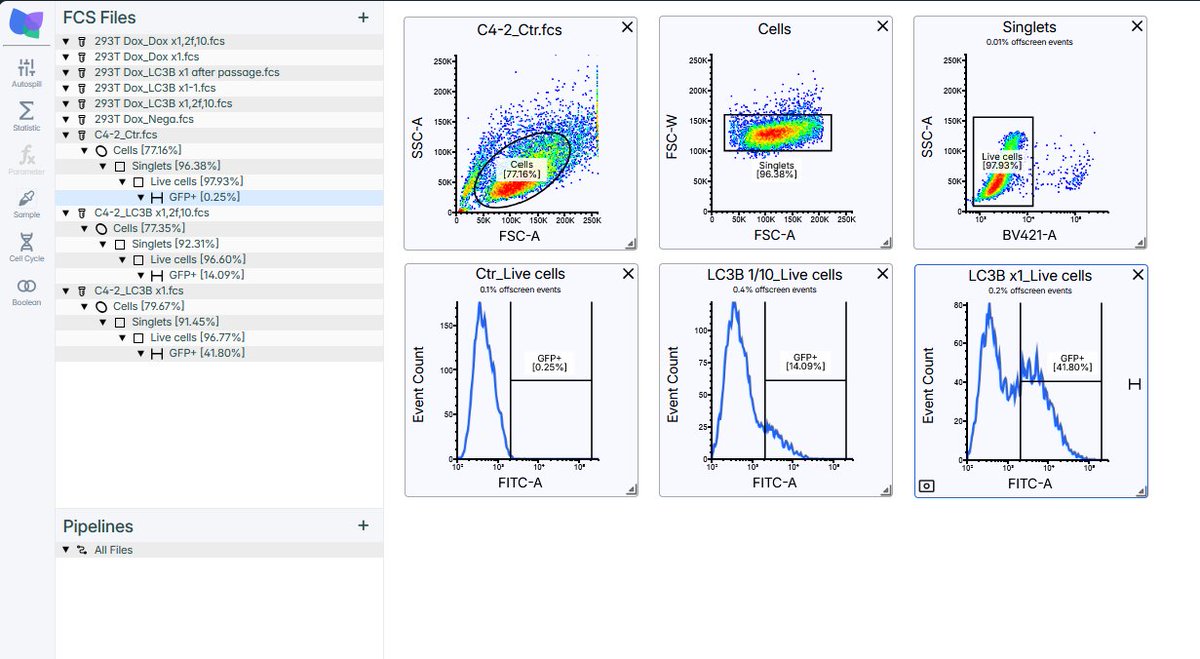
I love that we can now just use Codex/Claude Code to create more enjoyable (and free) versions of software for biology
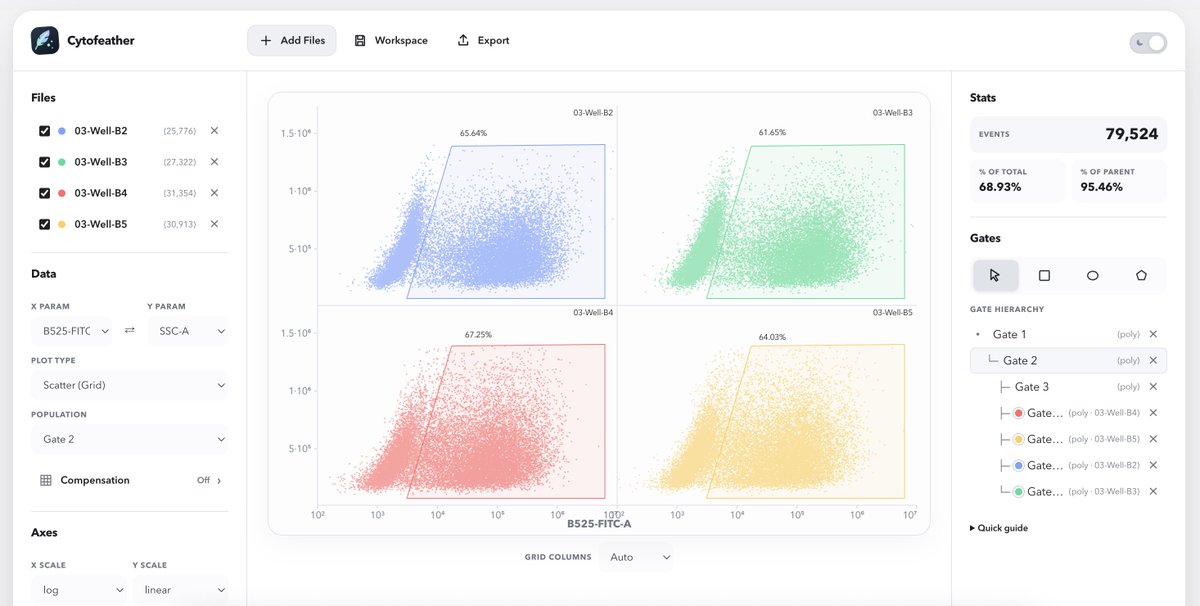
Meet Cytofeather 🪶 A lightweight flow cytometry app for your browser
https://t.co/dGyuDlFYo6
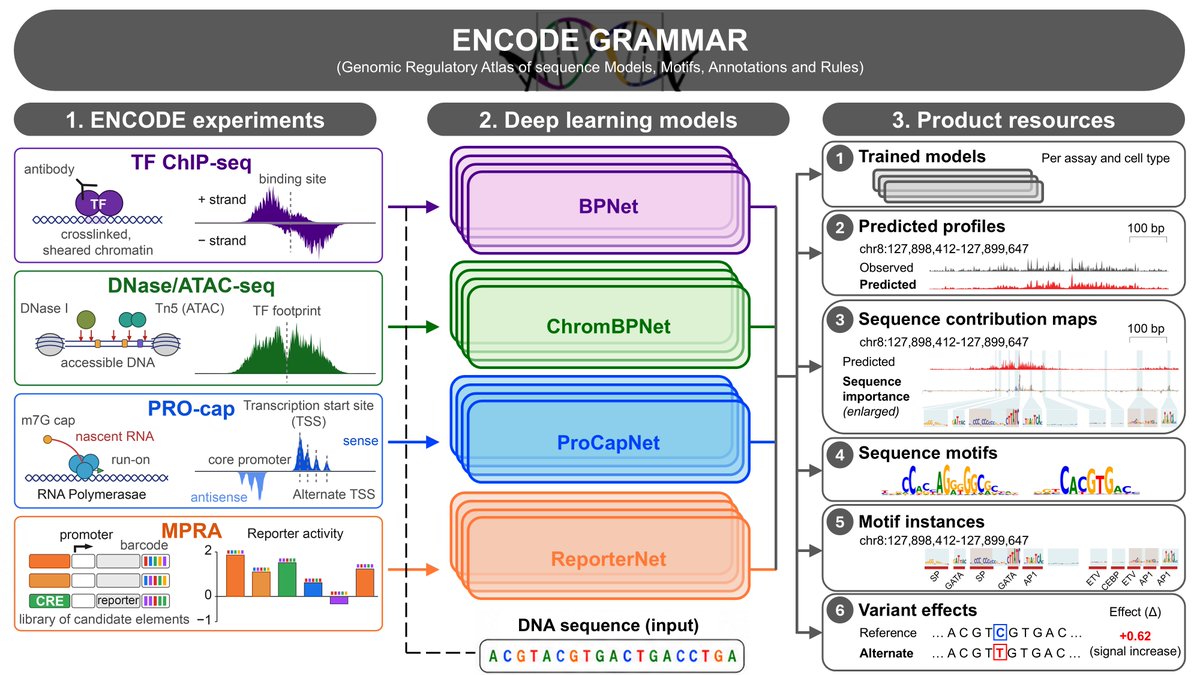
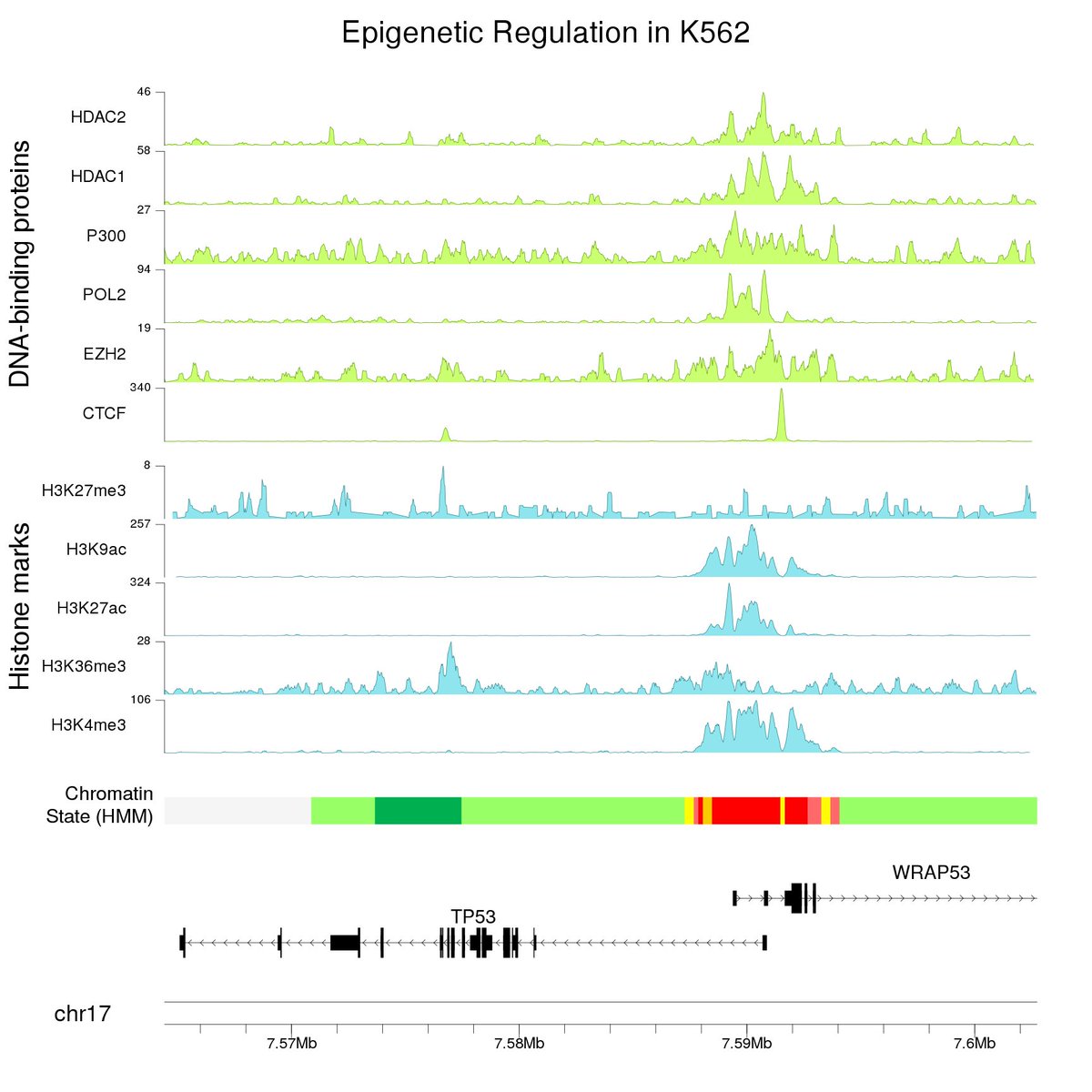
Very excited to announce ENCODE GRAMMAR (Genomic Regulatory Atlas of sequence Models, Motifs, Annotations & Rules): 3,865 experiment-specific deep learning model sets and sequence annotations for decoding human regulatory DNA. 1/
I said to my PI, I want to go do my postdoc, will you write a letter for me. And he wrote in my letter that I wasn't very creative .. I finally met with Magda and she told me she saw straight through the letter.
–Samantha Morris, Harvard Professor
@morris_lab@ZernickaGoetz
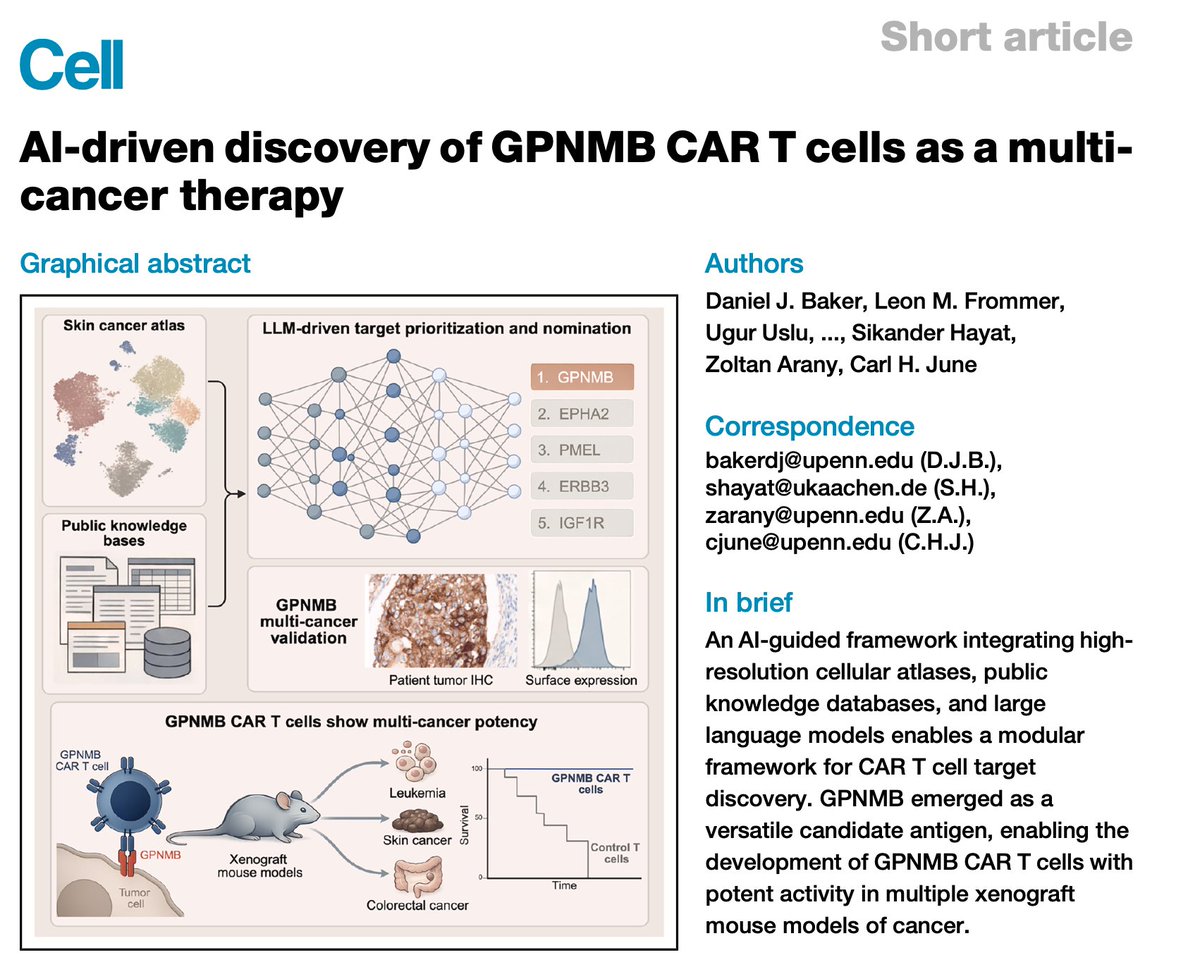
Can AI help identify targets for living therapies?
We grounded frontier LLMs with patient tumor data and public knowledge bases, then tested their ability to nominate targets. GPNMB rose to the top—and GPNMB CAR T cells showed promise across blood and solid-tumor models.
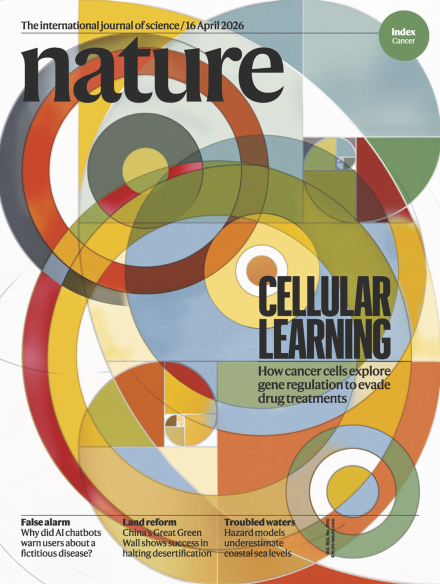
We're in this week's Nature! We propose a model of how a cell learns by running an evolutionary algorithm: exploring different gene-regulatory combinations and using feedback responses to stabilize those combinations that reduce stress levels.
Full text: https://t.co/yQYic2owl0
Exciting breakthrough technology from the lab, now live in @CellCellPress ! Instead of cutting the genome where proteins bind (e.g., Cut&Tag), D&D-seq scars the DNA with a deaminase, allowing single cell genome mapping of TFs and chromatin remodellers!
One limitation of single-cell CRISPR screens is losing spatial context after tissue dissociation. This new paper introduces Spatial Perturb-seq to study gene knockouts in intact tissue. 🧠🧬
In mouse brain, it captures both cell-intrinsic effects and how perturbations alter ajacentd cell networks.
https://t.co/NNfWgwKD8F
After a short break in our webinars we are delighted to be back up & running this month!
First up, on Jan 30th we will be joined by @LucasFarnung from @harvardmed 🔬
Shortly after, on Feb 13th we will be hosting
@heard_lab from @TheCrick 🧬
Registration details 👇
GENOME: THE GIS SPEAKER SERIES
Join us for our virtual seminar by Dr. Arjun Raj @arjunrajlab, Richard K. Lubin Professor of Bioengineering, Professor of Genetics University of Pennsylvania on Tuesday 15 April 2025, 9.30am (SGT, GMT +8). Host: @shyam_lab
Webinar ID: 925 1281 1559
Participant ID: 285010
Passcode: 487568
#GISSPEAKERSERIES #genomics
Happy to present our work in @embojournal where we show how p53 acts as a transcriptional repressor by directly recruiting DREAM complex in p21-independent manner. Congrats to @AgrawalRitu https://t.co/8UXAvZPhnm. @DBTIndia@FollowDbtNibmg@NImmunology
What if single-cell analysis of 1,000 samples wasn’t just imaginable—but affordable?
Imagine analyzing 1,000 samples at the single-cell level, each containing ~25,000 cells or nuclei. That’s ~25 million cells in one experiment!. Until now, the costs of such an experiment were staggering, making it seem like a dream only billion-dollar projects could afford. But the game has changed and this is no longer science fiction.
Let’s break it down.
For this, let’s choose the RNA Flex family of kits from 10x Genomics. In my unsolicited opinion the best single cell RNA kits out there yet.
To estimate the total cost for single-cell RNA sequencing (scRNA-seq) of 1,000 samples, each containing 25,000 cells or nuclei, we'll consider both library preparation and sequencing expenses, and calculate the cost per cell. For this case, let’s consider we have a large cohort (n=1000) of post vaccine PBMC samples.
Library Preparation Costs:
The average cost of an RNA Flex reaction at core facilities in the USA is $4,492 for four samples, using a four-barcode pooling strategy. This amounts to $1,123 per sample. Since each reaction accommodates ~10,000 cells and the goal is ~25,000 cells per sample, 2.5 reactions are required per sample:
•Cost per sample: $1,123 × 2.5 = $2,807.50
•Total library preparation cost for 1,000 samples: $2,807.50 × 1,000 = $2,807,500
Sequencing Costs:
The ballpark read-pairs/cell most researchers I know are using is at least c 20,000 read-pairs/cell so for ~25,000 cells per sample, we'll need:
•Total reads per sample: ~25,000 cells × 20,000 reads/cell = ~500 million reads
•Total reads for 1,000 samples: ~500 million reads × 1,000 samples = ~500 billion reads
Assuming a sequencing cost of $1.50 per million reads on the Illumina NovaSeq X platform:
•Sequencing cost per sample: ~500 million reads × $1.50 per million reads = $750
•Total sequencing cost for 1,000 samples: ~500 billion reads × $1.50 per million reads = $750,000
Total Project Cost:
•Library preparation: $2,807,500
•Sequencing: $750,000
•Total cost per sample: $2,807.50 (library preparation) + $750 (sequencing) = $3,557.50
•Total cost for 1,000 samples: $2,807,500 + $750,000 = $3,557,500
•Total cost per cell: $3,557,500 / 25,000,00 cells = $0.1423 per cell
Yeah…scary!
Ok…don’t panic, we got you. Recently, @DrJasPlummer@hoheyn and yours truly made an orthogonal approach to perform single cell analysis without sequencing: STAMP: Single-Cell Transcriptomics Analysis and Multimodal Profiling through Imaging (doi: https://t.co/m4OHy3BP5N). Here, we repurposed various imaging platforms like Xenium and CosMx to perform Single Cell Imaging…no sequencing!
What do you think the costs of profiling 25 million cell would be?
Let’s see…
To estimate the total cost for STAMP of 1,000 samples, each containing 25,000 cells or nuclei. For this, let’s consider that we have 50 sub-STAMPs/slide, that’s 100 per run on a Xenium slide and even more in a standard superfrost slide for CosMx, but let’s stick to 50/slide. For the calculations, the costs per run for both Imaging Platforms costs per run are similar.
Total Imaging Platform Runs Needed:
•Number of samples: 1000
•Sub-STAMPs per slide: 50
•Slides per run: 2
•Total slides required = 20 slides.
•Total Imaging Platform runs = 10 runs
Total Cost:
•Cost per Imaging Platform run (2 slides) = $7,500 (average across various cores in USA for 5k and 6k panels)
•Cost per sample = $75
•Total cost for 1,000 samples = $75,000
•Cost per cell: $0.003/cell (0.3 cents per cell)
Now that you’ve seen this, do me a favor—step away for a bit. Take a walk, ride your bike, or do whatever inspires you while dreaming up crazy experiments. The only limit of what you can do now is your imagination.
@mason_lab@JIWOONPARK_@ACEpigenetics@cnag_eu@StJudeResearch@GESTALT_sp@ioavlachos@brukerspatial@10xGenomics@vizgen_inc@AkoyaBio@ElemBio